
El Llanto Against I.C.E.: Toward a Latinx Sonic Phenomenology of the Dignified Cry
DOI: https://doi.org/10.59350/xgm8r-acg57
It is July 4, 2025. The air is hot; the sun is beaming on concrete and asphalt. Sweat is accumulating on my cotton Disrupt band t-shirt. My skin is sticky. Inside a suffocating room, the volume penetrating my ears is the racket of voices producing a steady pulsation of disunified sounds. A brown noise. In a studio room in Boyle Heights, the acoustics create a space-time of rebellious gravity. There’s something gestating. We are in that in-between aural space, the time-lag between speaker, musician, or performance. The MC is letting the crowd know what is next. We all desired to know.
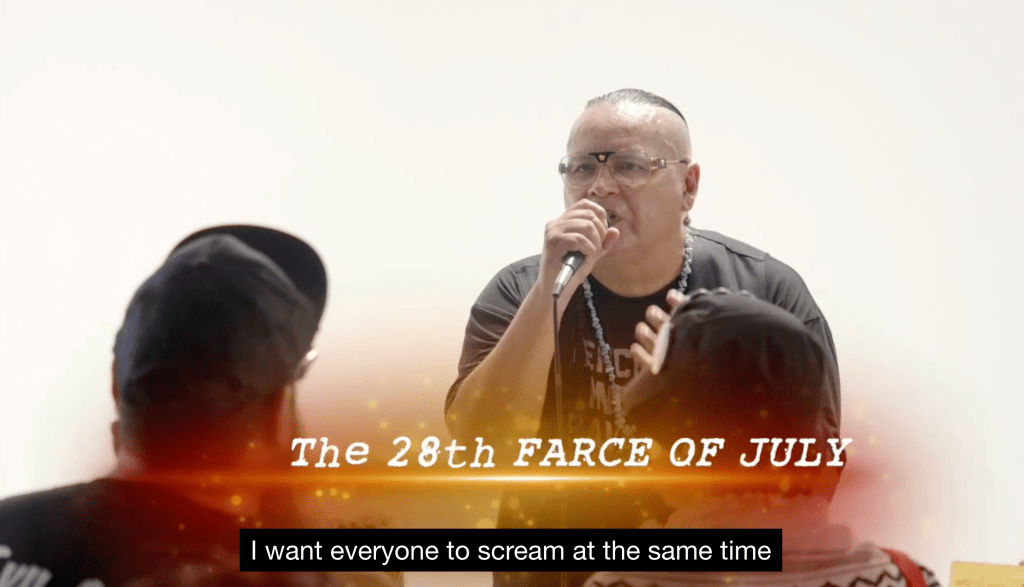
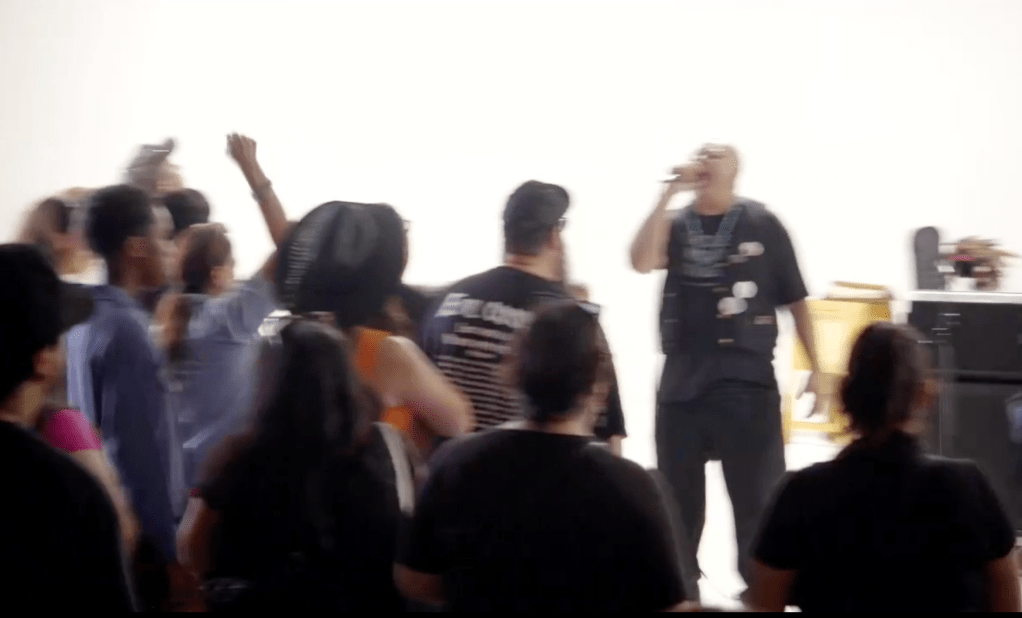
Yaotl—the vocalist of Xicano hip-hop/punk group Aztlán Underground—is the MC. He is speaking to the crowd during that transition to the next set. Doing so, Yaotl used this exact instance to identify the political moment we were all witness to, the historical cause for the event here, and then, surprising everyone, facilitated a collective llanto. He called it “scream therapy.” The dignified cry, as I am calling it, for him, is sticky, piercing, and angry—a sonorous form of dignified rage. We are all here for Xican@ Records and Film annual cultural event, the Farce of July that hosts vendors and musicians. Yaotl readies the crowd, his contagious call for a llanto also fused with the intimate violences of coloniality, what decolonial theorists of modernity, such as semiotician Walter Mignolo, have called its darker side or underside. “I want everyone to scream your fucking rage against all this shit.” He counts to three. One. Two. Three. We scream. We yell. We cry and cry out together. We manifest the sound of el llanto.
Gritos, llantos, sonidos, caos, and roncas are not new in Latinx Sound Studies. Their history, particularly in Latinx cultural studies, is intimate with the genealogy of not only musical or popular cultural forms (think rancheras in Mexico) but ancestral ceremony, rituals, and mythic stories (like La Llorona). From the invasion of Mexico-Tenochtitlan by Cortés in 1519 to the sonic protest of the 2018 Llanto Colectivo against the Otay Mesa Detention Center in San Diego, we can adequately identify the historically loud opposition against racism and coloniality in the United States. I explore the function of el llanto in relationship to a generalized response to the fascist sequences of repression emerging in the United States, showing how llantos orient both the listener and participant toward a discernment of grief and catharsis. This twofold function facilitates an embodied practice of corporeal sound-making and its therapeutic effect, which I ground here as a form of affective suture. Suffering, transmuted into coraje (angry-tinged courage), generates a collective sounding that pulls listeners into the acoustic llanto. In doing so, it transforms the listener into an agent of dignified rage.
Theorizing llantos requires a Latinx sound and listening methodology grounded in sonic phenomenology—drawing from phenomenological and sound studies traditions—that develop an “acoustic perception” sensitive to the “sonic environment.” I contribute to the notes toward a Latinx listening methodology introduced by Wanda Alarcón, Dolores Inés Casillas, Esther Díaz Martín, Sara Veronica Hinojos, and Cloe Gentile Reyes, who affirm faithful listening as, “attuned not only to sound, but to histories, structures, and acts of refusal that resist dehumanization.” Historically, phenomenologists have privileged the visual phenomenal field, the primacy of visuality being the ocular sense to discern or disclose the meaning of consciousness and lived experience. The sonic phenomenologist tunes into the soundscape as the totality of the aural experience.
The sonic phenomenologist of el llanto, or the dignified cry, develops a decolonial listening technique to perceive the aural structure of coloniality, the audition of dispossession mediated by anti-migrant animus, and the desire for emancipation from such sonic hauntings in everyday life. Many who let out a llanto do so in the face of anti-immigrant, anti-Latinx racism. It emerges as a vocal response to coloniality as lived and enforced through everyday regimes of racialized governance, from linguistic profiling and labor precarity to the slow violence of immigration delay and the spectacle of public kidnappings.
The collective llanto in July came at a time when in Los Angeles, California a popular revolt broke out in the early days of June amongst dissenters against I.C.E. raids and the Trump administration’s deployment of the National Guard to the streets. The spectacle, of a Xicano hip-hop/punk ensemble inviting a collective llanto, became much more than the cacophony of discordant screams but the dissensus of an aggrieved community. In their grief, mediated by the capture, detainment, and transport of undocumented migrants to detention centers, the catharsis of a llanto fueled the connection between desire and social movement. The sounds exiting the body, resonating as vibration in a shared room, identified the mutual feelings of others, in the exhalation of a noisy, impulsive breath.
This was not euphoria.
This instance of a rageful cry—loud, infectious, piercing – builds on the “faithful witnessing” articulated by María Lugones and Yomaira Figueroa-Vásquez, disclosing collective anguish fused with a tender fury. The listener must resist the organization of the dignified cry as melodic, rhythmic, or joyful. Rather, the llanto disturbs, ruptures, and erupts as a thunderous dissonance. Its saturation of auditory space interrupts the experience of conviviality or seriality and enchants the temporal form of the ensemble where the participants disappear behind the guttural and raucous sounds.
Faithful listening not only decolonizes racializing sonic structures but amplifies resistance, revolt, and coraje. Llantos are spontaneous, organized, lived. To voice el llanto is to become el llanto; an affective suture where a new auditory imaginary links with the Xicanacimiento of Yaotl’s specificity. Llantos, thus, are particular vocal moments continually shaped and fashioned. For the critical Latinx listener, el llanto offers a few seconds of catharsis and collective grief.
—
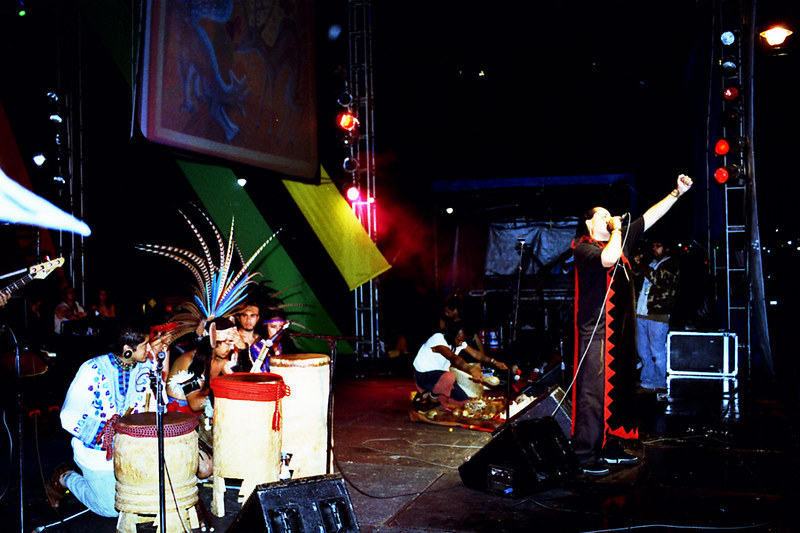
Featured Image: Aztlan Underground en Tenochtitlán by Flickr User Joél Martínez CC BY-NC-SA 2.0
—
Kristian E. Vasquez is a Ph.D. candidate in the Department of Chicana and Chicano Studies at the University of California, Santa Barbara. His research on the affects, performances, sounds, and semiosis of La Xicanada expands the concept of Xicanacimiento, centering the aesthetic force of expressive cultural forms in California.
—
.

REWIND!…If you liked this post, you may also dig:
Boom! Boom! Boom!: Banda, Dissident Vibrations, and Sonic Gentrification in Mazatlán—Kristie Valdez-Guillen
Listening to MAGA Politics within US/Mexico’s Lucha Libre –Esther Díaz Martín and Rebeca Rivas
Ronca Realness: Voices that Sound the Sucia Body—Cloe Gentile Reyes
Echoes in Transit: Loudly Waiting at the Paso del Norte Border Region—José Manuel Flores & Dolores Inés Casillas
Share this:




Current Top Posts





April 2021

January 2020

November 2019

October 2019

August 2019

April 2014

November 2017

March 2015

December 2017

October 2015


Recent Comments