
The Screech Within Speech

 Welcome back to SO!‘s Sonic Shadows series, which focuses on what it means to “have a voice.” In the first post in the series, I considered the role of the novel in sound studies, and how, paradoxically, this led us back to the embodied voice of the writer. In Joseph Conrad’s prose, traces of accent and translingualism shape the sonic space of difference, but also reframe the novel as a social, yet ambiguous act of communication.
This week, I’m happy to welcome Dominic Pettman, who picks up the question of the embodied human voice as it brushes up against the animal in what he calls the “voice of the world.” Next week, the series will conclude with uncanny mechanical sounds of early recording that trouble the voice of the human from within.
— Julie Beth Napolin, Guest Editor
—
This is the sound of “the loneliest whale in the world.”
Scientists have tracked this mournful creature for several years, intrigued by the melancholy songs, which go unanswered. The call of this singular cetacean, an Internet cult figure of unidentified species, registers at the unusual frequency of 52hz, much higher than that of all other types of whale.
These days, in general, whales have been forced into relatively tiny sonic boxes because of the din created by ship engines and various audio probings of the marine environment by military and industry alike. As bio-acoustician Christopher Clark, suggests, this assault and subsequent diminishment of the whale’s soundscape must be extremely traumatic for the animal, whose overall umwelt has shrunk from large swathes of the watery planet to barely a mile or so in any given direction. The noisier the ocean becomes the lonelier whales are likely to become.

“anim1083” by Flickr user NOAA Photo Library, CC BY 2.0
The 52hz whale is a bit like an outsider artist, offering personalized songs to the sub-aquatic world, only to be snubbed by the more “vocal” members of whale community. Cetaceans could arguably be considered the first instance of global communication, many millions of years ago, since their calls could travel astonishing distances – up to 500 miles under water. Songs of the humpback, for instance, can “sweep across the Pacific in just a few years,” as biologists from the University of Queensland explain. “In any given year, all the males in a population sing the same song, but the songs change from year to year. The changes are more than incremental; they represent whole new repertoires.”
Can we really, however, speak of singing in such cases? Many would argue that simply using the organ of vocalization does not equate to singing in that it lacks the element of self-reflection necessary for true expression; for artistry. Others have conversely argued that humans were likely taught to sing by other creatures, especially the birds. These perspectives on the question of the interspecies voice have a long and complex history, crisscrossing epochs, as well as those divergent orientations to the natural world crudely divided into “East” and “West.” In this post, I focus on what it means to try to hear the animal beyond or through human terms, to explore the question of who or what can rightly claim to have a voice – is it a property or capacity that belongs to a subject, even a nonhuman subject? Might we consider voice to include “expression” of the elements themselves? Might the world itself, whatever such a grand phrase might denote, have a vox mundi – a voice of the planet?

“Angry” by Pixabay user PublicDomainPictures, public domain
Such questions deserve long and careful consideration, [and SO! has housed a series of reflections on acoustic ecology and a singing planet.] But in this brief context, I focus on the historically contested existence of a creaturely voice – one which describes a plurality of vocal expressions, distributed among those species blessed with the capacity to make sounds with their bodies. As Tobias Menely explains in a wonderful new book, the creaturely voice, like the human one, forms the vector of sympathy; and is thus suspended between the individual producing the sound, and the one listening to it. Through “the voice of nature” we understand our essential “creaturely entanglement” with other animals. This perspective pushes Mladen Dolar’s psychoanalytic theory that voice ties self to other to include the nonhuman experience of the animal realm.
Menely argues for a condition of social identity in “creaturely voice,” which is a way of testing the world, and one’s location, role, and value in it. In other words, monkeys, birds, whales, and so on, test their own existence when they emit non-symbolic equivalents of, “I’m here.” “Where are you?” “Are you really there?” “Who are you?” “Marco.” “Polo.” These are the unspoken – and yet at least partially communicated – messages woven into the ever-vanishing, yet always returning, medium of the voice.
Take, for instance, the parrot or cockatoo. We humans have been fascinated by these birds, largely by virtue of their perceived organic capacity to “record” our own voices, and throw these back at us, like trickster ventriloquists, long before the invention of the phonograph. Certainly, this can create an uncanny effect in the human listener: hearing our own voice echoed back from the larynx of a creature so different from ourselves – a creature that may or may not have its own mind or soul. Historically speaking, many people who had their figurative feathers ruffled by the impertinence of parrots deflected the discomfort they felt, upon hearing their own words screeched back at them.
This pet parrot, who had clearly been in the room when its owner was watching X-rated material, recently became famous. The instant mirth, and/or discomfort, that this clip produces is a function of hearing ourselves, as humans, echoed back by an animal. Our words are “rebroadcast” back to us by an entity that has no sense of irony or decorum. It is literally obscene. It is as if the world were engaged in objective parody of the planet’s most arrogant animal: revealing one of our most sacred activities (“making love”) to be little more than a kind of crude ventriloquial trick. This parrot is not deliberately lampooning us, yet, the refrain created by the bird’s imitative tendencies means that we are lampooned nevertheless.
Another famous pet cockatoo was given to a new couple after a bitter divorce obliged it to find a new home. The details of the break-up remain obscure to the second owners. However, this (traumatized?) cockatoo re-enacts the tone, pitch, and vehemence of the arguments that it was obliged to witness in its previous life. While most of the “words” the cockatoo screeches are not clear enough to be translated, the emotions that initially launched them are obvious to all within hearing distance. The bird even bobs its head, and spreads its wings, in imitation of the angry body language of a wife scorned, spurned, or otherwise so aggrieved that she can only incessantly shriek at the man who made her so miserable. Whose voice is this, then?
Parrots are like children, some might claim, squawking back syllables they will never comprehend. One might as well yell into a cave, and be astonished that the words return as a consequence of physics. Bird songs, according to such a concept, create what Gilles Deleuze and Felix Guattari call “a refrain,” which in turn generates a territory through the act of sonically diagramming it. This operation is not limited to the natural world, however, since we may say the same about television sets or saxophones.
Consider how children, or lovers, playfully imitate the speech of the other. In doing so, they assert their own identity, while also putting such an identity under erasure. Many animals (including humans) may thus be creatures who continue to flesh themselves out in(to) this territory. But instead of the animal echoing back the human, what about the reverse? As a final example, consider one famous instance of simulated human suffering, “devolving” into a creaturely register; namely, the old literature professor, Dr. Immanuel Rath, who experiences a nervous breakdown when he succumbs to intense jealousy and a broken heart, at the climax of Josef von Sternberg’s classic film, The Blue Angel (1930).
Just as the full weight of his rejection, at the hands of Lola Lola (Marlene Dietrich) is being registered in his psyche, the professor – who has quit teaching to follow his beloved in the cabaret world – is ushered out onto the theatrical stage, dressed as a clown. The audience waits in skeptical anticipation of an amusing performance, but the haunted ex-professor can only unleash a torrent of repressed anguish at his broken heart, and his humiliation at the hands of the vulgar mob. The horrible sound he releases, silencing the crowd, is part spurned lover, part rooster, and wholly abject. The professor seems to lose almost all his humanity, which was once verifiable in his composed and authoritative teaching voice, but is now some kind of demonic bird, screeching in misery, fury, and defeat. As this seemingly mindless force of vengeance tries to strangle his romantic obsession backstage, and as he continues to struggle against those who restrain him, the ex-professor has become creaturely: a supposedly subhuman status signified more by his inhuman voice than by anything else.
And yet, as we have seen, there is no simple hierarchy here, where the human occasionally – in times of great distress – finds themselves, by this logic, reduced to being “an animal.” We might call this the vox mundi – the voice of the world—in which, like the shadowy depths of the ocean, there is a swath of sound shared by human and animal. The creaturely voice can be sweet, like the nightingale. Or it can be harsh, like the traumatized cockatoo or the green-eyed professor-clown. There is an intimate link between the voices of animals and those of humans, which cannot be reduced to a concept like “communication,” but which nevertheless impacts and influences all those in hearing distance.

“Humpback Whales” by Flickr user Christpher Michel, CC BY 2.0
That is, unless one happens to be a whale, singing at 52hz. In which case, we are likely to keep singing into the inky darkness, without any reply.
—
Dominic Pettman is Chair of Liberal Studies, New School for Social Research, and Professor of Culture & Media, Eugene Lang College. He is the author of several books, including Look at the Bunny: Totem, Taboo, Technology (Zero books), and the forthcoming Infinite Distraction: Paying Attention to Social Media (Polity).
—
Featured image: “Humpback Whales” by Flickr user Christopher Michel, CC BY 2.0
—
 REWIND! . . .If you liked this post, you may also dig:
Animal Renderings: The Library of Natural Sounds — Jonathan Skinner
Sounding Out! Podcast #34: Sonia Li’s “Whale” — Sonia Li
Sounding Our Utopia: An Interview With Mileece — Maile Colbert
Share this:

In the Flesh: Embodiment, Listening, and Transcription
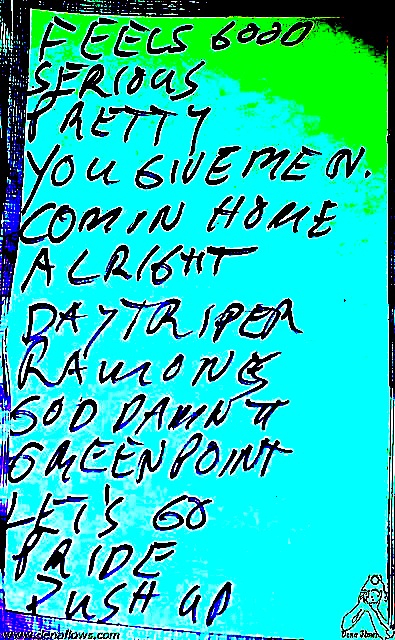
The Fleshtones Setlist, 9/11/12 show in Bilbao, Spain,
 Editor’s Note: July 18th, 2012 has been designated as World Listening Day by the World Listening Project, a nonprofit organization founded in 2008 “devoted to understanding the world and its natural environment, societies and cultures through the practices of listening and field recording.” World Listening Day is a time to think about the impacts we have on our auditory environments and, in turn, its affects on us. This year, Sounding Out! has decided to observe World Listening Day by planning a month-long special forum of posts exploring several different facets of listening such today’s offering by SO!‘s Multimedia Editor Aaron Trammell on listening’s relationship to the body and next week’s discussion by novelist Bridget Hoida on the impact of listening on her writing process. We will also explore questions that we need to remember when we celebrate listening as a cultural, embodied act. What happens when listening is interrupted? distorted? A post on tinnitus by Mack Hagood will help us think through what happens when we take listening (and the able body) for granted as a universal, normative experience. We’ll also publish a special bonus multi-sensory post by our newest regular writer, Maile Colbert, on World Listening Day itself and we will launch our regular quarterly spring podcast for on July 12th, which will feature Eric Leonardson, director of the World Listening Project. In addition to being interesting as all hell, the podcast will suggest some ideas for how to get involved in WLD activities–or how to embark on a listening project of your own this July. Enjoy our ear-opening extravaganza and please keep those comments coming. We’d love to hear from you! –JSA, Editor-in-Chief
—
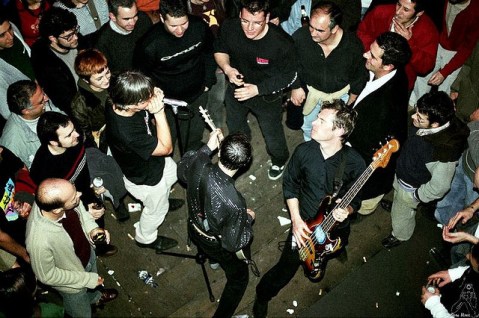
The Fleshtones, October 23, 2008, Image by Flickr User Dena Flows
What happens when the body translates sound from one medium to another? How is the body both affected by a song (when listening), and affecting it’s content (when writing)? In this post, I will relate my experience transcribing the lyrics of the song “Hexbreaker!” by The Fleshtones in an effort to answer these questions.
I love to sing. Often, I feel that it is only through singing that I feel that I can adequately relate to the emotions, ideas, and narrative of the songwriter. This relational practice is called embodiment. While psychologists such as Sigmund Freud and Carl Jung had at one point considered this sort of emotional relationship to be a libidinal drive – either to the phallus (in Freud’s case), or a unifying mythological symbol like the mandala (in Jung’s). These feelings, or drives, in classical psychoanalytic theory are part of our interior psyches, the unconscious mind.
Contemporary physiological research has departed from the sharp dichotomy of the conscious/unconscious mind. Instead, emotions are looked at as exterior phenomena – invisible links which form between bodies. As Lisa Blackman (2010) explains in her essay Embodying Affect: Voice-hearing, Telepathy, Suggestion and Modelling the Non-conscious: “The voices can be materialized through particular technologies of inscription such as neuro- imaging scans, and can even be located within the right temporal-parietal lobe, showing the capacity of the right brain not only for psychological attunement, but also for registering the affects of others” (166). Other theorists such as Sara Ahmed (2004) have argued that emotions float between and stick to bodies. Julian Henriques (2010) has even noted the ways that sonic vibrations work to activate reciprocal affective moods in others (75), a point very much in line with Blackman’s musings on the voice’s centrality to “psychic,”right brain, linkages. To these points, it is important to consider exactly what it means for the body to work as a medium of translation. What emotions can a song activate in my body, and how do these feelings become words, stored in the mnemonic confines of paper?
Because listening is central to the transmission and construction of emotional bonds, I will now detail my experience transcribing “Hexbreaker!”.
The Fleshtones are a band that I love. Their songs find the perfect balance of Animal House cool, Swinging Medallions style garage rock, and campy B-movie flavor. They have cred too, as they were a frequent act in the late-70s CBGB punk scene who shared a rehearsal space with The Cramps (a similar, but notably more famous band). Their song “American Beat” was key in the soundtrack of Tom Hanks’ shlocky 1984 film Bachelor Party. Peter Zaremba, the group’s singer, was a host on MTV’s interview based program, I.R.S. Records Presents the Cutting Edge. And, best of all, The Fleshtones have been largely eclipsed by bands with more visible albums, members, and histories. The band is all mine, and they serve as the perfect accent to any mixtape or conversation trivia at a mixer.
The digital footprint left by The Fleshtones is surprisingly sparse. Only a handful of key songs (from movie soundtracks) come up when a search for “fleshtones lyrics,” is queried on Google. A search for guitar notation or chord charts is completely fruitless, a rare feat in today’s search ecosystem. Even their vintage releases, 1982’s Roman Gods and 1983’s Hexbreaker!, were hard to pin down until the Australian label Raven re-released them on CD in 2011. For whatever reason, this sense of scarcity does nothing but excite me. It makes me feel an increased sense of intimacy and ownership. The Fleshtones, in this sense, are a knowledge commodity that has been underappreciated. By transcribing “Hexbreaker!”, and submitting it to the lyrics archive at lyrics.com (yet to be posted), I feel that I am laying claim to a space of knowledge and expertise neglected by many others.
Transcription is generally dull. Having transcribed many interviews in the past, I admit to regarding it as a job that requires patience more than practice: Press play. Listen for ten seconds. Jot down what was said. Forget half of what I was writing. Rewind five seconds. Listen again. Not quite enough to replace when I missed. Rewind eight seconds. Finish constructing the first sentence. Repeat. Hang in there for a few hours. Slow, repetitive, and monotonous is the work of interview transcription. In lieu of my previous experiences, I was happy to learn that the work of song transcription is notably more pleasurable. Although it came with its own share of frustrating and repetitive points, the presence of melody, cadence, and rhyme schemes made the entire process much more endearing and predictable.
One of the most engaging portions of song transcription came with the puzzling-out of unintelligible lyrics. The second verse of “Hexbreaker!” begins with a line that sounded like “With ____-____ mud and a hoodlum stack, finding fire in a mangled park” on first listen. It wasn’t until I had listened to each phrase five times in a row that I was able to revise to, “Well knee-high mud, and a moon lit shack, fightin’ flies in a mangled marsh.” Still not confident with that wording, I decided to do a dictionary search for similar words. To my elation after I had typed m-a-n-g into the dictionary the first word to appear was “mangrove,” the perfect word which I would never have guessed (it’s a weed-like tree found in coastal swamps!). Next I was spirited to discover that the following line evoked images of conquistadors sailing and exploring: “Well knee-high mud, and a moon lit shack, fightin’ flies in a mangrove marsh / Sendin’ sabres across the seven seas, or any foreign shores they may wash / I need a hexbreaker!”
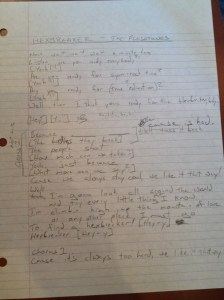
A transcript well done!
After I was able to get a gist of the overall narrative through transcription, I went back through the piece and was better able to make educated guesses about what the lyrics were. Although Zaremba often takes an unintelligible pitch when singing, the context of 17th century exploration helped me to piece together many of the tougher bits of the song. For instance, I revised the beginning of the chorus from “Well toss it back / [The bottles they break],” to fit the overall theme of colonial exploration, “The cause is had. / [The bodies they break].” Although, I’m not certain that these are the words to the song, I’m very confident because they match the overall theme. The practice of song-transcription has been fulfilling in the same way that figuring out a jigsaw, or tangram is exciting. It is a creative sort of problem solving, one that combines both analytic (left brain) and spatial, metaphoric (right brain) intelligence.
Emotionally, however, I did not feel the same satisfaction that I do when singing. Perhaps this has something to do with transcription alternate mode of embodiment. Transcription, and the pleasures associated – problem solving, precision, and permanence – are all of an analytical, and somewhat strategic sort. These are the pleasures of a conduit, processes associated more with the enduring construction of emotional bonds (belonging, and community), than the lucid enjoyment of them. It is my hope that one day another Fleshtones fan plumbs the depths of Google to find the lyrics of “Hexbreaker!” and that the fruit of my efforts, a completed transcript on lyrics.com, greets them and helps them to sing along and revel. Until then, it is enough to know that the work of transcription, for myself at least, is analytic and dry–definitely worlds apart from the euphoric mode of singing where my entire body vibrates in rhapsody to the melody, rhythm, and harmony of song.
—
Aaron Trammell is co-founder and multimedia editor of Sounding Out! He is also a Media Studies PhD candidate at Rutgers University.
Share this:


Current Top Posts





April 2021

January 2020

November 2019

October 2019

August 2019

April 2014

November 2017

March 2015

December 2017

October 2015
 Sounding Out!
Recent Comments