
Beyond the Grave: The “Dies Irae” in Video Game Music
For those familiar with modern media, there are a number of short musical phrases that immediately trigger a particular emotional response. Think, for example, of the two-note theme that denotes the shark in Jaws, and see if you become just a little more tense or nervous. So too with the stabbing shriek of the violins from Psycho, or even the whirling four-note theme from The Twilight Zone. In each of these cases, the musical theme is short, memorable, and unalterably linked to one specific feeling: fear.
The first few notes of the “Dies Irae” chant, perhaps as recognizable as any of the other themes I mentioned already, are often used to provoke that same emotion.
Often, but not always. The “Dies Irae” has been associated with death since its creation in the thirteenth century, due to its use in the Requiem Mass for the dead until the Second Vatican Council (1962–65). Its text describes the Last Judgment, when all humanity will be sent to heaven or hell. But from the Renaissance to today, the “Dies Irae” has also come to symbolize everything from the medieval church and Catholic ritual to the sinister, superstitious, or supernatural, even violence and battle—and any combination of the above.
Because of its unique history not only within its original liturgical context but also within later musical genres, this chant has become largely divorced from its original purposes, at least in modern popular imagination. Instead, it now holds a multiplicity of meanings; composers manipulate these meanings by utilizing this chant in a new setting, and thus in turn continue to reinforce those meanings within modern media. Since its use within the Mass, concert music, and films has already been well documented, this blog post explores its presence in an as yet unexamined medium: video games.

By Willem Vrelant (Flemish, died 1481, active 1454 – 1481) 1481 – illuminator (Flemish) Details of artist on Google Art Project [Public domain], via Wikimedia Commons
Beginning in the late eighteenth century, the text was set in Requiems for the secular stage by composers such as Mozart, Verdi, and Britten. But due to both its evocative text and its memorable melody (often just the first sixteen, eight, or even four notes), the “Dies Irae” chant soon was incorporated into secular instrumental works, where it signified the past, the supernatural, the oppressive, the demonic, and death. No work is more responsible for this than Hector Berlioz’s Symphonie Fantastique, where the chant symbolizes the composer’s own death and the depravity of the demons and witches who dance at his funeral.
The history of this chant, together with its use in film, has been explored by scholars such as Linda Schubert and John Haines. Because the “Dies Irae” was already a well-known symbol of the aforementioned characteristics, and because early silent film musicians borrowed musical ideas from previously composed works, the chant segued quickly into early film, where its symbolic possibilities were reinforced. Thus, even in newly composed soundtracks, composers utilized this chant as an aural shortcut to a host of emotional and psychological reactions, especially (as James Deaville and others discuss) within horror films. It appears in scenes depicting inner anguish, fear, the occult, evil, and imminent death in films from It’s a Wonderful Life, The Seventh Seal, and The Shining to Disney’s The Lion King and Star Wars, in musicals like Sweeney Todd, and in literary works such as Gaston Leroux’s The Phantom of the Opera, but it also symbolizes power and even heroism, such as in this Nike shoe commercial.
The “Dies Irae” appears analogously in video game soundtracks, where it communicates the same symbolic meanings that it does in film scores and concert music. Its recognizability also lends itself to parody, as it did in Monty Python and the Holy Grail. Yet, unlike in film music, the evolution of its use in game music speaks also to the evolution of game music technology.
In the earlier years of video games, technology could not create continuous soundtracks. The first such was in Space Invaders (1978), although it consisted only of four descending notes looped indefinitely. Additionally, while voice synthesis was used in game soundtracks as early as 1982, reproduction of musical voices was limited even into the 1990s. William Gibbons describes how early systems had a limited number of channels (40); as a result, Baroque-style counterpoint worked well texturally, and reproducing music from earlier composers such as Bach was not only permissible by copyright but also demonstrated the capabilities of their systems (201–204). As such, earlier games were less interested in a monophonic chant, although several (such as Fatal Fury) did use Mozart’s setting of the “Dies Irae.”
The “Dies Irae” chant is first used in game music in the late 1980s and early 1990s, by which point most systems had five or more channels, allowing for improved timbres and sound synthesis. The opening theme song to F-19 Stealth Fighter (1988–92, DOS/PC/Amiga/Atari) subtly references the first phrase of the chant. Composer Ken Lagace sets the first eight pitches evenly in the lower voice before moving them to a higher, rhythmicized register. The chant is accompanied by a consistent percussive element and several higher, chordal voices, which splinter off into fast arpeggios before restating the opening. There is as yet no action, nor is the plot either spiritual or supernatural, so the chant here actually works in a somewhat anomalous way. It heightens the player’s tension through its aural connotations of fear and death, thus setting the stage for the battles still to come in the game itself.
Indiana Jones and the Fate of Atlantis (1992, PC) is another early instance of the “Dies Irae,” which appears at the end, when Indiana and his companion Sophia confront the malevolent Doctor. The chant again increases tension but also indicates the presence of evil. Musically, the first two phrases of the chant appear in long, low tones, accompanied by several high, sustained, dissonant pitches. New voices enter, reminiscent of the opening phrase, before the chant returns in full in all registers. The system’s capability for thicker textures allowed the composers to stack the monophonic “Dies Irae” against itself, further emphasizing the threat of imminent danger in this final encounter.
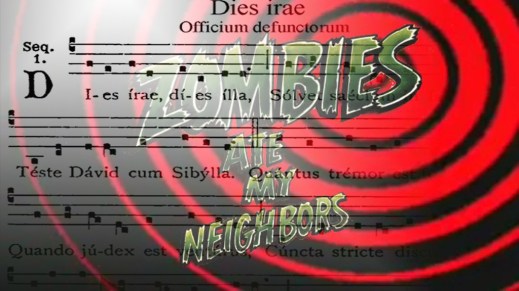
The last of the early case studies is Zombies Ate My Neighbors (1993, SNES/Genesis). These systems featured multiple channels capable of emulating a variety of acoustical settings. The game is a parody of 1950s horror films; the protagonists race through standard horror settings such as malls and castles to rescue their neighbors from demonic babies, vampires, zombies, and other stock creatures. The soundtrack also mimics the musical tropes in such films: chant itself, especially the “Dies Irae,” but also timbres such as tremolo, stingers, extreme ranges, and dissonance. The track “Curse of the Tongue,” which plays upon encountering the final boss, Dr. Tongue’s Giant Head, emulates a Gothic pipe organ. The low organ drone sustains underneath the first sixteen notes of the chant, which sound in a shrieking, vibrato-heavy register. The voices then move in parallel fifths as in medieval polyphony. The “Dies Irae” here brings to mind an entire film genre while also overtly characterizing the final battle against the otherworldly, sinister, evil Head. In this case, the chant works literally to signify the current battle and threat of death, but also parodically to indicate the absurdity of the situation.
The development of video game audio technology allowed first for voice emulation, then voice reproduction. Vocal samples were used as early as the 1980s, but were often confined to theme songs. Yet even after voices were reproduced within soundtracks, it is the “Dies Irae” melody alone that is most frequently sampled, strikingly paralleling its earlier use in film and concert music. When the “Dies Irae” text is used, it is set to newly composed music or borrowed from the Mozart or Verdi Requiems. Moreover, as in earlier media, all that is needed as an aural mnemonic is the first phrase, even just the first four notes, of the chant melody.
For example, two games released for PC in 1999—Heroes of Might & Magic III and Gabriel Knight 3: Blood of the Sacred, Blood of the Damned—both use just the first portion of the “Dies Irae.” In “Burying the Manuscript” from Gabriel Knight, pizzicato violins first allude to the first four or five notes of the chant (1:25); the full first phrase is then presented in parallel motion in the brass. The remainder of this theme alludes to the first few notes, making the “Dies Irae” a constant presence here and underscoring the secrecy, even the occult nature, of the manuscript in this scene.
Heroes III uses even less melodic material. In the Necropolis, composer Paul Romero uses the first four notes of the “Dies Irae” to underpin the entire theme. The bass plays the first four notes in a low register before seguing into newly composed material, but the contour of that phrase returns throughout the theme. The full chant phrases do not appear until the very end. The chant hints constantly at the overwhelming metaphor of death in this area, as well as to the presence of supernatural creatures such as vampires, zombies, and wraiths.
Unusual for many reasons, then, is the last case study: the game Dante’s Inferno (2010, PS3/Xbox360). It is the sole example here to use voices, but the text appears to be newly composed. As John Haines noted, the presence of Latin or pseudo-Latin is in and of itself a trope of the diabolical or demonic, which adds further nuance to this scene (129). The familiar melody is presented by a choir of mixed voices, accompanied by a roar of low brass, ambient noise, and a descant voice singing on open vowels, all signifiers of horror or the medieval. Moreover, the “Dies Irae” is not reserved for a final battle, as in previous examples, nor does it characterize supernatural creatures. Rather, it is the first theme heard in the game, reinforcing not only the medieval setting and the constant presence of death but also the ultimate trajectory of Dante, and the gamer, into Hell.
While the “Dies Irae” has been well studied as an aural signifier within film and concert music, its use in video games has, before now, been largely ignored. As in earlier musical genres, this chant brings to games a host of culturally accepted, musically mediated meanings that allow composers to immediately flesh out a character or scene. In so doing, game composers acknowledge that sound is not just sound, but rather it is (to borrow a phrase from Elizabeth Randell Upton) “a complex interaction of experiences and expectations on the part of the audience.” These experiences are continuously shaped by new compositions, scores, and soundtracks, which in turn continuously shape the audience’s expectations for future works.
As such, game soundtracks, along with other kinds of media, continue to transform the “Dies Irae” out of its original context and into an ever-growing set of pop culture symbols. The chant now signifies everything from the medieval to the present day, from judgment, battle, and death to demons, witches, and the occult. Within games in particular, though, it acts as a “memento mori,” a reminder of the mortality that game characters, and thus game players, seek to avoid through play. As such, it may instill fear in a player, but also suspicion, alertness, tension, even excitement, spurring the player to react in whichever manner suits the individual game.
The iconic status of the opening phrases of the “Dies Irae” chant marks it as a particularly useful polyvalent symbol for composers. Yet the utilization of this well-known trope is not without its problems. As I discuss in a forthcoming article, this chant, and indeed all plainchant, originates in a particular sacred, liturgical tradition. When a chant such as “Dies Irae” is used as a signifier of a general sense of spirituality, or of the medieval, or even of horror, then by default those characteristics are reified, if subtly, as Christian. Moreover, linking a chant such as the “Dies Irae” to the supernatural or the occult serves to perpetuate early modern stereotypes of Catholicism as nothing more than superstitious magic; see, for example, the purported origins of the phrase “hocus pocus.” Such anachronistic uses further obfuscate chant’s continuous role within Catholic (and other) liturgy; it is both a historic and a very modern practice.
Given that the “Dies Irae” is certainly not the only musical means to the aforementioned symbolic ends, perhaps these concerns are not pressing. Still, as Anita Sarkeesian points out, we can enjoy modern media while simultaneously critiquing facets that are problematic. There is no clear-cut way, at this point, to overturn hundreds of years of accumulated symbolic meaning for a musical icon such as the “Dies Irae,” but it behooves us as participants in auditory culture to become better aware of the multiple, and occasionally challenging, meanings within what we hear.
[Other games that also use the “Dies Irae” chant include Gauntlet Legends (1999, N64/PS/Dreamcast), Final Fantasy IX (2000, PS), EverQuest II (2004, MMORPG), Heroes of Might and Magic V (2006, PC), Sam & Max: Season 2 (2007–8, Wii/PC/PS3/Xbox 360), Ace Combat: Assault Horizon (2011, PS3/Xbox 360), and Diablo 3 (2012–4, PC/PS3/Xbox/PS4). My thanks go to VGMdb and Overclocked Remix for bringing several of these games to my attention, and to Ryan Thompson and Dana Plank for comments.]
–
Featured Image: A mashup of the first lines of the Dies Irae and the Zombies Ate My Neighbors title screen. Remixed for purposes of critique.
–
Dr. Karen Cook specializes in medieval and Renaissance music theory, history, and performance. She is currently working on a monograph on the development of rhythmic notation in the fourteenth and early fifteenth centuries. She also maintains active research interests in popular and contemporary music, especially with regard to music and identity in television, film, and video games. She frequently links her areas of specialization together through a focus on medievalism, writ broadly, in contemporary culture. As such, some of her recent and forthcoming publications include articles on fourteenth-century theoretical treatises, biographies of lesser-known late medieval theorists, and the use of plainchant in video games, a book chapter on medievalist music in Harry Potter video games, and a forthcoming co-authored Oxford Bibliography on medievalism and music.
–
 REWIND!…If you liked this post, you may also dig:
SO! Amplifies: Mega Ran and Sammus, The Rappers With Arm Cannons Tour–Enongo Lumumba-Kasongo
Video Gaming and the Sonic Feedback of Surveillance: Bastion and the Stanley Parable–Aaron Trammell
Playing with the Past in the Imagined Middle Ages: Music and Soundscape in Video Game–James Cook
Share this:

The Eldritch Voice: H. P. Lovecraft’s Weird Phonography

 Welcome to the last installment of Sonic Shadows, Sounding Out!’s limited series pursuing the question of what it means to have a voice. In the most recent post, Dominic Pettman encountered several traumatized birds who acoustically and uncannily mirror the human, a feedback loop that composes what he called “the creaturely voice.” This week, James Steintrager investigates the strange meaning of a “metallic” voice in the stories of H.P. Lovecraft, showing how early sound recording technology exposed an alien potential lingering within the human voice. This alien voice – between human and machine – was fodder for techniques of defamiliarizing the world of the reader.
— Guest Editor Julie Beth Napolin
—
A decade after finding itself downsized to a dwarf planet, Pluto has managed to spark wonder in the summer of 2015 as pictures of its remarkable surface features and those of its moon are delivered to us by NASA’s New Horizons space probe. As scientists begin to tentatively name these features, they have drawn from speculative fiction for what they see on the moon Charon, giving craters names including Spock, Sulu, Uhuru, and—mixing franchises—Skywalker . From Doctor Who there will be a Tardis Chasma and a Gallifrey Macula. Pluto’s features stretch back a bit further, where there will also be a Cthulhu Regio, named after the unspeakable interstellar monster-cum-god invented by H. P. Lovecraft.
We can imagine that Lovecraft would have been thrilled, since back when Pluto was first discovered in early 1930 and was the evocative edge of the solar system, he had turned the planet into the putative home of secretive alien visitors to Earth in his short story “The Whisperer in Darkness.” First published in the pulp magazine Weird Tales in 1931, “The Whisperer in Darkness” features various media of communication—telegraphs, telephones, photographs, and newspapers—as well as the possibilities of their manipulation and misconstruing. The phonograph, however, plays the starring role in this tale about gathering and interpreting the eerie and otherworldly—the eldritch, in a word—signs of possible alien presence in backwoods Vermont.
In the story, Akeley, a farmer with a degree of erudition and curiosity, captures something strange on a record. This something, when played back by the protagonist Wilmarth, a folklorist at Lovecraft’s fictional Miskatonic University, goes like this:
Iä! Shub-Niggurath! The Black Goat of the Woods with a Thousand Young! (219)
The sinister resonance of a racial epithet in what appears to be a foreign or truly alien tongue notwithstanding, this story features none of the more obvious and problematic invocations of race and ethnicity—the primitive rituals in the swamps of Louisiana of “The Call of Cthulhu” or the anti-Catholic immigrant panic of “The Horror at Red Hook”—for which Lovecraft has achieved a degree of infamy. Moreover, the understandable concern with Lovecraft’s social Darwinism and bad biology in some ways tends to miss how for the author—and for us as well—power and otherness are bound up with technology.
 The transcription of these exclamations, recorded on a “blasphemous waxen cylinder,” is prefaced with an emphatic remark about their sonic character: “A BUZZING IMITATION OF HUMAN SPEECH” (219-220). The captured voice is further described as an “accursed buzzing which had no likeness to humanity despite the human words which it uttered in good English grammar and a scholarly accent” (218). It is glossed yet again as a “fiendish buzzing… like the drone of some loathsome, gigantic insect ponderously shaped into the articulate speech of an alien species” (220). If such a creature tried to utter our tongue and to do so in our manner—both of which would be alien to it—surely we might expect an indication of the difference in vocal apparatuses: a revelatory buzzing. Lovecraft’s story figures this “eldritch sound” as it is transduced through the corporeal: as the timbral indication of something off when the human voice is embodied in a fundamentally different sort of being. It is the sound that happens when a fungoid creature from Yuggoth—the supposedly native term for Pluto—speaks our tongue with its insectile mouthparts.
Yet, reading historically, we might understand this transduction as the sound of technical mediation itself: the brazen buzz of phonography, overlaying and, in a sense, inhabiting the human voice.
For listeners to early phonographic recordings, metallic sounds—inevitable given the materials used for styluses, tone arms, diaphragms, amplifying horns—were simply part of the experience. Far from capturing “the unimaginable real” or registering “acoustic events as such,” as media theorist Friedrich Kittler once put the case about Edison’s invention, which debuted in 1877, phonography was not only technically incapable of recording anything like an ambient soundscape but also drew attention to the very noise of itself (23).
For the first several decades of the medium’s existence, patent registers and admen’s pitches show that clean capture and reproduction were elusive rather than given. An account in the Literary Digest Advertiser of Valdemar Poulsen’s Telegraphone, explains the problem:
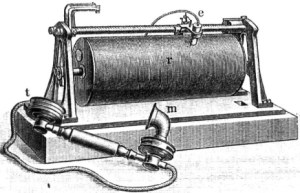 The talking-machine records sound by the action of a steel point upon some yielding substance like wax, and reproduces it by practically reversing the operation. The making of the record itself is accompanied by a necessary but disagreeably mechanical noise—that dominating drone—that ‘b-r-r-r-r’ that is never in the human voice, and always in its mechanical imitations. One hears metallic sounds from a brazen throat—uncanny and inhuman. The brittle cylinder drops on the floor, breaks—and the neighbors rejoice!
The Telegraphone, which recorded sounds “upon imperishable steel through the intangible but potent force of electromagnetism” such that no “foreign or mechanical noise is heard or is possible,” of course promised to make the neighbors happy not by breaking the cylinder but rather by taking the inhuman ‘b-r-r-r-r’ out of the phonographically reproduced voice. Nonetheless, etching sound on steel, the Telegraphone was still a metal machine and unlikely to overcome the buzz entirely.
In his account of “weird stories” and why the genre suited him best, Lovecraft explained that one of his “strongest and most persistent wishes” was “to achieve, momentarily, the illusion of some strange suspension or violation of the galling limitations of time, space, and natural law which forever imprison us and frustrate our curiosity about the infinite cosmic spaces beyond the radius of our sight and analysis.” In “The Whisperer in Darkness,” Lovecraft put to work a technology that was rapidly becoming commonplace to introduce a buzz into the fabric of the everyday. This is the eldritch effect of Lovecraft’s evocation of phonography. While we might wonder whether a photograph has been tampered with, who really sent a telegram, or with whom we are actually speaking over a telephone line—all examples from Lovecraft’s tale—the central, repeated conundrums for the scholar Wilmarth remain not only whose voice is captured on the recorded cylinder but also why it sounds that way.
 The phonograph transforms the human voice, engineers a cosmic transduction, suggesting that within our quotidian reality something strange might lurk. This juxtaposition and interplay of the increasingly ordinary and the eldritch is also glimpsed in an account of Charles Parson’s invention the Auxetophone, which used a column of pressurized air rather than the usual metallic diaphragm. Here is an account of the voice of the Auxetophone from the “Matters Musical” column of The Bystander Magazine from 1905: “Long ago reconciled to the weird workings of the phonograph, we had come to regard as inevitable the metallic nature of its inhuman voice.” The new invention might well upset our listening habits, for Mr. Parson’s invention “bids fair to modify, if not entirely to remove,” the phonograph’s “somewhat unpleasant timbre.”
What the phonograph does as a medium is to make weird. And what making weird means is that instead of merely reproducing the human voice—let alone rendering acoustic events as such—it transforms the latter into its own: an uncanny approximation, which fails to simulate perfectly with regard to timbre in particular. Phonography reveals that the materials of reproduction are not vocal chords, breath, labial and dental friction—not flesh and spirit, but vibrating metal.
Although we can only speculate in this regard, I would suggest that “The Whisperer in Darkness” was weirder for readers for whom phonographs still spoke with metallic timbre. The rasping whisper of the needle on cylinder created what the Russian Formalist Viktor Shklovsky was formulating at almost exactly the same time as the function of the literary tout court: defamiliarization or, better, estrangement. Nonetheless, leading the reader to infer an alien presence behind this voice was equally necessary for the effect. After all, if we are to take the Auxetophone as our example—an apparatus announced in 1905, a quarter of a decade before Lovecraft composed his tale, and that joined a marketplace burgeoning with metallic-voice reducing cabinets, styluses, dampers, and other devices—phonographic listeners had long since become habituated to the inhumanity of the medium. That inhumanity had to be recalled and reactivated in the context of Lovecraft’s story.
 To understand fully the nature of this reactivation, moreover, we need to know precisely what Lovecraft’s evocative phonograph was. When Akeley takes his phonograph into the woods, he adds that he brought “a dictaphone attachment and a wax blank” (209). Further, to play back the recording, Wilmarth must borrow the “commercial machine” from the college administration (217). The device most consistent with Lovecraft’s descriptions and terms is not a record player, as we might imagine, but Columbia Gramophone Company’s Dictaphone. By the time of the story’s setting, Edison Phonograph’s had long since switched to more durable celluloid cylinders (Blue Amberol Records; 1912-1929) in an effort to stave off competition from flat records. Only Dictaphones, aimed at businessmen rather than leisure listeners, still used wax cylinders, since recordings could be scraped off and the cylinder reused. The vinyl Dictabelt, which eventually replaced them, would not arrive until 1947.
Meanwhile, precisely when the events depicted in “The Whisperer in Darkness” are supposed to have taken place, phonography was experiencing a revolutionary transformation: electronic sound technologies developed by radio engineers were hybridizing the acoustic machines, and electro-acoustic phonographs were in fact becoming less metallic in tone. Yet circa 1930, as the buzz slipped toward silence, phonography was still the best means of figuring the sonic uncanny valley. It was a sort of return of the technologically repressed: a reminder of the original eeriness of sound reproduction—recalled from childhood or perhaps parental folklore—at the very moment that new technologies promised to hide such inhumanity from sensory perception. Crucially, in Lovecraft’s tale, estrangement is not merely a literary effect. Rather, the eldritch is what happens when the printed word at a given moment of technological history calls up and calls upon other media of communication, phonography not the least.
I have remarked the apparent absence of race as a concern in “The Whisperer in Darkness,” but something along the lines of class is subtly but insistently at work in the tale. The academic Wilmarth and his erudite interlocutor Akeley are set in contrast with the benighted, uncomprehending agrarians of rural Vermont. Both men also display a horrified fascination with the alien technology that will allow human brains to be fitted into hearing, seeing, and speaking machines for transportation to Yuggoth. These machines are compared to phonographs: cylinders for storing brains much like those for storing the human voice. In this regard, the fungoid creatures resemble not so much bourgeois users or consumers of technology as scientists and engineers. Moreover, they do so just as a discourse of technocracy—rule by a technologically savvy elite—was being articulated in the United States. Here we might see the discovery of Pluto as a pretext for exploring anxieties closer to home: how new technologies were redistributing power, how their improvement—the fading of the telltale buzz—was making it more difficult to determine where humanity stopped and technology began, and whether acquiescence in this changes was laudable or resistance feasible. As usual with Lovecraft, these topics are handled with disconcerting ambivalence.
—
James A. Steintrager is a professor of English, Comparative Literature, and European Languages and Studies at the University of California, Irvine. He writes on a variety of topics, including libertinism, world cinema, and auditory cultures. His translation of and introduction to Michel Chion’s Sound: An Acoulogical Treatise will be published by Duke University Press in fall of 2015.
—
Featured image: Taken from “Global Mosaic of Pluto in True Color” in NASA’s New Horizons Image Gallery, public domain. All other images courtesy of the author.
—
 REWIND! . . .If you liked this post, you may also dig:
Sound and Sanity: Rallying Against “The Voice” — Mark Brantner
DIANE… The Personal Voice Recorder in Twin Peaks — Tom McEnaney
Reproducing Traces of War: Listening to Gas Shell Bombardment, 1918 — Brían Hanrahan
Share this:


Current Top Posts





April 2021

January 2020

November 2019

October 2019

August 2019

April 2014

November 2017

March 2015

December 2017

October 2015
 Sounding Out!
Recent Comments