
Make a Noise Joyful: Cirm in the Old English Exodus


Series co-editors Dorothy Kim and Christopher Roman
When the narrator of the Old English poem Exodus declares “Gehyre se ðe wille” (Let him hear who will), what sounds is he asking us to attend to? [Note: Text from Peter Lucas’s edition, 7b. All translations are author’s own.] This post argues that the Old English noun cirm (noise, shout, outcry) challenges our conceptualization of noise. In the Anglo-Saxon corpus, cirm most often refers to the indistinguishable, non-linguistic hum of a crowd, rather than the meaningful utterance of an individual. This accords with the popular view of noise in sound studies: whether medieval or modern, noise (as opposed to meaningful sound) is associated with alterity, disruption, and violence.
However, and strikingly, in the Old English Exodus, words for noise describe not only the terrible sounds of the drowning Egyptians as the roaring waters of the Red Sea rush over them, but also the survival of the Israelites. I argue that this cirm is a mark of the Israelites’ triumphal assertion of their continued presence and plenitude, a celebration of the fact that they can still be a multitude despite captivity. That cirm may not sit easily within our definition of noise should provoke not a redefinition of cirm’s joyful use, but a reconceptualization of Anglo-Saxon noise.

‘Amalek Attacks Israel and Is Defeated’, in the Old English Hexateuch, British Library, MS Cotton Claudius B IV
What is Noise?
“Noise” has a range of meanings, but most often implies “unwanted sound” as R. Murray Schafer argues in The Soundscape (73). Following the work of Jacques Attali and Jeffrey J. Cohen, noise has been associated with alterity, difference, and monstrosity. Noise, as opposed to sound, may be non-linguistic or disordered: nonsense, babble, the roar of a jet engine. According to David Novak’s contribution to Keywords in Sound, noise is not present in nature, but is created by modern technology (129). In the modern world, noise is often considered negative: cities have rules about noise pollution, apartment buildings set quiet hours, and airplane passengers don noise-cancelling headphones. In the pre-industrial age, noise was not exempt from criticism, though the word could also be applied to more pleasant sounds, like birdsong.
In the European Middle Ages, Valerie J, Allen argues in “Broken Air,” noise was often figured as violent, transgressing boundaries, inappropriately closing the distance between sound producer and sound receiver (310 and 317-318). According to Macrobius, it was not silence that was the opposite of sound, but noise (311). Grammar, which was “devoted to the pursuance of ratio through sound,” was ethical; noise was therefore considered “a kind of audible violence; corruption [wa]s something one can hear” (305). But some medieval noises were more ambiguous: the Old English word dream (joy, joyful sound) could also be applied to the terrible sounds of Hell or the terror of Judgment Day, as in Kazutomo Karasawa’s analysis in “OE dream for Horrible Noise in the Vercelli Homilies.” Likewise, “clamor,” which originated as a (mostly) negative noise, became an important legal instrument, as discussed by Richard Barton in “Making a Clamor to the Lord: Noise, Justice and Power in Eleventh- and Twelfth-Century France.” But in general, we tend to assume medieval noise is negative, or marks its producer as other.
Noises in Exodus
The Old English Exodus, found in the c. 1000 manuscript known as Bodleian MS Junius 11, is a notoriously difficult and complex poetic adaptation of the Old Testament Exodus 12-14. The author and date of composition are unknown, though it is often considered quite early, perhaps as early as the eighth century as Paul Remley and Lucas argue. Few institutions were rich enough to own a complete Bible. The author of Exodus may have had access to a written Latin version of Exodus, or may have been exposed to the text via the liturgy, especially the liturgy of the Easter Vigil.
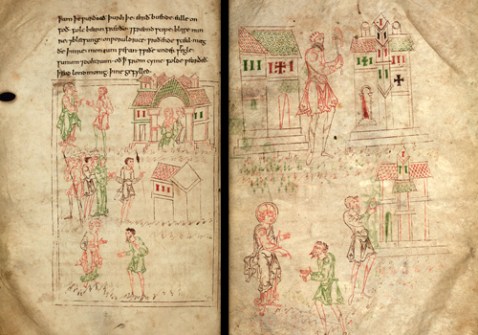
The Junius Manuscript, Oxford, Bodleian Library, MS. Junius 11, pp. 84-5
Exodus delights in sensory details, but until recently, I had always thought of Exodus as primarily visual – the gleaming of war-gear, the glittering of Egyptian spoils washed up on the shore, tents and a pillar of cloud to protect the Israelites from the desert sun, and a pillar of fire to guide them. But the poet is also attentive to the larger sensory world, including the world of sound and noise. Those who accept the poet’s opening challenge to his audience (“Gehyre se ðe wille!” [Let him hear who will!]) will recognize that the poem is in fact filled with sounds – the battle trumpets that provide order and structure to the movements of the army, the rushing and later silencing of waters, the terrible evening songs of wolves eager for battle, the awful rasping of the blade Abraham draws to sacrifice Isaac in the poem’s digression on the patriarchs, the triumphant songs produced by Israelite men and women in praise of God after the Egyptians are defeated. In what follows, I focus on the multiple deployments of a single word for noise (cirm), applied to both Israelites and Egyptians, asking what this word can reveal about Anglo-Saxon conceptions of noise.
It has often been remarked that the poet resists easy distinctions between Israelites and Egyptians, applying similar vocabulary to both, and this is certainly illustrated by the poet’s sonic play. In a climactic scene near the end of the poem, the drowning of the Egyptians in the Red Sea is accompanied by horrible noises:
Storm up gewat
heah to heofonum, herewopa mæst;
laðe cyrmdon (lyft up geswearc)
fægum stæfnum. Flod blod gewod:
randbyrig wæron rofene, rodor swipode
meredeaða mæst. Modige swulton,
cyningas on corðre. Cyrm swiðrode
wæges æt ende; wigbord scinon.
[A storm went up high to the heavens, the greatest of cries of the army; the hostile ones cried out with doomed voices (the air grew dark above). Blood pervaded the water: ramparts were broken, the greatest of sea-deaths lashed the sky. The brave ones died, kings in a troop. The noise fell silent at the end of the water; battle-boards shone. (460b-467; emphasis added)]
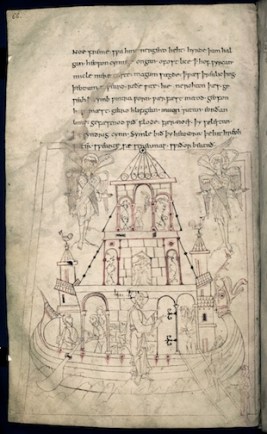
The Junius Manuscript, Oxford, Bodleian Library, MS. Junius 11, p. 66.
Cirm occurs twice in this passage, first as a verb (cyrmdon) and then as a noun (cyrm). The manuscript reading in 466b is cyre (choice). Lucas emends to cyrm because cyre is not a poetic word, and I would argue that the echo with the Israelites’ cyrm (107) must be deliberate. Even if we accept MS cyre, the passage still includes the verb cyrmdon (462a), and other sonic vocabulary (herewopa, “army’s cries” [461], and fægnum stefnum, “doomed voices” [463]). The noun occurs roughly 60 times in the corpus; the verb 17 times (DOE).
In the Old English corpus, cirm is often negative, applied to the tortures of hell or the terror of Judgment Day, and indicates a particularly loud sound (DOE, Lucas). According to the DOE, the noun means “shout, cry, shriek” or “noise of non-human origin, clamour.” The Egyptian cirm is obviously threatening, the meaningless cries of men who, like a raging storm, lash out in terror as the waters close over their heads. Even the visual horror of blood mingling with water maintains sonic affiliations: this line is a rare example of internal rhyme in Old English poetry (flod blod gewod). The end of the Egyptian threat is marked by the silencing of their voices and cirm, metaphorically a silencing of the army’s advance against the Israelites.
Given the negative associations with noise in both medieval and modern sound theory, that the Egyptian defeat is accompanied by their terrible cirm may not seem particularly surprising. Strikingly, this is not the only such noise in the poem. Near the beginning of the poem, the Israelites celebrate their initial escape from Egypt by producing not just any noise, but cirm. On the third day, after the pillar of cloud has appeared, the Israelites awaken with trumpets, and seeing the pillar,
Folc wæs on salum,
hlud herges cyrm.
[The people were joyful, loud was the noise of the army. (106b-107a; emphasis added)]
If cirm is threatening, loud noise, associated with difference and violence, why would the Israelites produce it? I would like to suggest that cirm suggests not merely loud noise, but crowd noise. The Israelites’ cirm is not an assertion of difference, or the meaningless babble of a drowning, almost non-human army, but an assertion of triumphant plenitude. Their joyful cirm is a fulfillment of God’s covenant with Abraham, which the poet will remind us of later in the poem (435-442). Just as God promised Abraham innumerable offspring, his support of the Israelites in their exodus signals that they will continue to be a multitude (as they certainly are in this battle, in which they have 600,000 fighting men (224-233).
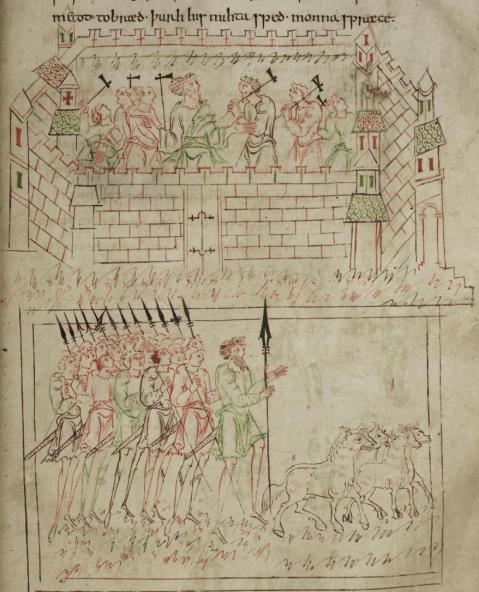
The Junius Manuscript, Oxford, Bodleian Library, MS. Junius 11, p. 81.
In fact, the Israelites’ triumphant crowd noise is echoed at the end of the poem as well. After the defeat of the Egyptians, who make terrible cirm as they perish in the Red Sea (460b-467), the Israelites issue more celebratory sound, this time transformed from crowd noise to harmonious music:
Æfter þam wordum – werod wæs on salum –
sungon sigebyman (segnas stodon),
fægerne sweg
[After these words – the troop was joyful – victorious trumpets sang a beautiful sound (battle-standards stood). (565-67a; emphasis added)]
The Israelites’ cirm (107), which they produced while on salum (joyful), is balanced and echoed by the celebratory sounds of the end of the poem, also produced by a people who are on salum (565). Whatever threat the Israelites’ assertion of plenitude and cirm may have made possible is mitigated by replacing that cirm (noise) with a beautiful sound (fægerne sweg), a harmonious, if also loud and multiple, expression.
According to Attali, music can be used to produce order, but “noise is violence: it disturbs. To make noise is to interrupt a transmission, to disconnect, to kill. It is a simulacrum of murder” (26). In this sense, the Israelites’ crowd noise in the desert is violent – it threatens the order of the Egyptians, or the hierarchy the Egyptians have sought to impose on the Israelites in their captivity. But because this story ends in the triumph of the Israelites, told from the point of view of their Christian descendants, it celebrates this assertion of communal power and communal violence without fully othering them. The true violence is inflicted on the Egyptians by God in the Red Sea, allowing the Israelites to reassert their normativity, their cohesion, their power, and their non-otherness. While the drowning Egyptians produce cirm, it is silenced because the cirm of the Israelites has conquered them. Noise, or at least cirm, is therefore not merely negative or disruptive; it is a powerful claim to be blessed by God, an assertion of belonging rather than a boundary crossing.
—
Featured Image:Detail of a miniature of the plague of hail (Exodus 9:22-25), Add MS 15277, f. 7r
—
Jordan Zweck is an assistant professor in the Department of English at the University of Wisconsin-Madison. She specializes in early medieval vernacular literature and culture, especially Old English, and is interested in documentary culture, media studies, and sound studies. She is currently completing a book on Anglo-Saxon epistolarity and early English media, examining the representation of letters in vernacular texts such as letters from heaven, hagiography, and poetry. She is also working on a second book on sound, noise, and silence in Anglo-Saxon England, a portion of which is forthcoming in Exemplaria. Zweck is a recipient of the University of Wisconsin-Madison Center for the Humanities’ First Book Award, has held a resident fellowship at the Institute for Research in the Humanities at UW-Madison, and has won several teaching awards.
—
REWIND!…If you liked this post, you may also dig:
‘A Clateryng of Knokkes’: Multimodality and Performativity in “The Blacksmith’s Lament”–Katherine Jager
Mouthing the Passion: Richard Rolle’s Soundscapes–Christopher Roman
Sounding Out! Podcast #54: The Sound of Magic-K.A. Laity
Share this:

Animal Renderings: The Library of Natural Sounds

 Today we bring you the latest post in SO!’s spring series, Live from the SHC, which follows the new research from the 2011-2012 Fellows of Cornell’s Society for the Humanities, who have gathered in the A.D. White House to study “Sound: Culture, Theory, Practice, Politics.” For the full series, click here. Today poet, scholar, and ecocritic Jonathan Skinner brings us all a treat for spring, so throw open your windows and take a deep listen. –Editor in Chief, JSA
—
This planet is singing 24/7 but are we listening to it? Take out your earbuds, turn down the music and the air conditioning, walk away from the fridge, shut off your engine, open the windows, and tell me what you hear. If you are in the humid parts of the temperate regions, chances are you’ll hear right now, amidst the myriad human sounds, and depending on the time of day, the spring peepers going, the woodcocks peenting and displaying, a grouse drumming, the whistling of cardinals and robins, chickadees countersinging, blackbirds trilling, cawing of crows, blue jays scolding, honking of geese, hooting of an owl or two, woodpeckers drumming, house sparrows chirping (in this case, to a Satie carillon), perhaps some coyotes yapping it up after midnight. Not to speak of wind in branches and leaves, water, thunder and lightning. These are just some of sounds I can pick up, with a bit of careful listening, in and around the relatively urban environment of Ithaca, New York. If you put your ear to the grass, you might hear this astonishing Treehopper communication.
Or maybe you heard these sounds in some music you were listening to, in a movie soundtrack or videogame? Just as we pervade their worlds, animals pervade our environments, and their sounds are used to “render” these environments within the relatively flat dimensions of our media—the way three dimensions of spatial information get “crunched” to the two dimensions of a video game’s display (see 4:00 – 5:20 for a demonstration of Aiden Fry’s “generative birdsong” program below, developed through the analysis and sampling of birdsong as a solution to repetitive sound effects that can diminish the immersive quality of the game). Even the most sophisticated “surround sound” audio must “render” figuratively the environed experience of hearing.
.
The next time you watch a movie, listen to some “ambient” music or play a videogame that renders an outdoors environment, imagine subtracting the animal sounds (either literal or evoked) from these media scapes and consider how incompletely rendered the experience would be. A reversal of the effect, as in Gus Van Sant’s use of Hildegard Westerkamp’s “Beneath the Forest Floor” soundscape, to track and underscore the anomie of certain characters through Elephant, his thinly veiled recreation of the Columbine High School tragedy, also proves the rule (note especially the soundtrack from 3:10 – 3:40).
.
Greg Budney and Mike Webster explain their dedication to compiling the world’s largest and best quality archive of animal recordings (now in video as well as audio), the Macaulay Library of Natural Sounds at Cornell University, as a responsibility to future acoustic biologists, who may bring tools and concepts to the data we have not remotely conceived. Their mission is first and foremost a scientific one. However, conservation is also high on their list: Budney, an expert recordist, points out how high quality recordings—as of lekking Greater Prairie-Chickens—can be played back into the environment, to promote nesting of endangered populations.

Cornell's Bioacousticians Performing FIeld Recording for the Macaulay Library of Natural Sounds
These bioacousticians agree that high quality sound recordings can be a powerful way to interest laypeople in the sounds of the robin in their backyard, and, by extension, in broader issues of conservation. Sounds in the Macaulay Library also are available to the entertainment industry, so that, indeed, myriad animal vocalizations contribute to the renderings of its various media. Licensing fees in turn contribute to the conservation mission of the Library.
Rendering is not so much a matter of reproduction—accurately representing a “real” environment—as of recreating, through a consistency that “completes” the aesthetic experience, the feelings associated with an environment. (Think of the difference in quality between the “finished” HD, surround-sound movie and the behind-the-scenes “special features” on a DVD.) In Audio-Vision: Sound on Screen, media theorist Michel Chion identifies an important feature of rendering in “materializing sound indices,” noises that help render, in sound and image, a particular “clump of sensations” (112-116).
For instance, spatial depth, in outdoor scenes, is often rendered through the presence of bird song or dogs barking, etc. Or consider the cooing of pigeons that often accompanies the opening of a garret window in a movie set in Paris. Or that ubiquitous red-tailed hawk’s cry indexing a “wild” landscape. The absence or thinness of these indices can be just as helpful to rendering, as when the landscape includes “ethereal, abstract, and fluid” entities: “out of touch” characters in Jacques Tati films or the drawn characters in Who Framed Roger Rabbit, where hollow, lightweight, plastic sounds help us believe that we are indeed seeing (or, as Chion reminds us, “hear-seeing”) cartoon characters (watch from 1:19 – 1:33 for the famous “clang” the drawn Jessica Rabbit makes as she collides with the live action Eddie Valiant).
.
Cormac McCarthy’s The Road, both the book and the film version, deploy effectively the total absence of animal sounds to convey the uncanny complex of feelings bound up in environmental apocalypse—the “silent spring” invoked by Rachel Carson a half century ago in her indictment of the toxic legacy of the chemical industry.
In his study of environmental aesthetics, Ecology Without Nature, ecocritic Timothy Morton faults rendering for perpetuating an “ecomimetic illusion of immediacy,” an “ambient” art that ultimately comes in between us and the life it is supposed to bring us close to (36). Rendering lures us into the “relaxing ambient sounds of ecomimesis,” precisely when we need to hear “the screeching of the emergency brake” (as Morton puts it: “whistling in the dark, insisting that we’re part of Gaia” 187, 196). However, Chion notes that “the disjunctive and autonomist impulse [à la Godard] that predominates in intellectual discourse on the question (‘wouldn’t it be better if sound and image were independent?’) arises entirely from a unitary illusion” that there is “a true unity existing elsewhere” (Audio-Vision 97-98). Such unity is in fact elusive: for instance, it can be difficult to identify the sources of sounds in “nature” (consider the bewildering variety of blue jay calls), while the notion that a sound can on its own invoke more abstract characteristics of its source, especially when it is produced by a nonhuman species, betrays a kind of magical thinking. (Forms of non-western magical thinking actually acknowledge the disjunctive quality of natural sounds by referring, for instance, to “voices in the forest.”) Also, sound is so context dependent, and our listening is so strongly influenced by the conventions of our media, that “sound in itself”can be a very slippery object. Chion notes that we need something like an “auditory analogy of the visual camera obscura” —i.e. the monitoring and recording of soundscapes—to help us listen to “sounds for themselves and to focus on their acoustical qualities” (108).
In a time of mass extinction, how are we to approach the rendering of animal sounds in our mediated environments? Do these sounds have agency? Does listening to and “capturing” animal sounds bring us closer to them, or only lure us, with an illusion of immersion and unity, away from realizing the dark nature of our ecology, and the urgent reforms needed, if we are actually to help animals (does our rendering and consumption of whale song—pace what Songs of the Humpback Whale has done for whale conservation—end up perpetuating the same extractive process that “renders” whale blubber)?
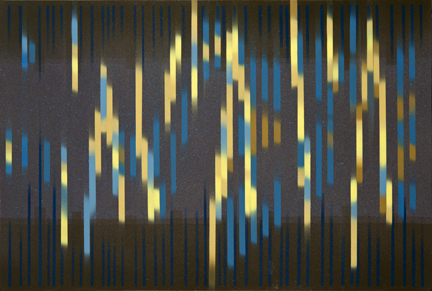
Connecticut Warbler by Carol Hanna, Songs of the Birds
I would say that, so long as we approach these sounds neither as a substitute for, nor as an experience “less than,” the daily practice of listening to our environments, a resource like the Macaulay Library can add immeasurably to our awareness of the diversity, and the vulnerability, of life on Earth. (Another resource worth exploring is the British Library’s Environment & nature sounds archive, especially the collection of early wildlife recordings.) Careful attention to renderings of animal sounds in our media can make us aware of the extent to which we “render” the landscape around us, through selective habits of listening, and open us to the disjunctive, noisy, reverberant, distorted sounds such renderings obscure. (R. Murray Schafer made this point long ago, in his book The Soundscape urging us to listen to noise if we want to defeat it.) Clips posted here, of media using birdsong to render scenes of human violence, state the complexity of our pastoral aesthetics in an exaggerated way, but every day our listening has access to a range of sonic collisions.
Consider the famous recordings of nightingales in Beatrice Harrison’s backyard, to the accompaniment of her cello, as well as to RAF bombers—on Minnesota Public Radio’s Music & Nature. Part of what we will hear when we listen with open ears is our own domination of the soundscape, one that can have concrete implications for the survival of other species (Chris Clark, head of Bioacoustics Research at Cornell, has imaged the way the noise of shipping lanes impacts the acoustic habitat of endangered Right Whales.) How might the infrasonic or ultrasonic vocal communications—of blue whales, elephants, mice and bats, for instance—that operate beyond the range of the naked human ear (but not of our instruments) impact our media environments? The “materializing sound indices” of recordings can be used to return us to the embodied, imperfect natures of these other beings, whose vulnerability, philosopher Jacques Derrida suggests in The Animal That Therefore I Am, it is our own nature to follow.

A Gaggle of Grackles by Flickr User Dan Machold
The more we listen to the environment acousmatically, the better critics we become of our media environments’ often crassly commercial renderings. Many of these sounds (see also some of the recordings collected on the Earth Ear label’s Dreams of Gaia) are simply beautiful, or astonishing—conveying an aesthetic dimension alluded to in veteran nature recordist Bernie Krause’s new book, The Great Animal Orchestra: Finding the Origins of Music in the World’s Wild Places. (My concern with a focus on the exotic is that privileging “wild places” might have the effect of devaluing the “not wild,” i.e. where most people live—places nonetheless full of wild creatures—and where we might best develop our listening.) Finally, the more we find ways to render these sounds meaningfully in our own lives, outside patterns of consumption, the better chances are we’ll begin to develop (politically, ethically) meaningful relationships with these other species, species with whom we must collaborate if we want to tend the web of life that so desperately needs our care.
**Featured Image Credit: Digital Collage Bird Art by Flickr User Peregrine Blue
—
Jonathan Skinner founded and edits the journal ecopoetics, which features creative-critical intersections between writing and ecology. Skinner also writes ecocriticism on contemporary poetry and poetics: he has published essays on the poets Mei-mei Berssenbrugge, Ronald Johnson, Bernadette Mayer, Lorine Niedecker, and Charles Olson; on Poetries of the Third Landscape, Documentary Poetics, and Poetry Animals; and an ethnographic study of the Tohono O’odham Mockingbird Speech. Skinner’s poetry collections include Birds of Tifft (BlazeVox, 2011), Warblers (Albion Books, 2010), With Naked Foot (Little Scratch Pad Press, 2009), and Political Cactus Poems (Palm Press, 2005). Skinner’s latest creative project is a book on the urban landscape designs of Frederick Law Olmsted.
Share this:


Current Top Posts





April 2021

January 2020

November 2019

October 2019

August 2019

April 2014

November 2017

March 2015

December 2017

October 2015
 Sounding Out!
Recent Comments