
Sounding Visibility in Anglo-Latin Prose

series co-editors Dorothy Kim and Christopher Roman
Here is a distilled introduction to the latest installment of Medieval Sound, Aural Ecology, by series co-editors Dorothy Kim and Christopher Roman. To read their previous introduction, click here. To read the first run of the series in 2016, click here. To read the full introduction to “Aural Ecology” and to read last week’s post by Thomas Blake, click here.
Aural Ecology
What is considered music, noise, or harmony is historically and culturally contingent. [. . .] The essays in “Aural Ecologies” address the issue of unharmonious sounds, sounds that often mark dissonant critical identities—related to race, religion, material—that reverberate across different soundscapes/landscapes. In this way, this group of essays begins to open up the stakes of Medieval Sound in relation to what contemporary sound studies has begun to address in relation to cultural studies, architectural and environmental soundscapes, and the marking of race through the vibrations of the body. —Dorothy Kim and Christopher Roman
While the raucous rancor of last year’s Super Tuesday was dominating network news and social networks—which, sadly, seems so long ago now—a quieter news story emerged from the tranquil fields of Lincolnshire: an Anglo-Saxon island has been discovered. Its artifacts are some of the most remarkable to have been found in recent decades; among these finds are writing utensils, game pieces, butchered animal bones, and other indicators of a sustained trading community.
The Guardian reported that surveys and software enabled the archaeologists to model the island in its contemporary landscape and seascape, revealing that it had once rested “between a basin and a ditch.”
This placement, the lead archaeologist continued, suggests that the site “was a focal point in the Lincolnshire area, connected to the outside world through water courses.” So if these reimagined waterways can show us how people saw the site, can they tell us how people heard it, as well?
I think so, especially because of the recent work on ancient acoustics in early churches. In February, The Atlantic published an article on the recent scholarly collaboration among an art historian-archaeologist, a music producer-engineer, and the founder of the USC Immersive Audio Laboratory (yes, it’s a real thing). This super-interdisciplinary team was able to “map the acoustic fingerprint of several [Byzantine] churches,” which were shown to have been deliberately “designed to shift a person’s sensory experience.” Now, the USC member explains, they can record a chant, “process it … and all of the sudden we have performances happening in medieval structures.” They can actually rebuild the sounds of our ancient past. [By the way, Allison Meier of hyperallergic reported on this story as well; her article provides links to the Escape Velocity podcast on Acoustic Museums, which is well worth a listen].

Interior of Lincoln Cathedral, Image by Flickr User Gary Ullah, (CC BY 2.0)
If they can recreate the lost sounds of ancient structures, and archaeologists can recreate early medieval topographies, then it stands to reason that the recreation of past landscapes, and even seascapes, might not be far behind.
But was sound different across the cooler, wetter climate of the early Middle Ages? Were the hearers’ auditory contexts drastically different in a pre-modern world? To what effect?
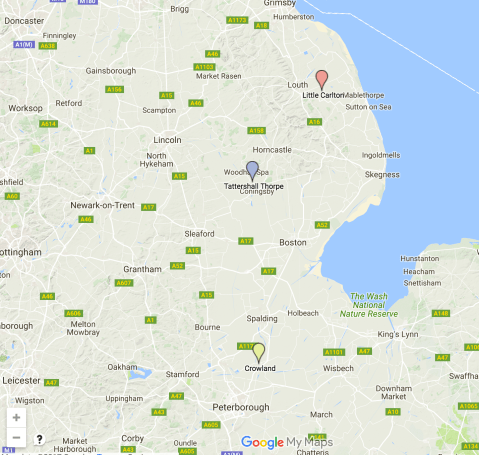
To me, what’s tantalizing about the Lincolnshire island is that it was on the border of the early medieval fenland—an area described by the 8th-century monk Felix as dense and undulating, “now consisting of marshes, now of bogs, sometimes of black waters overhung by fog, sometimes studded with wooded islands and traversed by the windings of tortuous streams” (Ch XXIV, trans Colgrave p 87). In such an aqueous environment, sound would have travelled well, staying close to the cool, dense air hovering over the waters.

Dark skies over fenlands, near Spilsby, Lincolnshire. Taken by Lutmans on Flickr, (CC BY 2.0).
In his prose hagiography, the Life of St Guthlac, Felix enshrines certain sounds in the wetland ecology of Guthlac’s surroundings. He does so most explicitly at the landing-place, where visitors must “sound a signal” to alert the hermit that they’ve arrived. But what was this signal, and why would Felix bother to emphasize such a mundane practice of alerting your host when you’ve arrived?
In monastic communities bells were used to sound the Daily Office to calling each member together in prayer. As moderns, we should remember that these bells—frequent, sonic interventions of everyday life—were rung on the shore, or in a church, or on monastic grounds rather than from the larger towers of later belfries (an exception to this is the early Irish Round Tower). These small hand-held bells “of hammered sheets or cast metal” which “would presumably have clanged or tinkled, rather than tolled sonorously across a distance” (Resounding Community, 103).
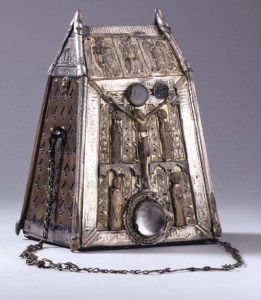
Bell-shrine; bronze and silver parcel-gilt; made for the bell of St Conall Cael.
Bells were spiritual and supernatural; they could cleanse or curse, and were kept by clerics and lay people alike. They were sometimes sworn on, as if they were relics. Sometimes, they were made into relics. For more about early Irish bell traditions, click here and or/ here.
In Northwest Europe in the Early Middle Ages, Christopher Loveluck describes David Hinton’s work on a seventh-century smith found buried alone, “next to the marshland and waterways to the sea, with his tools, a bell, a fine seax and a silk-wrapped amulet” and therefore “emblematic of the transition from such ‘outsider’ itinerant artisan/merchants to the vibrant artisan and trading communities of the emporia ports.” Still, the“[p]erception of threat from itinerant ‘outsiders’ is emphasized in the late seventh-century Anglo-Saxon law code of Wihtred, by the obligation on non-local travellers and foreigners to announce themselves with bells or horns, prior to leaving principal roads or trackways to approach settlements.”
For seventh-and eighth century people, then, bells sounded time, community, and stillness as well as place, strangeness, and travel. In either instance, the aural intrusion always betokened a human presence. And of course, these were some of the only sounds that weren’t naturally occurring; this might have been as close as they got to manmade sound pollution.
For Guthlac, sound was especially important because he could not see far from his earthen hermitage. Not having any need for a bell to sound the Daily Office, he nevertheless depended on some kind of signal for approaching visitors.
In one episode, distraught parents bring their once-possessed, now very ill son to Crowland in the hope that he might be cured. This is quite different from an earlier visitation from Wilfrid and Æthelbald, whom Guthlac knew personally, and with whom he might have traded correspondence. To me, this is the real test of Guthlac’s grace: will he help the neediest? The stranger? The tired, desperate parents? Does the bell, or whatever the signal is, proclaim their sameness or difference?
We can sense the tension in the passage, during their sounding of the signal and speaking to Guthlac:
Then when the sun rose in its splendour, they approached the landing place of this said island, and having struck the signal they begged for a talk with the great man. But he, as was his custom, burning with the flame of most excellent charity, presented himself before them…[and after hearing their story] immediately seized the hand of the tormented boy and led him into his oratory, and there prayed on bended knees, fasting continually for three days…(XLI, Colgrave 131).
The parents had expected to wait; they expected to plead on their son’s behalf. They expected a struggle to be heard. But—and I do think that’s a rather crucial autem in the Latin—Guthlac is eager to listen; the sound on the shore was enough.
What’s more, his cure is a series of utterances. He prays (aloud) for three days straight, without pausing to eat. And after ritually rinsing and breathing the “breath of healing” on the boy, the child, “like one who is brought into port out of the billows and the boiling waves, heaved some deep sighs from the depth of his bosom and realized that he had been restored to health”(XLI, Colgrave 131).
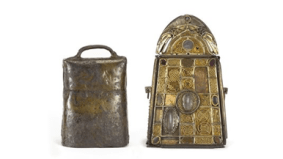
Image from National Museum of Ireland
I’m a mom to an asthmatic toddler, so I find myself quite moved by this scene. I can imagine ringing the bell—the thing I might have heard in church, or had in my home; the signal by which monks were called to prayer and children inside for curfew—to make a sound for myself. I can imagine traveling with my husband to a strange place far from home, not knowing what would happen. I can imagine using something everyday for something extraordinary, and having the sound of my arrival echo with anticipation. If I were this mother, I would hear it bounce off the marshes and off the low-lying islands. The dawn would be warming the air above us, amplifying our sound. And I would be standing there, with my child wrapped in my arms, hoping to see someone emerge from a barrow; a man of God whose isolation and entrenchment was supposed to be part of his holiness.
The sound travels outwards to the hermitage and back with the hermit—the echo of her hope, meeting them at the shore. This is a soundscape and a landscape in which time seems still on the shore, but sped through in the oratory. Felix joins both sites, and both temporalities, with the simile of the boy as one rescued from shipwreck catching his breath as he washes ashore. The image recalls the sound of their arrival, and that first bell still seems to ring through this narrative of hope against all odds.
Wouldn’t it be great to hear that again?
—
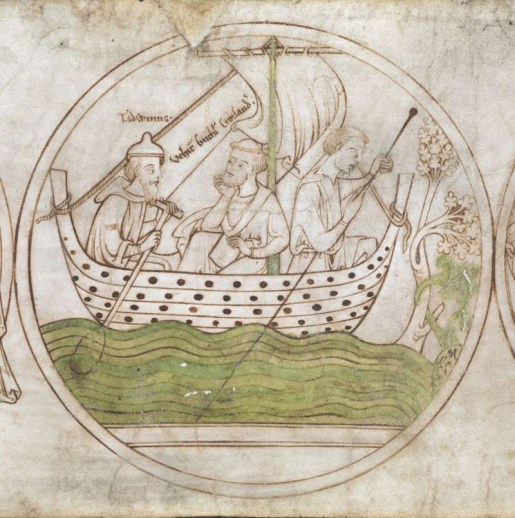
Featured Image: Guthlac sailing to Crowland with Tatwin. © British Library, Harley Roll, Y 6, roundel 4, from Medieval Histories.com
—
Rebecca Shores is a Ph.D. candidate in English Literature at the University of North Carolina at Chapel Hill. Her Dissertation is entitled “Bringing Saints to the Sea: Ships in Old English and Anglo-Latin Hagiography.”
—
REWIND!…If you liked this post, you may also dig:
(Sound)Walking Through Smithfield Square in Dublin–Linda O’Keeffe
Wayback Sound Machine: Sound Through Time, Space, and Place–Maile Colbert
Audiotactility & the Medieval Soundscape of Parchment–Michelle M. Sauer
Share this:

SO! Amplifies: The Women in L.A. Punk Archive

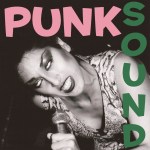
Image of Alice Bag used with her permission (thank you!)
For full intro and part one of the series click here. For part two, click here.
Our Punk Sound series implicitly argues that sound studies methodologies are better suited to understanding how punk works sonically than existing journalistic and academic conversations about musical genre, chord progressions, and/or genealogies of bands. Alexandra Vasquez’s sound-oriented work on Cuban music, for example, in Listening in Detail (2014) opens up necessary conversations about the “flashes, moments, sounds” in music that bear its meanings and its colonial, raced, classed, and gendered histories in material ways people can hear and feel. While retaining the specificity of Vasquez’s argument and the specific sonic archive bringing it forth, we too insist on “an ethical and intellectual obligation to the question: what do the musicians sound like” (12) and how do folks identifying with and through these musical sounds hear them?
In this series, we invite you to amplify varied historicized “details” of punk sound–its chunk-chunk-chunk skapunk riffs, screams, growls, group chants, driving rhythms, honking saxophones–hearing/feeling/touching these sounds in richly varied locations, times, places, and perspectives: as a pulsing bead of condensation dripping down the wall of The Smell in Downtown LA (#savethesmell), a drummer making her own time on tour, a drunk sitting too near the amp at a backyard party, a queer teenager in their bedroom being yelled at to “turn it down” and “act like a lady[or a man]”. . .and on and on. Today’s entry is done in conjunction with our SO! Amplifies series. . .a highly-curated, rolling mini-post series by which we editors hip you to cultural makers and organizations doing work we really really dig. Today we round out our series on punk by diving into Alice Bag’s archive of interviews with women in the L.A. punk scene.
SOUND!
–Aaron SO! (Sounding Out!) + Jenny SO! (Sounding Out!)
—
 Alice Bag’s Women in L.A. Punk Archives is a treasure trove of interviews that she has conducted with women in the L.A. punk scene. Today we share with you some of the most insightful and exciting gems we curated from her amazing archive. We encourage you to hear punk in a new way, and to explore her archive for yourself.
***

Joanna Spock Dean of Backstage Pass
[Excerpt from an interview on March, 2006]
Alice Bag: What was/is your contribution to the punk community?
Joanna Spock Dean: I was the ONLY bass player in Backstage Pass (since we had more rotating members than any other band!), and one of the singer/songwriters. I always felt that Backstage Pass was one of the first bands to come out of the Punk Scene (which we loved, of course), and move into the poppier “New Wave” scene, and others were able to do the same thing. We also were unapologetic groupies, and I think the fact that that was a big part of us, and that we were proud of it, added to the band.
AB: Do you have any funny or interesting stories to share?
Joanna Spock Dean: I [do] remember one. We were in San Francisco @ The Mabuhay, maybe opening for Devo, so it was a 2 night thing. The first night, I remember walking into the bathroom, and finding some girl harassing Genny and Marina, and I told her to leave them alone. (I was always the ‘leader’ in that way.) The second night, the same girl comes up to the stage, and starts screaming and throwing popcorn at me as we’re onstage – hey, she probably just thought it was a ‘punk’ thing to do. Well, I exploded. I threw off my bass, jumped off the stage and started pummeling her – I heard that Rod came flying over the top of his drum kit to pull me off. I do remember that as I’m swinging away, she’s yelling “I changed my mind, I changed my mind, I love your band, I love your band!”

Penelope Houston of The Avengers
[Excerpt from an interview on June 2007]
AB:What was/is your contribution to the punk community?
Penelope Houston: As singer/lyricist of the Avengers in the late 70’s and now again leading the band to play all over the world.
PH: What was the role of women in the early punk scene?
Penelope Houston: It seems like there was more freedom and fewer rules in 1977-79, before hardcore took over the mantle of punk. The early scene embraced all comers, be they female, gay, non-white or even older. There was no dress code. Women were pioneers along with everyone else involved. I noticed no separation. I knew women who were musicians, bookers, managers, photographers, visual artists, film makers, journalists, label owners… etc.
***

Heather Valiant Ferguson, scenemaker, style breaker and hairdresser
[Excerpt from an interview on November 2009]
AB:What was/is your contribution to the punk community?
Heather Valiant Ferguson: My name is Heather Ferguson. I now go by the first name Valiant. I became a hairdresser at age 18 and went to San Francisco to work for Vidal Sassoon. I did a lot of free hair for a lot of fellow punks, including The Avengers, The Cramps, The Ramones, Belinda C., The Dils, etc.
AB: Which artist, band concert and/or show had the most impact on your life?
Heather Valiant Ferguson: I lived in Pacific Heights on Broadway and Laguna. It was around 1974-75. The punk rock scene was making its way over the waves from Britain through Sassoon’s. At the very place in time that punk rock came streaming into consciousness, I was hanging around with some very dark and edgy people like myself. We used to go to a place in North Beach and I would smoke Black Sobranie cigarettes in a short black cigarette holder. I wore black clothing and Hats with veils. I was dating a musician lead singer named Bobby Death. He kept crooning on about this band from New York called ‘THE RAMONES’. One night he got tickets to their SF debut at a place called the Savoy Tivoli. Well, he disappeared somewhere, but I didn’t care…..WOW, who were these brilliant moptops?? Beat on the brat, with a baseball bat, Oh yeah, yeah, oohh oohhh. I was in my version of Nirvana. I felt something growing inside me and it wasn’t a baby. It was life alright, but they just knocked me out. Bobby appeared near the end to tell me that he had invited them over to my apartment for champagne and coke……WOW again. We stayed up all night long telling each other all our stories. That was too kewl for words. So that show was me plugging into me, plugging into the whole synchronistic punk scene. I moved to Hollywood a year later to work at Sassoon’s there.
***

Connie Clarksville, a Blackette with Black Randy & The Metro Squad
[Excerpt from an interview on January 2008]
AB: What was/is your contribution to the punk community?
Connie Clarksville: When I moved to Hollywood from Orange County in 1972, I moved into the Canterbury Apartments. Back then it was full of drag queens and pimps and gays. I was a Bowie fan and liked the array of different people. After (the era of) Glitter, Rodney Bingenheimer’s (English Disco), The Real Don Steele Show, The Rainbow, disco and hanging out on Sunset, I went to a show at Larchmont Hall one Saturday afternoon. There was a show at the Whiskey where I met Bruce (Moreland) who would become Bruce Barf (of the Weirdos) later. He told me how this guy named Brendan Mullen was wanting to open a place where we could hang out and bands would play in the basement of the Pussycat Theatre on Hollywood Blvd. He took me over to this mess of a basement where I met Brendan. I loved his accent and had a crush on him rite away. He said he’s naming this mess “the Masque.” I loved the idea and wanted to do something to help so I hauled trash out of the basement. There was a small, cut-out room in the middle, so when bands started playing and people started showing up, I decided to ask Brendan if I could sell sodas. He said, “sure, Clarksville.” Nobody had ever called me that before, so I got used to the name. Brendan was really the only person who called me that.
Soon after, I met this girl named Sheila (Edwards) and we needed a place to stay. I was going to beauty school and had a little money and with her half (of the rent), I suggested the Canterbury. It was close to school and the Masque. Soon after, many bands moved in: The Bags, Nicky Beat from the Weirdos, The Germs, Geza X lived across the hall… so, so many to list.
***

Debbie Dub, scenemaker, producer, management and booking
[Excerpt from an interview on July 2011]
AB: What was/is your contribution to the punk community?
Debbie Dub: In the early days, I think just being part of the scene was a huge contribution. There weren’t very many of us, and we were just making it up as we went along – which means I helped create it! Producing the first Negative Trend single is one of my lasting contributions. The record is famous now but we couldn’t give them away at the time.
AB: Are there any punk women from the early scene that you feel have not been adequately recognized?
Debbie Dub: All of them. I don’t think you can underestimate the impact that women had on the scene. We were equals in standing but also in numbers. When you think about it, for a phenomenon filled with such over the top aggressive music and attitude, it’s amazing how many women played vital roles in shaping the scene. I don’t think there had ever been anything like it before in terms of women’s participation.
Read More in the Women in L.A. Punk Archives
–
All text and images reproduced with the permission of Alice Bag. The featured image is of the Bags Live at the Mabuhay Gardens, January 1978.
–
Alice Bag is a punk rock singer, musician, author, educator and feminist archivist. Alice was lead singer and co-founder of The Bags, one of the first wave of punk bands to form in the mid-1970’s in Los Angeles, CA.
Her first book, Violence Girl, East LA Rage to Hollywood Stage is the story of her upbringing in East LA, her eventual migration to Hollywood and the euphoria and aftermath of the first punk wave. Violence Girl reveals how domestic abuse fueled her desire for female empowerment and sheds a new perspective on the origin of hardcore, a style most often associated with white suburban males.
An outspoken activist, feminist and a self-proclaimed troublemaker, Alice has remained active in music since the late 1970’s and published her second book, Pipe Bomb for the Soul in 2015. The ongoing influence of Alice’s style can be seen in the traveling Smithsonian exhibition, American Sabor. She has been profiled by PBS, AARP and has been an invited speaker at colleges including Stanford, Wellesley and USC. Her memoir, Violence Girl, is now required reading in gender and musicology courses throughout the country.
—
REWIND!…If you liked this post, you may also dig:
SO! Amplifies: Ian Rawes and the London Sound Survey–Ian Rawes
SO! Amplifies: Cities and Memory–Stuart Fowkes
SO! Amplifies: #hearmyhome and the Soundscapes of the Everyday–Cassie J. Brownell and Jon M. Wargo
Share this:


Current Top Posts





April 2021

January 2020

November 2019

October 2019

August 2019

April 2014

November 2017

March 2015

December 2017

October 2015
 Sounding Out!
Recent Comments