
Acousmatic Surveillance and Big Data


It’s an all too familiar movie trope. A bug hidden in a flower jar. A figure in shadows crouched listening at a door. The tape recording that no one knew existed, revealed at the most decisive of moments. Even the abrupt disconnection of a phone call manages to arouse the suspicion that we are never as alone as we may think. And although surveillance derives its meaning the latin “vigilare” (to watch) and French “sur-“ (over), its deep connotations of listening have all but obliterated that distinction.
Moving on from cybernetic games to modes of surveillance that work through composition and patterns. Here, Robin James challenges us to consider the unfamiliar resonances produced by our IP addresses, search histories, credit trails, and Facebook posts. How does the NSA transform our data footprints into the sweet, sweet, music of surveillance? Shhhhhhhh! Let’s listen in. . . -AT
—
Kate Crawford has argued that there’s a “big metaphor gap in how we describe algorithmic filtering.” Specifically, its “emergent qualities” are particularly difficult to capture. This process, algorithmic dataveillance, finds and tracks dynamic patterns of relationships amongst otherwise unrelated material. I think that acoustics can fill the metaphor gap Crawford identifies. Because of its focus on identifying emergent patterns within a structure of data, rather than its cause or source, algorithmic dataveillance isn’t panoptic, but acousmatic. Algorithmic dataveillance is acousmatic because it does not observe identifiable subjects, but ambient data environments, and it “listens” for harmonics to emerge as variously-combined data points fall into and out of phase/statistical correlation.
Dataveillance defines the form of surveillance that saturates our consumer information society. As this promotional Intel video explains, big data transcends the limits of human perception and cognition – it sees connections we cannot. And, as is the case with all superpowers, this is both a blessing and a curse. Although I appreciate emails from my local supermarket that remind me when my favorite bottle of wine is on sale, data profiling can have much more drastic and far-reaching effects. As Frank Pasquale has argued, big data can determine access to important resources like jobs and housing, often in ways that reinforce and deepen social inequities. Dataveillance is an increasingly prominent and powerful tool that determines many of our social relationships.
The term dataveillance was coined in 1988 by Roger Clarke, and refers to “the systematic use of personal data systems in the investigation or monitoring of the actions or communications of one or more persons.” In this context, the person is the object of surveillance and data is the medium through which that surveillance occurs. Writing 20 years later, Michael Zimmer identifies a phase-shift in dataveillance that coincides with the increased popularity and dominance of “user-generated and user-driven Web technologies” (2008). These technologies, found today in big social media, “represent a new and powerful ‘infrastructure of dataveillance,’ which brings about a new kind of panoptic gaze of both users’ online and even their offline activities” (Zimmer 2007). Metadataveillance and algorithmic filtering, however, are not variations on panopticism, but practices modeled—both historically/technologically and metaphorically—on acoustics.
In 2013, Edward Snowden’s infamous leaks revealed the nuts and bolts of the National Security Administration’s massive dataveillance program. They were collecting data records that, according to the Washington Post, included “e-mails, attachments, address books, calendars, files stored in the cloud, text or audio or video chats and ‘metadata’ that identify the locations, devices used and other information about a target.” The most enduringly controversial aspect of NSA dataveillance programs has been the bulk collection of Americans’ data and metadata—in other words, the “big data”-veillance programs.

Borrowed from thierry ehrmann @Flickr CC BY.
Instead of intercepting only the communications of known suspects, this big dataveillance collects everything from everyone and mines that data for patterns of suspicious behavior; patterns that are consistent with what algorithms have identified as, say, “terrorism.” As Cory Doctorow writes in BoingBoing, “Since the start of the Snowden story in 2013, the NSA has stressed that while it may intercept nearly every Internet user’s communications, it only ‘targets’ a small fraction of those, whose traffic patterns reveal some basis for suspicion.” “Suspicion,” here, is an emergent property of the dataset, a pattern or signal that becomes legible when you filter communication (meta)data through algorithms designed to hear that signal amidst all the noise.
Hearing a signal from amidst the noise, however, is not sufficient to consider surveillance acousmatic. “Panoptic” modes of listening and hearing, though epitomized by the universal and internalized gaze of the guards in the tower, might also be understood as the universal and internalized ear of the confessor. This is the ear that, for example, listens for conformity between bodily and vocal gender presentation. It is also the ear of audio scrobbling, which, as Calum Marsh has argued, is a confessional, panoptic music listening practice.
Therefore, when President Obama argued that “nobody is listening to your telephone calls,” he was correct. But only insofar as nobody (human or AI) is “listening” in the panoptic sense. The NSA does not listen for the “confessions” of already-identified subjects. For example, this court order to Verizon doesn’t demand recordings of the audio content of the calls, just the metadata. Again, the Washington Post explains:
The data doesn’t include the speech in a phone call or words in an email, but includes almost everything else, including the model of the phone and the “to” and “from” lines in emails. By tracing metadata, investigators can pinpoint a suspect’s location to specific floors of buildings. They can electronically map a person’s contacts, and their contacts’ contacts.
NSA dataveillance listens acousmatically because it hears the patterns of relationships that emerge from various combinations of data—e.g., which people talk and/or meet where and with what regularity. Instead of listening to identifiable subjects, the NSA identifies and tracks emergent properties that are statistically similar to already-identified patterns of “suspicious” behavior. Legally, the NSA is not required to identify a specific subject to surveil; instead they listen for patterns in the ambience. This type of observation is “acousmatic” in the sound studies sense because the sounds/patterns don’t come from one identifiable cause; they are the emergent properties of an aggregate.

Borrowed from david @Flickr CC BY-NC.
Acousmatic listening is a particularly appropriate metaphor for NSA-style dataveillance because the emergent properties (or patterns) of metadata are comparable to harmonics or partials of sound, the resonant frequencies that emerge from a specific combination of primary tones and overtones. If data is like a sound’s primary tone, metadata is its overtones. When two or more tones sound simultaneously, harmonics emerge whhen overtones vibrate with and against one another. In Western music theory, something sounds dissonant and/or out of tune when the harmonics don’t vibrate synchronously or proportionally. Similarly, tones that are perfectly in tune sometimes create a consonant harmonic. The NSA is listening for harmonics. They seek metadata that statistically correlates to a pattern (such as “terrorism”), or is suspiciously out of correlation with a pattern (such as US “citizenship”). Instead of listening to identifiable sources of data, the NSA listens for correlations among data.
Both panopticism and acousmaticism are technologies that incite behavior and compel people to act in certain ways. However, they both use different methods, which, in turn, incite different behavioral outcomes. Panopticism maximizes efficiency and productivity by compelling conformity to a standard or norm. According to Michel Foucault, the outcome of panoptic surveillance is a society where everyone synchs to an “obligatory rhythm imposed from the outside” (151-2), such as the rhythmic divisions of the clock (150). In other words, panopticism transforms people into interchangeable cogs in an industrial machine. Methodologically, panopticism demands self-monitoring. Foucault emphasizes that panopticism functions most efficiently when the gaze is internalized, when one “assumes responsibility for the constraints of power” and “makes them play…upon himself” (202). Panopticism requires individuals to synchronize themselves with established compulsory patterns.
Acousmaticism, on the other hand, aims for dynamic attunement between subjects and institutions, an attunement that is monitored and maintained by a third party (in this example, the algorithm). For example, Facebook’s News Feed algorithm facilitates the mutual adaptation of norms to subjects and subjects to norms. Facebook doesn’t care what you like; instead it seeks to transform your online behavior into a form of efficient digital labor. In order to do this, Facebook must adjust, in part, to you. Methodologically, this dynamic attunement is not a practice of internalization, but unlike Foucault’s panopticon, big dataveillance leverages outsourcing and distribution. There is so much data that no one individual—indeed, no one computer—can process it efficiently and intelligibly. The work of dataveillance is distributed across populations, networks, and institutions, and the surveilled “subject” emerges from that work (for example, Rob Horning’s concept of the “data self”). Acousmaticism tunes into the rhythmic patterns that synch up with and amplify its cycles of social, political, and economic reproduction.

Sonic Boom! Borrowed from NASA’s Goddard Space Flight Center @Flickr CC BY.
Unlike panopticism, which uses disciplinary techniques to eliminate noise, acousmaticism uses biopolitical techniques to allow profitable signals to emerge as clearly and frictionlessly as possible amid all the noise (for more on the relation between sound and biopolitics, see my previous SO! essay). Acousmaticism and panopticism are analytically discrete, yet applied in concert. For example, certain tiers of the North Carolina state employee’s health plan require so-called “obese” and tobacco-using members to commit to weight-loss and smoking-cessation programs. If these members are to remain eligible for their selected level of coverage, they must track and report their program-related activities (such as exercise). People who exhibit patterns of behavior that are statistically risky and unprofitable for the insurance company are subject to extra layers of surveillance and discipline. Here, acousmatic techniques regulate the distribution and intensity of panoptic surveillance. To use Nathan Jurgenson’s turn of phrase, acousmaticism determines “for whom” the panoptic gaze matters. To be clear, acousmaticism does not replace panopticism; my claim is more modest. Acousmaticism is an accurate and productive metaphor for theorizing both the aims and methods of big dataveillance, which is, itself, one instrument in today’s broader surveillance ensemble.
–
Featured image “Big Brother 13/365” by Dennis Skley CC BY-ND.
–
Robin James is Associate Professor of Philosophy at UNC Charlotte. She is author of two books: Resilience & Melancholy: pop music, feminism, and neoliberalism will be published by Zer0 books this fall, and The Conjectural Body: gender, race and the philosophy of music was published by Lexington Books in 2010. Her work on feminism, race, contemporary continental philosophy, pop music, and sound studies has appeared in The New Inquiry, Hypatia, differences, Contemporary Aesthetics, and the Journal of Popular Music Studies. She is also a digital sound artist and musician. She blogs at its-her-factory.com and is a regular contributor to Cyborgology.
—
 REWIND!…If you liked this post, check out:
“Cremation of the senses in friendly fire”: on sound and biopolitics (via KMFDM & World War Z)–Robin James
The Dark Side of Game Audio: The Sounds of Mimetic Control and Affective Conditioning–Aaron Trammell
Listening to Whisperers: Performance, ASMR Community, and Fetish on YouTube–Joshua Hudelson
Share this:

“Cremation of senses in friendly fire”: on sound and biopolitics (via KMFDM & World War Z)

There’s a 20-year gap in chronology between KMFDM’s 1993 song “A Drug Against War” and Marc Forster’s 2013 film World War Z, but sonically and ideologically they’re very, very similar. They contain the same kinds of sounds–machine guns, military orders barked over radios, buzzing crowds–and they use these sounds in the same way: to build sonic intensity past its breaking point (a “sonic bombardment brighter than sunlight,” as the KFMDM lyrics say). Their sonic similarity is evidence of neoliberalism’s intensification in the 20 years between them: what was once avant-garde opposition is later mainstream norm.
The songs’ sonic similarity reveals the central role of sound in contemporary biopolitics. By listening closely to “A Drug Against War” and the soundscape of World War Z—a film in which Brad Pitt saves humanity from a zombie apocalypse by giving all survivors a terminal disease—I show sound as more than a privileged aesthetic domain; sound actually provides the epistemic background and the concrete mechanisms for organizing society. Just as vision and “the gaze” are the ideological and technological foundation of panopticism, sound is the ideological and technological foundation of contemporary biopolitics. Much more is at stake in this post than just a song and a film: it takes on how—and why—society is organized as it is. It’s also about a particular understanding of “the sonic”: sound as dynamic patterning.
Because “A Drug Against War” lays out, in fairly elementary form, this “biopolitical” sonic vocabulary, it makes sense to start there. But before I do that, I will briefly define what I understand as ‘biopolitics.’
Life
Like “neoliberalism,” “biopolitics” is a trendy concept whose precise meaning can get lost in loose usage. By “biopolitics,” I mean both an ideology of health and vitality and a political strategy whose medium is “life.” “Life,” here, isn’t individual health, wellness, or existence; it’s the ongoing vitality of the segment of society that counts as “society” tout court (e.g., in white supremacy, that segment would be whites). Biopolitics manages society like a living thing; for example, we often talk about the “health” of the economy, or use metrics such as obesity rates to compare different countries.

“Overweight or obese population OECD 2010” by ZH8000 – Own work. Licensed under Creative Commons Attribution-Share Alike 3.0 via Wikimedia Commons
As Foucault explains in Society Must Be Defended, biopolitics’ “basic function is to improve life, to prolong its duration, to improve its chances, to avoid accidents, and to compensate for failings” (254). But to do that, power sometimes has to kill. Pruning my raspberry bush causes more berries to sprout, for example, just as weightlifting tears all my muscle fibers so they’ll rebuild in bigger, stronger shape. Killing off the weak is a positive investment in society’s overall strength. Again, Foucault:
The fact that the other dies does not mean simply that I live in the sense that his death guarantees my safety; the death of the other, the death of the bad race, of the inferior race (or the degenerate, or the abnormal) is something that will make life in general healthier: healthier and purer. (Society, 255).
Hitler’s “final solution” is an obvious example of this biopolitical approach to killing, but this practice also informs many contemporary US policies and practices. In the US, black people as a population have significantly higher mortality rates than any other race, for example. Following Foucault, we could say it’s in the interest of white supremacist society to maintain a high mortality rate among black populations because this makes white supremacist society “healthier.” The key point here is this: biopolitics promotes and administers life by generalizing and naturalizing what Foucault calls “the relationship of war: ‘In order to live, you must destroy your enemies’” (Society 256). Biopolitical warfare is precisely what is waged in both “A Drug Against War” and World War Z, and sound emerges as a weapon of choice.
“Kill Everything”
 In its original context, KMFDM’s “A Drug Against War” used sound to counter US Presidents Reagan and Bush 1’s War on Drugs/”New World Order” thinking. Indeed, in 1993, it was hard not to hear it as a response to 1991’s Operation Desert Storm, the US’s first military action as the ‘winner’ of the Cold War. It performs, in music, the “cremation of senses in friendly fire,” that its lyrics describe. It burns out our hearing, realizing through sound the sort of “creative destruction” or “shock doctrine” that characterizes neoliberalism more generally. In this rather Nietzschean model, the only way to make something “stronger than ever, ever before” is to first kill it. Death is the means to the most vibrant life.
The lyric–“stronger than ever, ever before”–is the first line of the chorus. At the end of every verse, there’s a short drumroll that leads into it. As S. Alexander Reed notes in Assimilate: A Critical History of Industrial Music, “clocking in at “322 bpm, the eighth-note snare fills at the end of the verses fire at about eleven rounds every second–the same rate as an AK-47” (29). This flourish foreshadows the gesture that, in the song’s bridge [after the second chorus, around 2:17 in the video above], musically “cremates” our senses in friendly fire–in this case, in the rapid fire of percussion. This rapid-fire percussion is one of the sonic elements that “Drug” shares with WWZ; in fact, the chorus uses what is likely (according to Reed) a machine gun sample. The machine gun effect mimics blast drumming. As Ronald Bogue explains in Deleuze’s Wake, blast drumming is a “tactic of accelerating meters to the point of collapse,” produced through the “cut-time alteration of downbeat kick drum and offbeat snare, the accent being heard on the offbeat but felt on the downbeat” (99). “A Drug Against War”’s AK-47 rolls actually accelerate to the point of auditory collapse, i.e. to the point at which humans generally can’t distinguish individual sonic events—the aural equivalent of seeing 24 frames per second as one continuous image. The AK-47’s rolls of ‘friendly’ fire cremate our sense of hearing.
The song’s chorus includes many other sonic elements shared by World War Z: doppler effects (such as the sounds of dropping bombs or planes buzzing the ground), rubble being moved around, military orders barked over radio. In the bridge several kinds of crowd noises are introduced: first, guitars buzz like a swarm of insects; then, a call-and-response in which singer Sascha Koneitzko echoes the chorus (which reverses the usual order in which the chorus echoes the individual leader); finally, a chaotic rabble of voices builds in intensity and leads into the sense-cremating climax.

KMFDM, 1 October 2009, Image by Flickr User Axel Taferner
An extended and intensified version of the “friendly fire” at the end of each verse, “A Drug Against War”’s climax builds to a peak by layering two full measures of AK-47-style drumroll on top of sounds of rabble, evoking the image of the military firing on an unruly crowd. This roll barrels towards the point of auditory collapse–if it got much faster, we’d be unable to distinguish individual rhythmic events, and hear a constant buzz (like in the beginning of the bridge), not a series of eighth notes. The roll’s forward momentum intensifies musical energy to an apex, culminating on the downbeat of the next measure in a florid lead guitar solo.
Describing the song as “sonic bombardment brighter than sunlight,” the lyrics confirm the music (and vice versa). The song overdrives sound until it sublimates into something else–if sunlight is more intense radiation than even soundwaves, here soundwaves amplify to a state more powerful than that. Cremating our senses in friendly fire, KMFDM channels soundwaves into a revolutionary drug, a drug against war. The band presents cleansing fire meant to purify us of disease: just as a fever kills pathogens in our bodies, the song burns our senses to kill a pathogenic ideology. Overdriving mainstream musical taste, offering something so brutal, so damaging to one’s ears, that only the avant-garde can survive, KMFDM inoculates the population against its most reactionary, war-mongering elements. “A Drug Against War” uses sound to perform a biopolitical operation, one that emerges as the basis of WWZ’s plot: the only way to save the human race from the zombies is to kill everything.
WWZ
 World War Z intensifies the horrors of contemporary biopolitics to the point that the only way to recuperate from them is to intensify them even further: in order for humanity to survive, everyone must be dead on their feet. In the sci-fi universe of World War Z, zombies aren’t eating for their survival, but for the survival of the virus they carry; they only attack and eat prey that are also (and primarily) attractive hosts for the virus. Pitt’s character, protagonist Gerry Lane, discovers that terminally ill humans aren’t legible to the zombies as human—that is, as attractive hosts. They won’t live long enough and/or are too weak to aggressively spread the virus. So, he decides the best way to protect humans from zombies and the virus they carry is to infect the remaining people with a deadly but ultimately curable illness. The World Health Organization develops a vaccine that allows healthy people to ‘pass’ as terminal cases. The only difference remaining in the post apocalyptic world of WWZ is between the quasi-dead and the walking dead. Death is the drug against WWZ.
The film doesn’t represent or express the biopolitical recuperation of death visually, but sonically: to make audiences feel what the narrative depicts, WWZ cremates their sense of hearing–often with more amplified and complex versions of the same sonic elements mobilized in “Drug.” Doppler effects, crowd noises, machine guns, military orders barked over radio bombards the film’s audience as sonic “friendly fire.” Though the film’s soundtrack doesn’t actually blow out its audience’s ears (what lawsuits!), it repeatedly simulates sonic cremation; the tinitus-y buzzing one hears after auditory trauma–what one hears in lieu of hearing—functions as a constant refrain. Narratively climactic moments are composed, cinematically, as sonic overdrive. The massive car crash as everyone tries to evacuate NYC in the beginning of the film, the moment when Pitt’s character thinks he may have been infected atop the NJ apartment building, the plane crash outside the Cardiff WHO office–each of these events culminates in tinitus-y ringing. As physical and psychological trauma overwhelms the characters, the film pretends to inflict overwhelming—cremating—auditory trauma on its audience.
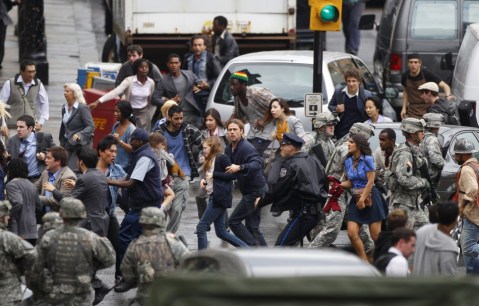
WWZ Screen Capture
In the WWZ universe, sound is destructive; it unleashes the zombie horde. At 49:00, a soldier says: “remember these things are drawn to sound…there’s only one way we’re getting you on that plane, and that’s quiet.” In a scene set in Jerusalem, excessive sound turns something miraculously positive—a Muslim girl and a Jewish girl leading a mixed crowd in song, a mini Arab-Israeli peace accord—Into a massacre. The sound attracts the zombie horde, leading them to swarm and overrun Jerusalem’s walls. Similarly, at the film’s end, Pitt’s character empties a soda machine so the cascade of cans will attract zombies away from the doors he needs to enter. By this point, Pitt’s character has injected himself with a deadly disease, effectively killing himself in order to preserve himself from zombification. The cascade of cans aesthetically represents this narrative point and hearkens back to KMFDM. The cans drop out of the machine at an increasingly rapid rate, mimicking “Drug”’s intensification of percussion events to and/or past the limit of human hearing. Just as Pitt’s character has crashed his body, the cascade of cans crashes our hearing.
The climax presents a narrative and the auditory convergence on the same biopolitical idea: kill everything, because then the best will bounce back, phoenix-like, from that sensory cremation, stronger than ever. Zombies can’t rebound from death, but still-living humans sure can (via immunization). Like a sonic bombardment brighter and more radiant than sunlight, this anti-zombie camouflage tactic phase-shifts death into exceptionally lively life. Just as the muted, tinitus-y moments in the film make the subsequent scenes feel comparatively more sonically rich and dynamic, intentional and carefully managed mass extinction ultimately makes the living more vibrant.
Sound & Biopolitics
Such vibrancy–that is, what Julian Henriques dubs “the dynamics of [the] periodic motion of vibrations” in Sounding Bodies: Reggae Sound Systems, Performance Techniques, and Ways of Knowing (265)–is what “life” and “sound,” as they are conceived by and function in contemporary biopolitics, have in common. “Sound,” according to Henriques is “a particular kind of periodic motion, variation and change” (247). Sound waves are dynamic patterns of intensities (pressure); they move through matter and respond in turn, both to that movement itself and the secondary sound waves (harmonics) that movement produces. WWZ treats this notion of periodic motion, variation, and change as the conceptual basis for the ideally biopolitical “life.” At around 20:00, when Pitt’s character attempts to convince the Latino family sheltering him to leave their apartment with him, he says “movement is life…Moviemento es vida.” Sedentary fortresses protect no one from zombies–we see this repeatedly in the film. The only way to survive is by rapidly adjusting to new conditions. The dynamism of adaptive flows—the ability to bounce back and recuperate (like an echoing pressure wave), to dynamically recombine (like both harmonizing frequencies and like a virus), to find signal in noise–this dynamism is life. Because it adapts to new challenges, because it moves, varies, and changes, life can bounce back from total annihilation, stronger than ever before. Only life lived like sound can be properly and sufficiently resilient. In WWZ, the zombie virus is a eugenic tool that weeds out insufficiently “sonic” life, life that is too static to respond to capitalist and biopolitical mandates for calculable motion, variation, and change.

WWZ Shooting in Glasgow, Scotland, Image by Flickr User Gerry McKay
When read through “Drug,” WWZ illustrates the epistemic and ontological importance of sound to contemporary biopolitics. We think “life” works like we think sound works. Because “life” is the object and the mechanism of biopolitical government, power works on and through us sonically. If we want to analyze, critique, and fight the institutions, structures, and practices that put power to work for white supremacy, cis/het patriarchy, and all other forms of domination, then we need to start thinking and working sonically, too.
Some theorists, such as Elizabeth Grosz and Adriana Cavarero incorrectly think this move to sound and voice is itself revolutionary and counter-hegemonic. Just as the critique posed in 1993’s “Drug” has been co-opted by 2013’s WWZ, white feminist theory’s sonic counter-modernities are the medium of biopolitical white supremacist patriarchy. When we think and work sonically, we’re working with the master’s tools; to bring down the master’s house, we have to use them critically and strategically.
—
Featured Image by Flickr User crisper fayltrash
__
Robin James is Associate Professor of Philosophy at UNC Charlotte. She is author of two books: Resilience & Melancholy: pop music, feminism, and neoliberalism will be published by Zer0 books this fall, and The Conjectural Body: gender, race and the philosophy of music was published by Lexington Books in 2010. Her work on feminism, race, contemporary continental philosophy, pop music, and sound studies has appeared in The New Inquiry, Hypatia, differences, Contemporary Aesthetics, and the Journal of Popular Music Studies. She is also a digital sound artist and musician. She blogs at its-her-factory.com and is a regular contributor to Cyborgology.
—
REWIND!…If you liked this post, check out:
Queer Timbres, Queered Elegy: Diamanda Galás’s The Plague Mass and the First Wave of the AIDS Crisis–Airek Beauchamp
On Sound and Pleasure: Meditations on the Human Voice–Yvon Bonenfant
The Noises of Finance— N. Adriana Knouf
Share this:


Current Top Posts





April 2021

January 2020

November 2019

October 2019

August 2019

April 2014

November 2017

March 2015

December 2017

October 2015
 Sounding Out!
Recent Comments