
The Sounds of Writing and Learning
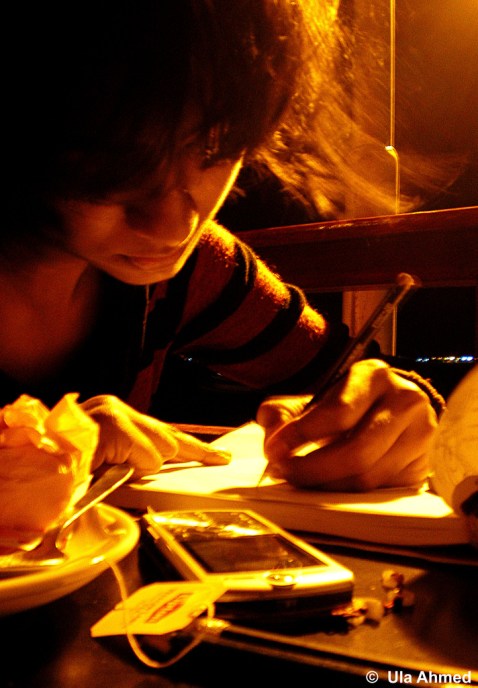
“I Rise,” image by Flickr User Lua Ahmed
 Welcome back to Sounding Out!‘s fall forum on “Sound and Pedagogy.” Developed to explore the relationship between sound and learning, this forum blends the thinking of our editors (Liana Silva), recruited guests (D. Travers Scott), and one of the winners of our recent Call For Posts (Jentery Sayers) to explore how listening impacts the writing process, the teachable moment, and the syllabus (and vice versa). Sharpen your pencils and/or give your typing fingers a good stretch, because today’s offering from Liana Silva asks you to exercise unexpected writing muscles—your tongue, mouth, and vocal chords! If you need a make-up assignment for last week’s post by D. Travers Scott, “Listening to #Occupy in the Classroom,” click here. And don’t forget–same class time next week!–JSA, Editor in Chief
—
When I started this draft, I sat in an office that is not mine, next to an old, whirring Westclox Dialite electric clock. When I write, I usually pop my headphones on and blast my “Writing” playlist on my iPhone. But that day, I was soothed by the sounds of a whirring clock and the air blasting through a wall vent. On another day I worked on my draft while I listened to sports talk radio, a big part of my morning routine; toward the end of the drafting process I shared this blog post with a writing consultant at the writing center where I work.
For me, writing is always connected to sound. Sound inhabits the spaces where I write, either in the shape of music, typing, or voices. These sounds are never far from my writing process. In fact, something so small as the typing of the keys as I write this can be construed as the soundtrack to my writing. Sounding Out! guest blogger and author Bridget Hoida made a case for how sound is part of the texts she reads and how she weaves sound into her own writing; in my case, I can’t think of writing without sound. It is my soundtrack/sound track, in the sense that sound is the track on which I lay my writing process, like the lines of a ruled notebook.

“Writing” by Flickr user Sara Bjork through Creative Commons License 2.0
However, many writers and educators tend to think of writing as a solitary, lonely, quiet endeavor. Last month, at an orientation where I was speaking, I heard someone refer to the “quiet activity of writing and learning.” As I looked around me, stunned, I seemed to be the only one surprised at this assertion. Although it is a common perception, as a writer, ex-writing instructor, and writing center staff member, this did not make sense to me. Both writing and learning, for me, are connected to sound, whether it was listening to music while editing or talking through my ideas during class discussion. If, to paraphrase Brandon Labelle in Acoustic Territories, places configure what sounds are deemed acceptable and unacceptable, do schools configure what are the appropriate sounds of learning?
I approach this question about the sounds of learning from the angle of my work at the writing center. For years I taught first-year composition, and later on in my academic career I started working at a writing center (where I currently work). At the Writing Center we are surrounded by the sounds of writing and learning. A student will walk up to one of our locations and meet with a writing consultant. They will discuss the writer’s text, in the case that the writer brings a draft. After this discussion, the consultant will read the writer’s text aloud, a practice that all of our writing consultants must adhere to. The text comes alive in the voice of the consultant; the good, the bad, and the ugly are made audible, concrete in the voice of the consultant. This enables both parties to hear the paper, but also to listen to the paper and, ideally, understand it better. The consultant and the writer then talk about what works, what doesn’t, what could be improved and how. Learning takes place through a conversation. It is at the writing center where writing and learning processes are no longer silent, but actually audible. The value for a writer of hearing their text aloud is not new; in 1967, Anthony Tovatt and Ebert L. Miller did a three-year study on how listening to their writing helped high-school writers improve their writing skills (see their article “The Sound of Writing”). My concern is how learning is coded as silent, despite evidence to the contrary.
I wonder about the implications of describing learning and writing as “silent” processes. Silence already has a domesticating quality: it is portrayed as the gift of the restrainted, of the eloquent, of the elite, and these ideas about silence and noise emerge from 19th Century ideas about respectability and middle-class values. As an example, American Studies scholar Daniel Cavicchi states in Listening and Longing: Music Lovers in the Age of Barnum,
“In fact, both in the North and the South, genteel people came to value the quietude of silent reading and listening as a form of ‘productive leisure’ that was explicitly opposed to the louder, more boisterous pastimes of slaves, immigrants, and workers. As in the days when European colonists and Native Americans struggled to understand each other’s sound worlds, aural difference now became a wedge that allowed those in power to place certain groups figuratively and literally outside the bounds of civilization” (52).
Ideas of learning as silent are coded in broader discourse about silence (or, to use Cavicchi’s more accurate terminology, quietude) and noise, about what is respectable and what is not. How do these common connotations of quietude as dignified and sound/noise as unpleasant carry over to descriptions of of learning? It is possible that society has normalized these types of learning (the “silent” types) as of a higher caliber, and schools have a major part in that: reading to one’s self in silence, filling out exam questions and not talking to anyone, typing in a quiet library at a computer station fit for only one. Even a lecture dignifies silence, in a way: students sit down and listen to what the teacher/professor has to say while they digest, quietly, what is being taught. In opposition, the sounds of learning can be associated to the sounds of collaboration, as it were: tutorials, consultations, advising sessions, discussion sections, movie viewings. Although talking is not the only way to collaborate in order to learn, I posit that these learning activities that are usually non-silent fall prey to hierarchies of sound and silence.

“Student Writing 2002,” Image by Flickr user Cybrarian
These hierarchies of sound and silence tell listeners that the learning activities that are portrayed as silent are more legitimate than those that are portrayed as boisterous, loud, animated—in other words, activities producing sound. In fact, it doesn’t have to be either/or. The fact that they are set in opposition to themselves is in itself problematic. Isolating sound from the learning process acts as a way of emphasizing writing as the main component of learning. Jody Shipka in “Sound Engineering: Toward a Theory of Multimodal Soundness” describes how writing is thought of as “the communication of scholarly, rigorous arguments or ideas, something more often associated with the production of linear, print-based texts” (356, emphasis in original). This dichotomy of rigor versus play can be portrayed also as visuality (as embodied in the written text) versus aurality. The writing center can be the place where these ideas are tested, in the sense that it is a location of collaborative learning where some learn by writing and others benefit from talk while others benefit from listening. By privileging quietude and solitude as the ideal modes for learning, we miss out on other important vehicles for learning, such as sound.
***
If I started this post with the whirring of the Westclox clock, how did I end this post? I ended it on a busy Sunday evening, while my daughter slept and my boyfriend talked on the phone. I finished it with the chatter of the air conditioner, the clack of baseballs against bats coming from the living room, and the click click click of the keyboard keeping me company.
—
Liana M. Silva is co-founder and Managing Editor of Sounding Out!
Share this:

Sounding Out! Podcast Episode #7: Celebrate World Listening Day with the World Listening Project
“Press to listen” by SO! Managing Editor Liana Silva
To commemorate this year’s World Listening Day, Sounding Out! is hosting a forum on different aspects of listening throughout the month of July. (For the full introduction to Sounding Out!‘s Forum on Listening click here. To read the previous posts in the series, click here.) Our latest podcast introduces readers to an organization that is close to the hearts of the folks at SO!: the World Listening Project, creators of World Listening Day. WLP has chosen July 18th as the day to celebrate listening practices and create awareness of the soundscapes we inhabit because it is also the birthday of composer and acoustic ecologist R. Murray Schafer. You may be familiar with Schafer for his World Soundscape Project. After you listen to our podcast, you can go to worldlisteningproject.org to find out more about how others are celebrating World Listening Week/Day, sign up to show your support, and discover ways you can celebrate WLD. You can also follow along on Twitter via the hashtag #wld2012, follow the official Twitter account of the World Listening Project @world_listening, or like their Facebook page. Listening will never be the same… –-LMS
CLICK HERE TO DOWNLOAD: Celebrate World Listening Day with the World Listening Project
SUBSCRIBE TO THE SERIES VIA ITUNES
Please note, if you have trouble seeing the audio player above, you may need to upgrade your browser to its newest version.
Co-Authors of this podcast:
Eric Leonardson is a Chicago-based audio artist and teacher. He has devoted a majority of his professional career to unorthodox approaches to sound and its instrumentation with a broad understanding of texture, atmosphere and microtones. He is President of the World Forum for Acoustic Ecology and founder of the Midwest Society for Acoustic Ecology, and Executive Director of the World Listening Project. Leonardson is an Adjunct Associate Professor in the Department of Sound at The School of the Art Institute of Chicago.
Monica Ryan is an instructor and audio artist from Chicago. Currently
her work explores spatialized sound recording and playback techniques
along with interactive sound environments. She teaches in several
institutions in Chicago, including The School of the Art Institute of
Chicago and Columbia College.
Tom Haigh is a British post production sound mixer, composer, and
phonography enthusiast, now residing in Chicago. As a staff engineer
at ARU Chicago, he works with clients in advertising, media, and
independent film.
List of interviewees, in order of appearance:
Dan Godston http://www.worldlisteningproject.org
Jed Speare http://www.studiosoto.org/
Darren Copeland http://www.naisa.ca/
Glenn Weyant http://www.sonicanta.com/
Pauline Oliveros http://deeplistening.org
Viv Corringham http://www.vivcorringham.org/shadow-walks
Hildegard Westerkamp http://www.sfu.ca/~westerka/index.html
Jay Needham http://www.jayneedham.net/
Bryan Pijanowski http://soundscapenetwork.org/
Bernie Krause http://www.wildsanctuary.com/
Udo Noll http://aporee.org/maps/projects/worldlisteningday2012
Luis Antero http://ocoleccionadordesons.yolasite.com/2012.php
Share this:


Current Top Posts





April 2021

January 2020

November 2019

October 2019

August 2019

April 2014

November 2017

March 2015

December 2017

October 2015
 Sounding Out!
Recent Comments