
Brasil Ao Vivo!: The Sonic Pleasures of Liveness in Brazilian Popular Culture

 After a rockin’ (and seriously informative) series of podcasts from Leonard J. Paul, a Drrty South banger dropped by SO! Regular Regina Bradley, a screamtastic meditation from Yvon Bonenfant, and a heaping plate of food sounds from Steph Ceraso, our summer Sound and Pleasure series gets even louder with Kaleb Goldschmidt‘s work on live events in Brazil. Brasil Ao Vivo! –-JS, Editor-in-Chief
—
Brazilians pray, cheer and celebrate in public and often in close physical proximity to each other. From the nearly 3 million people that flocked to Copacabana Beach to hear Pope Francis lead a mass in 2013 to the huge crowds that regularly turn out for concerts at Maracanã stadium, Brazilians earn their global reputation for large-scale public events. Of course there is Carnival in Rio de Janeiro and Salvador; the largest LGBT Pride Parade in the world held in São Paulo; and then there is football.
The relationship between large-scale public events and sound hit home as the country reacted to the national team’s humiliating loss to Germany in the semi-final round of the 2014 FIFA World Cup. The world witnessed a different kind of public outpouring as the Brazilian public mourned. Within hours of the initial shock at the lopsided score, images of Brazilian football fans weeping and screaming in the stadium and on the street became a humorous meme with music and sound playing a prominent role. By the next day, most Brazilian football observers were taking pleasure in the public spectacle of weeping fans. With the abundance of images featuring hysteria, videos mocking the intensity of the crying went viral with dramatic musical scores. One observer proclaimed : “essa capacidade de rir de nós mesmos é uma das melhores qualidades”; the capacity to laugh at ourselves is one of our best qualities. That Brazilians express all varieties of emotions and annual passages together in public for everyone to witness, even when they border on campy excess, allow for everyone to feel the pleasures of community and the power of public performance.

“Abschlussfeier Maracana Fifa WM 2014” by Flickr user Marco Verch, CC BY 2.0
All of this led me to believe that such a public culture has an effect on the aesthetics of what performance studies scholar Philip Auslander calls “liveness” in recorded music and related viral media. Auslander argues that the appeal of liveness for television broadcasts, concerts, and other stage performances allows audiences to feel the immediacy of the moment even if the presence of mediation, such as screens and on-air censorship, is obvious. The international spectacle of Brazilians emoting en masse, then, has a direct relationship with Brazilian sonic aesthetics. Nowhere, I argue, is this more prominent than in the (sometimes viral) popularity of live recordings.
That immediacy Auslander speaks of spreads to many aspects of Brazilian popular culture, including the popularity of concert DVDs and albums which are regularly listed among the most popular domestic recordings. In fact, concert records tend to be more popular than the studio albums that inspire the tour. These live albums often carry the designations Ao Vivo, live or MTV Acústico (the equivalent of the Unplugged albums popular in the United States), and they are often recorded in such a way so as to feature the interaction of the crowds. In place of the draw for authenticity (a value that permeates the MTV Unplugged recordings) is the love for community, and for experiencing big emotions together no matter how obviously they are mediated through cameras, microphones and other technology. Through the example of the continued popularity of live albums in Brazil, there is an opening for a different theorization for sounding liveness; in place of celebrating canonic performances and virtuosity, the valorization of liveness in Brazil reinforces the importance of crowds and the so-called “popular classes” at the root of the politicized singer-songwriter genre MPB or Música Popular Brasileira.
The pleasure and preference for live recordings also extends to social media. For meme chasers, a good example of this is Michel Teló’s 2011 hit “Ai Se Eu Te Pego.” The song and video were recorded ao vivo before a crowd dominated by young women. A close listen reveals that sounds of Teló’s female audience members are just as important as his voice even if his voice is only slightly louder in the mix. There is barely a moment in the recording when the audience stops making itself heard; the engineering revels in their presence. This is especially obvious during the opening seconds of the track when Teló and his audience sing “Nossa, nossa / assim você me mata / Ai, se eu te pego / Ai, ai, se eu te pego” [Wow, wow / you kill me like that / Ah, if I could get you / ah, ah, if I could get you] in unison at nearly the same volume in the mix. When the accordion and electric bass (crucial instruments for the song’s forró style) finally enter over the screaming audience, there is a noticeable break in the tension set up by the audience and Teló singing together. Their cries, like those in other live recordings, illustrate Teló’s appeal to the crowd in that moment while also allowing other listeners to imagine themselves there.
Teló’s song went viral (as of this writing, the official version currently has nearly 580 million views on YouTube and over 72 million plays on Spotify), with alternate video versions teaching the song’s dance steps and others highlighting global football stars dancing and singing along to the song. At one point Neymar, the national team’s biggest hope for World Cup victory, sang with Teló in front of a crowd. In general, Teló’s live songs easily outpace his studio recordings in terms of virality, and, I would argue, that a major part of the appeal of “Ai Se Eu Te Pego” is its provenance in a concert setting. It is just as important that the screaming throngs of women are audible as it is for those dance steps to be easy and recognizable. The liveness of the recording is so important, in fact, that the screaming audience appears as sampled snippets in the Pitbull remix. In its viral form, Teló’s song united the popularity of live spectacle with Brazil’s enthusiasm for other live events, merging concert goers with football fans.
The popularity of Teló’s live song is not an isolated incident. Look, for example, at record sales figures for all time. Two are live albums by artists who do not appear elsewhere on the list. Other albums that have sold more than 2 million copies in Brazil alone are by Roberto Carlos (Acústico MTV) and the teen pop/rock duo Sandy and Júnior (As Quatro Estações ao Vivo and Era Uma Vez… Ao Vivo). In 2011, five of the top ten albums in Brazil fit the ao vivo mode with little regard to genre: MPB stars Caetano Veloso and Maria Gadú are there alongside sertanejo artists Paula Fernandes and Luan Santana. In 2012, three of the top 20 best-sellers were live albums. Meanwhile, DVDs of concerts in Brazil continue to be strong sellers. Thus, the communal pleasure palpable on-screen translates to that experienced in the home.

“Eric Clapton – Unplugged” by Flickr user Ian Alexander Martin, CC BY-NC-ND 2.0
Compare this with the status of live records in the United States in the last few years where they have rarely seen any chart success. If anything, liveness continues in YouTube clips and Spotify Sessions but not in physical sales and downloads. This is probably because live albums for U.S. based artists are embedded with different values having to do with the rock authenticity rather than communal pleasure. These performances demonstrate the chops of the musician and valorize the concerts (and tours) as events. The double live albums from the 1970s such as as Frampton Comes Alive, Lynyrd Skynyrd’s One More From The Road, and Kiss Alive! hold a prized place in the classic rock canon, often as much for extended guitar solos rather as the screaming throngs of fans. In the late ‘80s and early ’90s live albums, especially MTV Unplugged, re-inscribed a love of liveness through acoustic instruments and songs that reached back into the roots of American popular music. Eric Clapton’s Unplugged (1992) even topped the Billboard album charts and won 6 Grammy awards including Album of the Year while other records such as Nirvana’s MTV Unplugged in New York and U2’s Rattle and Hum were multi-platinum hits. While there is the occasional top-40 live single, these songs are the exception to a genre of that has has moved liveness to YouTube rather than streaming and MP3 markets.
SO! contributor Osvaldo Oyola has noted there is a tension between the efforts recording engineers often go through to make studio recordings sound as immediate as possible, and those that call attention to the recording process. Live records replace the need to sound polished with the need to sound spontaneous, often reveling in mistakes and banter. That immediacy is something I enjoy when listening to live recordings and it has a parallel for many people who participate in the reception of major events in real time through social media.
In Brazil, audiences enjoy the immense power of participation in live events. As part of a larger work in progress I’m particularly fascinated by how this power and pleasure is mediated through the sonic experience of recordings and viral social media. Whether they are sharing tears over an international football loss or singing along to “Ai Se Eu Te Pego” Brazilians extend Auslander’s liveness by prolonging and replaying the immediacy of the crowds to experience that shared sonic moment, again and again.
—
—
Featured image: Adapted from “Gloria” by Flickr user Lourenço Fabrino, CC BY-NC-SA 2.0
—
 REWIND! . . .If you liked this post, you may also dig:
Sound-politics in São Paulo, Brazil— Leonardo Cardoso
Calling Out To (Anti)Liveness: Recording and the Question of Presence–Osvaldo Oyola
Hello, Americans: Orson Welles, Latin America, and the Sounds of the “Good Neighbor“– Tom McEnaney
Share this:

The Musical Flow of Shane Carruth’s Upstream Color
Welcome back to Sculpting the Film Soundtrack, SO!‘s new series on changing notions about how sound works in recent film and in recent film theory, edited by Katherine Spring.
Two weeks ago, Benjamin Wright started things off with a fascinating study of Hans Zimmer, a highly influential composer whose film scoring borders on engineering — or whose engineering borders on music — in many major Hollywood releases. This week we turn to the opposite end of the spectrum to a seemingly smaller film, Shane Carruth’s Upstream Color (2013), which has made quite a few waves among sound studies scholars and fans of sound design, even earning a Special Jury Prize for sound at Sundance.
To unpack the many mysteries of the film and explore its place in the field of contemporary filmmaking, we are happy to welcome musicologist and film scholar Danijela Kulezic-Wilson of University College Cork. Listen to Upstream Color through her ears (it’s currently available to stream on Netflix) and perhaps you’ll get a sense of why you’ll have to listen to it two or three more times. At least.
–nv
—

When Shane Carruth’s film Upstream Color was released in 2013, critics described it in various ways—as a body horror film, a sci-fi thriller, a love story, and an art-house head-scratcher—but they all agreed that it was a film “not quite like any other”. And while the film’s cryptic imagery and non-linear editing account for most of the “what the hell?” reactions (see here for example), I argue that the reason for its distinctively hypnotic effect is Carruth’s musical approach to the film’s form: he organizes the images and sounds according to principles of music, including the use of repetition, rhythmic structuring, and antiphony.
The resulting musicality of Upstream Color may not be surprising given that Carruth composed most of the score, and also, as Jonathan Romney has noted in Sight & Sound, Carruth has said on many occasions that he was hoping “people would watch this film repeatedly, as they might listen to a favourite album” (52). In this sense, Carruth (whose DIY toolkit also includes writing, directing, acting, producing, cinematography, and editing) joins the ranks of filmmakers such as Darren Aronofsky and Joe Wright who recognize that, despite our culture’s obsession with the cinematic and narrative aspects of “visual” media, music governs film’s deepest foundations.
Upstream Color is a story about a woman, Kris, who is kidnapped by a drug manufacturer (referred to in the credits as Thief) and contaminated with a worm that keeps her in a trance-like state during which the Thief strips her of all her savings. Kris is subsequently dewormed by a character known as the Sampler, who transfers the parasite into a pig that maintains a physical and/or metaphorical connection to Kris. Kris later meets and falls in love with Jeff who, we eventually discover, has been a victim of the same ordeal. Although the bizarreness of the plot has encouraged numerous interpretations, the film’s unconventional audio-visual language suggests that its story of two people who share supressed memories of the same traumatic experience shouldn’t be taken at face value, but rather serves as a metaphor for existential anxiety resulting from being influenced by unknown forces.
Such an interpretation owes as much to the film’s disregard for the rules of classical storytelling as it does to a formally innovative soundtrack, one that uses musicality as an overarching organizing principle. The fact that Carruth wrote the score and script simultaneously (discussed in the video below) indicates the extent to which music was from the beginning considered an integral part of the film’s expressive language. More importantly, as the scenes discussed in this post suggest, the musical logic of the film is even more pervasive than the style, role, and placement of the actual score.
Whereas feature films traditionally assign a central role to speech, allowing music and sound effects supporting roles only, Upstream Color breaks down the conventional soundtrack hierarchy, often reversing the roles of each constitutive element. For example, hardly any information in the film that could be considered vital to understanding the story is communicated through speech. Instead, images, sound, music, and editing–for which Carruth shares the credit with fellow indie director David Lowery–are the principal elements that create the atmosphere, convey the sense of the protagonists’ brokenness, and reveal the connection between the characters. At the same time, characters’ conversations are either muted or their speech is blended with music in such a way that we’re encouraged to focus on body language or mise-en-scène rather than trying to discern every spoken word. For example, Jeff and Kris’s flirting with one another during their initial meetings (at roughly 0.44.20-0.47.00 of the film) is conveyed primarily through gestures, glances, and fragmentary editing rather than speech, which would be more typical for this sort of narrative situation.
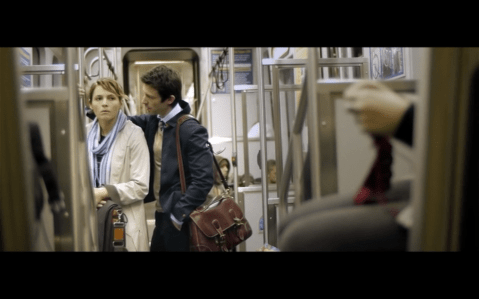
Further undercutting the significance of speech across the film is how the film has been edited to resemble the flow of music. For example, non-linear jumps in the narrative are often arranged in such a way as to create syncopated audio-visual rhymes. This technique is particularly obvious in the montage sequence in which Kris and Jeff argue over the ownership of their memories, whose similarities suggest that they were implanted during the characters’ kidnappings. In this sequence, both the passing of time and the recurrence of the characters’ argument is conveyed through the repetition of images that become visual refrains: Kris and Jeff lying on a bed, watching birds flying above trees, touching each other. Some of these can be seen in the film’s official trailer:
The scene’s images and sounds are fragmented into a non-linear assembly of pieces of the same conversation the characters had at different times and places, like the verses and the choruses of a song. Importantly, the assemblage is also patterned, with phrases like “we should go on a trip” and “where should we go?” heard in refrain. The first time we hear Jeff say “we should go on a trip” and suggesting that they go “somewhere bright”, his words are played in sync with the image of him and Kris lying on the bed. The following few shots, accompanied only by music, symbolize the “honeymoon” phase of their relationship: the couple kiss, hold hands, and walk with their hands around each other’s waists. A shift in mood is marked by the repetition of the dialogue, with Jeff again saying “we should go on a trip” – only this time, the phrase plays asynchronously over a shot of Jeff and Kris pushing a table into the house that they have moved into together. Finally, the frustration that starts infiltrating the characters’ increasingly heated arguments is alleviated by the repetition of the sentence “They could be starlings.” As it is spoken three times by both characters in an antiphonic exchange, the phrase emphasizes the underlying strength of their connection and gives the scene a rhythmic balance. Across this sequence, the musical organization of audio-visual refrains prompts us to recognize the psychic connection between Kris and Jeff, and even to begin to guess the sinister reason for it.
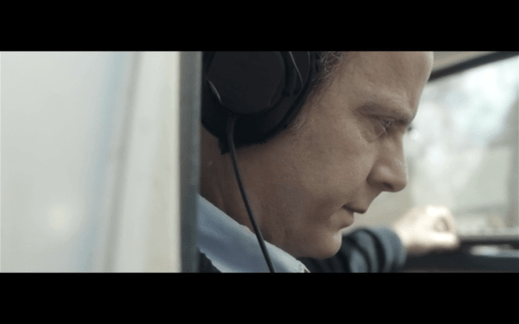
While speech in Upstream Color is often stripped of its traditional role as a principal source of information, sound and music are given important narrative functions, illuminating hidden connections between the characters. In one of the most memorable scenes, the Sampler is revealed to be not only a pig farmer but also a field recordist and sound artist who symbolizes the hidden source of everything that affects Kris and Jeff from afar. As we hear the sounds of the Sampler’s outdoor recordings merge with and emulate the sounds made and heard by Kris and Jeff at home and at work, the soundtrack eloquently establishes the connection between all three characters while also giving us a look “behind the scenes” of Kris’s and Jeff’s lives and suggesting how they are influenced from a distance.
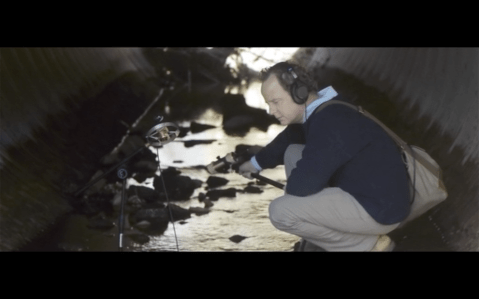
In one sense, by calling attention to the very act of recording sound, the scene exposes how films are constructed, offering a reflexive glimpse into usually hidden processes of production. The implied idea here–that the visible and audible are products of not-so-obvious processes of formation–refers not only to the medium of film but also to the complexity of the inner workings of someone’s mind. Thus the Sampler’s role, his actions, and his relationship to Kris, Jeff, and other infected victims can be interpreted as a metaphor for the subconscious programming – all the familial, social and cultural influences – that all of us are exposed to from an early age. The Sampler is portrayed symbolically as the Creator, a force whose actions affect the protagonists’ lives without them knowing it. The fact that he is simultaneously represented as a sound artist establishes sound-making and musicality as the film’s primary creative principles.
Considering Carruth’s very deliberate departure from the conventions of even what David Bordwell calls “intensified” storytelling, it is fair to say that Upstream Color is a film that weakens the strong narrative role traditionally given to oral language. What is intensified here are the musical and sensuous qualities of the audio-visual material and a mode of perception that encourages absorption of the subtext (in other words, the metaphorical meaning of the film) as well as the text.
The musical organization of film form and soundtrack is no longer limited to independent projects such as Carruth’s Upstream Color. As I have shown elsewhere, musicality has become an extremely influential principle in contemporary cinema, acting as an inspiration and model for editing, camera movement, movement within a scene and sound design. Some of the most interesting results of a musical approach to film include Aronofsky’s “hip hop montage” in Pi (1998) and Requiem for a Dream (2000), Jim Jarmusch’s rhythmically structured film poems (The Limits of Control, 2009; Only Lovers Left Alive, 2013), the interchangeable use of musique concrète and environmental sound in Gus Van Sant’s Death Trilogy and films by Peter Strickland (Katalin Varga, 2009; Berberian Sound Studio, 2012); the choreographed mise-en-scène in Joe Wright’s Anna Karenina (2012); the musicalization of language in Harmony Korine’s Spring Breakers (2012); and the foregrounding of musical material over intelligible speech in Drake Doremus’s Breathe In (2013). Given the breadth of these examples, it’s no exaggeration to say that filmmakers’ growing affinity for a musical approach to film is changing the landscape of contemporary cinema.
—
Danijela Kulezic-Wilson teaches film music, film sound, and comparative arts at University College Cork. Her research interests include approaches to film that emphasize its inherent musical properties, the use of musique concrète and silence in film, the musicality of sound design, and musical aspects of the plays of Samuel Beckett. Danijela’s publications include essays on film rhythm, musical and film time, the musical use of silence in film, Darren Aronofsky’s Pi, P.T. Anderson’s Magnolia, Peter Strickland’s Katalin Varga, Gus Van Sant’s Death Trilogy, Prokofiev’s music for Eisenstein’s films, and Jim Jarmusch’s Dead Man. She has also worked as a music editor on documentaries, short films, and television.
—
All images taken from the film.
—
REWIND! . . .If you liked this post, you may also dig:
Sound Designing Motherhood: Irene Lusztig & Maile Colbert Open The Motherhood Archives— Maile Colbert
Play it Again (and Again), Sam: The Tape Recorder in Film (Part One on Noir)— Jennifer Stoever
Animal Renderings: The Library of Natural Sounds— Jonathan Skinner
Share this:




Current Top Posts





April 2021

January 2020

November 2019

October 2019

August 2019

April 2014

November 2017

March 2015

December 2017

October 2015
 Sounding Out!
Recent Comments