
Could I Be Chicana Without Carlos Santana?
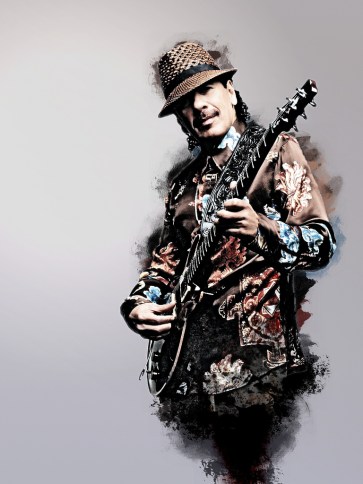
Carlos Santana by Flickr User Momez
This may be a given but I have to ask: Why is the music of Carlos Santana considered “Chicano music?”
It’s true; I am a fan. And as a fan I never question why I love the music, but I often ask myself what it is specifically about the music that resonates so strongly with me. I could say that I love Santana because I love a soulful electric guitar voice, because I admire the musicianship of the band, because I feel the “sabor” they sing about, because I’ve always loved Santana. But these parts surely do not make up a satisfying the “whole.” There is something else, something about listening to the music that amplifies my sense of identification as a Chicana with other Chicanos and Mexicanos. This happens whether I’m among raza, in the various communities I call home, or whether I find myself feeling very far from Aztlán. I’ve witnessed the effect of the music – maybe you have too – when it comes on the car radio, at backyard family BBQs, and friend’s living room dance floors, the music gets your body up and connects you to your Chicano roots.
In this sense, Santana is forever part of the Chicano sounded imaginary. For Chicanos, identifying with the music of Carlos Santana may have a special meaning that has something to do with a particular Chicano/Mexicano subjectivity. Yet, for non-Chicanos, Santana still retains their quintessential American rock band status. Most of their airplay is on mainstream radio, rarely if ever on Spanish-language stations. So Santana can be thought of at once as “puro” Chicano or “classic rock,” except that Santana is a straight up fusion band. This is why I have to ask, is the music of Santana “Chicano” music? And I further wonder, could I be Chicana without Carlos Santana?
…Oye Como Va…
Before the Rob Thomas & Carlos Santana collaboration on the Grammy award-winning album Supernatural (1999), before the phenomenon of “Smooth,” there was classic Santana. The Santana that produced the self-titled debut album Santana (1969) and Abraxas (1970). The songs “Evil Ways,” “Black Magic Woman,” and “Oye Como Va” from these two albums are on constant rotation on “classic rock” stations well after forty years since they first hit the airwaves. Even if you’re not a fan or a music connoisseur, when listening to “Oye Como Va” or “Smooth” it’s easy to recognize a distinct “Latin-ness” about them. In part, this is because of the fusion of Spanish and English lyrics with rock, blues, jazz, and Afro-Latin musical styles. For Chicanos, this particular fusion of language and sound might also resonate as something familiar and close to home – if sound can be a home. A quick search on YouTube will lead you to the classic 2000 Grammy Awards Performance of “Smooth” and a wealth of competing claims by fans (and foes) in the comments section.
Fan 1: “SANTANA ERES LO MAXIMO, VIVA MEXICO!!!!!!!!”
Fan 2: “Salsa baby, Oye Como Va is universal, Carlos is the man!!!!”
This was a special and high-profile performance so these comments are exceptionally spirited. But, YouTube is full of spontaneous, impassioned, (albeit anonymous) examples like this on any given day. I highlight these two as sort of placeholders for the idea of how sound and music mighty carry significant meaning toward subject formation in an everyday sense. These fans claim Santana both for Mexico and for the world, respectively, because they reflect a strong sense of Mexican or Chicano pride. In the first comment, the very enthusiastic fan could easily be a Mexico City native, maybe a Chicano wanting to sound like a Chilango –“ERES LO MAXIMO” is not a Chicano Spanish expression. The second fan’s comment is all in English and could be Chicano simply based on that—but those are slightly secondary points. As I suggested earlier, for Chicanos, Santana’s music has the potential to reflect a sense of ethnic history and culture. Sound can be a home. After all, the first comment claims Santana’s music for a whole country with “VIVA MEXICO!” helping to affirm the feeling that this fan and Carlos are Mexicanos together, across time and place.
When I was studying music in college, Mexican, Chicano, or Latino music was not part of the curriculum. Instead, in my private piano lessons, I would gravitate toward pieces by Spanish or Latin American composers as a sort of “good enough” way to stay in touch with my latinidad. This helped, but the fact is that Latin American art songs have much more in common with the Western musical canon than they do with my experiences and Chicana consciousness. In other words, it was a reach to identify with these composers solely because we shared a language. What would I miss in a too quick move to identify with the Latin-ness of Santana’s music this way? Would I hear only the Spanish spoken in the song? If so, then gaining a sense of my Chicana/o subjectivity by claiming “Oye Como Va” (for Aztlán?) relies on partially subsuming the specific Caribbean contexts and poetics of the song. Is this song originally Cuban, Puerto Rican? It’s really just a party song. “Oye como va, mi ritmo, bueno pa’ gozar, mulatta” Eso! Does it really matter now if Santana’s version has re-defined it for all time?
In a way, the second fan expresses a more complex desire: “Oye Como Va is universal.” Everyone knows that Carlos Santana is Mexican, some know that he is also an immigrant, and still others may have read that he grew up in Tijuana. As part of American rock music history, Santana’s roots are firmly planted in San Francisco and the Bay Area and it is well known that Santana played at the historic Woodstock Festival of 1969. Clearly, amongst other identities, Santana is a classic American rock band with long and wide appeal. But from the beginning, along with creative fusions of rock, jazz, blues, and salsa, it has been the distinctly Afro-Latino percussion core that defines their emblematic sound. And this is exactly how and why dwelling on these details in the sound of Santana matters. If Santana comes to mean or signify something like “pur0 Mexicano” or “pur0 Chicano” (in a brown pride or brown power sense) then that purity is already so productively and interestingly troubled because there is nothing remotely “pure” about Santana’s music.
Therefore, to identify with the music means confronting those complex fusions of language, race, and music that make up the Santana “sound.” To partly answer my earlier question, “Oye Como Va” is a composition by the renowned Puerto Rican timbalero and band leader Tito Puente, but the musical form, a basic cha-cha-cha, is Cuban. The song has other authors as well, that both Santana and Puente name. But ultimately, this song and indeed much of Santana’s music, comes in wake of much older histories of African diaspora, migration, colonization, artistry and spirituality.
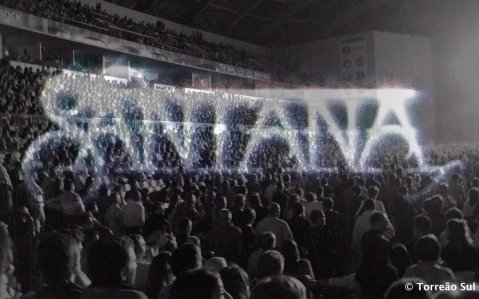
Santana fans. Image by Torreãu Sul.
…Sounding Home…
In a way, I’ve always felt that Santana’s music was making a black/brown connection, that racial boundaries were necessarily crossed or brought together because of the many histories that flow through the music. As a child of Mexican immigrant parents, I grew up listening to a wide repertoire of Afro-Latino music – elegant danzónes, romantic boleros, joyous cumbias, mad mambos, as well as more traditional Mexican music. Maybe that is also part of why listening to Santana reminds me of home. But this is perhaps too simple a response.
Santana’s music and popular image has been engaged in positive but also problematic ways in Chicana/o cultural production. Most recently, I noted this in a performance of the play New Fire, by Cherrie Moraga, in San Francisco. At a critical point in the drama, the evocative love song “Samba Pa’ Ti” is used to introduce a male character and a difficult, sexually violent scene. Moraga’s larger critique is of violent Chicano patriarchy and masculinity. The play is offered as a healing ceremony. But the association of this song, which features a famous guitar solo, with that specific scene is profoundly jarring. My sense was that Moraga selected Santana for the play’s soundscape it served as a shorthand for “Chicano.” Here, it was made to bear the history of violence of brown men against brown women and girls. This made it difficult for me to identify as a Chicana–queer and feminist–with Carlos Santana at that moment, and some time after. Surely this is also part of what “home” means.
Santana’s music interests me for these reasons, which go beyond the sounded Chicano imaginary in my headphones. What I find worthwhile in thinking further about Santana’s “sound” is how in the many acts of claiming Santana for oneself, one’s country, or one’s community, I can trace the way in which Chicano and Caribbean histories, both racialized and gendered, touch and cross in the music. That is, I see this as an invitation for the listener to reimagine notions of race, nation, gender, and sexuality even while dancing and singing along. In these ways, I see meaningful possibilities for imagining Chicana/o as a sounded subjectivity. I am certain that my sense of who I am, how I think, and how I walk in the world has been shaped by a life-long relationship with music and sound. And although being “Chicana” to me is not the same for anyone else, Santana’s music helps me to imagine a connection, a musical lineage I can trace and take part in. Santana is not my parent’s music. It’s not even my generation’s music. And, it’s not my only musical identity. But, even so, I couldn’t imagine being Chicana without Carlos Santana. Because when I listen, I do hear it, I hear how it all goes, together, and that is so, so good. “Give me your heart, make it real, or else forget about it!”
—
Wanda Alarcón is a PhD student in Ethnic Studies at UC Berkeley where her research involves reading Chicana and Caribbean “stories” together in a decolonial feminist vein. When she’s not living the glamorous grad student life she likes to make zines about po’try, learning new songs on her childhood piano, cooking for her loved ones, and exploring NorCal with her main squeeze. A native Los Angelena, she is beginning to appreciate thinking and writing about her beloved hometown from afar. Music helps bridge that distance. So do the trees and ocean breezes. She lives and loves kibbutz-style in Santa Cruz with her partner por vida, Cindy, their two sassy cats Lucy & Mona, and dear housemate, Ella.
Share this:

Norman Corwin: Radio at the Intersection of Art and Commerce
 Editor’s Note: Today, Shawn VanCour continues our summer series “Tune In to the Past,” which explores the life and legacy of radio broadcaster Norman Lewis Corwin, the “poet laureate of radio” who died last summer at the age of 101. Sounding Out!‘s three-part exploration of his legacy by radio scholars Neil Verma (June), VanCour (July), and Alex Russo (August) not only gives Corwin’s work new life (and critique), but also speaks to the growing vitality of radio studies itself. And now, a word from our sponsor, Shawn VanCour.–JSA
—
An experiment in radio is something nobody ever tries except strange people with a funny look. Good businessmen know better than to try experiments . . . . on account of you can’t play too safe when it comes to trying out new things.
–Unaired passage from script for “Radio Primer,” Twenty-Six by Corwin, May 4, 1941
The story of Norman Corwin is by now a familiar one: joining such illustrious figures as Irving Reis, William Robson, and Orson Welles, Corwin led a new generation of sound artists in developing pioneering techniques of radio drama that exploited the medium’s potential as a “theater of the mind” and inaugurated the celebrated “Golden Age” of network broadcasting. In death as in life, Corwin has been much praised for these contributions, and for his signature style so eloquently analyzed by Neil Verma in the opening volley of this SO! series.
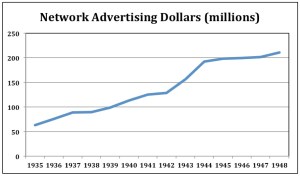
Advertising dollars spent on network radio programming from 1935-1948, based on data compiled in the 2002 edition of Christopher Sterling and John Kittross’s Stay Tuned: A History of American Broadcasting. Advertiser investment climbed sharply, spurred by a corresponding growth in network affiliates.
However, as Erik Barnouw notes in his preface to LeRoy Bannerman’s biography of this broadcasting legend, Corwin’s story is also bound up with a larger economic history of radio, unfolding during a period of intensified growth in and controversy surrounding commercial broadcasting. From Corwin’s first show for CBS in 1938 to his last network broadcast in 1947, the percentage of affiliated stations in the country grew from 52 to 97, while investment by commercial advertisers more than doubled. To answer critics of commercialism and give its network signs of distinction, CBS dramatically increased its public service commitments (what David Goodman refers to as “radio’s civic ambition”), investing heavily in “sustaining” (unsponsored) shows that gave producers like Corwin room for unprecedented aesthetic experimentation.
This second, institutional dimension of Corwin’s story warrants further consideration. Observing the Marxist adage that history is made by individuals not in conditions of their own making, I propose that assessing Corwin’s legacy for radio and sound studies demands we attend not only to the what of that legacy–the techniques Corwin pioneered and programs he produced–but also to its how and why: the institutional context that spawned and encouraged these aesthetic innovations. How, in other words, did commercial concerns at the structural level shape and enable the rise of the “Corwinesque” as a viable mode of sonic expression? What peculiar set of economic relations undergirded these grand experiments in twentieth century sound art, and what lessons might this period offer for understanding creativity and aesthetic innovation in subsequent eras such as our own?
Sounds of Commerce
Corwin’s 1941 play, “A Soliloquy to Balance the Budget,” opened with the sounds of an adding machine and voice of a “soliloquist” tabulating the cost of each musical note and on-air gag. Such is the secret soundtrack of every broadcast since commercial radio’s inception, as one of the past century’s largest and most successful industries dedicated to the business of packaging and selling sounds for corporate profit.
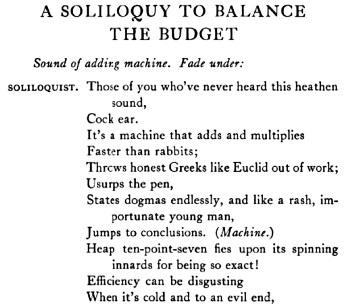
Excerpt from script for “A Soliloquy to Balance the Budget,” broadcast on CBS’s Twenty-Six by Corwin series, June 15, 1941.
Rather than seeing the flowering of the Corwinesque as a brief but “golden” reprieve from an otherwise dark history of commercial mediocrity, I propose we use the case of Corwin to critically interrogate presumed antipathies between opposing forces of art and commerce in U.S. broadcasting, and seemingly intractable tensions between competing goals of public service and corporate profit. Might we see in Corwin, instead, an instance where concerns with profit margins in fact facilitated aesthetic innovation, and where goals of public service and commercial success entered into strategic (if temporary) alignment?
This perspective is by no means intended as a neoliberal apologia for the commercial system. Yet, at the same time, the modes of aesthetic experimentation in which Corwin engaged were never so antithetical to run-of-the-mill commercial forms as traditional histories have implied. Corwin contributed to both sustaining and commercial programs, and the techniques he developed were eagerly copied by radio ad-writers. Moreover, public service programming for CBS was no mere loss leader, but rather offered opportunities for financial profit both in its own right and as part of a larger system of coordinated transmedia flows. Listening for the sounds of commerce in these programs demands a more sophisticated grasp of industry economics than the reductive binaries of traditional histories allow, beginning with an interrogation of the Romantic ideology of art on which those binaries rest.
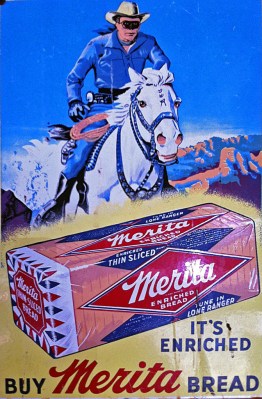
Merita was a longtime sponsor of The Lone Ranger on radio and television beginning in 1938. Image by Flickr user Jeffrey.
De-Romanticizing Radio Art
Unlike other radio greats such as Robson and Welles who worked extensively on commercial series, what distinguishes Corwin in traditional accounts is his alignment with a protected sphere of noncommercial programming. Hired by CBS to work on sustaining series such as the Columbia Workshop, Corwin was celebrated by contemporaries like Richard Goggin as “pleasantly isolated from ‘commercial’ broadcasting,” with its “struggle for sales and maximum audiences” (63-4). His official biographer similarly praised him as an artist who “flourish[ed] in a freedom of ‘sustaining’ programming [that was] the hallmark of the Golden Age” and “refused to forsake this liberty for commercial earnings, although corporations clamored for his talent” (5).
Corwin himself directly contributed to this anti-corporate mythos. In a 1944 book on radio writing, he advised those aspiring to work in radio to “Do the opposite of what a sponsor or an agency executive tells you, if you want to write originally and creatively” (53), while including regular jabs at network and advertising executives in scripts for sustaining shows such as his “Radio Primer” or “Soliloquy to Balance the Budget.” But by 1947, Bannerman explains, “the contest for higher ratings” had won out, and Corwin exited the network arena for greener pastures and a new job with the United Nations (10). In a 1951 article for The Writer, Corwin now recommended that “the writer who wants to do the best work in his power, in defiance of formula,” simply “forget radio,” and “until such time as [it] returns to a constructive attitude toward public service and the esthetic values in writing, look upon [it] as a trade outlet, not an art” (1, 3).
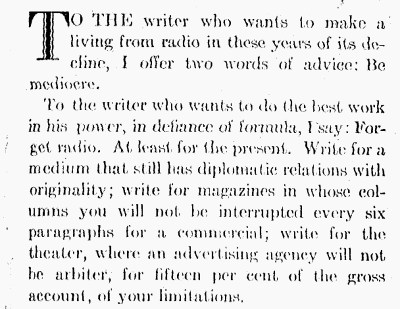
Opening lines of February 1951 essay by Corwin for The Writer, in which aspiring writers who wish to exercise their creative freedom are advised to “forget radio” and look elsewhere.
Setting aside the dubious merit of a narrative that denies any real aesthetic achievements for the 15 years preceding and 65 years following Corwin’s ten-year run in network radio–the apogee of a tragically brief “Golden Age”–we may recognize the conception of creativity espoused here as a distinctly Romantic one. Within this view, so-called “true art” flouts the rules and formulas on which commercially driven mass art depends, and is pursued for purposes other than financial gain. This Romantic ideology of art has been repeatedly challenged, from earlier work by M. H. Abrams, to more recent critiques by Noel Carroll and R. Keith Sawyer. My own concern is not with its veracity per se, but rather with the historical exclusions needed to sustain its underlying binaries of art/commerce and public service/commercialism vis-à-vis the work of Norman Corwin. These exclusions (acts of forgetting on which remembrances of Corwin’s legacy are grounded) may be grouped into three basic categories: the selective operations of canon-formation, cross-fertilization of techniques in commercial and sustaining programming, and profitability of public service within the CBS business model.
Canon-Formation
The received view immediately works to remove Corwin from the sphere of commercial programming, marginalizing his contributions to sponsored series such as the Cresta Blanca Carnival—whose ad agency Corwin himself commended for checking the customary “fear of anything suggesting artistic endeavor” (402)—or Dupont’s Cavalcade of America, for which he wrote his “Ann Rutledge” play, better known from its later revival on the Columbia Workshop. So, too, does it single out among his many production credits a comparatively small list of broadcasts for which he wrote his own scripts, while limiting its purview to his radio works at the expense of his contributions to other media. (For a comprehensive list of Corwin’s creative works, including his many commercial film and television productions, see the appendix in this volume.) As with all processes of canon-formation–a crucial component of what Michel Foucault calls the “author-function”–bids for Corwin’s artistry thus entail a series of selective filtering operations. The totality of the individual’s creative labor is negated within a synecdochical logic of “best” works that renders the exceptional as typical and relegates the typical to the realm of historical oblivion. What other “Corwins” might further scrutiny reveal?
Cross-Fertilization
Efforts to preserve the purity of Corwin’s art by maintaining its opposition to and inherent tension with commercial broadcasting also ignore the extent to which the advertising industry itself embraced Corwin’s techniques. In 1942, trade magazine Broadcasting reported with much clamor Corwin’s acceptance of a bronze medal at New York’s Annual Advertising Awards Dinner, given to honor an “individual, who by contemporary service has added to the knowledge or technique of radio advertising” (22). Authors of popular radio writing manuals noted, in particular, the impact of Corwin’s technique of “choral speech,” which Barnouw in his 1945 Radio Drama in Action claimed was “so successful with listeners that . . . producers of dramatized commercials . . . [now] use [it] for spot announcements to sell soap flakes” (204-5).
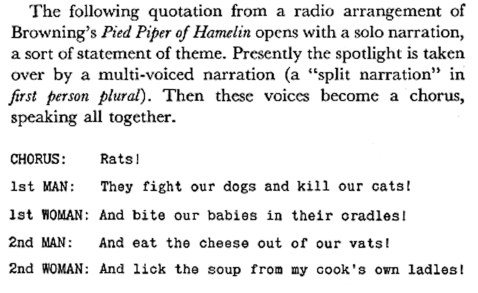
Example of choral speech from script for episode of Corwin’s 1938-39 Words Without Music, reproduced in Barnouw’s 1939 Handbook of Radio Writing
Choral Speech in ad for Ajax household cleanser, late 1940s
Omitted from later accounts, such lost tales of cross-fertilization suggest not simply blind spots in the received view, but a fundamental abnegation: the separation of art and commerce as much an achievement of historical memory as historical fact.
Profitability of Public Service
Positioning the art of Corwin in contradistinction to growing tendencies toward commercialism also ignores the tremendous profitability of public service programming within CBS’s business model, both in its own right and as part of a system of carefully coordinated, cross-platform media flows. As Barnouw notes in Vol. 2 his 1968 History of Broadcasting series, CBS ramped up its investment in sustaining programming during the 1930s as part of a race with NBC to attract affiliates and expand its national network. Whereas NBC charged affiliates for sustaining shows to defray production costs, CBS provided stations with sustaining programs at no charge in exchange for guaranteed carriage of its sponsored series. (NBC stations, by contrast, were given right of refusal for any sponsored shows they wished to opt out of.) For CBS, sustaining shows presented not a financial burden but a path to commercial profitability. Attracting stations eager for free “quality” programming, the network drew fresh revenue in membership fees for each new affiliate it added. Eager to capitalize on these expanded economies of scale and willing to pay the corresponding ad rates, sponsors in turn flocked to the network, giving CBS valuable new accounts and further revenue boosts.
Recognizing their economic value, CBS heavily promoted sustaining stars like Corwin as talented auteurs who represented the network at its best, while working to parlay their products across multiple media platforms. In a 1942 Broadcasting ad promoting Corwin’s newly published script collection, Thirteen by Corwin, the network highlighted his artistry while tracing its corporate signature into his own, reminding readers that these plays were “written and produced under the sponsorship of the Columbia Broadcasting System,” as a new “literature of the air . . . . [whose] first editions . . . [are] printed in decibels instead of type” (62-3).
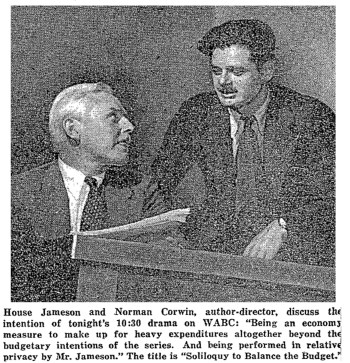
Images of a well-oiled network publicity machine at work. Newspapers such as the New York Times frequently printed network-supplied publicity stills and promotional copy in their radio sections. Here’s a publicity still of Corwin with actor House Jameson preparing for the the “Soliloquy” episode of Twenty-Six by Corwin (6-15-41).
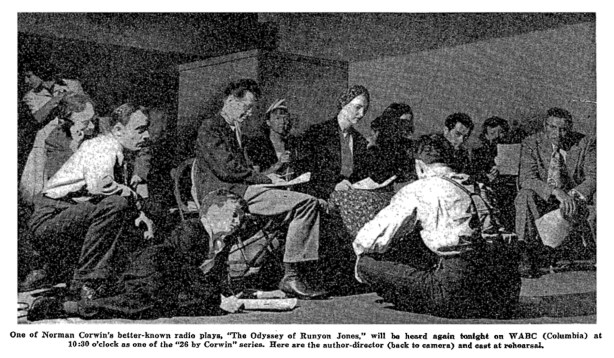
Publicity still of actors rehearsing for an encore presentation of Corwin’s critically acclaimed radio play, “Odyssey of Runyon Jones” (11-26-41).
Corwin’s 1945 VE-Day celebration, “On a Note of Triumph,” was released not only in print, but also on disc by Columbia Records, converting an otherwise ephemeral sustaining feature into a source of direct profit while advancing the larger Columbia brand.
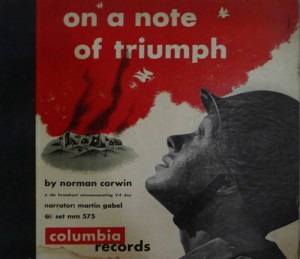
Cover art for 1945 Columbia Records release of Corwin’s “On a Note of Triumph” – leveraging content across media platforms for increased profit potential.
Whether attracting new affiliates and sponsors, or offering opportunities to improve brand recognition and exploit ancillary markets, CBS’s public service programming thus operated not in opposition to commercial forces but rather in the service of the network’s larger bid for economic competitiveness.
Lessons for Radio and Sound Studies
My remarks here are not intended to impugn Corwin’s artistic integrity, nor to imply a lack of commitment to loftier civic goals by CBS executives. The question, again, is a structural one: within what institutional context do the forms of aesthetic expression associated with “the Corwinesque” become possible and desirable? Put simply, how and why, from a structural perspective, do innovations in radio and sound art occur, and what forms can they take under given conditions?
Such inquiries are ill-served by presuming ipso facto oppositions between art and commerce or public service and commercial profit. Indeed, while often resting uneasily together, in the American system they have been bedfellows from the very beginning. To presume, moreover, that aesthetic innovation demands a protected space of noncommercial programming, or that such a space inherently fosters meaningful alternatives to commercial fare, would be a mistake. Within the received view, the legacy of Norman Corwin can be read only as a tale of lament: the death of public service and triumph of commercialism over art. Instead, I suggest we critically interrogate both present and past alike: the “Golden Age” is gone and likely never was, while closer scrutiny of earlier or subsequent eras may reveal aesthetic and institutional complexities hitherto unsuspected.
In a historical moment characterized by an unprecedented proliferation of new media outlets and alternative distribution platforms, but also an extreme concentration of media ownership, can we chart a critical trajectory that avoids both the Scylla of knee-jerk anti-capitalism and Charybdis of hyberbolic neoliberal and techno-utopian praise?

Conflicting attitudes toward contemporary sound industries. User-generated images responding to the SodaHead.com post, “Is Hannah Montana a Tool of the Devil?”, offer excoriating views on the cultural effects of commercialization and conglomeration.

Meanwhile, popular books such as Start and Run Your Own Record Label celebrate opportunities for creative autonomy and aesthetic innovation afforded by niche marketing and digital distribution technologies.
The proper course, whether studying conditions and possibilities for sound art in Corwin’s era or our own, lies somewhere in between.
—
Featured Image Credit: Julia Eckel, Radio Broadcast, 1934, Courtesy of the American Art Museum. An idealized representation, it contains no scripts in hand, no call numbers on the microphone and, importantly, no sponsors’ symbols on the wall.
—
Shawn VanCour is a media historian and lecturer in Film and Media Studies at the University of South Carolina. He has published articles on radio music and sound style in early television, as well as essays on Rudolf Arnheim’s radio theory and the origins of American broadcasting archives. He is currently completing a book on production practices and aesthetic norms for early radio programming and pursuing work for a second project on the radio-television transition of the 1940s-1950s.
Share this:


Current Top Posts





April 2021

January 2020

November 2019

October 2019

August 2019

April 2014

November 2017

March 2015

December 2017

October 2015
 Sounding Out!
Recent Comments