
Quiet on the Set? : The Artist and the Sound of a Silent Resurgence
On a recent episode of Law and Order: SVU Mariska Hargitay’s Olivia Benson takes her new paramour, David Haden (played by Harry Connick Jr.) to see Michel Hazanavicius’s The Artist. When Benson asks him what he thought of the film, he replies with notable disdain: “I think maybe there’s a reason they don’t make silent films anymore.” When Benson responds nervously to his subsequent display of affection, presumably fearing that someone from work might see them, Haden pronounces, “Don’t worry. Nobody we work with could sit through two hours of black-and-white, no talking.”
Haden’s response might seem surprising given the box-office and critical success of the film, with The Artist grossing more than $120 million worldwide and receiving five of the Academy’s most coveted Oscars, including Best Picture, Best Direction, and Best Actor in a Leading Role. In fact, with both The Artist and Martin Scorsese’s Hugo walking away with a preponderance of Academy Awards, many critics, including the editors of Cineaste, began to wonder if we were finally seeing a long-overdue challenge to “long-entrenched cultural prejudices against silent cinema.” There seems to be a renewed optimism that, with The Artist’s critical and commercial success, the popular stereotypes about silent film—heavy-handed acting, artless cinematography, mundane plots—may finally begin to break down.
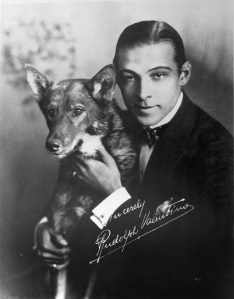
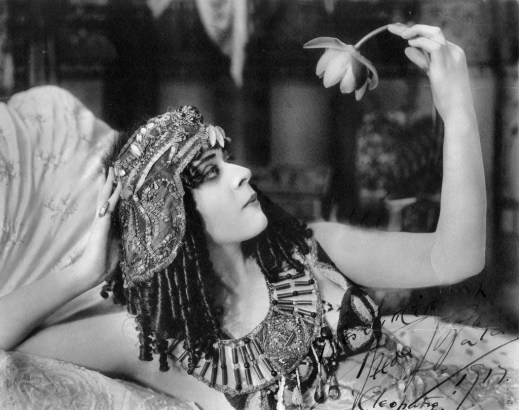
Rudolph Valentino and his Dog, this and featured photo of Theda Bara as Cleopatra (1917) courtesy of the Orange County Archives
As a film studies professor who specializes in the pre-sound era and frequently asks even my freshman students to engage with at least one silent film, I am both buoyed and dubious about this supposed sea change in public attitudes toward silent cinema. While some of my students sound a lot like David Haden after I ask them to watch even the most accessible silent slapstick comedies, many of my upper-level students now count works like F. W. Murnau’s Sunrise among their favorite films. And I’ve discussed the merits of The Artist with many of those same students, who easily recognized the film’s many references to other silent-era works, and appreciated its ability to mimic a very particular brand of silent film. I honestly believe there is some truth to the claim that films like The Artist and Hugo have encouraged spectators to engage with other silent films, including the recently restored color version of Trip to the Moon that is showcased in Scorsese’s film. In fact, in recent weeks there has been considerable buzz about skyrocketing demand for silent films via streaming services and even Cinemark’s XD-equipped theaters will be screening the 1927 film Wings as part of its “Reel Classics” series in late May. Rumor has it that Broadway will soon be hawking a production about Charlie Chaplin’s life and 2012 will see the life of silent film star Rudolph Valentino represented in Silent Life.
Michel Hazanavicius explains in the production notes to The Artist that his desire to make a silent film had been brewing for years: “From the beginning of my career, I fantasized about making a silent film.” But he also viewed the dream as far-fetched, one that would be unlikely to draw support in contemporary film production circles: “I call it a fantasy because whenever I mentioned it, I’d only get an amused reaction—no one took this seriously.” Despite this resistance, Hazanavicius refused to let go of the idea and continued to imagine how he might capitalize on the unique artistic potential of the silent medium: “As a director, a silent film makes you face your responsibilities. . . .Everything is in the image, in the organization of the signals you’re sending to the audience. And it’s an emotional cinema, it’s sensorial; the fact that there is no text brings you back to a basic way of telling a story that only works on the feelings you have created. I thought it would be a magnificent challenge and that if I could manage it, it would be very rewarding.”
Despite the initial skepticism Hazanavicius faced, The Artist’s unexpected international success has revealed consumers’ (perhaps temporary) appetite for silent film. Parody trailers of upcoming Hollywood blockbusters like The Avengers have aped silent film form and The Artistifier allows users to transform any Youtube video into a silent film.
.
Even hipster clothiers, Shabby Apple, have taped into silent film’s newfound cultural cache by launching a “Silent Era” collection of swimsuits with names like the “Bara swim mini” and the “Karloff swim top.” Despite this recent upsurge in references to and imitations of the silent film medium, advertisers, filmmakers, artists, and musicians have expressed a nostalgic reverence for silent film for decades. Between 2007 and 2010, Janelle Monáe released her Metropolis and ArchAndroid Suites, which refashioned Fritz Lang’s iconic 1927 film, Metropolis.
.
Mimicking both the film’s visual style and political message, Monáe also refashioned herself as Metropolis’s iconic android and adopted her trademark tuxedo attire after seeing photos of Marlene Dietrich, the silent and sound film star who helped mainstreamed this androgynous look in the 1920s (and also as a tribute to the working class uniforms of her parents). From AFLAC’s 2006 satirizing of the medium’s stereotyped damsel in distress, to IBM’s 1986 series of ads featuring Charlie Chaplin, marketers have frequently banked on silent films’ ability to attract the public eye.
.
What do we make of this renewed interest in silence? We must first remember that, as I tell my students, silent films were never designed for silent viewing at all given that most were screened with musical accompaniment that ranged from a single organist to a 40-piece orchestra. Even the composition of The Artist reveals the lie behind silent film “silence,” with composer Ludivic Bource employing 80 musicians from the Flanders Philharmonic Orchestra in developing the score for the film. Despite the fact that live orchestral accompaniments of silent film have become staples of film festivals around the world, most of today’s viewers’ experiences with silent film are limited to watching DVD transfers of varying quality, with canned music that is sometimes recycled from one DVD release to another, regardless of film title or subject matter. Few viewers, including those who have attended screenings of The Artist, have truly experienced the “silent” medium as it was intended, with sound and image working in tandem via a combination of “live” music and projected celluloid. Two years ago, I saw the transformative effect of recreating a more authentic silent film viewing experience when I arranged a screening of Sunrise at the University of Northern Colorado with the Mont Alto Chamber Orchestra providing live musical accompaniment. Many of my students still speak of that experience with tremendous reverence, explaining that they finally understood what it meant to truly experience a “silent film.”
While popular audiences tend to neglect how integral sound was to silent film, Rick Altman has argued in Silent Film Sound that sound has thus far failed to establish its own “autonomous measure of worth,” with scholars arguing that because film’s historical roots are bound up in silence “cinema is thus essentially a visual art” (6). Yet, this bias seems to be belied by the reaction to The Artist, with even the Oscars ceremony choosing to use the film’s only synchronized sound scene when introducing it as a the Best Picture nomination. It seems that even an acclaimed twenty-first century silent film must flaunt its, albeit brief, reliance on synchronized sound. Certainly, the many viewers who demanded refunds from their local cineplexes reflect the prevailing opinion that film must include sound if it hopes to maintain their interest and earn their cinema-going dollars.

Silent Film Festival Winter event at the Castro by Flickr User Steve Rhodes
So, what is the appeal then of these “silent” films in which, though accompanied by music and sound effects, dialogue is not spoken but read via soundless lips or intertitles? For me, the attraction comes from both understanding the aesthetic and technological roots of an art form that I admire and the fact that they require the development of character and narrative in purely visual terms. I am also attracted to its higher degree of abstraction, its ability to create a kind of poetry while also defying the very essence of language itself. And I see in the absence of sound a refreshing denunciation of contemporary demands for ever-increasing realism. Silent film is the antithesis of today’s fetishizing of 3-D.

Projector, Chaplin by Flickr User Stephen Coates
While I acknowledge this statement may seem naïve given that Scorsese’s aforementioned film manages to combine that “new” technology with a tremendous reverence for silent film’s seemingly “primitive” techniques, I firmly believe that the aesthetics of “silence” have an important resonance for contemporary viewers raised on Dolby. After hearing my frequent complaints about the current impetus toward 3-D, one of my students has taken to calling me Charlie Chaplin, seeing in my resistance a mirroring of the great comedian and director’s opposition to sound technology. Like Chaplin’s Tramp in Modern Times who cannot keep up with the machine-age and its insistence on productivity, I often find myself longing for something simpler from film, something more retrained and abstracted, less motivated by the demand for “progress” and, at least on the surface, The Artist’s return to silence seems to fulfill that admittedly nostalgic desire. While it is an imperfect, and perhaps misleading, example of the silent medium, even the modernized form of silent cinema that we see in The Artist demands that viewers consider the relationship between history and memory, between film’s relatively youthful heritage and its contingent representations of the past, between sound and silence.
—
April Miller is an Assistant Professor and Director of Film Studies at the University of Northern Colorado. Her research focuses primarily on the intersections between literature, film and socio-scientific concerns such as criminality and mental illness. She is currently completing a book manuscript, Offending Women: Modernism, Crime, and Creative Production, which investigates the female criminal and her often-overlapping sites of representation in literature, journalism, and silent film.
Share this:

my mother’s voice, my father’s eye, and my other body: the sound of deaf photographs

Editor’s Note: This post is the second in a three-part Sounding Out! series on deafness, Sound Studies, and Deaf Studies during February 2012. Read last week’s post by Liana Silva here–JSA
dizzy snapshots
Lately, I’ve been halted by a particular photograph of my mother. Like Roland Barthes’ wonderland photo of his mother in Camera Lucida,
this picture “corresponded to a discomfort I had always suffered from: the uneasiness of being a subject torn between two languages, one expressive, the other critical” (8).
It began when my father reorganized his photographs. Since retirement, he’s taken on archival projects with renewed fervor. He began with 1974 (the year I was born), made it all the way to 1984 and from there slipped back. My mother, a freckled farm girl in South Dakota, standing in front of a box house and snow, lots of snow. The year, 1957 or so. My father in a high chair in Sepulveda, California. Perhaps 1948. By then my grandparents knew he was deaf.
And every couple of weeks or so my dad calls me. I finished another year, come see the pictures, he tells me via the Iphone, his slow, thoughtful typing shaped by many years of TTY-use (TTYs, or “Text Telephones,” are increasingly receding from every day use, replaced by chatting and text messaging). I imagine him at home in my old room, surrounded by generations of Waldners, Cardinales, Jensons and Ewings. Eagerly, he fills an old stereoscope viewer with 3d slides. His favorite is of my brother and me at the Buschart Gardens in Victoria, Canada. My brother is six and I am eight; our young faces are carefully tilted towards the pale cabbage roses. My father fits more years into fewer albums, filing the stray photos in new Costco cardboard photo boxes. And yet, as he reduces by putting old pictures into new boxes, he continually finds older pictures, older boxes.
The last time he called me, he was in 1984. These pictures depress my dad; he won’t spend much time here. In the photos I’m always on the phone or covering my face. Perhaps he remembers, as I do, the times he would attempt to enter my teenage world of sound. He’d follow the knotted coil of the cord, pick up the phone and say “huh-lllll-ooo,” exaggerating his lips in a comical lip-synch, emitting a low, guttural voice while I danced for the phone. We’d both laugh as if we secretly agreed: hearing language is silly, ugly; my father rarely uses his voice.
But within 1984 was a stack of black and white 5×6 matte photographs bound by a rubber band. They were a series of still television shots of my mother. We lived in Berkeley then, and my mother would drive to San Francisco to record the DeafNews; I remember being sleepy, confused, and excited when my mother’s face appeared on the TV. These photographs frame my mother the way I saw her: her face elongated by the distorting concave screen surrounded by blackness; in the picture she seems still to be floating in TV space. I wonder, who stood in front of the television, through several barriers and captured these stills of language?

In high school, I went to a dance at the Fremont School for the Deaf where my parents were chaperones. It was easy to find the dance; you could hear the throbbing bass from across campus. It was so loud, it hurt. When I walked in, I wasn’t surprised to see a wall full of uncomfortably dressed teenagers holding balloons to feel the sound and bobbing their heads in tempo. “Careless Whispers” played as it did at all high school dances and embraced couples locked bodies in a slow sway on the dance floor. The music, the discomfort of boys in pressed shirts and Drakkar Noir, it was no different than the stiff dances at Ramona High school down the street. But it was Deaf more than any silence could be. When my friends found out my parents were deaf they nearly almost always gasped: “I bet your house must be so quiet!”; they nearly always got it wrong. Here, in this cafeteria-turned “sea of love,” Deafness announced itself. Deafness was not mute.
sound does not just enter the gateway of hearing; it can also be perceived through the sense of force” (77).
The song changed to M.C. Hammer, and the dancers on the floor continued slowly rocking. A nervous looking redhead held his palm out with one hand and with the other shaped his hands to form legs; he put the two signs together and asked me to dance.
I was flattered, and acutely aware that I was the foreigner there. As I took his hand, I was filled with adolescent shame forever demanding: “be quiet! People can hear.”
sonnet xvii
así te amo porque no sé amar de otra manera,/sino así de este modo en que no soy ni eres/tan cerca que tu mano sobre mi pecho es mía,/tan cerca que se cierran tus ojos con mi sueño–Pablo Neruda, 100 Love Sonnets Cien Sonetos de Amor
I am six, and eight, and thirteen. The door is open, so I crawl into my parents’ bed, and the pull of the sheets awakens my mother. She grasps my hand. I whisper in sign language so my father won’t be disturbed by the light. Then, I take her hand and listen, tracing the terrain of her fingers, following the curves to read her words. I fall asleep talking to my mother, her hand in mine, my father’s snoring vibrating the bed.
I am twenty-nine and I am watching her hands, her signing, and seeing my own. Her name, signed with a sweep from a handshape “L” to a curved “C” down the shoulder to the wrist (my name, the same “C”)— “now I know your mother, you sign just like her.” And my punctum—sting, speck, prick—the kind of subtle beyond—as if the image launched desire beyond what it permits us to see: not only toward ‘the rest’ of nakedness, not only toward the fantasy of a praxis, but toward the absolute excellence of a being, body and soul together. Barthes again.
Her hands—her hands and my hands, let me see your hands she tells me. She too sees herself on my body; we are both always looking at the blurrr of her hands.
And looking, I return always to a short story by Julio Cortázar, “Axototl” from Blow-Up and Other Stories about a boy who spends hours at the aquarium watching the axolotls; he is transfixed, haunted, obsessed, and keeps returning to watch these fish, no not fish. The boy consults a dictionary and discovers that they are the larval stage of a kind of Mexican salamander. I find the boy and his axolotls among my books, and discover highlighted in purple:
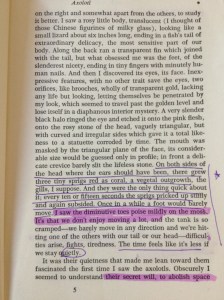
I was, I am, struck by this passage. These atavistic creatures capture, compress space and being. Identity breaks down—I, we, they are no longer discrete. What side are you on? Mother, Father Deaf.
non-negotiable photos
When I was eleven our family bought a deluxe conversion Dodge Caravan complete with metallic bronze customized paint job, rust colored velour captain’s chairs, and a boomerang-shaped television antenna. I went with my parents to the car dealer on a sticky August afternoon. “We want a minivan,” my mother signed to me, I voiced to the short man with greasy black hair and uncomfortably freckled arms. He immediately took us past rows of suburb-like cutouts of vans and led us to the Las Vegas model of minivans—all the deluxe features and without a deluxe price. A special deal. I signed this eagerly—I wanted my parents to understand as I did—we were lucky to see this car. It’s a familiar scene: father adjusting the seats and falling in love with cruise control; mother insisting it was more than they budgeted; the dealer crawling in the back and hollering out through the nifty sliding third door all of the fantastic features.
Inside the car. Tell them the back seat can be removed for more room. Tell them there’s an acoustical equalizer for the stereo. Tell them there’s air conditioning. Tell them there’s a threeyearthirtythousandmilewarranty. Tell them we do financing right here in the lot. Tell them.
Outside the car. Is this the best price? Does he have anything less expensive? Does it come with a warranty? Do you have special discounts? Are you telling us everything?
“Yes, they like all the extras.” No—best price.
We left the dealer and got back into our happy orange VW van. My bare legs stuck to the vinyl seats and I cried. My mother was upset: “What’s wrong? Did you want that car?”.
 The salesman knew my parents didn’t care about the equalizer or the TV monitor in the back seat; but he didn’t know they understood. “How nice of you to help your mother go to the store and do the groceries” while my mother writes a check, looking at the cash register screen for the correct amount. I am the mute one. “What did the lady say?” my mother asks; “nothing,” is my silent reply. Nothing. Nothing. Nothing.
Yes, my mother has a college degree. Table 7 shows that the proportion of persons 18 years of age and over with under 12 years of education increases monotonically as the level of their hearing ability decreases. A bachelor of library sciences. No, she does not work in a library. They were afraid of what would happen if she answered the phone. They were afraid of hearing a deaf woman speak. We moved several times when the rent for one reason or another had to go up; even being six you become familiar with friendly discomfort. Interpreting for my mother when she caught my landlord in a contradictory lie—the distrust on both sides boomeranged off my nine-year old body.
In that parking lot, the traffic of misunderstanding and mistrust, all I wanted to do was to hide my lips, shield my transparent body so that neither side would see they were being betrayed.
talking pictures
The stage is dark, but the theatre is vibrating. “Red hots . . .” lingers in the air. My dad taps me on the shoulder. What does the music sound like?
My father is sitting to my left, my husband to my right. It is between scenes at the DEAFWEST performance of Tennessee Williams’s A Streetcar Named Desire. I’m thrilled to watch the interpreters peering from the balcony above; their voices float above the Deaf actors who take center stage. Sign language takes center stage. The interpreters are for the hearing. The dividing line of the stage is several feet ahead of us. Blanche Dubois begins signing to Stella on the stage. But unlike the other Deaf actors, Blanche speaks with her own voice; the interpreters above are silent. Her signs are stiff, they struggle to keep up with her vocal cadence. I nod as I watch, transfixed: everything has been reversed.
I quickly sign to my father: She is speaking. She’s hearing! Then I lean over and whisper to my husband: her signing. It’s not Deaf. She’s hearing.
I am signing Deaf. I am whispering Hearing.
Cara Cardinale gives sound to her narrative with her mother’s voice–“sounding out” against audist notions of sound that keep Deaf voices silent and perpetuate the idea that deafness is interchangeable with muteness. She would like to thank her mother for sharing her beautiful voice, which to a CODA is a distinctive and comforting sound but often carries a stigma outside the home. Cara uses her own signing body here, not as interpreter, but as primary narration of this intimate photograph.
From his jacket pocket, my father pulls out his hearing aid still marked with red dormitory tape from his years at the residential state school for the Deaf; the opaque embossed letters have slowly curled back on themselves. He adjusts the petrified, squealing earmold then smiles at me.
photo emulsion
Her hands are strapped to the hospital bed. More violent than the search for willing veins to take the sedatives, is the silencing. I cover my mouth to keep from gagging. In the darkness, I watch the television screen as it shows the tour of my mother’s internal body: my face looking back at me against the glass.
The doctor freezes the image and points out the polyps clinging to the intestinal walls. But I see gestation, birth—I am looking from the inside out:
If there exists a border-line surface between such an inside and outside, this surface is painful on both sides. When we experience this passage . . . intimate space loses its clarity, while exterior space loses its void–Gaston Bachelard, The Poetics of Space (218).
It was my body in her body and I found myself looking for the lost baby from years ago; perhaps it was there, inside of her body, my body.
The intimacy, the motion still in the blurrr of the photograph. I am fascinated with a delightful dread, horror. Her name in captions, my name. Her body, my body. That picture says everything about my body. Everything about sitting between my father and my husband: lines drawn between us in the newly reupholstered seats, steel blue like everything new, between the actors and the audience, close enough to see the eyeliner drawn in for emphasis, between the Deaf actors on the stage and the hearing interpreters peering over them on the balcony.
I am transfixed. No transition and no surprise, I saw my face against the glass, I saw it on the outside of the tank, I saw it on the other side of the glass. Then my face drew back and I understood.
Florescent lights saturate the room. I lean forward; take a breath; faint.
center of vision
Sometime within the last six months, my father’s left eye has had an aneurysm. This led to a detached retina and a burst blood vessel. The blood has been slowly moving towards the center of vision. During the day, my father sees shadows. And my mother has been hearing things. Last week she was startled by a high pitched noise; moments later the light in the kitchen flashed indicating that the phone was ringing. Lines are bleeding. The darkness is terrifying for my father in the same way that sound has become disorienting for my mother. And lately I’ve been on the verge of vertigo. It seems as if it were the moving forwards and looking backwards at the same time that’s been disorienting me.
I go with my father to see a retinal specialist. Once in the examining room, I am in the dark again. I am signing in the dark, but my father cannot hold my hand. He is across the room, peering at me with one eye, seeing my signs with the shadow of the pinlight. It must be dark, they explain, his eye needs time to dilate, to open so we can see inside. He will be injected with a kind of serum so that the shadow can be seen.
While we wait for the dizzy eye to dilate, I describe my vertigo to my father. He notes with interest and nods, yes, mother took me to doctors in Washington D.C. He looks at me. Your age. Even the emergency room. Nothing wrong. Gone—he signs with a shrug. Maybe gone—he points at me—soon.
The doctor returns and looks into my father’s eye. The serum has worked, and the image is transparent.
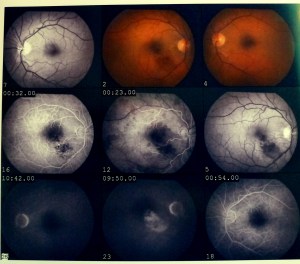
I see his eye, enlarged, disembodied, projected on the screen behind him. It is beautiful and dark, a moonscape clouded over by an eclipse. Everything is transparent, and I think of the axolotls.
—
C.L. Cardinale has a PhD in English Literature from University of California, Riverside. Currently she is editing her manuscript on what she calls “look-listening”—deafened gestures—in twentieth century narratives. She also publicly reads Proust, edits for Lettered Press, and sings with her one and six year old in California’s east bay.
Share this:


Current Top Posts





April 2021

January 2020

November 2019

October 2019

August 2019

April 2014

November 2017

March 2015

December 2017

October 2015
 Sounding Out!
Recent Comments