
Radio’s “Oblong Blur”: Notes on the Corwinesque
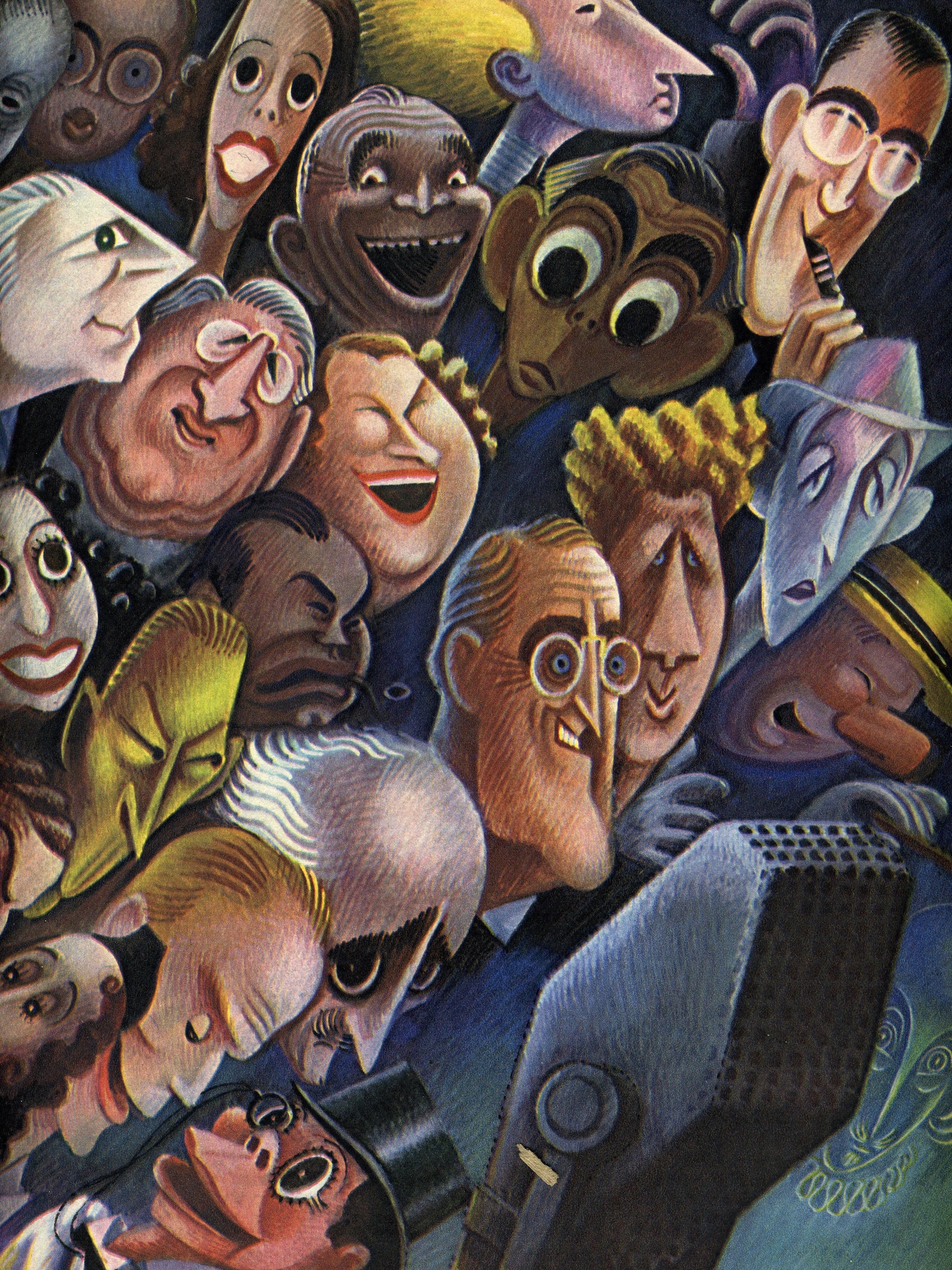
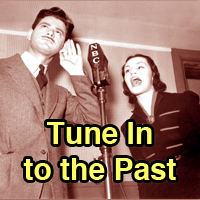
Editor’s Note: Today, Neil Verma kicks off our summer series “Tune In to the Past,” which explores the life and legacy of radio broadcaster Norman Lewis Corwin, the “poet laureate of radio” who died last summer at the age of 101. Corwin, pictured in the icon to the left with actress Peggy Burt around 1947, passed too quietly into the ether–as, unfortunately, has too much of radio history. Sounding Out!‘s three-part exploration of his legacy by radio scholars Verma, Shawn VanCour (July), and Alex Russo (August) not only gives his work new life (and critique), but also speaks to the growing vitality of radio studies itself. As I mentioned this past March in my round-up of the 2012 Society of Cinema and Media Studies conference, radio scholarship is on the rise–a Radio Studies Special Interest Group was established at SCMS this year, reaching a critical mass–and scholars are finding new and innovative ways to approach radio’s unique silences. We are proud over here at SO! to broadcast the future of radio studies by helping you “Tune In to the Past” this summer, so get ready for an array of voices–living and dead, textual and aural–spirited debate, and great sound history, in both senses of the word. So don’t touch that dial. –JSA
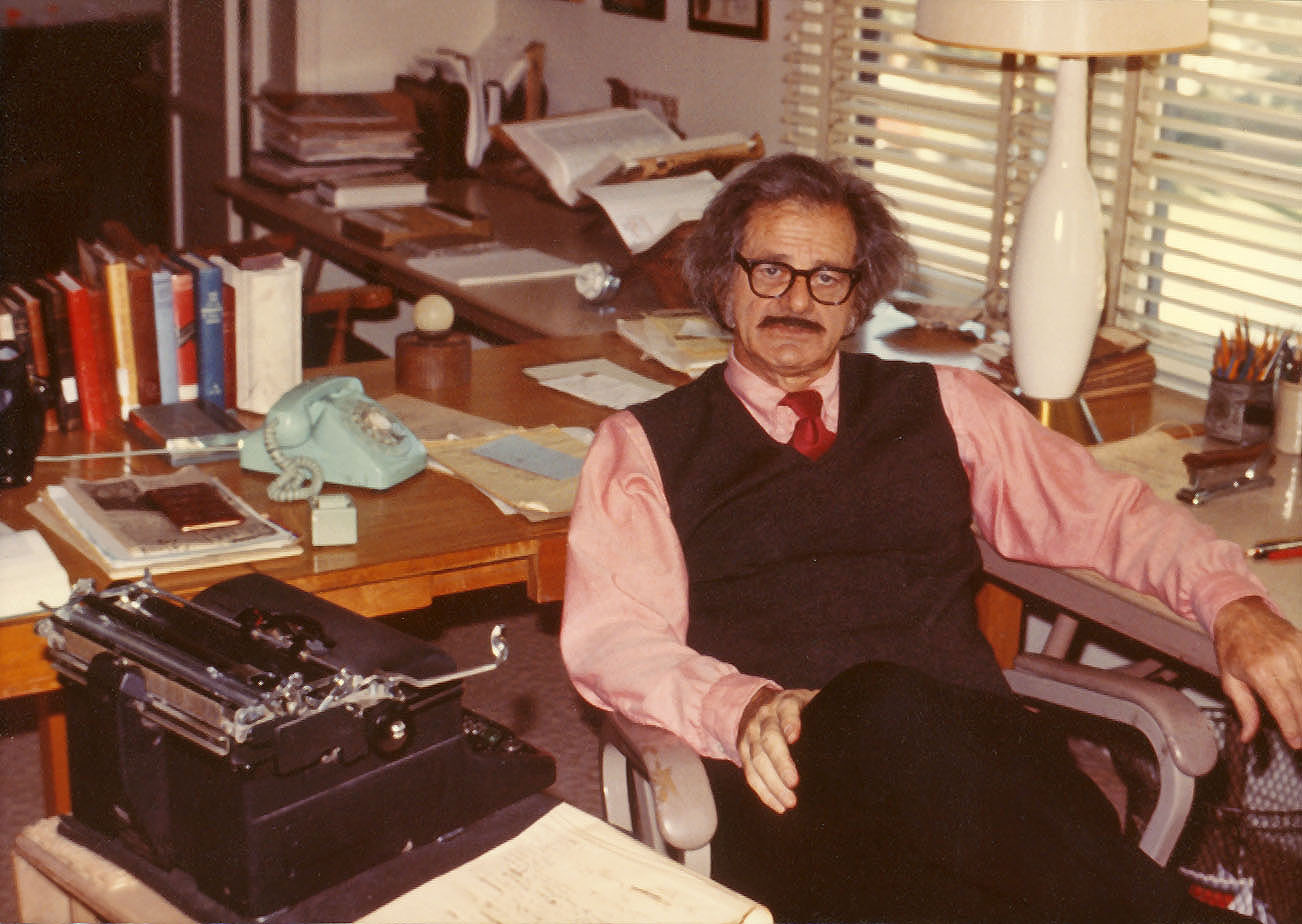
“I am a Dead Sea Scroll,” Norman Corwin, in an interview with writer Tom Lewis, 1992.
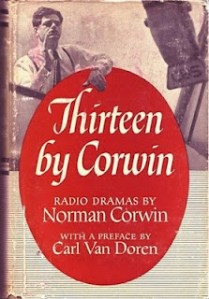
Rising to prominence in the 1930’s, radio dramatist Norman Corwin (1910-2011) aired a body of work of unsurpassed variety, reaching audiences upwards of sixty million with plays that range from “The Odyssey of Runyon Jones,” about a boy searching the afterlife for his beloved dog, to One World Flight, for which Corwin visited 17 countries seeking voices of peace. Often compared to such figures as Eugene O’Neill and Walt Whitman, Corwin was known for seventy years as the “Poet Laureate” of radio, an unofficial title invented for him and impossible to confer on another. I interviewed Norman for my book Theater of the Mind (University of Chicago Press, 2012). These remarks derive in part from those conversations.
—-
DOI: https://doi.org/10.59350/b690v-1kf27
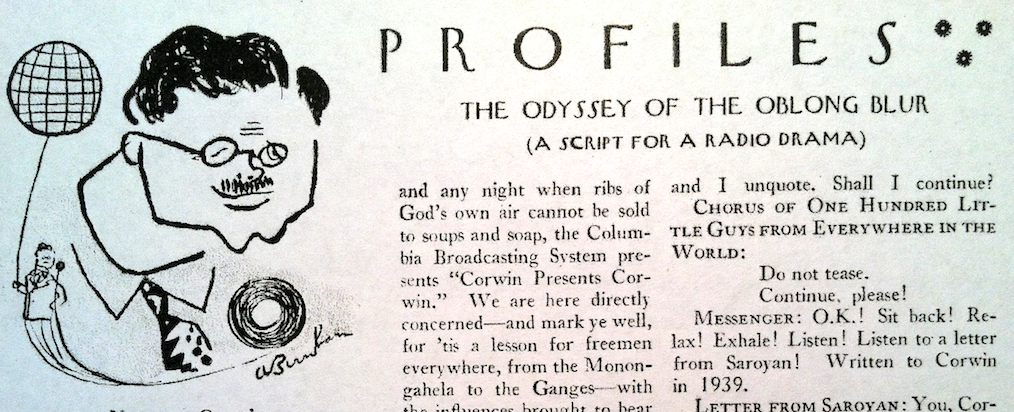
In June of 1947, New Yorker writer Philip Hamburger published a profile of Norman Corwin, then already recognized as a distinguished radio dramatist. From Pearl Harbor to V-J Day, Corwin had staged daring plays to mark Allied milestones and earned frothy praise from the likes of Carl Sandburg, who called Corwin’s V-E Day show “On a Note of Triumph” one of the “all-time best” American poems.
Such acclaim was not universal. That same broadcast drew scorn from historian Bernard DeVoto, who called it a “mistake from the first line” full of “pretentiousness” and “bargain-counter jauntiness.” Like many others, DeVoto and Sandburg reacted to Corwin’s habit of excess by mimicking it. Hamburger’s profile caught that same bug. Billing itself as “The Odyssey of the Oblong Blur,” Hamburger tells a gauzy story of Corwin’s older brother building him a crystal set out of a box of Quaker Oats, and relates tall tales of Corwin’s artistry, like the time he spent two days trying to simulate the sounds of depth charges. And not only did Hamburger write the profile as a radio play, but he wrote it in the style of Norman Corwin.
What is that style, exactly? Thoughts on that question have been surprisingly minimal. When Corwin died last fall, commentators celebrated his life (see here, here, here and here), but the memorials lacked precisely the sense of scale to which both Sandburg and DeVoto responded. There was no voice to speak of Norman in a “Corwinesque” manner, in part because the man probably outlived more likely eulogists than anyone else in the history of broadcasting. Had he not outlasted them, Corwin would have been mourned by the avuncular elders of midcentury liberalism, like his friends Edward R. Murrow and Carl Sandburg or admirers Robert Altman, Walter Cronkite and Studs Terkel, any one of whom could have written a loving burlesque in Corwin’s voice.
But no one did, and no one can, not now. Who would get the joke, anyway? Collective experience of Corwin’s sound is passing out of living memory. Yet this very elapsing “afterlife” of the radio age, I feel, lends new richness to the question of the Corwinesque, an aesthetic that needs clarification both to give full credit to the man behind it, and, in a larger sense, to show how a theory of sound experience can “happen” at the twilight zone of collective human memory.
So what was “the Corwinesque” around 1947? What is it nowadays? What might it become in the future? In this post I’ll consider both the nature of the “Oblong Blur” and the methods we’ve tried to bring its ongoing odyssey into focus.
A High Wireless Act
In its profile, The New Yorker poked fun at how Corwin made unreasonable demands of sound (e.g. “Music: a universal theme, oscillator beneath, denoting pain of the world and bigness thereof, fading”) and let childish literary tactics run amok, as when the audience is called “Sons of a Sun spinning sadly through space.” In his era, Corwin’s penchant for such overwriting was an unavoidable aesthetic issue.
Corwin’s work was widely understood as a challenge to technicians and actors just for the sake of it. In the script for “New York: A Tapestry for Radio,” for example, a date scene contains this befuddling note: “Music: Love on brownstone stoop at three in the morning after an evening at the RKO Proctor Theater and a long walk in the park. It sustains, behind.” In “The Undecided Molecule,” meanwhile, we learn of a particle that refuses to select his destiny before “The Court of Physiochemical Relations.” Here are some of many tongue-twisting lines in verse:
I’d argue that Corwin’s writing is impressive here precisely because it’s so easy to botch in delivery. The style spotlights its own overworked literary calisthenics, saying: look at me trying so hard I might blow it.
In this way, the Corwinesque names a connection between the soaring and the buffoonish, a link that a contemporary called his “frontier spirit.” Thanks to this spirit, even when the prose was purple, the defect came across as that of an innovator. To keep that up, Corwin had to innovate constantly. That’s why his plays took on so many other forms – the letter (“To Tim and Twenty”); the lecture (“Anatomy of Sound”); the pageant (“Unity Fair”).
So one key to the Corwinesque was to walk a high wire without a net, another was to say so. Nothing confirmed both better than a fall. I’d wager many listened for a lousy line or overdone tune as part of the pleasure of it all. Indeed, it may be incorrect to evaluate Corwin’s aesthetic as poetic; think of the Corwinesque as broadcasting rather than writing, and its liabilities come across as dares.
If that is correct, then the “high wire act” of the Corwinesque relies on a kind of listening-for-risk that’s hard for us to do now, because we can’t listen to Corwin’s work new, or live. One deep aspect of the Corwinesque of the 1940’s – the possibility, even anticipation, of artistic failure, up above an enormous audience out there in the dark – seems lost for good.
Coalition and Collation
But in another way, the Corwinesque is only possible to grasp now, at the safe remove of the digital era. Today it’s easy to listen “distantly” to classic radio through formats that allow us to pause, rewind, categorize and remix vast amounts of golden age audio in a way that was impossible in 1947. By doing so it becomes clear that what we call the “Corwinesque” drew on a broad vocabulary of radio dramaturgy, a way of “talking about” time and space that characterized many programs of that time.
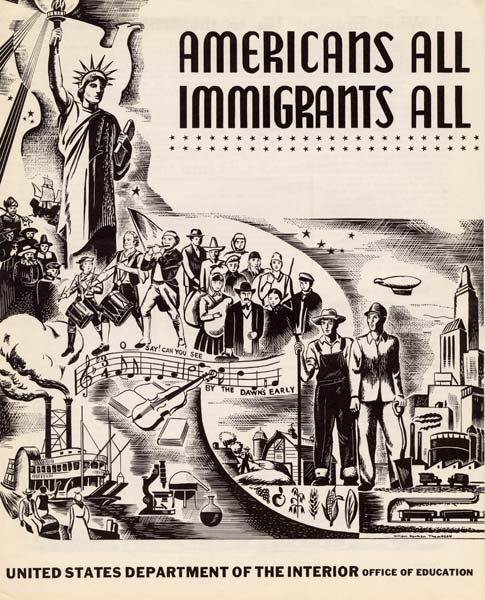
Consider Corwin’s famous attempts to glorify the “common man” – farmers, G.I.s, factory workers – by drawing their voices to a sonorous space and national coalition, indeed by making these two imaginary sites mirror and rationalize one another. Perhaps the paramount example is “We Hold These Truths,” which celebrated the 150th anniversary of the Bill of Rights only days after Pearl Harbor. In that broadcast, we hear Americans of the revolutionary period (widows, blacksmiths, politicians) speak from a series of shallow locations in a quick succession, and a similar group in the present (workers, Okies, businessmen, mothers), as a way of building mystical union through time.
This style has had many names. Historian Erik Barnouw likened it to painting, calling it a chance to “splash quickly over a large canvas,” while actor Joseph Julian called it a “telescoping montage.” Variety’s radio editor Bob Landry suggested that it resembled cantata. When I interviewed him, Corwin said that it was like writing music; elsewhere he spoke of a kind of “horizontal” drama, or mosaic form.
In my book, I employ another word: “kaleidosonic.” In kaleidosonic radio, we segue from place to place, experiencing shallow scenes as if from a series of fixed apertures, thereby giving time periods expressive existence. That can be contrasted with what I refer to as the “intimate style,” in which the listener is attached to a character who moves through deep scenes, as a way to give space expressive existence. A good example of the latter is Corwin’s American in England series, in which the horizon of wartime is shaped by a proximal relation to a surrogate narrating entity “nearby.” Here’s a representative episode:
Today, listening broadly, it becomes clear that neither of these styles belongs to Norman exclusively. For other uses of the kaleidosonic, consider the works of Stephen Vincent Benét, Orson Welles’ “The War of The Worlds” or Cavalcade of America. For examples of the “intimate style,” listen to Brewster Morgan’s “A Trip To Czardis,” or any “first-person” style play from The Mercury Theater on the Air. What made Corwin special was how he made these styles complimentary. The opening of “On a Note of Triumph” is a good example:
In six minutes, we go from a kaleidosonic sequence of songs and crowds to an ordinary G.I. overseas asking questions intimately. This connection between the context and the individual, between the nearby and the simultaneous, is Corwin’s way of letting space and time merge together vividly.
It is that capability, I contend, that underlies and secures Corwin’s glorification of the common man, who is really Corwin’s public aestheticized. In 1939, Archibald MacLeish wrote, “The situation of radio is the situation of poetry backwards. If poetry is an art without an audience, radio is an audience without an art.” Corwin intuited what MacLeish didn’t understand: in radio, the audience is the art.
And just as airing a coalition of voices was an epistemological act that reinvented those it depicted in 1945, our use of a new collation of recordings today redraws the parameters of what those sounds might mean, amplifying latencies, superficialities, and entwinings hitherto inaudible.
A Dead Sea Scroll
By 1947, Corwin’s dedication to the “little guy” was out of vogue. It seemed seditious to red-baiters, phony to leftists, and compromised to critics – The Nation’s Lou Frankel wrote of One World: “It is as if the late John Barrymore decided, without warning, to play Hamlet in pantomime.” On this point Hamburger’s profile pivots from hagiography to satire, including a series of goofy verses voiced by a “Chorus of One Hundred Little Guys from Everywhere in the World” and a grouchy monologue by the “Common Man,” complaining that Corwin talked past him, advising “you ought to think about what the words mean before you use them.”
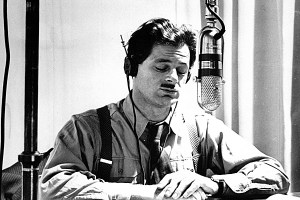
That reminds me of another coda, this one in Corwin’s 1944 play “Untitled.” The play concerns a dead soldier named Hank Peters, who speaks as he lies “fermenting in the wisdom of the earth.” The monologue concludes this way:
Death is a patriotic act, a metaphysical state, but also a restless moral energy bearing down on life, a thing standing in requirement of its vindicating narration. Perhaps this feature of the Corwinesque will ring especially true as classic radio continues to exist in its ongoing pseudo-immortality. Now that Corwin reposes in his own acre of undisputed ground and his voice circulates ghostlike in clouds of data, our question may be what ontological relation we ought to have with that voice, and those of other dead social visionaries, who really do keep on advising us after death, and will go on echoing after we’re gone.
But the Corwinesque isn’t just about how the dead “speak” to the living, long the ruling conceit in the theory of sound recording. It is also about another enigma: how the dead listen to us, an audience eavesdropping, in hiding, taking notes on an old scroll in a lost language.
—
Neil Verma is a Harper-Schmidt Postdoctoral Fellow at the University of Chicago, where he teaches media aesthetics. Verma works on radio and its intersection with other media, and has taught subjects including film studies, sound, art history, literature, critical theory and intellectual history. His book, Theater of the Mind: Imagination, Aesthetics, and American Radio Drama, is published by the University of Chicago Press.
—
Share this:

Sound + Vision: Andy’s Mick
Hello Internet! It’s great to be here in cyberspace! Are you ready to rock? Today’s dispatch from our Spring Series, Live from the SHC, finds Cornell’s Society for the Humanities Fellow Eric Lott jamming it out on the relationship between the early 70s sound and vision of one Sir Mick Jagger. If you happen to be thinking that Monday morning at 9:00 a.m. is the least rock and roll time slot possible, just remember that’s when Jimi Hendrix gave “The Star Spangled Banner” the business at Woodstock. To give earlier installments by Damien Keane, Tom McEnaney, and Jonathan Skinner a listen, click here. As May comes to a close and the “Sound: Culture, Theory, Practice, Politics” fellows reluctantly break up the A.D. White House house band, look for our final two dispatches from Jeanette Jouili and Society Director Tim Murray. Until then, we’ll keep turning it up to 11 here at Sounding Out! –JS, Editor in Chief (and 2011-2012 SHC Fellow)
—
DOI: https://doi.org/10.59350/qtpg6-4b336
After we left the Carlyle I told Jerry I thought Mick had ruined the Love You Live cover I did for them by writing all over it—it’s his handwriting, and he wrote so big. The kids who buy the album would have a good piece of art if he hadn’t spoiled it. –Andy Warhol
Andy Warhol’s complaint in his Diaries captures the almost cartoonish play for artistic control between himself and Jagger in the 1970s—between painter and singer, portrait artist and subject (Jagger and the other Stones biting each other), the visual and the verbal (“he wrote so big”!): between sight and sound in the realm of popular music. Warhol was no stranger to sound artistry, of course, from his work with the Velvet Underground to the everyday taping he did with his portable cassette recorder, the machine he called his “wife.” But Warhol as visual conceptualist returns us to a moment when, through album art and other commercial iconography, the visual domain shaped our sonic experiences perhaps more immediately than it does in these digital days. At the recent EMP conference in New York, I raised the question of the visual/conceptual from the perspective of sound, looking and listening to how the modalities were conjoined during an excellent and rather brief (and nowadays mostly scorned) passage of Jagger time in the middle 1970s: Jagger in his thirties.
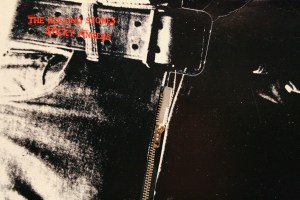
A funny thing happened after Exile on Main St. in the early 1970s: the Rolling Stones became a New York band instead of a London and L.A.-based one, and their frontman Mick Jagger, always an outlandish presence, became a swishier one. The manner in which this happened owes a lot to their encounter with Andy Warhol. From his cover designs for Sticky Fingers (1971) and Love You Live (1977) to the Stones’ renting of his Montauk house to rehearse for their 1975 tour to conspicuous late-70s hanging out together at Studio 54 and New York dinner parties of the rich and not so fabulous, it’s clear the Stones, or at least Jagger (and for sure his wives, Bianca and Jerry Hall), steered ever closer to Warhol’s orbit.
Good writing about the Stones’ New York phase has recently begun to appear, including Cyrus Patel’s 33 1/3 book on Some Girls (2011) and Anthony DeCurtis’s liner notes to that record’s 2011 deluxe re-release; Ron Wood’s Ronnie: The Autobiography (2008) opens with the band’s famous promo stunt playing on the back of a flatbed truck rolling down lower Fifth Avenue on 1 May 1975 to advertise their upcoming tour.
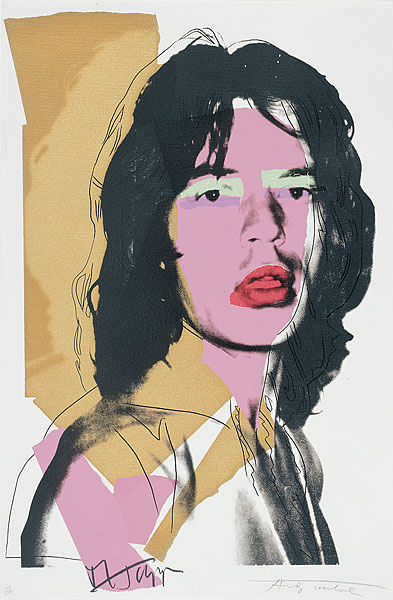
.But the influence on them of the Andy aesthetic has gotten far less attention, at least in pop music criticism (the Warhol Museum mounted a show, Starfucker: Andy Warhol and the Rolling Stones, in 2005, full of great stuff). In particular, Warhol’s 1975 Ladies and Gentlemen black drag queen series, and the draggy portrait series of Jagger done at the same time and in the same way, attest to their mutual influence on each other. The gain for the Stones was exponential: a new persona for a new decade and indeed a new town.
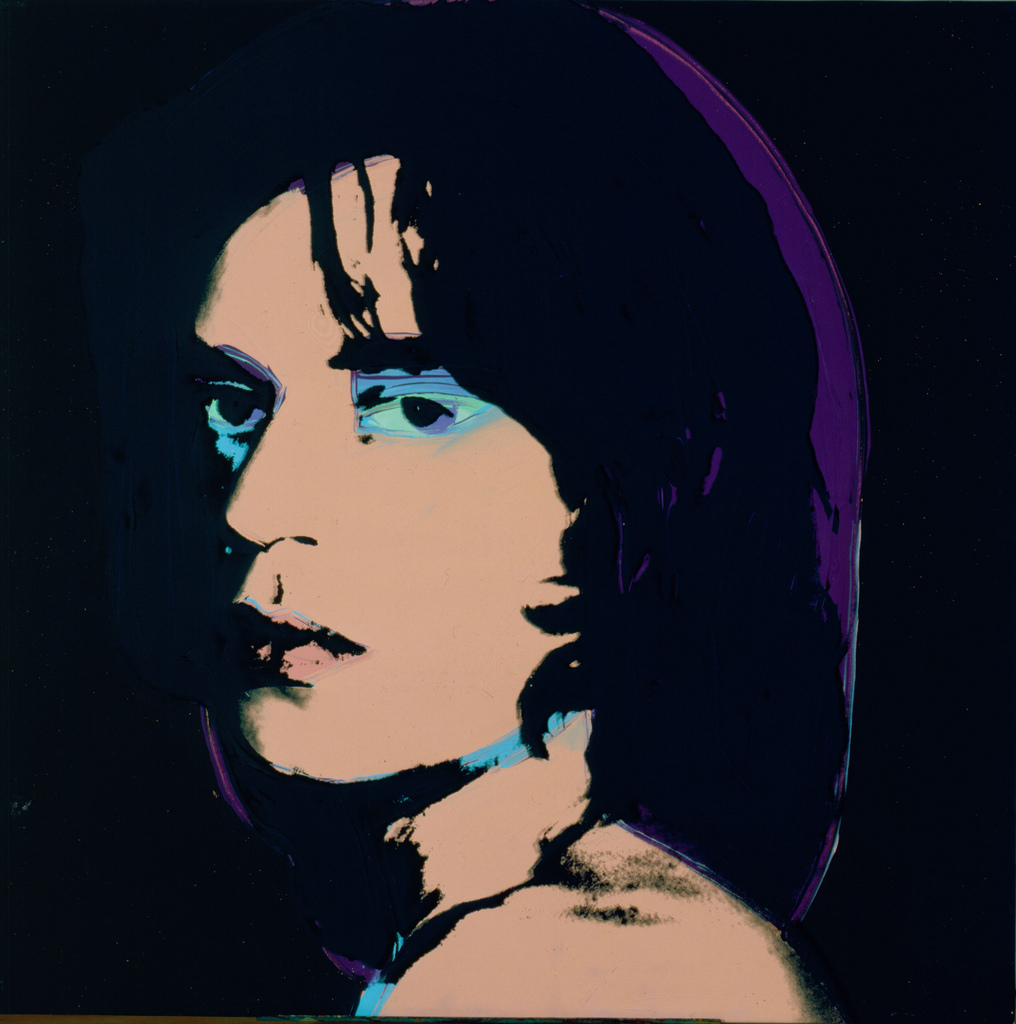
The persona as influenced by Warhol arrives at the nexus of drag, hustling, and stardom, and Jagger in the 70s can be seen to be addressing and/or capitalizing on all three. Warhol’s Ladies and Gentlemen was originally referred to as simply the Drag Queen series. As Bob Colacello tells the story in Holy Terror: Andy Warhol Close Up, some Factory workers were sent to the Times Square gay bar The Gilded Grape to hire several hustlers there to sit for some Warhol Polaroids for fifty dollars a pop. (They later quipped that they were used to doing a lot more than that for fifty bucks.) As was his practice at the time, Warhol transferred these images to silkscreen for mechanical reproduction, over (or under) which he painted in unusually expressive fashion, at times applying collages of torn paper as well. Geometries of color in these pictures war with the photographic image; they signify on race as well as the drag queen’s everyday glamour and its defensive-aggressive thrust-and-parry. In any case, Times Square hustlers of color became stars in Andy’s hands. At this point the title was changed to Ladies and Gentlemen—perfect, since his subjects in the works can be thought of as both—and it may be that the title was taken from the 1974 Stones film of their celebrated 1972 tour, Ladies and Gentlemen, the Rolling Stones (it’s worth recalling lest we be tempted to discount such a film that almost everyone in a broad swath of the New York milieu saw it—in Just Kids (2010), for example, Patti Smith writes of seeing the film with Lenny Kaye and then going off to CBGB to catch a set by Television). What is certain is that Warhol at this same moment was giving Polaroids he had taken of Jagger in Montauk the exact treatment he gives the drag queens in Ladies and Gentlemen.
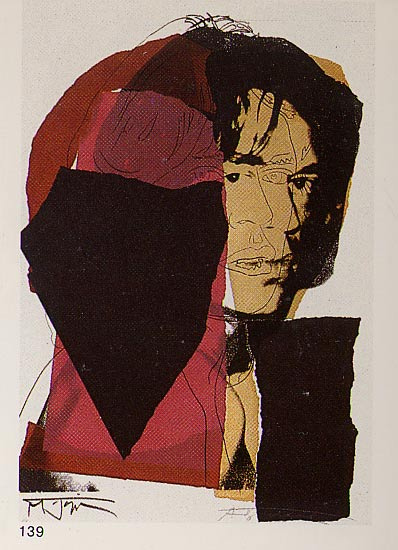
Being a drag queen is really hard work, Warhol famously wrote in The Philosophy of Andy Warhol (1975), and it is in part the connections between hard work, its celebrity remuneration, drag, and prostitution that link the Ladies and Gentlemen series with the portraits—paintings and then prints—of Jagger. These connections link this output with Warhol himself, making the portraits a sort of displaced self-portraiture. Their mechanics, if you will, seem homologous with drag, in fact. Starting with the Warhol-snapped Polaroid—not, say, with newspaper photos or commercial iconography as in Warhol’s 60s silkscreens—the works depend on Warhol’s presence, which then puts the images through the silkscreening process, after which (or before it) an uncharacteristically painterly (or collagist) procedure is applied, the latter akin to make-up itself. Where in some of the series the paint obscures the face, acting as a kind of negation or comment on the negation behind black queer hustling, in most of it the faces rise to a new form of presence or fabulousness, as if by repeating the act of drag the portraits affirm its “success.” Warhol’s make-over of Jagger, meanwhile, both drags the singer and makes him Warhol’s: Andy’s Mick.
According to a scheme worked out by Warhol and Jagger, the latter signed the portraits so that they could promote both artists. Which, if it doesn’t exactly make Jagger a co-author of the works, does signal his endorsement of Warhol’s vision of him. (Indeed the Warhol Museum has a facsimile of a 1983 letter from Jagger to Warhol asking for his assistance with Mick’s autobiography—a collaboration that boggles the mind.) As John Ashbery had it in Self-Portrait In a Convex Mirror, his multiple-prize-winning long poem of 1975:
Your [the artist Parmigianino’s] eyes proclaim
That everything is surface. The surface is what’s there
And nothing can exist except what’s there;
It [the surface] is not
Superficial but a visible core. . .
Your [Parmigianino’s] gesture . . . is neither embrace nor warning
But . . . holds something of both in pure
Affirmation that doesn’t affirm anything.
Not a bad definition of the Warholian image, this, and in the 1970s, as the Rolling Stones entered their second decade of performance and stardom, Jagger took the lesson and ran with it. A new self-consciousness about his own stardom enters Jagger’s (underrated) lyrics in the 70s; while self-reference is not unknown in the band’s 60s work (cf. 1968’s “Street Fighting Man”), and while one of their first hits takes on the culture industry itself (“Satisfaction”), in the 70s a new kind of meditation on rock-star celebrity enters the picture—I have seen the culture industry, and it is me: Jagger begins to write about himself as the culture industry. And this under the sign of Warhol, I think, which is to say, with a queerly knowing intimacy informed by a sense of the artist-star as a hustler for money in what we might call image-drag. Everything is surface, the surface is what’s there and nothing can exist except what’s there, and it’s not superficial but a visible core.
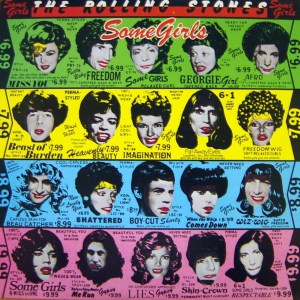
From 1973 forward, in the music from Goat’s Head Soup to Tattoo You (with It’s Only Rock n Roll, Black and Blue, Some Girls, and Emotional Rescue in between), and even more on the covers of these albums, culminating in the one for Some Girls with the Stones in drag—Andy in the Warhol Diaries: “[Mick] showed me their new album and the cover looked good, pull-out, die-cut, but they were back in drag again! Isn’t that something?”; the Some Girls cover, though Warhol didn’t do it, really does recall his drag queens, right down to the double drag of the inner-sleeve pull-out—to say nothing of the made-up glam of the 1975 and 1978 tour performances: in all this one sees a flouncier, queerer Mick, one that Jagger nodded to in various lyrics (for that demonstration you’ll have to wait for the longer version of this piece!). What this means in part is that the cliche we have of Jagger strutting like a neo-blackface soul man is due for revision: it’s much more precise to think of his aura as proximate to black femininity (icons like Tina Turner, say, who of course opened for the Stones), which he (re-)crafted through the adoption of a persona right out of Warhol’s colored drag queen sensibility.
.
So why the now-canonical assumption of the Stones’ decline at just this moment? Is their 70s sound discounted because of the queer reinvigoration of their visual/conceptual appeal? (One counter to this hegemony is Ellen Willis’s fine 1974 review of It’s Only Rock n Roll, included in her Out of the Vinyl Deeps.) Did the Stones’ sound change all that much, beyond new acquisitions of this reggae vibe or that funk riff or the other disco groove, or does the insistence on their fall come from a sense of their queening around? Is it this—not only this, I know, I know, Mick’s such an asshole, but still—that lies in part behind the (particularly post-Life) cult of Keith?
—
Eric Lott teaches American Studies at the University of Virginia. He has written and lectured widely on the politics of U.S. cultural history, and his work has appeared in a range of periodicals including The Village Voice, The Nation, New York Newsday, The Chronicle of Higher Ed, Transition, Social Text, African American Review, PMLA, Representations, American Literary History, and American Quarterly. He is the author of the award-winning Love and Theft: Blackface Minstrelsy and the American Working Class (Oxford UP, 1993), from which Bob Dylan took the title for his 2001 album “Love and Theft.” Lott is also the author of The Disappearing Liberal Intellectual (Basic Books, 2006). He is currently finishing a study of race and culture in the twentieth century entitled Tangled Up in Blue: The Cultural Contradictions of American Racism. This post is adapted from a talk Eric gave at the 2012 EMP POP Conference in New York City entitled “Andy’s Mick: Warhol Builds a Better Jagger.”
—
Share this:




Current Top Posts





April 2021

January 2020

November 2019

October 2019

August 2019

April 2014

November 2017

March 2015

December 2017

October 2015


Recent Comments