
Sound at SCMS 2015

Each March one brave Sounding Out! author takes on the task of wading through the catalog of the annual conference of the Society for Cinema & Media Studies (SCMS), to produce a curated guide for scholars interested in sound and its intersection with media. For several years now, SCMS has been both widening its intellectual scope and becoming one of the primary venues for scholars working in sound, and so making sense of the rich and noisy expansion of the field in this context takes a pretty keen ear.
This year we are extremely happy that that ear belongs to Alyxandra Vesey of the University of Wisconsin, Madison. Vesey is not only a leading feminist sound theorist, a radio host, and an editor at our peer website Antenna, but she is also one of the people behind the recent special issue of Velvet Light Trap on Sound, which is sure to become a landmark in the field in years to come.
We asked her to begin with some thoughts on what this year’s offerings at the Montreal conference (held March 25 to 29) tell us about sound scholarship these days. Some food for thought for conference attendees as they contemplate the best place for an oven-warm Montreal bagel on a cold winter morning, or work up the courage to try out some rusty French in la belle province …
— Special Editor Neil Verma
—
In a recent essay for this site, Robin James situated Dove’s #SpeakBeautiful Twitter campaign within larger histories of patriarchal conventions that moderate “women’s literal and metaphoric voices to control their participation in and affect on society, ensuring that these voices don’t disrupt a so-called harmoniously-ordered society” (2015).
That line came back to me as I began assembling a list of relevant panels, workshops, presentations, and events for sound studies scholars at this year’s SCMS Conference. Of course, the field of film and media studies has been concerned about the voice since the works of Michel Chion, Kaja Silverman, Michele Hilmes and Roland Barthes, many of whose ideas have been revived in recent years, including in a recent issue of Velvet Light Trap, which pursued the voice through a variety of contexts.
 But that legacy alone can’t explain the diversity of interest in the subject at SCMS this year; Montreal’s conference might signal the year of the voice in media studies.
Wednesday’s itinerary features “Hearing Voices, Songs, and Speech.” The panel is chaired by Kyle Stevens, who will also present research on the functions of voice-over in representations of suicide and women’s sexuality. Dolores McElroy’s research on Judy Garland, Patrik Sjoberg’s exploration of documentaries’ dubbing and lip sync practices, and Liz Greene’s work on pop music’s signification of middle-aged nostalgia rounds out the proceedings. On Saturday, “The Voice in Transition” includes presentations from chair Jennifer Fleeger, Sarah Wright, Tom Whittaker, and Christine Ehrick on opera in Italian film, silent cinema, dubbing in Spanish film, and Niní Marshall’s film comedies. “Hear and There: The Politics of Sound” include two compelling presentations: Cassie Blake and Tessa Idlewine’s work on female voiceover in theatrical trailers and Allison McCracken’s discussion on auditions and essentialism on NBC’s The Voice.
Heightened interest in podcasting also appears to be symptomatic of interest in the voice. The first day of the conference includes an entire panel on the subject. Chaired by Andrew Bottomley, “Podcasting: A Decade into the Life of a ‘New’ Medium” includes presentations from Brian Fauteux on podcast aesthetics and satellite radio, Andrew Salvati on historiography in Dan Carlin’s Hardcore History, and Kelli Marshall on WTF host Marc Maron.
However, scholarly inquiry around podcasts may have as much to do with the interest in radio and the medium’s extensions online. On Thursday, Doron Galili and Gabriel Paletz will chair “A Paragon of Intermedial Adaptation: The War of the Worlds in Radio, Film, and Social Media,” exploring the program’s long afterlife alongside a co-authored paper by Neil Verma and Jennifer Stoever and respondent Timothy Corrigan. This event occurs simultaneously with a workshop on radio production cultures chaired by Bottomley and featuring participants Shawn VanCour, Tom McCourt, and David Uskovich. Friday afternoon winds down with a workshop chaired by Jason Loviglio entitled “The Problem of the Radio Canon” that includes Debra Rae Cohen, Bill Kirkpatrick, Kate Lacey, and Elena Razlogova. And on Saturday Jennifer Wang will chair “Fringe Time: Gender and Crossover Programming in the U.S. Radio-TV Transition” with presentations on soap opera’s transitional moment, ethnicity and diet-oriented programming, and discourses around liveness in wrestling from Elana Levine, Jennifer Lynn Jones, and Kate Newbold.
Saturday’s radio studies panels also touch on three other areas of interest for sound studies scholars: technological affordances, historical interventions, and identity politics. To that first point, Wednesday includes Tim Anderson’s presentation on musicians and the professional economies of social networking and Andrew deWaard’s discussion on big data’s influence over ownership in the recording industries. Saturday evening’s “Stream Engines: Streaming Services and Media Distribution” promises to deliver some compelling original research as well. Jeremy Morris and panel chair Devon Powers will co-present a paper on curation and digital music services. Eric Harvey will explore how streaming services become sites of commerce, an extension of his and Maura Johnston’s “Loose Change” series for Pitchfork.
In terms of historiography, Wednesday’s “Music Screens, Music Stars, Music Scenes” is at the top of my list. Chaired by Charlotte Howell, who will also present original research on Atlanta’s public access program The American Show, the panel includes Kristen Alfaro’s work on the Fales Library’s nightclubbing collection, Matt Stahl’s research on royalty reform for R&B artists in the mid-1980s, and Brad Stiffler’s study on TV Party and cable access in the 1970s.
Saturday afternoon includes “Historicizing Music and Transmedia” with presentations from Kyle Barnett, Kevin John Bozelka, chair Landon Palmer, and myself on Jazz Age-era media convergence, post-war publishing and recording practices, The Beatles’ relationship with United Artists, and playlist production as extensions of feminist activism. During that time, Morgan Sea of Tranzister Radio will also participate in a panel with Alexandra Juhasz on trans women’s AIDS media activism. If I could be at two places at once, I would.

This brings us back to questions of identity and how sound signifies larger representational strategies. On Thursday, Jack Curtis Dubowsky chairs “Sound Tracks,” which features presentations from Monique Bourdage, Carl Laamanen, and Rembert Hueser about gender and taste on Playboy after Dark, Her and acousmêtre, the music of La Chinoise, and queer musical signification. I’m also looking forward to seeing Ryan Powell’s presentation on “Queer Aurality in Seventies Gay Art Porn.” Thursday’s panels conclude with “Screening Instability: Genders, Genres, and Soundscapes of Cinematic Modernization in 1960s Mexico,” which includes Brian L. Price’s work on rock ‘n’ roll films in the country, chair Francisco Flores-Cuante’s analysis of masculinities in Viento Negro, and Carolyn Fornoff’s discussions on musical interludes. And on Friday, I plan to attend “She Bop on Screen: Girls, Popular Music, and Visual Media” with original research from Mary Kearney, Norma Coates, Morgan Blue, and Diane Pecknold on the gendering of post-war teen media, the Disney Channel and pop girlhood, and tween pop in the public sphere.
Finally, there are a number of special events for sound scholars to enjoy. Those interested in sound’s immersive potential should take time out on Friday night to visit the Satosphere Dome, which harnesses the potential of 360-degree screen projections, complex speaker system, and environmental sound to place visitors within a large-scale work of art. The official meeting of the Sound Studies Special Interest group (SSSIG) is Wednesday, 3/25, from 2-3:45pm in Les Voyageurs, Lobby Level. The official meeting of the Radio Studies Scholarly Interest Group (RSSIG) will be Saturday, 3/28, from 9:00-10:45 pm, in Les Voyageurs 2, Lobby Level. In addition to SIG business, the RSSIG will also share an update from the Radio Preservation Task Force and will host award-Winning WireTap producer Mira Burt-Wintonick, who will present ideas on storytelling and sound design in the golden age of podcasting. How do you make your stories stand out in a sea of audio content? What’s different about producing for radio vs. podcasts? How do you create a signature sound? Part listening party, part discussion, this session aims to explore a variety of new sonic trends and possibilities in radio production.
 But considerations for the voice also lead us to listen for silences and absences. In that regard, I’m reminded of Neil Verma’s desire “to see future presenters using sound in innovative ways to think about objects and events well outside the perimeter of sound studies, drawing experimental modes of listening in to the conference experience and challenging how scholarship itself is fashioned and displayed” at the end of his “Sound at SCMS 2013” post. This appeal brings to mind Pauline Oliveros’ concept of deep listening, which describes how the music heard in a live or recorded context cannot be reduced to composition without critical attention toward the intersection of producers, listeners, and their shared environment (Rodgers 2010). Such interests seem to influence certain panels’ and participants’ work, particularly “Historicizing Technical Standards and Practices in Film Sound,” “Sounding the Interactive Documentary: Non-fiction, New Media, and the Problem of Immersion,” and James Deaville’s “Music and Sound in Film Trailers: A Preliminary Ethnographic Study of Producers and Consumers.”
Yet I wonder how we could harness sound as a resource for developing pre-existing scholarly approaches and fields. How might we “use sound” in production and industry studies research not only of radio, but in scholarship around other areas and sectors where the image still has primacy? What can sound teach us about precarity and other bedrock concepts within those discourses?
Furthermore, how can we “use sound” as a political intervention? As a field, we know how to analyze sound for the purposes of academic critique. But sound’s relationship to activism is underrepresented at this conference. I’m heartened by Morgan Sea and Jonathan Sterne’s participation in workshops on trans women’s media activism and disability studies. But I want consideration for how to use sound as resources to challenge institutions and ideologies that advance the violent force of intersectional discrimination, civil rights violations, widening class division, surveillance, eroding labor rights, and geopolitical conflict.
In addition, how can we “use sound” to teach? Wednesday concludes with “Participatory Pedagogy” a workshop and networking event about issues related to teaching gender and media. How can we use sound not only to enter into discussions amongst ourselves, but as a resource in the classroom?
Nick Couldry argues that the role of the voice hinges upon the cultural and political value assigned to it, which “involves particular conditions under which voice as a process is effective, and how broader forms of organization may subtly undermine or devalue voice as a process” (2). A number of presentations, panels, and workshops take up the voice as a resource for inquiry. Others will be raising them to ask questions of sound, music, and aurality’s influence in shaping media technologies, texts, representational strategies, and reception practices. And, as always, there are silences and absences we must recognize and address.
Let’s listen. Let’s raise our voices as well.
—
Alyxandra Vesey is a feminist media scholar who uses industry and production studies approaches to explore the relationship(s) between gender, labor, and music. Her dissertation analyzes identity and music-based intermediary practices in post-network television. Her work has appeared in Antenna, Flow, In Media Res, The Moving Image, Cinema Journal, Studies in French Cinema, and Saturday Night Live and American TV. She is also an editor for Antenna and The Velvet Light Trap. As an extension of her scholarship, she is also a contributor to Bitch Magazine, a volunteer for Girls Rock Camp Madison, and the host of WSUM 91.7 FM’s “Feminist Music Geek Presents…”
—
Featured image: “Feux d’artifice au port du vieux Montréal” by Flickr user Emmanuel Huybrechts, CC BY 2.0
—

“Queen Elizabeth” by Flickr user Robert Anthony Provost, CC BY 2.0
Jump to WEDNESDAY, MARCH 25, 2015
Jump to THURSDAY, MARCH 26, 2015
Jump to FRIDAY, MARCH 27, 2015
Jump to SATURDAY, MARCH 28, 2015
Jump to SUNDAY, MARCH 29, 2015
WEDNESDAY, March 25
Session A 10 – 11:45 a.m.
A11. Sound and Music
Chair: Michael Baumgartner, CLEVELAND STATE UNIVERSITY
Ian Kennedy, WAYNE STATE UNIVERSITY, “Visual Music and the Enactive Theory of Musical Perception”
Mark Durrand, SUNY-UNIVERSITY AT BUFFALO, “On Seeing and Hearing in Sergio Leone’s Once Upon a Time in the West (1969)”
Summer Kim Lee, NEW YORK UNIVERSITY, “‘Too Much Exposure’: The Paranoia of Race in Gothic Orientalism”
Michael Baumgartner, CLEVELAND STATE UNIVERSITY, “Expanding the Horizon on Film Music Studies: Jean-Luc Godard’s Use of Music in His Films as a Counter-model to the Music in the Mainstream Film Tradition”
Session C 2:00 – 3:45 p.m.
C1. The Spoilage of America Garbage, Junk, and Audiovisual Noise in US Film and TV
Chair: Allison Rittmayer, NORTHWESTERN STATE UNIVERSITY OF LOUISIANA
Michael Rowin, UNIVERSITY OF FLORIDA, “Noise and Spectatorship in Lynch’s Films”
Tania Darlington, SANTA FE COLLEGE, “From Hill Street to Farmington: The Station House as Symbol of Urban Neglect in Television Police Procedurals”
Jacob Agner, UNIVERSITY OF MISSISSIPPI, “Salvaging The Counselor: Watching Cormac McCarthy’s Really Trashy Movie”
Allison Rittmayer, NORTHWESTERN STATE UNIVERSITY OF LOUISIANA, “‘Deswamped and Denuded, and Derivered’: Some Aspects of the Southern Gothic in Rural Noir Landscapes”
C11. Hearing Voices, Songs, and Speech
Chair: Kyle Stevens, BRANDEIS UNIVERSITY
Dolores McElroy, UNIVERSITY OF CALIFORNIA-BERKELEY, “In Extremis: An Inspirational Reading of Judy Garland and The Man That Got Away”
Patrik Sjoberg, KARLSTAD UNIVERSITY, “Your Tongue in My Mouth: Lip Synch, Dubbing, Ventriloquism, and the Othering of Voice in Documentary Media”
Liz Greene, DUBLIN CITY UNIVERSITY, “Listening, Singing, and Dancing to Pop Songs in Film: The Sound of Middle-aged Nostalgia”
Kyle Stevens, BRANDEIS UNIVERSITY, “‘I Had No Thoughts at All’: Voice-over, Suicide, and Women’s Sexuality”
Session D 4:00 – 5:45 p.m.
D11. Music Screens, Music Stars, Music Scenes
Chair: Charlotte Howell, UNIVERSITY OF TEXAS AT AUSTIN
Kristen Alfaro, NEW YORK UNIVERSITY, “Screens of Punk, Punks of Screen: Video History and the Nightclubbing Collection at the Fales Library, New York University”
Matt Stahl, UNIVERSITY OF WESTERN ONTARIO, “We Have Paid a Price to Sing This Music: Aging R&B Stars’ Struggle for Reparations and Royalty Reform in the US Recording Industry, 1984–2004”
Brad Stiffler, UNIVERSITY OF MINNESOTA, “Anti-antinetwork TV: TV Party and the (Un)popular Avantgarde on 1970s Cable Access”
Charlotte Howell, UNIVERSITY OF TEXAS AT AUSTIN, “Symbolic Capital and Cable Access: Production Discourse of The American Music Show”
Sponsor: Sound Studies Scholarly Interest Group
D18. Podcasting: A Decade into the Life of a “New” Medium
Chair: Andrew Bottomley, UNIVERSITY OF WISCONSIN-MADISON
Brian Fauteux, WILFRID LAURIER UNIVERSITY, “Blog Radio: Satellite Radio and the Aesthetics of Podcasting”
Andrew Salvati, RUTGERS UNIVERSITY, “Podcasting the Past: Historiography and Interactivity in Dan Carlin’s Hardcore History”
Kelli Marshall, DEPAUL UNIVERSITY, “Transmedia Storytime with Your Host Marc Maron”
Sponsor: Radio Studies Scholarly Interest Group
Session E 6:00 – 7:45 p.m.
E11. Hear and There: The Politics of Sound
Chair: Allison McCracken, DEPAUL UNIVERSITY
Jim Knippling, UNIVERSITY OF CINCINNATI, “Vicissitudes of Normativity in Non-diegetic Film Music: 1940–1975”
Tim Bell, INDIANA UNIVERSITY, “White Jazz: Music and Fantasies of English Modernity in The Avengers (1961–69)”
Cassie Blake and Tessa Idlewine, ACADEMY FILM ARCHIVE, “Better Seen than Heard: The Anomaly of Female Voiceover in Theatrical Trailers”
Allison McCracken, DEPAUL UNIVERSITY, “Blind Auditions and Vocal Politics: Enacting and Exposing Vocal Essentialism on NBC’s The Voice”
Sponsor: Sound Studies Scholarly Interest Group
Wednesday Individual Papers of Interest
A5. Asha Tamirisa, BROWN UNIVERSITY, “Aurality, Virtuality, and the Feminization of Technological Space in Her”
A10. Lindsay Affleck, UNIVERSITY OF CALIFORNIA-LOS ANGELES, “‘100 Dollars a Day Plus Expenses’: Richard Diamond as Radio Shamus and Hollywood Telefilm Production”
A17. Anna Dimitrova, UNIVERSITY OF PITTSBURGH, “Polyphonic Soundscape in the Dardenne Brothers’ Film Lorna’s Silence”
A18. Tim Anderson, OLD DOMINION UNIVERSITY, “Time for Brand Practice: Networking Finances and the ‘Social Musician’”
C6. Kara Fagan, UNIVERSITY OF IOWA, “Dancing on Ice, Falling out of the Gender Script: Sonja Henie’s 20th Century Fox Musicals and the Feminization of Figure Skating”
Spring-Serenity Duvall, SALEM COLLEGE, “When Gen X Icons Grow Up: Celebrity, Aging, and (Trans) national Canadian Identity in the Careers of Alanis Morissette and Sarah McLachlan”
D5. Veronica Fitzpatrick, UNIVERSITY OF PITTSBURGH, “The Also at Work in Every Intended Something: Belief, Belonging, Sound of My Voice, the East”
D12. Joseph Pfender, NEW YORK UNIVERSITY, “The Lifespan of Circuits: Cinematic Experimentalism in the Chaotic Music of Louis and Bebe Barron”
D16. Rachel Kahn and Marc Rose, SOLOMON R. GUGGENHEIM MUSEUM AND UNIVERSITY OF PORTSMOUTH, “Music Video Art House: An Auteurist Study of the Music Video Production Company”
E12. Jing (Jamie) Zhao, CHINESE UNIVERSITY OF HONG KONG, “Problematizing a ‘Desirable’ Queer Media Culture: A Study of the Chinese Reality Talent Shows Super Girls, The Voice of China, and Your Face Sounds Familiar”
E20. Andrew deWaard, University of California-Los Angeles: “New Gatekeeper Same as the Old Gatekeeper: Big Data, Big Content, and the Continued Concentration of Ownership in the Music Industry”

“MetrOoo Montréal” by Flickr user Éole Wind, CC BY-NC-SA 2.0
THURSDAY, March 26
Session F 9:00 – 10:45 a.m.
F11. Composing Narratives: The Role of Music in Film and Television
Chair: Paula Musegades, BRANDEIS UNIVERSITY
Paula Musegades, BRANDEIS UNIVERSITY, “The Sounds of Shangri-La: Romantic Exoticism in Lost Horizon”
Sheri Chinen Biesen, ROWAN UNIVERSITY, “Blues, Smoke, and Shadows: Jazz in ‘Musical’ Noir Films”
Reba Wissner, MONTCLAIR STATE UNIVERSITY, “‘I Am Big—It’s the Pictures that Got Small’: Franz Waxman’s Scores for the Big and Small Screens: Sunset Boulevard (1950) and The Twilight Zone’s ‘The Sixteen Millimeter Shrine’ (1959)”
Georgia Luikens, BRANDEIS UNIVERSITY, “Singing Suburbia, Seeing Suburbia: Leonard Bernstein’s Trouble in Tahiti and the Operatic Teleplay”
Session G 11:00 a.m. – 12:45 p.m.
G7. A Paragon of Intermedial Adaptation: The War of the Worlds in Radio, Film, and Social Media
Chair: Doron Galili, STOCKHOLM UNIVERSITY
Co-Chair: Gabriel Paletz, PRAGUE FILM SCHOOL
Gabriel Paletz, PRAGUE FILM SCHOOL, “Book to Broadcast and across Media: Orson Welles’s Strategies of Adaptation”
Doron Galili, STOCKHOLM UNIVERSITY, “War of the Worlds, Mass Media Panic, and the Coming of Television”
Jennifer Stoever-Ackerman, SUNY-UNIVERSITY AT BINGHAMTON, “Invading Auditory Practice: On the War of the Worlds and #WOTW75”
Respondent: Timothy Corrigan, UNIVERSITY OF PENNSYLVANIA
Sponsor: Radio Studies Scholarly Interest Group
G12. Sound Tracks
Chair: Jack Curtis Dubowsky, ACADEMY OF ART UNIVERSITY
Monique Bourdage, UNIVERSITY OF MICHIGAN, “‘You Don’t Appreciate True Musical Genius’: Negotiating Gender and Musical Taste on Playboy after Dark”
Carl Laamanen, OHIO STATE UNIVERSITY, “Her and the Technological Acousmêtre”
Rembert Hueser, GOETHE UNIVERSITY FRANKFURT, “Easy Listening in Godard’s La Chinoise”
Jack Curtis Dubowsky, ACADEMY OF ART UNIVERSITY, “Queer Monster Music”
Sponsor: Sound Studies Scholarly Interest Group
G21. Workshop: Sound Work Radio Production Cultures
Chair: Andrew Bottomley, UNIVERSITY OF WISCONSIN-MADISON
Workshop Participants:
Shawn VanCour, NEW YORK UNIVERSITY
Tom McCourt, FORDHAM UNIVERSITY
David Uskovich, ST. EDWARD’S UNIVERSITY
Sponsor: Radio Studies Scholarly Interest Group
Session H 1:00 – 2:45 p.m.
H12. Historicizing Cinema’s Sounds and Color
Chair: Andrew Horton, UNIVERSITY OF OKLAHOMA
Benjamin Wright, UNIVERSITY OF TORONTO, “The House that Zimmer Built: Romantic Minimalism and Group Style in Contemporary Film Music”
Julie Hubbert, UNIVERSITY OF SOUTH CAROLINA, “Records, Repertoire, and Rollerball (1975): The Hi-Fi Movement and the New Hollywood Soundtrack”
John Belton, RUTGERS UNIVERSITY, “Man, God, and Kodachrome: The Beginnings of a Color Vernacular”
Session I 3:00 – 4:45 p.m.
I11. Historicizing Technical Standards and Practices in Film Sound
Chair: Katherine Quanz, WILFRID LAURIER UNIVERSITY
Michael Slowik, SAN DIEGO STATE UNIVERSITY, “The Curious Case of Myrna Loy: Voice, Ethnicity, Impersonation, and Early Synchronized Sound Technology”
Eric Dienstfrey, UNIVERSITY OF WISCONSIN-MADISON, “Prints and the New Power Regulations: New Data on the 1938 Academy Curve”
Katherine Quanz, WILFRID LAURIER UNIVERSITY, “The Aesthetic Impact of the National Film Board’s Sound Technology After 1956”
Kevin Donnelly, UNIVERSITY OF SOUTHAMPTON, “Progressive Rock, Technology, and Film in the 1970s”
Sponsor: Sound Studies Scholarly Interest Group
Session J 5:00 – 6:45 p.m.
J11. Screening Instability Genders, Genres, and Soundscapes of Cinematic Modernization in 1960s Mexico
Chair: Francisco Flores-Cuautle, WICHITA STATE UNIVERSITY
Brian L. Price, BRIGHAM YOUNG UNIVERSITY, “Rock and Roll Films and the Development of Mexican Counterculture”
Francisco Flores-Cuautle, WICHITA STATE UNIVERSITY, “Hyperbolic Masculinity and Effeminacy in Viento Negro (Dark Wind)”
Carolyn Fornoff, UNIVERSITY OF PENNSYLVANIA, “Musical Interludes in Mexican Melodrama: Crafting a Sonic Space of Exclusion”
Ignacio Sanchez Prado, WASHINGTON UNIVERSITY IN ST. LOUIS, “A Hero and the Monsters of Modernity: Wrestler Cinema as Popular Cosmopolitanism”
Respondent: Sergio de la Mora, UNIVERSITY OF CALIFORNIA-DAVIS
Special Event 7:30 p.m.
Wind from the Middle East: An Evening of Music and Film
Location: La Vitrola, 4602 Boulevard Saint-Laurent
The Middle East Caucus presents an evening of entertainment and discussion, featuring a performance by local Montreal musicians Sam Shalabi (playing oud) and Stefan Christoff (on electric guitar). Following the musical performance, there will be a presentation by Negar Mottahedeh, Associate Professor of Literature at Duke University, and author of Displaced Allegories: Post-Revolutionary Iranian Cinema. Professor Mottahedeh’s talk is titled “Le Vent Nous Portera: of lovers possessed, times entangled, and bodies carried away,” and will be accompanied by a video projection.
Metro: Station Laurier or a short taxi ride from the conference hotel.
Sponsored By: Middle East Caucus and supported by SCMS
Thursday Individual Papers of Interest
F6. Zachary Campbell, NORTHWESTERN UNIVERSITY, “The Audiovisual Otherwise: Valences of Media as Political Figurations”
F7. Denise Mok, UNIVERSITY OF BRITISH COLUMBIA, “Transnational Agencies and Auras: Performance and Star Power in Transatlantic Film Performances in Early Sound Cinema”
F8. Theo Stojanov, CONCORDIA UNIVERSITY, “Manufactured Soundscapes: Recycled Media, Sound Archives, Materiality”
G10. Anupama Kapse, QUEENS COLLEGE-CUNY, “Autobiographies of Dissent: Memories of Screen Acting in the Early Sound Film”
G11. Colin Burnett, WASHINGTON UNIVERSITY IN ST. LOUIS, “The Vernacular of Rhythm: How the Language of Postwar Film Culture Elaborated on a Musical Analogy”
H8. Jane Stadler, UNIVERSITY OF QUEENSLAND, “Sonic Disturbance: Film, Phenomenology, and the Threshold of Acoustic Experience”
H11. Anne Jerslev, UNIVERSITY OF COPENHAGEN, “David Lynch and Haptic Audio-Visuality in Crazy Clown Time”
H18. Ryan Powell, INDIANA UNIVERSITY, “Queer Aurality in Seventies Gay Art Porn”
I4. James Deaville, CARLETON UNIVERSITY, “Music and Sound in Film Trailers: A Preliminary Ethnographic Study of Producers and Consumers”
J7. Katherine Spring, WILFRID LAURIER UNIVERSITY, “Film Music and Moral Rights in Hollywood’s Early Sound Era”

“Place des Arts” by Flickr user Logan Charlot, CC BY-NC-SA 2.0
FRIDAY, March 27
Session K 9:00 – 10:45 a.m.
K22. Dis-locating Sound
Chair: Lutz Koepnick, VANDERBILT UNIVERSITY
Co-Chair: Nora M. Alter, TEMPLE UNIVERSITY
Nora M. Alter, TEMPLE UNIVERSITY, “Shocking Sounds: Surrealism, Songs, and the Essay Film”
Jennie Hirsh, MARYLAND INSTITUTE COLLEGE OF ART, “Transmissions of Fascism: Advertising Architecture through the Ente Radio Rurale Poster Campaign”
Kenneth White, STANFORD UNIVERSITY, “Reason and Passion: Joyce Wieland, Pierre Vallières, and Cold War North American Avant-garde Cinema”
Lutz Koepnick, VANDERBILT UNIVERSITY, “Sounds without Frontiers, Cinemas without Screens”
Sponsor: Sound Studies Scholarly Interest Group
Session M 2:15 – 4:00 p.m.
M2. She Bop on Screen Girls, Popular Music, and Visual Media
Chair: Diane Pecknold, UNIVERSITY OF LOUISVILLE
Mary Kearney, UNIVERSITY OF NOTRE DAME, “Getting Girls to Rock: Gendering Rock ‘n’ Roll in US Teen Media, 1956–1966”
Norma Coates, UNIVERSITY OF WESTERN ONTARIO, “Dangerous Representations: Empowered Teen Girls, the Monkees, and ‘The’ Monkees”
Morgan Blue, UNIVERSITY OF TEXAS AT AUSTIN, “Disney Channel’s Pop Girlhood”
Diane Pecknold, UNIVERSITY OF LOUISVILLE, “Spectral Cityscapes and the Tween Pop Public Sphere”
Sponsor: Sound Studies Scholarly Interest Group
M8. Workshop: The Problem of the Radio Canon
Chair: Jason Loviglio, UNIVERSITY OF MARYLAND
Workshop Participants:
Debra Rae Cohen, UNIVERSITY OF SOUTH CAROLINA
Bill Kirkpatrick, DENISON UNIVERSITY
Kate Lacey, UNIVERSITY OF SUSSEX
Jason Loviglio, UNIVERSITY OF MARYLAND
Elena Razlogova, CONCORDIA UNIVERSITY
Sponsor: Radio Studies Scholarly Interest Group
Special Event 9:00 – 9:30 p.m.
Satosphere: 360-Degree Spherical Screen with 157 Speakers
Location: Société des Arts et Technologies, 1201 Boulevard Saint Laurent, 3rd Floor
Channeling the techno-utopianism of Expo 67, the Satosphere Dome is a state-sponsored, permanent environment dedicated to large-scale moving image and sound experimentation. With a screen that is eighteen meters in diameter (that’s 60 feet!), you can sit back—or literally lie down—on the couches and ponder a distinct mode of spectatorship, immersion, and art. An experience of audio-visual envelopment not to be missed!
Metro: St Laurent
Directions: From conference hotel—a 15 minute walk from the hotel. Walk east on René-Lévesque and turn left (north) onto Boulevard Saint Laurent.
Sponsor: Concordia University
Friday Individual Papers of Interest
K13. Alan Pike, EMORY UNIVERSITY, “The Genrefication of Prison Films in the Early Sound Era”
K14. Thomas Dorey, YORK UNIVERSITY, “Pop-up Paratext: Film Directors, Music Videos, and Paramediality”
L9. Eileen Rositzka, UNIVERSITY OF ST. ANDREWS, “Corpographic Coordinates: Zero Dark Thirty, United 93, and the Sound of Vision”
L12. Lilya Kaganovsky, UNIVERSITY OF ILLINOIS AT URBANA-CHAMPAIGN, “Socialist Realist Sound”
M6. Vanessa Chang, STANFORD UNIVERSITY, “From Playback to Play: Gestural Invention and Digital Music”
M7. Michael B. Gillespie, OHIO UNIVERSITY, “‘Ne me quitte pas’: 9/11, Civic Pop, and Sonic Historiography”

“18/07/12” by Flickr user Thien, CC BY-NC-ND 2.0
SATURDAY, March 28
Session N 9:00 – 10:45 a.m.
Meeting
Radio Studies Scholarly Interest Group
Room: Les Voyageurs 2, Lobby Level
N8. The Voice in Translation
Chair: Jennifer Fleeger, URSINUS COLLEGE
Sarah Wright, ROYAL HOLLOWAY-UNIVERSITY OF LONDON, “Locating the Voice in Silent Cinema: Pablo Berger’s Blancanieves”
Jennifer Fleeger, URSINUS COLLEGE, “Tito Schipa, Italian Film Sound, and Opera’s Legacy on Screen”
Tom Whittaker, UNIVERSITY OF LIVERPOOL, “‘Being’ Woody Allen: Dubbing, Vocal Performance, and Stardom in Spanish Film”
Christine Ehrick, UNIVERSITY OF LOUISVILLE, “Voice, Gender, and the Soundscapes of Buenos Aires in the Comedy of Niní Marshall, 1937–1947”
Session O 11:00 a.m. – 12:45 p.m.
O6. The Public Good Goes to Market: North American Public Service Media and the Marketplace in the Digital Convergence Era
Chair: Christopher Cwynar, UNIVERSITY OF WISCONSIN-MADISON
Jason Loviglio, UNIVERSITY OF MARYLAND, “NPR Listens: Psychographics, Audience Measurement, and the Privatization of Public Service Radio”
Kyle Conway, UNIVERSITY OF OTTAWA, “Policy beyond the Nation-State; or, Why the French Didn’t Watch Canada’s Little Mosque on the Prairie”
Christopher Cwynar, UNIVERSITY OF WISCONSIN-MADISON, “Social Service Media?: Assessing the CBC and NPR’s Engagement with Social Media Platforms”
Respondent: Laurie Ouellette, UNIVERSITY OF MINNESOTA
Sponsor: Radio Studies Scholarly Interest Group
O11. The Sonic Impact of Scale Local and National Radio in “the 1960s”
Chair: Darrell Newton, SALISBURY UNIVERSITY
Josh Glick, YALE UNIVERSITY, “Soundscapes of South Los Angeles: Radio and the Voices of Resistance”
Darrell Newton, SALISBURY UNIVERSITY, “Being of Color in Britain: Identity, 1960s Radio, and West Indian Immigration”
Eleanor Patterson, UNIVERSITY OF WISCONSIN-MADISON, “We Are Not Reviving a Ghost: Reconfiguring Radio Drama in Post-network Era United States”
Alexander Russo, THE CATHOLIC UNIVERSITY OF AMERICA, “Musical Storytelling to a Fragmented Nation: American Top 40 and Cultural Conflict”
Sponsor: Radio Studies Scholarly Interest Group
Session P 1:00 – 2:45 p.m.
P7. Fringe Time: Gender and Crossover Programming in the US Radio-TV Transition
Chair: Jennifer Wang, INDEPENDENT SCHOLAR
Elana Levine, UNIVERSITY OF WISCONSIN-MILWAUKEE, “Picturing Soap Opera: Daytime Serials and the Transition from Radio to Television”
Jennifer Wang, INDEPENDENT SCHOLAR, “Resuscitating the Wife Saver: Gender, Genre, and Commercialism in Postwar Broadcasting”
Jennifer Lynn Jones, INDIANA UNIVERSITY, “Signal Size: Gender, Ethnicity, and Diet Episodes in the Radio-TV Transition”
Kate Newbold, NORTHWESTERN UNIVERSITY, “‘Now the Booing Is Done in Soprano’: Wrestling, Female Audiences, and Discourses of Liveness in the Radio-to-TV Transition in America, 1940–1953”
Sponsor: Radio Studies Scholarly Interest Group
P10. Historicizing Music and Transmedia
Chair: Landon Palmer, INDIANA UNIVERSITY
Kyle Barnett, BELLARMINE UNIVERSITY, “Popular Music Celebrity, Jazz-age Media Convergence, and Depression-era Transmedia”
Kevin John Bozelka, AUSTIN COLLEGE, “Everything on the Pig but the Squeal: Artist/ Publishers and Recordings in the Post-WWII American Entertainment Industry”
Landon Palmer, INDIANA UNIVERSITY, “All Together Now: The Beatles, United Artists, and Transmedia Conglomeration”
Alyxandra Vesey, UNIVERSITY OF WISCONSIN-MADISON, “Mixing in Feminism: Playlists, Networks, and Counterpublics”
Sponsors: Radio Studies and Sound Studies Scholarly Interest Groups
P12. Workshop: Trans Women’s Media Activism Digital Interventions and HIV/AIDS
Chair: Marty Fink, GEORGIA INSTITUTE OF TECHNOLOGY
Workshop Participants:
Morgan Page, MCGILL UNIVERSITY
Morgan Sea, TRANZISTER RADIO
Bryn Kelly, INDEPENDENT SCHOLAR
Alexandra Juhasz, PITZER COLLEGE
Sponsor: Media Literacy & Pedagogical Outreach Scholarly Interest Group
Session Q 3:00 – 4:45 p.m.
Q18. Workshop: Something Good? The Sound of Music at Fifty
Chair: Desirée Garcia, Arizona State University
Workshop Participants:
Steven Cohan, SYRACUSE UNIVERSITY
Caryl Flinn, UNIVERSITY OF MICHIGAN
Sean Griffin, SOUTHERN METHODIST UNIVERSITY
Adrienne L. McLean, UNIVERSITY OF TEXAS AT DALLAS
Desirée Garcia, ARIZONA STATE UNIVERSITY
Q22. New Approaches to Music and Film Theory and History
Chair: Lea Jacobs, UNIVERSITY OF WISCONSIN-MADISON
James Buhler, UNIVERSITY OF TEXAS AT AUSTIN, “Toward a Theory of the Part-talkie”
Lea Jacobs, UNIVERSITY OF WISCONSIN-MADISON, “Rethinking the Sync: Adorno, Eisler, and Eisenstein”
Jeff Smith, UNIVERSITY OF WISCONSIN-MADISON, “Paying the Piper at Paramount: Budgets, Shooting Schedules, and the Score for Midnight (1939)”
Andrew Johnston, NORTH CAROLINA STATE UNIVERSITY, “Chromatic Rhythms and Display Memories”
Q23. Stream Engines: Streaming Services and Media Distribution
Chair: Devon Powers, DREXEL UNIVERSITY
Jeremy Morris and Devon Powers, UNIVERSITY OF WISCONSIN-MADISON AND DREXEL UNIVERSITY, “Now Streaming: Control, Content, and Curation in Digital Music Services”
Blake Hallinan, INDIANA UNIVERSITY, “‘My Context Is My Query’: Algorithmic Flow as Emergent Entertainment Paradigm”
Eric Harvey, WEBER STATE UNIVERSITY, “Listening Like a Platform: The Reorganization and Intensification of Streaming Music Commerce”
Chris Baumann, STOCKHOLM UNIVERSITY, “It’s Not TV, It’s Netflix: On Streaming Netflix, Technological Obsolescence, and the Cultural Status of a Medium”
Session R 5:00 – 6:45 p.m.
R11. The Acoustic 1930s: Global Film Sound Technique and Aesthetic from Silent to Sound
Chair: Ling Zhang, UNIVERSITY OF CHICAGO
Kathryn Kalinak, RHODE ISLAND COLLEGE, “New Means of Enormous Power: Soviet Film Music in the 1930s”
Charles O’Brien, CARLETON UNIVERSITY, “Film Sound and Dubbing Technique”
Jeremy Barham, UNIVERSITY OF SURREY, “When Is a Musical Film Not a Film Musical?: Diegetic and Generic Complexity in Germany’s First Sound Films”
Ling Zhang, UNIVERSITY OF CHICAGO, “The Comic Soundscape and Audiovisual Heterogeneity: Yuan Muzhi’s Scenes of City Life (1935) and Street Angel (1937)”
Respondent: James Lastra, UNIVERSITY OF CHICAGO
R12. Sounding the Interactive Documentary: Non-fiction, New Media, and the Problem of Immersion
Chair: Michael Baker, SHERIDAN COLLEGE
Co-Chair: Randolph Jordan, SIMON FRASER UNIVERSITY
Michael Baker, SHERIDAN COLLEGE, “Bear 71, Popular Music, and the Problem of Immersion”
Randolph Jordan, SIMON FRASER UNIVERSITY, “The Soundscapes of Mobile Periodization in Stan Douglas’s iOS app, Circa 1948”
Milena Droumeva, SIMON FRASER UNIVERSITY, “Curating Everyday Life: Smartphones and Interactive Documentary as Daily Practice”
Respondent: Andrew Utterson, ITHACA COLLEGE
Sponsor: Documentary Studies Scholarly Interest Group
Special Event 8:00 – 9:30 p.m.
Experiments in 3D: Norman McLaren
Location: Henry F. Hall Building, Concordia University, 1455 boulevard de Maisonneuve Ouest, Room H-110
Please refer to Montreal vicinity map on page 32 for location. Join us for a screening of four recently restored stereoscopic and stereophonic shorts by renowned Scottish-Canadian animator and experimental filmmaker Norman McLaren. The evening will also feature a new documentary about McLaren’s musical compositions entitled Norman McLaren: Animated Musician, with its director Donald McWilliams in attendance. A brief question period will follow the screening with the National Film Board filmmakers, researchers, and McLaren collaborators who formed the restoration team.
Films to be screened in 3D:
Around Is Around, directed by Norman McLaren, 1951 (3D animation)
Now Is the Time, directed by Norman McLaren, 1951 (3D animation)
O Canada, directed by Evelyn Lambart, 1952 (3D animation)
Twirligig, directed by Gretta Ekman, 1952 (3D animation)
Norman McLaren: Animated Musician, directed by Donald McWilliams, 2014 (documentary live action)
Metro: Guy-Concordia
Directions: From the conference hotel—15 minute walk from the hotel. Walk west on René-Lévesque and then turn right on MacKay St. until you come to boulevard de Maisonneuve. The Hall Building will be on the north and west side of de Maisonneuve and MacKay.
Sponsors: Concordia University, McGill Institute for the Study of Canada, and the National Film Board
Saturday Individual Papers of Interest
N7. Yeidy Rivero, UNIVERSITY OF MICHIGAN, “The Original Miami Sound Machine: The Emergence of Miami as a Production Center for the US and Latin America”
Christopher Westgate, JOHNSON & WALES UNIVERSITY, “Passion Points for Latin@ Pop Music: Heat, Hits, and the Emotion of Economics”
P17. Ioana Uricaru, MIDDLEBURY COLLEGE, “No Melo—Music and Minimalism in Recent Romanian Cinema”
Q4. Andrew Ritchey, UNIVERSITY OF IOWA, “Trompe l’oreille: Dislocations of Sound and Sense in a Partly Québécoise Family of Recorded Sound Works by Michael Snow”
R7. Kathy Fuller-Seeley, UNIVERSITY OF TEXAS AT AUSTIN, “Becoming Benny: Jack Benny’s Production of a Radio Comedy Persona, 1932–1936”
Lauren Sklaroff, UNIVERSITY OF SOUTH CAROLINA, “The Hilarious Sophie Tucker: Humor, Womanhood, and the Dynamics of Delivery”
R20. Victoria Simon, MCGILL UNIVERSITY, “Anybody Can Be a Musician: Transparency and the Discursive Construction of Touch in Interfaces for Music Composition”

“Montreal skyline from McGill University” by Flickr user slack12, CC BY-NC-ND 2.0
SUNDAY, March 29
Session S 9:00 – 10:45 a.m.
S16. Speaking of Sound: Historical Studies in Sound Practices and Technologies
Chair: Matthew Perkins, UNIVERSITY OF CALIFORNIA-LOS ANGELES
Meredith Ward, NORTHWESTERN UNIVERSITY, “The Sound Industry Lays the Golden Egg: Noise, Electroacoustical Research, and the Adjustment to Film Sound”
Casey Long, UNIVERSITY OF WISCONSIN-MADISON, “First Thing I Learned . . . Is When to Say Ain’t: Dialect in 1930s Hollywood”
Jennifer Psujek, WASHINGTON UNIVERSITY IN ST. LOUIS, “‘Free to Do Anything’: Fight Club (1999), Indiewood, and the Composite Score at the Turn of the Twenty-first Century”
Matthew Perkins, UNIVERSITY OF CALIFORNIA-LOS ANGELES, “Sound Work: The Acquisition of Sound Labor and Division Thereof at Vitaphone and Warner Bros., 1925–1931”
Sponsor: Sound Studies Scholarly Interest Group
Session T 11:00 a.m. – 12:45 p.m.
T11. Sound, Technology, and Auditory Knowledge
Chair: Alejandra Bronfman, UNIVERSITY OF BRITISH COLUMBIA
Workshop Participants:
Axel Volmar, MCGILL UNIVERSITY
Carolyn Birdsall, UNIVERSITY OF AMSTERDAM
Anthony Enns, DALHOUSIE UNIVERSITY
Alejandra Bronfman, UNIVERSITY OF BRITISH COLUMBIA
Session U 1:00 – 2:45 p.m.
U3. Workshop: What Can Disability Studies Do for Media Studies?
Chair: Bill Kirkpatrick, DENISON UNIVERSITY
Workshop Participants:
Elizabeth Ellcessor, INDIANA UNIVERSITY
Mara Mills, NEW YORK UNIVERSITY
Tasha Oren, UNIVERSITY OF WISCONSIN-MILWAUKEE
Jonathan Sterne, MCGILL UNIVERSITY
U12. Music Structures and Affect
Chair: Britta Hanson, UNIVERSITY OF SOUTHERN CALIFORNIA
Katherine Reed, UNIVERSITY OF FLORIDA, “Between Grace and Nature: The Tree of Life’s Musical Dialogic Process and Formal Structure”
Phoebe Macrossan, UNIVERSITY OF NEW SOUTH WALES, “Constructing Glee’s Sung-through Musical Narrative through Spontaneity and Verisimilitude”
Christopher Culp, SUNY-UNIVERSITY AT BUFFALO, “‘This Isn’t Real, but I Just Wanna Feel’: Musicals, Television, and the Queer Ineffable Passage of Time”
Britta Hanson, UNIVERSITY OF SOUTHERN CALIFORNIA, “Music as Rhetoric in Contemporary Documentaries”
U18. Discontinuous Colonial Modernities of Media Film and Radio in British Malaya and Portuguese Southern Africa
Chair: Peter Bloom, UNIVERSITY OF CALIFORNIA-SANTA BARBARA
Co-Chair: Nadine Chan, UNIVERSITY OF SOUTHERN CALIFORNIA
Ines Cordeiro Dias, UNIVERSITY OF CALIFORNIA-LOS ANGELES, “Discourses of Urban Modernity in Portuguese Colonial Cinema”
Nadine Chan, UNIVERSITY OF SOUTHERN CALIFORNIA, “Cinematic Afterlives: Films of the Malayan Emergency at the Transition from Empire to Independence”
Peter Bloom, UNIVERSITY OF CALIFORNIA-SANTA BARBARA, “Learning the Speech of Counterinsurgency as National Allegory: BBC Radio and Instructional Propaganda Film during the Malayan Emergency”
Respondent: Peter Limbrick, UNIVERSITY OF CALIFORNIA-SANTA CRUZ
Sponsor: Middle East Caucus and Radio Studies Scholarly Interest Group
Sunday Individual Papers of Interest
T7. Keir Keightley, UNIVERSITY OF WESTERN ONTARIO, “Tin Pan Alley Goes Silent: Two Films about the Music Industry in 1919”
T13. Roger Almendarez, NORTHWESTERN UNIVERSITY, “Radio Arte—The Formation of a Mediated, Local Latina/o Identity in Chicago’s Pilsen Neighborhood”

“Youppi ! (31 / 365)” by Flickr user Jacques Fournier, CC BY-NC-ND 2.0
Share this:

Unsettled Listening: Integrating Film and Place
 Welcome to the third and final installment of Sculpting the Film Soundtrack, our series about sound in contemporary films. We’ve been focusing on how filmmakers are blurring the boundaries between music, speech, and sound effects – in effect, integrating distinct categories of soundtrack design.
In our first post, Benjamin Wright showed how celebrated composer Hans Zimmer thinks across traditional divisions of labour to integrate film sound design with music composition. Danijela Kulezic-Wilson followed up with an insightful piece on the integration of audio elements in Shane Carruth’s Upstream Color, suggesting how scholars can apply principles of music, like tempo and rhythm, to their analyses of the interactions between a film’s images and sounds. In this final entry, Randolph Jordan, considers another dimension of integration: a film’s sounds and the place where it was produced. In his provocative and insightful reading of the quasi-documentary East Hastings Pharmacy, Jordan, who is completing a post-doctoral post at Simon Fraser University, elaborates on how the concept of “unsettled listening” can clue us into the relationship between a film and its origins of production. You’ll be able to read more about “unsettled listening” in Jordan’s forthcoming book, tentatively titled Reflective Audioviewing: An Acoustic Ecology of the Cinema, to be published by Oxford University Press.
I hope you’ve enjoyed taking in this series as much as I’ve enjoyed editing it with the help of the marvelous folks at SO!. Thanks for reading. — Guest Editor Katherine Spring
—
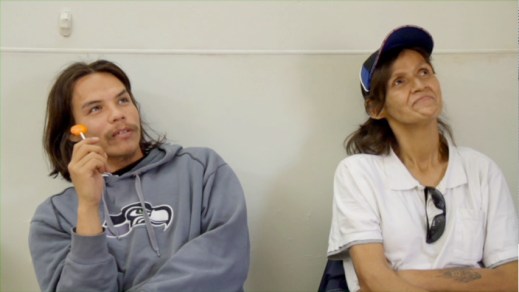
A mother and son of First Nations ancestry sit in the waiting area of a methadone clinic in Vancouver’s Downtown Eastside, their attention directed toward an offscreen TV. A cartoon plays, featuring an instrumental version of “I’ve Been Working on the Railroad” that mingles with the operating sounds of the clinic and ambience from the street outside. The tune is punctuated by a metal clinking sound at the beginning of each bar, calling to mind the sound of driving railway spikes that once echoed just down the street as the City of Vancouver was incorporated as the western terminus of the Canadian Pacific Railway (beginning thus the cycle of state-sanctioned erasure of indigenous title to the land). The familiar voice of Bugs Bunny chimes in: “Uh, what’s all the hubbub, bub?”
.
Hubbub indeed. Let’s unpack it.
The scene appears one third of the way through East Hastings Pharmacy (Antoine Bourges, 2012), a quasi-documentary set entirely within this clinic, staging interactions between methadone patients (played by locals and informed by their real-life experiences) and the resident pharmacist (played by an actress). Vancouver’s Downtown Eastside, dubbed Canada’s “worst neighborhood” for its notorious concentration of transients and public drug use, is also home to the largest community of First Nations peoples within the city limits, a product of the long history of dispossession in the surrounding areas. When the film presents this indigenous pair listening to a Hollywood fabrication of the sounds that marked their loss of title to the city it is a potent juxtaposition, especially given the American infiltration of Vancouver’s mediascape since the 1970s. Long known as “Hollywood North,” Vancouver is more famous as a stand-in for myriad other parts of the world than for representing itself, its regional specificity endlessly overwritten with narratives that hide the city and its indigenous presence from public awareness.
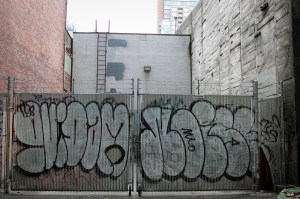
“Quidam + Noise” graffiti in Downtown Vancouver, April 6, 2013, by Flickr User Kevin Krebs
In her essay “Thoughts on Making Places: Hollywood North and the Indigenous City,” filmmaker Kamala Todd stresses how media can assist the process of re-inscribing local stories into Vancouver’s consciousness. East Hastings Pharmacy is one such example, lending some screen time to urban Natives in the 21st Century city. But Todd reminds us that audiences also have a responsibility “to learn the stories of the land” that have been actively erased in dominant media practices, and to bring this knowledge to our experience of the city in all its incarnations (9). Todd’s call resonates with a process that Nicholas Blomley calls “unsettling the city” in his book of the same name. Blomley reveals Vancouver as a site of continual contestation and mobility across generations and cultural groups, and calls for an “unsettled” approach that can account for the multiple overlapping patterns of use that are concealed by “settled” concepts of bounded property. With that in mind, I propose “unsettled listening” as a way of experiencing the city from these multiple positions simultaneously. Rick Altman taught us to hear any given sound event as a narrative by listening for the auditory markers of its propagation through physical space, and recording media, over time (15-31). Unsettled listening invites us to hear through these physical properties of mediatic space to the resonating stories revealed by the overlapping and contradictory histories and patterns of use to which these spaces are put, all too often unacknowledged in the wake of settler colonialism.
East Hastings Pharmacy provides a great opportunity to begin the practice of unsettled listening. The film’s status as an independent production amidst industrial shooting is marked by the intersection of studio-fabricated sound effects and direct sound recording, as in the example described above, and further complicated by the film’s own hybrid of fiction and documentary modes. That speaks to the complexity of overlapping filmmaking practices in Vancouver today, a situation embedded within the intersecting claims to land use and cultural propriety on the streets of Vancouver’s Downtown Eastside. To unsettle listening is to hear all these overlapping situations as forms of resonance that begin with the original context of the televised cartoon and accumulate as they spread through the interior of the clinic and outwards across the surrounding land. So let’s try this out.
.
The cartoon is Falling Hare (Robert Clampett, 1943), a good example of the noted history of cross-departmental integration at The Warner Bros.’ cartoon studios. The scene in question begins at 1:55, and here the metallic clinking sound is just as likely to have been produced by one of music orchestrator Carl Stalling’s percussionists as by sound effects editor Treg Brown. This integration can be heard in the way that the music’s unspoken reference to railway construction charges each clink with the connotation of hammer on spike. However, the image track in Falling Hare doesn’t depict railway construction, but rather a gremlin whacking the nose of a live bomb in an attempt to do away with enemy Bugs seated on top. James Lastra would say (by way of Christian Metz) that the clinking sound is “legible” as hammer on spike for the ease with which the sound can be recognized as emanating from this implied source (126). But this legibility is premised upon a lack of specificity that also allows the sound to become interchangeable with something else, as is the case in this cartoon.

Screen Capture from Falling Hare
East Hastings Pharmacy capitalizes on this interchangeability by re-inscribing the clinking sound’s railway connotations, first by stripping the original image and then by presenting this sound in the context of the dire social realities of Vancouver’s Downtown Eastside as the city’s sanctioned corral for the markers of urban poverty – and indigeneity – that officials don’t want to spill out across the neighborhood’s increasingly gentrified perimeter.
As one of a string of Warner Bros. cartoons put in the service of WWII propaganda, the Falling Hare soundtrack also resonates with wartime xenophobia and imperialist expansion, branches of the same pathos that leads to the effacing of indigenous culture from the consciousness of colonizing peoples. In Vancouver, this has taken the form of what Jean Barman calls “Erasing Indigenous Indigeneity,” the process of chasing the area’s original peoples off the land while importing aboriginal artifacts from elsewhere to maintain a Native chic deemed safe for immigrant consumption (as when the city paid “homage” to the vacated Squamish residents of downtown Vancouver’s Stanley Park by erecting Kwakiutl totem poles imported from 200km north on Vancouver Island) (26). This is an interchangeability of cultural heritage premised upon a lack of specificity, the same quality that allows “legible” sound effects to become synchretic with a variety of implied sources. And this process is not unlike the interchangeability of urban spaces when shooting Vancouver for Seattle, New York, or Frankfurt, emphasizing generic qualities of globalized urbanization while suppressing recognizable soundmarks from the mix (such as the persistent sound of float plane propellers that populate Vancouver harbour, the grinding and screeching of trains in the downtown railyard, or the regular horn blasts from the local ferry runs just north of the city).
The high-concept legibility of Warner Bros.’ sound effects – used in Falling Hare to play on listener’s expectations to comic effect – is further unsettled by its presentation within the context of documentary sound conventions in East Hastings Pharmacy. Bourges’ film commits to regional specificity in part through the use of location sound recording, which, as Jeffrey K. Ruoff identifies in “Conventions of Documentary Sound,” is particularly valued as a marker of authenticity (27-29). While Bourges stages the action inside the clinic, the film features location recordings of the rich street life audible and visible through the clinic’s windows that proceeds unaffected by the cameras and microphones. This situation is all the more potent when we account for the fact that, in this scene, the location-recorded cartoon soundtrack and ambient sound effects were added in post-production, and so represent a highly conscious attempt to channel the acoustic environment according to the conventions of “authentic” sound in documentary film.
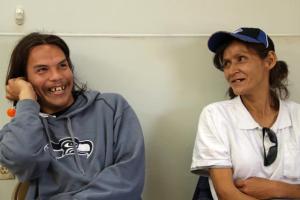
Screen Capture, East Hastings Pharmacy
While the film uses location recording as a conscious stylistic choice to evoke documentary convention, it does so to engage meaningfully with the social situation in the Downtown Eastside, underlining Michel Chion’s point that “rendered” film sound – fabricated in studio to evoke the qualities of a particular space – is just as capable of engaging the world authentically (or inauthentically) as “real” sound captured on location (95-98). By presenting this Hollywood cartoon as an embedded element within the soundscape of the clinic, using a provocative mix of location sound and studio fabrication, East Hastings Pharmacy unsettles Hollywood’s usual practice of erasing local specificity, inviting us to think of runaway projects in the context of their foreign spaces of production and the local media practices that sit next to them.
Finally, this intersection of sonic styles points to the complex relationships that exist between the domains of independent and industrial production around Vancouver. In his book Hollywood North, Mike Gasher argues for thinking about filmmaking in British Columbia as a resource industry, pointing to how the provincial government has offered business incentives for foreign film production similar to those in place for activities like logging and fishing. Here we can consider how the local film industry might follow the same unsustainable patterns of extraction as other resource industries, all premised upon willful ignorance of indigenous uses of the land. Yet as David Spaner charts in Dreaming in the Rain, the ability to make independent films in Vancouver has become largely intertwined with the availability of industrial resources in town. Just as Hollywood didn’t erase the independent film, colonization didn’t erase indigenous presence.
East Hastings Pharmacy offers a powerful example of how we can practice unsettled listening on the staged sound of Falling Hare, devoid of local context and connected to the railway only by inference, to reveal a rich integration with regional specificity as the cartoon’s auditory resonances accumulate within its new spaces of propagation. In this way we can hear local media through its transnational network, including the First Nations, to understand the overlaps between seemingly contradictory modes of being within the city. And in so doing, we can also hear through the misrepresentation of the Downtown Eastside as “Canada’s worst neighborhood” to the strength of the community that has long characterized the area for anyone who scratches the surface, an important first step along the path to unsettling the city as a whole.
—
Featured Image: Still from East Hastings Pharmacy
—
Randolph Jordan wanted to be a rock star. Academia seemed a responsible back-up option – until it became clear that landing a professor gig would be harder than topping the Billboard charts. After completing his Ph.D. in the interdisciplinary Humanities program at Concordia University in 2010 he floated around Montreal classrooms on contract appointments before taking up a two-year postdoctoral research fellowship in the School of Communication at Simon Fraser University. There he has been investigating geographical specificity in Vancouver-based film and media by way of sound studies and critical geography, research that will inform the last chapter of his book Reflective Audioviewing: An Acoustic Ecology of the Cinema (now under contract at Oxford University Press). If you can’t find him hammering away at his manuscript, or recording his three young children hammering away at their Mason & Risch, look for him under Vancouver’s Burrard Bridge where he spends his “spare time” gathering film and sound material for his multimedia project Bell Tower of False Creek. Or visit him online here: http://www.randolphjordan.com
—
 REWIND!…If you liked this post, you may also dig:
Fade to Black, Old Sport: How Hip Hop Amplifies Baz Luhrmann’s The Great Gatsby– Regina Bradley
Quiet on the Set?: The Artist and the Sound of a Silent Resurgence– April Miller
Play It Again (and Again), Sam: The Tape Recorder in Film (Part Two on Walter Murch)– Jennifer Stoever
Share this:


Current Top Posts





April 2021

January 2020

November 2019

October 2019

August 2019

April 2014

November 2017

March 2015

December 2017

October 2015
 Sounding Out!
Recent Comments