
Gendered Soundscapes of India, an Introduction

**This post was co-authored by forum co-editors Praseeda Gopinath and Monika Mehta
A note on the collection: Our original Call For Posts was for “Gendered Sounds of South Asia,” as we hoped to use this de-center India and explore terrain beyond cinema. However, the submissions that we received compelled us to recalibrate the framing of this forum, which will now focus on cinema and sound in India. It occurred to us once we received the pitches that there were structural reasons for the paucity of submissions on both South Asia and sound beyond cinema. The listservs on which the CFP circulated as well as the ways in which the CFP framed sound shaped the submissions. Intersecting sound with gender immediately invokes the female voice, since gender still signals the female. This invocation leads to the next term, “Indian film,” which dominates the region. That said, it is also possible that gender may not be a key lens for analyzing sound in current work on South Asia; noise regulation, caste, religion, ethnicity, and region might be more salient at the moment. We curated the current forum, “Gendered Sounds of India” to expand the terrain of what constitutes sound and voice in India, and through this means, these articles also offer new modes of listening.

Bow Bazar Area, Kolkata, West Bengal, 2011, Image by Flickr user Lorenzo, (CC BY-NC 2.0)
—
Praseeda Gopinath: My childhood is lived soundscapes. It’s revelatory to think about memory and self through the paradigm of sound, because it is only now that I realize that some of my abiding memories are shaped by sound, film, and voice. Urban Indian childhood meant inhabiting layers of sound, and learning to separate and parse the various layers in order of situational importance: the call of the ice-cream man from the call of the peanut-seller, depending on what you were in the mood for; raucous playful yelling of friends from your mother yelling to check on where you were; and of course, the ubiquitous sound of radios and televisions from various homes in your neighborhood. Your ear heard the professional cadences of the radio announcer or television announcements, but you were waiting for the film’s songs you liked, or the dialogue delivery of your favorite actor. If we heard Amitabh Bachchan’s distinctive baritone—the undisputed and worshipped Hindi film star of 70s-80s—we immediately stopped whatever we were playing at and listened to his voice as it drifted out on to the aether. He was the gendered voice of power and glamor emanating from invisible radios or televisions and seeping into our childish brains, defining sound, stardom, and most importantly, cool.
—
Our listening practices are discursively constructed. In the sonic landscape of India, in particular, the way in which we listen and what we hear is often normative, produced within hegemonic discourses of gender, class, caste, region, and sexuality. Today’s entry in the forum, Claire Cooley’s entry on the The Lor Girl (1933)–a film collaboration between Iranian expatriates and The Imperial Film Company–unpacks the ways in which the gendered voice and accent of the female protagonist become symptomatic of modernity in Bombay and Tehran. Class and modernity are rendered through the transformation of her voice and accent. In the process, gendered modernity is also produced and circulated through the film’s soundscape; The Lor Girl offers a lesson in listening, what and how to listen to gendered voice, sound, and accent. It reveals how the ear is trained to identify class, region, and the modern, discourses that continue to shape listening practices in contemporary India.
Similarly, Pavitra Sundar’s article on Falguni Pathak, a sought-after vocalist for heternormative and religiously-inflected Navaratri celebrations, reveals how Pathak’s vocalic body challenges heteronormative ideas about sexuality and gender and consequentially heteronormative listening practices. Sundar asks us to think about how “queerness” might sound in Indian public culture, and indeed, how this aural queerness might not necessarily align with the “queer timbre” theorized in Euro-American queer theory. Perhaps what seems most intriguing about Sundar’s analysis of Pathak is not just her elusive queer voice, but that it is this elusiveness, Pathak’s ability to slip between and across heteronormative aural spaces, that makes her vocal queerness both pervasive and difficult to label.

Women’s Radio Listening Group, Bhubaneswar, Odisha, India, Image by Flickr User UK Department for International Development, (CC BY-NC 2.0)
—
Monika Mehta: When I think of sound, an image surfaces of my mama (maternal uncle) reclining on a bed and cradling a transistor by his ear. The time is the late 1970s and the location, Railway Colony, Kishan Ganj, New Delhi, my maternal grandparents’ home. Thinking back, the transistor must have provided a sense of privacy, perhaps, even facilitated cultivation of a private self in a middle-class, bustling joint family; in such a family, home was not a private place. For better or worse, most things were shared. These shared objects included the radio, and later, the television, both of which were ensconced in the living room and functional, bulky, and ornamental, signaling middle-class status.
Unlike the radio and television, the transistor and the two-in- one were portable; they could be moved and held. The two-in- one was often transported to a grill-window of a bedroom where another mama (maternal uncle) loved listening to Talat Mahmood songs on it. While most Hindi song aficionados were fans of the playback singer Mohammed Rafi, he preferred Mahmood’s voice. For him, the cassette player enabled the cultivation of pleasure and fandom. What appears curious now was that it was mostly, if not exclusively, the male members of the family who were attached to the transistors and the two-in- ones. Similarly, in bazaars, on sidewalks, nears shops, men would cluster around these audio technologies, riveted by a cricket commentary, or at times, enjoying film songs. These technologies produced a sense of male privacy at home, and homosociality outside.
—
Technology is often imagined as a neutral entity, unaffected and unrelated to socio-economic divisions. Priva Jaikumar and Ronit Ghosh’s posts challenge this normative assumption by examining the relations amongst sound technology, gender, and the public.

Bengaluru, Karnataka, India, 2008, Image by Flick user Paul Weller (CC BY-NC 2.0)
Jaikumar discusses how the adoption of sync sound recording by Bombay filmmakers in the 1990s generates new forms of labor that are divided along lines of class and gender. Bouncers and sound-security personnel are drawn from lower-class migrant men, whereas the sound artists and engineers are recruited from the middle and upper classes. In both cases, women are excluded from working with or on sound. Ghosh demonstrates how the introduction of new recording technology in India in the 1930s privatizes listening experiences. If the consumption of live music occurred in public spaces, which could only be accessed by male audiences, then this new technology, not only provided a new listening experience, but made music available to middle-class female audiences. Both Ghosh and Jaikumar’s posts show that consumption, or the labor of sound in public, is masculinized whereas private sounds, or ones that require private labor, are feminized.
On a closing note, the posts offer snapshots of sound at sites of trans/national production, marketing, filmic and musical texts. Complementing these posts, the accompanying photographs offer glimpses of gendered community formation, homosociality, the pervasiveness of sound technology in India, and the discordant stratified soundscapes of the city. This series opens up for us the question of other contexts in India where sound, gender, and technology might intersect, but more broadly, it demands that we consider how sound exists differently in Pakistan, Sri Lanka, the Maldives, Bangladesh, Bhutan, Nepal, and Afghanistan. How might we imagine a sonic framework and South Asia from these locations?
To read all of the posts in the forum, click here.
—
Praseeda Gopinath is an associate professor of English at SUNY Binghamton and author of Scarecrows of Chivalry: English Masculinities after Empire (University of Virginia Press, 2013).
Monika Mehta is an associate professor of English at SUNY Binghamton and author of Censorship and Sexuality in Bombay Cinema (University of Texas press, 2011).
—
 REWIND! . . .If you liked this post, you may also dig:
Sounding Out Tarima Temporalities: Decolonial Feminista Dance Disruption–Iris C. Viveros Avendaño
Lokananta: Sounds of Crisis and Recovery from Indonesia’s National Record Company–Ian Coss
Tape Hiss, Compression, and the Stubborn Materiality of Sonic Diaspora–Chris Chien
Share this:

(Re)Locating Soundscapes of Schooling: Learning to Listen to Children’s Lifeworlds

 Here at Sounding Out! we like to celebrate World Listening Day (July 18) with a blog series that focuses on the importance of listening. This year, we bring your attention to the role of listening when it comes to the sounds of the K-12 classroom, and by extension, the school.
Any day in a K-12 school involves movement and sounds day in and day out: the shuffling of desks, the conversations among classmates, the fire drill alarm, the pencils on paper, the picking up of trays of food. However, in many conversations about schools, teaching, and learning, sound is absent.
This month’s series will have readers thinking about the sounds in classrooms in different ways. They will consider race, class, and gender, and how those aspects intersect how we listen to the classrooms of our past and our present. More importantly, the posts will all inspire assignments that educators at all stages can use in their classrooms. Our first post came from Shakira Holt, a playlist of her black girl students’ songs as philogynoir. Our second post was penned by Caroline Pinkston, and in it she questions common classroom management strategies for quieting a classroom instead of listening to students. Today’s post comes from the point of view of a student, teacher, and now researcher, who reflects upon how we listen to the sounds (and students!) in our classrooms.
Time’s up, pencils down, let’s take our notebooks outside to the playground and listen along with Cassie J. Brownell. –Liana Silva, Managing Editor
—
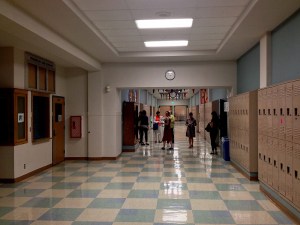
“Franklin High School, Seattle WA: Representative Hallway” by Flickr user Joe Wolf, CC BY-ND 2.0
I have spent much of my life listening in schools. I essentially grew up in the public elementary school in Montana where my mother taught for over 40 years. The sounds of my childhood are those of feet squeaking on the tile floor of the hallways, the bounce of a kickball in the gym, and the slam of desks opening and closing throughout the day.
Across my elementary school years, I spent many early mornings attempting to write my name in cursive with a squeaky dry erase marker on the whiteboard in her classroom. Other mornings, I rapidly clicked the keyboard as I played Oregon Trail alongside two friends whose guardians also worked at the school. After school, I chased these same friends across the schoolyard, shot hoops with them in the gym, or discovered new worlds in the stacks of the library. The whipping Montana winds on the open playground later gave way to new sonic experiences, as I transitioned from elementary student to classroom teacher and, eventually, educational researcher.

“School Supplies 02” by Flickr user Derek K. Miller, CC BY-NC 2.0
When I later became a teacher at an elementary school in post-Katrina New Orleans, Louisiana, the chorus of sounds from my childhood reverberated around me. The delightful shrieks of children on the playground and the sounds of trays being stacked after lunch were familiar. So, too, was the daily stacking of chairs. The frequencies of childhood, both my own and that of my students, informed my entrée into teaching. The familiar rhythms of pencil sharpeners and stapled butcher paper were welcoming waves as I settled into not only my new role, but my new school community in the neighborhood of Algiers Point. Yet, with the opening bells of the school year at this New Orleans elementary school, I began to hear schooling in new registers.
***
On my first day of teaching, I was acutely attuned to the “noise” the second-grade children in my classroom made—sounds I had not been aware of as a student. I quickly tried to “correct” their behavior with promises of external rewards if they could only make better “choices,” including quieting themselves to listen to me. Yet, few of the classroom management “tricks” I had learned in my educational training seemed to work. After the last child walked away from the schoolyard, I crumbled in the classroom of my mentor teacher. Crying, I told her I was not cut out for such work. She laughed as she told me that to be a teacher I must (re)learn to listen to the sounds of my classroom.
In time, I learned to listen. The day-to-day sounds of teacher-directed schooling, or what I now know as the banking model of education, quickly gave way to my listening to children. I slowly learned the value of listening to the whispers of children as they read, the scuffle of their feet as they sought a different color crayon from a child at another table, and the wise words they shared with one another about how they used an alternative route to solve a given math problem. I listened to them too when they found my hand to hold during recess and the high-fives before they departed each day. Rather than hearing their sounds as unruly chatter, I opened my ears to the excitement and learning children were sharing with one another.

“Reading%20Fun%20Day%202013%20Jun%2014,%202013%2010-20%20AM” by Flickr user K.W. Barrett, CC BY 2.0
That semester Hurricane Gustav appeared in the Gulf Coast. The impending arrival of the storm coincided with the three-year anniversary of Hurricane Katrina. As the whole city of New Orleans was encouraged to evacuate, I felt the resonances from Katrina’s devastating impact in the stories and questions of my second-grade students. As Gustav approached, many of the children shared In the final days before we evacuated, we commemorated Katrina and shared hopes for protection during Gustav.
While I listened to their words, I also learned to listen to their bodies. I could hear their worries about the storm in their hugs, the intonation of their voices, and in their reactions to thunderstorms shaking our classroom windows. As a bodily experience, multimodal listening quite literally moves beyond just what our ears can hear to how sound moves across/through/with bodies, materials, and contexts. Through multimodal listening, listeners can develop their skills as both critical consumers and producers of sound. Listeners are thus better positioned to reflect on and identify how sound informs other sensations and feelings. Although I have only recently put words to what it means to engage in multimodal listening, my body was already experienced with it.

“Gustav 038” by Flickr user Jim Hobbs, CC BY-NC 2.0
I returned to the city almost two weeks later, after the Gulf Coast suffered the one-two-punch of Hurricanes Gustav and Ike. Whispers of wind rustled art supplies by sneaking through fresh cracks in the windows. As my colleagues and I hurriedly re-vamped our classrooms, the traditional staccato sounds of schooling slowly echoed in my ears. In the quiet clean-up of the storm, new frequencies of the school soundscape could be heard. This soundscape was not new in and of itself, but rather it was the absence of the consistent beat that harmonized the everyday sounds to which I had become attuned. Without the slap of a jump rope on the ground or the cheers of children playing kickball to punctuate the silence, waves of emotion—despair, hope, and uncertainty—underlying the soundscape of schooling I thought I knew became apparent to me for the first time.
***
As an educational researcher in an urban, elementary classroom in the Midwest, I now find myself hearing other frequencies of schooling that remained unheard even in my early teaching. In my new role, my job is to engage in multimodal listening at all times as I participate in elementary classrooms. As a teacher in New Orleans, I was only just beginning to engage in the task of multimodal listening that Ceraso describes. Still today, I am often still attempting to hear and feel all the vibrations happening around me. Yet, as a researcher, I can attend more fully to the task of listening.
Unlike when I was teaching, I do not need to adhere to strict policies regarding the learning of a group of students, but I can instead take an exploratory approach to learning alongside children. Specifically, in collaboration with a culturally and linguistically diverse group of 3rd-grade children in Mr. Holiday’s classroom this past year, I started to earwitness the ambient soundscapes of children’s life spaces. Although I first began listening with the children at Community School J three years earlier, I entered in to Mr. Holiday’s class this year interested in considering the ways children were engaging with and drawing upon various cultural, linguistic, and modal experiences to communicate. I did so aware that, for many historically marginalized children, such communicative practices are often overlooked or unheard in standardized curricular materials.
Mr. Holiday challenged his students to think—and hear—beyond the standardized curriculum by considering how sound can be a tool to write with and through.
“You’re writing, but you can use words, pictures, you can sketch…anything you want to,” Mr. Holiday shared with his class of diverse 3rd graders one day. “Just remember to listen. When we come back inside, we will all share what we heard and then we will talk about how we could use this in our stories about our school.”
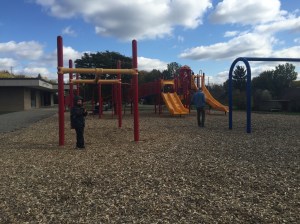
Photo courtesy of author
Outdoors, a low-flying plane could be heard. With little bodies quietly kicking them back-and-forth, swings creaked. On the playground, we listened to the whipping wind and felt the cool fall weather on our skin. From the slide, one child sounded out for his peers the word chilly, stretching the ls as long as he could. The mulch of the dry ground was kicked by one child as another, with her stomach on the seat of a swing, pushed the ground under her feet to glide back-and-forth.
Some children imagined the empty playground to be filled with the familiar sounds of their daily recesses. Others began to set strict boundaries for how they and their peers might begin to listen. In an attempt to control the bodies of her peers, one girl sent away her friend, suggesting that they could not hear together. Almost simultaneously, another child silently waved from the highest playground tower to the three boys from her class seated closely next to each other on a bench.
As Mr. Holiday called for all children to make a line outside his classroom door, a cacophony of cheers and groans lurched from the children as they sprinted from their observation sites.
“Look at how much I noticed!” one little boy shouted as he handed his notebook to me with a list of sounds. He included sounds heard in the moments we were outdoors like the airplane, but he also included imagined shrieks of children at play.
***
The sounds of elementary schooling have shown me that much of classroom teaching and learning needs to be grounded in listening. From the structured directions—like those presented by Mr. Holiday—to the daily screams of children racing across the school grounds. In other words, we must listen to children, to their experiences, and to their emotions in order to critically consider how schooling, as a space, informs and is informed by children’s bodies and sounds.

“Teachers” by Flickr user Jane Selomulyo, CC BY-NC-ND 2.0
I sometimes wonder what frequencies and rhythms are unheard. With each passing observation in a school, I question whether Western schooled notions of listening contaminate the uniquely trained ears of children. As I observed in the listening exercise with Mr. Holiday’s class, children were capable of engaging in multimodal listening: they not only heard, but felt the wind; they created and felt the vibrations of the swings. They imagined the movement of bodies across the playground and cacophony of sounds and emotions that accompanied them. All of these were embodied sounds I missed as an adult and classroom teacher.
At the same time, I remain hopeful. I am hopeful because the children I came to know in Mr. Holiday’s classroom took the task of listening seriously. They understood hearing as more than simply about the cars passing by or the birds in the nearby trees, but instead engaged in listening with their bodies. Throughout the year, I noticed they were acutely aware of the sniffles or the slow shuffle of feet of a peer who was having a rough day. Their eyes grew large as they danced along with their friends on brain breaks and they often cheered with the whir of a fidget spinner balanced on their teacher’s thumb.
This hope is also based in my various sonic experiences, across spaces and places that visually appear quite different. Teachers interested in learning to listen with their students might consider how they, like Mr. Holiday, might foreground sound as a mode of primacy within the perceived constraints of the mandated curriculum. Engaging in a multi-sensory experience may be as simple as Mr. Holiday’s listening task on the familiar grounds of the schoolyard. Or, perhaps, it is starting your curriculum with the children’s stories of their lived experiences as I did in New Orleans. As others have discussed, when it comes to listening, there is not a clearly defined beginning or end as there does not exist a “blink of an ear.” I am slowly becoming more attuned to the sonic possibilities of how children’s stories and experiences of schooling may be amplified if we, as Mr. Holiday shared, “Just remember to listen.”
—
Featured image: “listen” by Flickr user Ren:), CC BY-ND 2.0
—
Cassie J. Brownell is a doctoral candidate and Marianne Amarel Teaching and Teacher Education Fellow in the Department of Teacher Education at Michigan State University. A corecipient of a 2015 NCTE-CEE Research Initiative Grant, Cassie’s most recent collaborative project—#hearmyhome—explores how writing with and through sound might help students and teachers attune toward literacies and communities of difference.
—
 REWIND!…If you liked this post, you may also dig:
SO! Amplifies: #hearmyhome and the Soundscapes of the Everyday–Cassie J. Brownell and Jon M. Wargo
(Sound)Walking Through Smithfield Square in Dublin— Linda O’Keeffe
A Listening Mind: Sound Learning in a Literature Classroom–Nicole Furlonge
Share this:


Current Top Posts





April 2021

January 2020

November 2019

October 2019

August 2019

April 2014

November 2017

March 2015

December 2017

October 2015
 Sounding Out!
Recent Comments