
Surf, Sun, and Smog: Audio-Visual Imagery + Performance in Mexico City’s Neo-Surf Music Scene

Riding the Surf Wave in a City Without a Seashore
On April 24, 2005, at Zócalo square in downtown Mexico City, the Surf y Arena music festival gathered around 100,000 people and nine bands, ranging from local, barely known groups to big names in the new-wave surf music scene: Fenómeno Fuzz, Los Magníficos, Perversos Cetáceos, Espectroplasma, Los Elásticos, Yucatán A Go-Go, Sr. Bikini, Lost Acapulco, and Los Straitjackets, the latter being the only U.S. band in the festival. One year before, hardly more than a thousand people attended the event, organized in a smaller venue at Alameda del Sur, a few hundred yards south of Zócalo square. Perhaps not even the bands were prepared for the huge response in 2005. Interviewed by local newspaper La Jornada, Fenómeno Fuzz lead guitarist stated, “It’s the first time we see something like this, with so many people. Surf is an instrumental rock genre that was played in the 50s and 60s. There is no sand or sun here as in Acapulco, but we’ve brought downtown a bit of the beach vibe. In Mexico City there must be some 40 bands playing to this rhythm.” In the same interview piece, Lost Acapulco lead guitarist El Reverendo considered, “this festival is a success, for you realize this music is going up. People are on the same pitch. This is not a movement, but a style with many followers. […] It doesn’t matter if there is no beach here—you have to imagine it.”
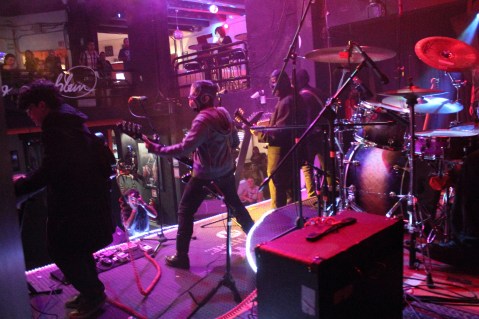
Sr. Bikini at Rock and Road on 30 de Marzo 2013, Image by Flickr User José Miguel Rosas (CC BY-SA 2.0)
The bands who played at the 2005 Surf y Arena Festival wondered whether the success was transitory or would endure. More than a decade later, some are still active, most notably Lost Acapulco, whose singles and compilations have been released in countries like Spain, Italy, and Japan; they have toured around the world, and have released a new EP, Coral Riffs (2015). Los Straitjackets lead guitarist Danny Amis has collaborated with local surf bands like Lost Acapulco and Twin Tones; after surviving a hard battle against cancer, he moved to Mexico City’s Chinatown. Los Elásticos also released a new album, Death Calavera 2.2, the Espectroplasma members formed Twin Tones and have played, toured and participated in the short film inspired by their first record, Nación Apache. In 2016, the Wild’O Fest brought together old and new surf stars, starring The Fleshtones (U.S.) and Wau y los Arrrghs! (Spain), as well as local legends Los Esquizitos and Lost Acapulco. In February 2017, the Russian band Messer Chups toured across Mexico, playing with local bands in several cities. So it seems the scene is alive and kicking.
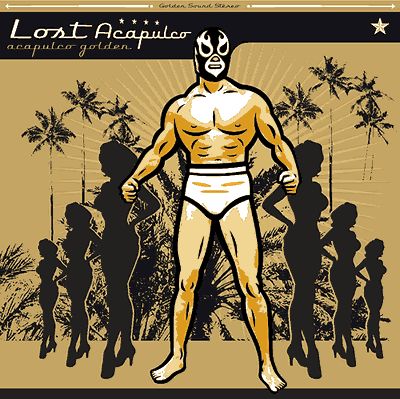
Lost Acapulco’s LP Acapulco Golden cover art by Dr. Alderete (2004). Masks became a famous trait of Mexican surf music. Danny Amys from Los Straitjackets and some Lost Acapulco members wear them on stage, as well as many other surf bands. This cover echoes films from the 50s and 60s featuring wrestlers like Santo and Blue Demon.
Today we can listen to how surf music shaped part of Mexico City’s underground music scene in the last decade of the 20th century and the early 21st. Being 235 miles away from Acapulco, one might wonder how wearing sandals, short pants, floral print shirts, plastic flower necklaces, and dark sunglasses became trendy in the country’s capital city. To this beach imagery, surf bands and fans added references to classic Mexican media icons, like wrestler Santo, comedian Mauricio Garcés, and black and white sci-fi movies. The work by visual artists like Dr. Alderete—who has designed covers and posters for many surf bands, such as Lost Acapulco, Fenómeno Fuzz, Telekrimen, The Cavernarios, Los Corona, among others—has been crucial for this imagery cross-reference process.

Lima-based visual art magazine Carboncito cover art by Dr. Alderete (2012). The cover features Kalimán, main character of an old Mexican comic strip, as well as other characters associated both with surf imagery (the Rapa Nui statue, oddly resembling a bamboo Tiki figure) and spy films like James Bond.
In this article I portray the neo-surf music scene in Mexico as a cultural-musical set of audiovisual and performative traits shared, modified, and transmitted by the scene’s partakers. It cannot be said there is a surf music “urban tribe” (a trendy concept for several years in Mexican youth studies), but rather shared “aesthetic” expressions of cultural syncretism, responding to the increase of atomization and alienation in Mexico City.
Just as in ska, punk, or hardcore rock, a number of surf concert attendees participate in typical genre-related rituals like moshing. Surf fans, however, are more “performatic” in the way Diana Taylor understands this term in The Archive and the Repertoire as “the adjectival form of the nondiscursive realm of performance” (6). Several surf concert goers wear masks, originally worn by notorious Mexican wrestlers like Santo, Blue Demon, and Rey Misterio (whose son would later become a WWE star). At the concert, when a song’s tempo suddenly stops or changes, masked dancers pose as if weightlifting, jump and crowd surf, stage fights, and mimic swimming movements. Surf music is the lyric-less soundtrack for the intertwined performance of different cultural traits, portraying a prolific tension between a hedonistic attitude associated with an invented nostalgia for West Coast surf culture, and the halo of exoticness surrounding Mexican culture in the U.S. imaginary, as portrayed by surf bands and artists (just to name a few, Herb Albert’s “Tijuana Taxi,” Link Wray’s “Tijuana,” and Los Straitjackets’ “Tijuana Boots”).
Mosh pit with masked participants. On stage, Lost Acapulco plays “Frenesick.” Multiforo Alicia, Mexico City, March 20 2009.
Tracing the Origins of Mexican Neo-Surf Music Scene
1960s Mexican rock and garage bands do not usually have instrumental songs in their repertoire, as is the case with Los Sleepers, or Los Rockin’ Devils. However, there are some examples of incursions in surf-related instrumentals, such as Los Teen Tops’ “Rock del diablo rojo,” or Los Locos del Ritmo’s  “Morelia.” It was not until Toño Quirazco (1935-2008) formed Quirazco y sus Hawaian Boys, though, that we find a Mexican instrumental song, “Surf hawaiiano,” explicitly using the noun “surf” as an identity marker, just like “Traveling Riverside Blues,” or “Jailhouse Rock”. The use of a pedal steel guitar (portrayed in their 1965 eponymous album cover photo), and its association to Hawaiian music through the slide guitar method, makes exotism an early sonic feature of Mexican surf. Born in Xalapa, Veracruz, Quirazco was not as famous as Los Teen Tops or Los Locos del Ritmo, but he is a key forerunner not only of surf music, as he is also known for having introduced ska to Mexican audiences, with songs like “Jamaica Ska” and “Ska hawaiano,” both off his album Jamaica Ska, also from 1965.
Although surf music bands suffered heavily with the arrival of the British Wave, not all of them disappeared. Bands such as The Ventures became famous for covering surf standards. Others, like The Beach Boys, eventually migrated to different music styles. Later in the 1970s and 80s, bands like The Cramps, The Stray Cats, and The Go-Go’s kept alive surf-related styles, so that by the time Pulp Fiction appeared, in 1994, there were some interesting bands we already can consider “neo-surf,” such as Man Or Astroman? and The Tantra Monsters; Los Straitjackets re-formed and Dick Dale began touring again. Quentin Tarantino’s soundtrack to Pulp Fiction (including songs by Southern California surf rockers Dale, The Tornadoes, The Revels, The Centurians, and The Lively Ones) contributed to bringing surf music back to mainstream attention, now as a vintage sound commodity (Norandi, 2002).
We might call this “the Pulp Fiction effect,” a phenomenon recognized by stakeholders in the scene, like Los Esquizitos guitar and theremin player Güili:
One day Nacho came up with the idea that we should play surf, because it was the moment in which […] in Satélite [a northern Mexico City neighborhood ] all bands wanted to play funk like Red Hot Chili Peppers or Primus. It became a virtuoso slap competition, and precisely no one was playing surf […]. Shortly afterwards, Tarantino’s Pulp Fiction was released and surf exploded impressively with the movie’s theme. But we were already riding the surf wave.
Multiforo Alicia has been an important venue for the consolidation not only of a surf scene, but also of other emerging movements at the time. Founder and owner Ignacio Pineda remembers,
When we started Multiforo Alicia [in 1995], there was a generational shift. There were a lot of new bands that didn’t fit into what had been going on in the last 10 or 11 years, and they were the punk rock, ska, hip-hop, transmetal, emo, and nu metal movements, which nowadays are quite normal. […] Luckily for us, [Alicia] was like home for all of them.
Interview with Multiforo Alicia owner Ignacio Pineda, 2011
It is a common venue for surf bands (Norandi, 2002, Caballero, 2012), and through their recording label, Grabaxiones Alicia, they have produced albums for some of the most interesting instrumental rock projects in Mexico, among them Twin Tones/Espectroplasma/Sonido Gallo Negro (three groundbreaking bands with the same members), Los Esquizitos, Los Magníficos, Telekrimen, The Cavernarios, and Austin TV. Massive festivals and concerts, like Vive Latino or Surf y Arena, have also contributed to positioning neo-surf as an ongoing trend in alternative rock.
Masking Identity, Performing Difference
While the emergence of Mexican neo-surf was contingent upon local and international music trends in the mid-90s, its permanence has been due to processes of cultural syncretism and appropriation. Wrestler masks are a good example. Worn first by Danny Amis, and later on by Los Esquizitos and Lost Acapulco, masks quickly spread out as a neo-surf visual icon. Los Esquizitos drum player, Brisa, doesn’t remember there being an aesthetic justification behind the masked man using a chainsaw portrayed in their first album cover. Nacho complains, “Argh! We created a monster unawares! Ah, I sometimes regret that. I really regret having worn masks at a concert.”
Los Esquizitos greatly contributed to blend a Mexican surf flavor through their imagery on stage, as well as with their most emblematic song, “Santo y Lunave.” One of the few songs with lyrics in the scene (and with spoken word rather than singing), it tells story of how Santo got lost in space, turning him into an important figure of Mexican neo-surf imagery. As Güili recognizes, “I think it was after the ‘Santo’ song when all the Tetris pieces fit perfectly into place—wrestling, masks, floral print shirts, surf— everything in the same box.”
Live version of “Santo y Lunave” by Los Esquizitos, Vive Latino Music Festival, Mexico City, May 17, 2009. The song was originally released in their first LP (1998)
“Performatic” moshing is another example of cultural appropriation. The apparently random movements of moshers in heavy metal concerts have been compared to the kinetics of gaseous particles (as in Silverberg, Bierbaum, Sethna & Cohen’s “Collective Motion of Moshers”) but in surf concerts their movements cannot be reduced to the categories of “self-propulsion,” “flocking” and “collision.” Here moshers interact in more complex ways, mimicking wrestling movements to the rhythm of the song in turn, enacting fights between masked and unmasked opponents, and helping other moshers to jump over the audience and crowd surf. They consciously perform the icons they associate with surf culture. They are aware of the differential traits existing between this and other rock sub-genres, and they externalize them through ritualized behaviors. In other words, Mexican surf concert goers adopt moshing to participate in simulacra about stereotyped representations of Mexican culture and subjects.
Dancing Desires
In his book Popular Music: The Key Concepts (2nd ed), Roy Shuker describes surf as “Californian good time music, with references to sun, sand and (obliquely) sex” (2005, 262). This sexual suggestiveness is still present in Mexican neo-surf, as can be noticed in songs like Fenómeno Fuzz’s “El bikini de la chica popof” [“The Snob Girl’s Bikini”]:
Ella viene caminando en su bikini de color,
ella viene caminando y a todos nos da calor,
y sus piernas bien bronceadas me hacen suspirar.
Ella viene caminando y no ve a nadie más.
[She’s walking by, wearing her colorful bikini,
she’s walking by and everyone gets hot,
and her well-tanned legs make me sigh.
She’s walking by and doesn’t look at anyone else]
Other bands seem to reinforce this fetishization. Sr. Bikini have sometimes hired women dancers wearing masks and bikinis for their shows, and Los Elásticos have a permanent member, La Chica Elástica, who dances in every live show.
[Final part of a Los Elásticos concert in 2012, featuring La Chica Elástica. All-men and all-women mosh pits can be seen at 0:40 and 3:36.]
However, even though sometimes subject to hedonistic and stereotyped representations, women participate in every level of the scene, expressing agency as band members, scenemakers, and/or fans. Women play in the most representative bands, such as Fenómeno Fuzz’s former singer and bass player, Biani, or Los Esquizitos drummer, Brisa. There are also all-woman bands, such as Las Agresivas Hawaianas (whose brief existence is scarely documented on the internet), rockabilly trio Los Leopardos, and garage-oriented Ultrasónicas, whose members have continued playing solo, most notably Jessy Bulbo.
Offstage, both genders wear masks and enter the pit. Sometimes, when there are many moshers, men and women gather in separate pits. Dancing is much more prominent in the surf scene than in punk; participants appropriate a go-go, swing, rock ‘n’ roll, and ska dancing moves, mixing them with wrestling and weightlifting positions. The attendees accomplish their middle-class expectations of leisure and entertainment by showing off their outfits, feeling desire, desired and/or admired (even if ironically) through dancing and moshing—literally by performing such expectations in situ.
The scene overall, has been critiqued for being too retro and insulated from political critique. As La Jornada‘s Mariela Norandi points out, “an element that the Mexican movement has inherited from the origins of surf is the lack of ideology. Curiously, surf is reborn in Mexico in a moment of political and social unrest [in the mid-90s], with the Zapatista uprising, the peso devaluation, Colosio’s murder, and Salinas’ escape” (2002, 6a). The fact that this scene has survived for over two decades, despite the many economic and political crises Mexico has faced ever since, suggests it works as an ideological outlet for scene partakers to elude their social reality. Just as it happened in the 60s with the Vietnam War, once again surfers stay away from social and political problems, and reclaim their right to have fun and dance. They wear their floral print shirts and dance a go-go style, remembering those wonderful 60s (6a). For Norandi, the lack of lyrics in surf music may be partly responsible for most surf bands seemingly uncritical position.
Into the Surf Sound
Although half of Mexico’s states have a seashore, surf music in the capital is related to everything but actual surfing. The imagery built around it, considered “surrealistic” by Norandi (6a), is the most visible novelty in the new scene, since melodically and rhythmically speaking surf remains fairly simple, like garage or punk. However constrained, like other genres, to the 12-bar blues progression, it is in timbre where we appreciate how surf sound has been defined by several generations of music bands and players. A triple-level approach to surf music (timbral, melodic, and stylistic) can account for the creation and development of several genres or scenes associated to the rise of Mexican neo-surf, like chili western (Twin Tones, Los Twangers, The Sonoras), space surf (Espectroplasma, Telekrimen, Megatones), garage (Ultrasónicas, Las Pipas de la Paz) and rockabilly (Los Gatos, Eddie y Los Grasosos, Los Leopardos, among many others).
Appropriation, practiced through covering standards and imitating riffs and melodies, has been always crucial for shaping the surf sound, just as it was in preceding genres that influenced rock ‘n’ roll, like blues, twist, and jazz. Although not exactly referred to as “surf standards,” there are some foundational songs that shaped the surf sound. Three pieces nowadays still debated as the first surf song—Duane Eddy’s “Rebel Rouser,”Link Wray’s “Slinky,” and Dick Dale’s “Miserlou”—influenced not only contemporary bands and their immediate successors, but also musicians in the ’90s wave.
These and other composers contributed collectively to establishing surf music’s standard traits: the 4/4 drum beat (whose earliest template may be Dale’s “Surf Beat”), the “wavy guitar” riff (perfectly illustrated in the beginning of The Chantay’s “Pipeline”), an extensive use of reverb, and the appropriation of “exotic” tunes (such as the Lebanese melody that inspired Dale’s tremolo style in “Miserlou”). Many surf songs contain, in particular, traits from “Slinky’s” guitar and “Surf Beat’s” drums. Both are simple and repetitive, but can be combined with other arrangements at will. This formula has been used in countless surf songs ever since.
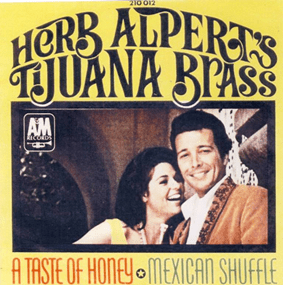 Covering is a way of making connections with specific songs, and paying homage to (or deflating) admired bands and musicians. Links between a band and certain collaboration networks are thus established. Sr. Bikini covered Alpert’s instrumental version of The Beatles’ “A Taste of Honey,” setting up a dialogue with a musician that played a lot with Mexican stereotyped imagery and sounds (like the trumpets, substituted by electric guitars in Sr. Bikini’s version).
Lost Acapulco renamed The Trashmen’s “Surfin’ Bird” as “Surfin’ Band,” participating in a long chain of covers (including The Cramps and The Ramones) of a song that in turn was the result of mixing two pieces by The Rivingtons, “Bird’s The Word” and “Papa Oom Mow Mow.” Los Esquizitos have their own covers of The Cramps’ “Human Fly” (“El moscardón”) and Rory Erickson’s “I Walked With A Zombie.”
Los Magníficos’ “Píntalo de negro,” after The Rolling Stone’s “Paint It Black,” shows that, just as in punk, any piece can be turned into a surf song.
Sometimes it is just a trait (a riff, or a beat) that is referenced. Fenómeno Fuzz’s initial riff in “Tiki Twist” resembles Chuck Berry’s “Johnny B. Goode,” whereas two chili western songs (“Transgenic Surfers” by Los Twangers and “Skawboy” by The Bich Boys) echo The Ramrods’ harmonic and timbral arrangements for “Riders In The Sky,” another song with a long cover history, including Dale, Johnny Cash, and Elvis Presley. A surf version of this song was familiar to Mexican TV viewers in the 90s, since it was a regular soundtrack of furniture store Hermanos Vázquez spots.
Surf was born at a time when stand-alone effects units were just about to change the way music was made, taking audio manipulation off the studio and bringing it to the stage. For example, The Shadows are known for having used the tape-based Watkins Copicat, “the first repeat-echo machine manufactured as one compact unit” according to Steve Russell, responsible for the guitar delay effect in their 1960 rendition of Jerry Lordan’s “Apache,” since then a surf standard. In his book Echo and Reverb, for example, Peter Doyle examines how effects like echo/delay and reverb shaped sonic spatiality in 20th century popular music recording in the U.S., from hillbilly, country, blues, and jazz to rock ‘n’ roll.
Although Doyle only dedicates a few paragraphs to Dale, Wray, and surf instrumentals, acoustic effects greatly contributed to characterize their styles as well. Some traits are intricately related to genre specific manifestations, like the double bass in rockabilly, or the twang effect in chili western. Timbre, then, is the aural counterpart to the scene’s visual aspect, “invoking the rich semiotic traditions that wove through southern and West Coast popular music recording” (Doyle, 2005, 226). It has become a way both to continually define the genre and, in the Mexical neo-surf scene in particular, to overcome melodic and harmonic limitations. Thanks to timbral play, what used to be a blind alley in rock history became in the 1990s a mirror for young generations of Mexicanos to create and feel aligned with fashionable trends, and a sonic filter enabling them to examine their social situations and, sometimes, to willfully sidestep them.
—
Featured Image: Lost Acapulco in Estadio Azteca 2009, Image by Flickr User Stephany Garcia (CC BY-ND 2.0).
—
Aurelio Meza (Mexico City, 1985) is a PhD student in Humanities at Concordia University, Montreal. Co-organizer of the PoéticaSonora research group at UNAM, Mexico City, where he is in charge of designing and developing a digital audio repository for sound art and poetry in Mexico since 1960. Author of the books of essays Shuffle: poesía sonora (2011) and Sobre Vivir Tijuana (2015). Blog: http://aureliomexa.wordpress.com/
—
 REWIND! . . .If you liked this post, you may also dig:
Share this:

Listen to the Sound of My Voice

Betrayal
I first realized there was a problem with my voice on the first day of tenth grade English class. The teacher, Mrs. C, had a formidable reputation of strictness and high standards. She had us sit in alphabetical order row after row, and then insisted on calling roll aloud while she sat at her desk. Each name emerged as both a command and a threat in her firm voice.
“Kelly Barfield?”
“Here,” I mumbled quietly. I was a Honor Roll student with consistent good grades, all A’s and one B on each report card, yet I was shy and softspoken in classes. This was an excellent way to make teachers amiable but largely go unnoticed. The softness of my voice made me less visible and less recognizable.
Mrs. C repeated my name. Caught off guard, I repeated “here” a little more loudly. She rose to her feet to get a better look at me. I knew what she saw: a petite girl with long ash blonde hair, big brown eyes, and overalls embroidered with white daisies on the bib. When her gaze finally met mine, Mrs. C frowned at me and cleared her throat loudly. I curled into my desk, hoping to disappear.

“Lincoln High School 9-16-2007 008” by Flickr user Paul Horst, CC BY-NC 2.0
“Miss Barfield, did you hear me call your name twice? In this class, when I call roll, you respond.” I gave a quick nod, but Mrs. C wasn’t finished: “We use our strong voices in here, not our girly, breathy ones.” My cheeks flushed red while Mrs. C droned on about confidence and classroom expectations.
“Do you understand me?”
I stammered a “yes.” Mrs. C turned her attention back to the roll call. Her harsh words rang in my ears. I sank low in my chair, humiliated and angry. I couldn’t help that I sounded girly: I was, in fact, a girl. This was the way my voice sounded. It was not an attempt to sound like the dumb blonde she appeared to think I was.
That day I decided that I would never speak up in her class. Forget the Honor Roll. If the sound of my voice was such a problem, then my mouth would remain firmly shut in this class and all of my others. I would never speak up again.

“Listen” by Flickr user lambda_x, CC BY-ND 2.0
My vow to stop speaking lived a short life. I enjoyed Mrs. C’s serious fixation on diagramming sentences and her attempts to show sophomores that literature offered ideas and worlds we didn’t quite know. At first, I spoke up with hesitation and fear of the inevitable dismissal, but I continued to speak. Becoming louder became my method to seem confident, even when I felt anything but.
Throughout high school, my voice emerged again and again as a problem. Despite the increased volume, my voice still sounded tremulous, squeaky, hesitant, and shrill to my own ears. Other girls had these steady, warm voices that encouraged others to listen to them. Some had higher voices that were melodic and lovely. I craved a lower, more resonant voice, but I was stuck with what I had. In drama club, our director scolded me with increasing frustration about my tendency to end my lines in the form of a question. My nerves materialized as upspeak. The more he yelled at me, the more pronounced the habit became. He eventually gave up, disgusted by my inability to control my vocal patterns.

By Dvortygirl, Mysid [GFDL (http://www.gnu.org/copyleft/fdl.html) or CC-BY-SA-3.0 (http://creativecommons.org/licenses/by-sa/3.0/)%5D, via Wikimedia Commons
Meanwhile, at a big state university in my native Florida, I learned quickly that a Southern accent marks you as a dumb redneck from some rural town that no one had heard of. Students in my classes asked me to say particular words and then giggled at my pronunciations. “You sound like a Southern belle,” one student noted. This was not really a compliment. According to my peers, Southern belles didn’t have a place in the classroom. Southern belles didn’t easily match up with “college student. As a working-class girl from a trailer park, I learned that I surely didn’t sound like a college student should. I worked desperately to rid myself of any hint of twang. I dropped y’all and reckon.
I listened carefully to how other students talked. I mimicked their speech patterns by being more abrupt and deadpan, slowly killing my drawl. When I finally removed all traces of my hometown from my voice, my friends both from home and from college explained that now I sounded like an extra from Clueless. My voice was all Valley girl. I was smarter, they noted with humor, than I sounded and looked. My voice now alternated between high-pitched and fried. Occasionally, it would squeak or crack. I thought I sounded too feminine and too much like an airhead, even when I avidly tried not to. I began to hate the sound of my voice.
My voice betrayed me because it refused to sound like I thought I needed it to. It refused to sound like anyone but me.
When I started teaching and receiving student evaluations, my voice became the target for students to express their displeasure with the course and me. According to students, my voice was too high and grating. Screechy, even: one student said my voice was at a frequency that only bats could hear. In every set of evaluations, a handful of students declared that I sounded annoying. This experience, however, was not something I alone faced. Women professors and lecturers routinely face gender bias in teaching evaluations. According to the interactive chart, Gender Language in Teaching Evaluations, female professors are more likely to be called “annoying” than their male counterparts in all 25 disciplines evaluated. The sound of my voice was only part of the problem, but I couldn’t help but wonder if how I sounded was an obstacle to what I was teaching them.
Once again, I tried to fix my problematic voice. I lowered it. I listened to NPR hosts in my search for a smooth, accentless, and educated sound, and I attempted to create a sound more like them. I practiced pronouncing words like they did. I modulated my volume. I paid careful attention to the length of my vowels. I avoided my natural drawl. None of my attempts seemed to last. Some days, I dreaded lecturing in my courses. I had to speak, but I didn’t want to. I wondered if my students listened, but I wondered more about what they heard.
Sound

Public Domain, https://commons.wikimedia.org/w/index.php?curid=1393933
The sound of your voice is a distinct trait of each human being, created by your lungs, the length of your vocal cords, and your larnyx. Your lungs provide the air pressure to vibrate your vocal cords. The muscles of your larnyx adjust both the length and the tension of the cords to provide pitch and tone. Your voice is how you sound beyond the resonances that you hear when you speak. It is dependent on both the length and thickness of the vocal cords. Biology determines your pitch and tone. Your pitch is a result of the rate at which your vocal cords vibrate. The faster the rate, the higher your voice. Women tend to have shorter cords than men, which makes our voices higher.
Emotion also alters pitch. Fright, excitement, and nervousness all make your voice sound higher. Nerves would make a teenage girl have an even higher voice than she normally would. Her anxious adult self would too. Her voice would seem tinny because her larnyx clenched her vocal cords tight. Perhaps this is the only sound she can make. Perhaps she is trying to communicate with bats because they at least would attempt to listen.
Biology, the body, gives us the voices we have. Biology doesn’t care if we like the ways in which we sound. Biology might not care, but culture is the real asshole. Culture marks a voice as weak, grating, shrill, or hard to listen to.

“Speak” by Flickr user Megara Tegal, CC BY-NC-ND 2.0
My attempts to change my voice were always destined to fail. I fought against my body and lost. I couldn’t have won even if I tried harder. My vocal cords are determined that my voice would be high, so it is. The culture around me, however, taught me to hate myself for it. Voice and body seem to cast aspersions on intelligence or credentials. It’s the routineness of it all that wears on me. I expect the reactions now.
I wonder if I’m drawn to the quietness of writing because I don’t have to hear myself speak. I crave the silence while simultaneously bristling at it. Why is my voice a problem that I must resolve to placate others? How can I get others to hear me and not the stereotypes that have chased me for years?
Fury
My silence has become fruitful. The words I don’t say appear on the page of an essay, a post, or an article. I type them up. I read aloud what I first refused to say. I wince as I hear my voice reciting my words. I listen carefully to the cadence and tone. This separation of words and voice is why writing appeals to me. I can say what I want to say without the sound of my voice causing things to go awry.
People can read what I write, yet they can’t dismiss my voice by its sound. Instead, they read what I have to say. They imagine my voice; my actual sound can’t bother them. But, they aren’t really hearing me. They just have my words on the page. They don’t know how I wrap the sound around them. They don’t hear me.
Rebecca Solnit, in “Men Explain Things to Me,” writes “Credibility is a basic survival tool.” Solnit continues that to be credible is to be audible. We must be heard to for our credibility to be realized. This right to speak is crucial to Solnit. Too many women have been silenced. Too many men refuse to listen. To speak is essential “to survival, to dignity, and to liberty.”

“Listen” by Flickr user Emily Flores, CC BY-ND 2.0
I agree with her. I underline her words. I say them aloud. The more I engage with her argument, the more I worry. What about our right to be heard? When women speak, do people listen? Women can speak and speak and speak and never be heard. Our words dismissed because of gender and sound. Being able to speak is not enough, we need to be heard.
We get caught up in the power of speaking, but we forget that there’s power in listening too. Listening is political. It is act of compassion and empathy. When we listen, we make space for other people, their stories, their voices. We grant them room to be. We let them inhabit our world, and for a moment, we inhabit theirs. Yes, we need to be able to speak, but the world also needs to be ready to listen us.
We need to be listened to. Will you hear me? Will you hear us? Will you grant us room to be?
When I think of times I’ve been silenced and of the times I haven’t been heard, I feel the sharp pain of exclusion, of realizing that my personhood didn’t matter because of how I sounded. I remember the burning anger because no one would listen. I think of the way that silence and the policing of how I sound made me feel small, unimportant, or disposable. As a teenager, a college student, and a grown woman, I wanted to be heard, but couldn’t figure out exactly how to make that happen. I blamed my voice for a problem that wasn’t its fault. My voice wasn’t the problem at all; the problem was the failure of others to listen.

“listen” by Flickr user Jay Morrison, CC BY-NC-ND 2.0
Loss
While writing this essay on my voice, I almost lost mine, not once but twice. I caught a cold and then the flu. My throat ached, and I found it difficult to swallow. A stuffy nose gave my voice a muted quality, but then, it sounded lower and huskier. I could hear the congestion disrupting the timber of my words. My voice blipped in and out as I were radio finding and losing signal. It hurt to speak, so I was quiet.
“You sound awful,” my husband said in passing. He was right. My voice sounded unfamiliar and monstrous. I tested out this version of my voice. It was rougher and almost masculine. I can’t decide if this is the stronger, more authoritative voice I wanted all along or some crude mockery of what I can never really have. I couldn’t sing along with my favorite songs because my voice breaks at the higher register. I wheezed out words. I croaked my way through conversations. “Are you sick?” my daughter asked, “You don’t sound like you.”
Her passing comment stuck with me. You don’t sound like you. Suddenly, I missed the sound of my voice. I disliked this alien version of it. I craved that problematic voice that I’ve tried to change over the years. I wanted my voice to return.
After twenty years, I decided to acknowledge the sound of me, even if others don’t. I want to be heard, and I’m done trying to make anyone listen.
—
Featured image: “Speak” by Flickr user Ash Zing, CC BY-NC-ND 2.0
—
Kelly Baker is a freelance writer with a religious studies PhD who covers religion, higher education, gender, labor, motherhood, and popular culture. She’s also an essayist, historian, and reporter. You can find her writing at the Chronicle for Higher Education‘s Vitae project, Women in Higher Education, Killing the Buddha, and Sacred Matters. She’s also written for The Atlantic, Bearings, The Rumpus, The Manifest-Station, Religion Dispatches, Christian Century’s Then & Now, Washington Post, and Brain, Child. She’s on Twitter at @kelly_j_baker and at her website.
—
 REWIND!…If you liked this post, you may also dig:
Vocal Gender and the Gendered Soundscape: At the Intersection of Gender Studies and Sound Studies — Christine Ehrick
On Sound and Pleasure: Meditations on the Human Voice– Yvon Bonefant
As Loud As I Want To Be: Gender, Loudness, and Respectability Politics — Liana Silva
Share this:


Current Top Posts





April 2021

January 2020

November 2019

October 2019

August 2019

April 2014

November 2017

March 2015

December 2017

October 2015
 Sounding Out!
Recent Comments