
Speaking American
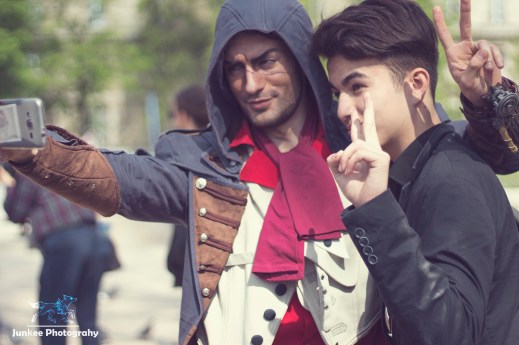
This is something you just don’t hear about in the history books.
–Alex Hutchinson, Creative Director, Assassin’s Creed III
What does it mean to speak American? According to Laura Amico, a teacher in the Cliffside Park school district in New Jersey, to speak American is the opposite of speaking Spanish. Students captured her saying this on Snapchat before they walked out in protest: to be American is the same as to speak American. Evidently, to speak American is to speak English, a historical curiosity, given that English was not spoken on the North American continent until the 17th century, preceded by many Native American languages and, ironically, Spanish. In simplest terms, “American English” is not a homogenous dialect either. What kind of “American English” does Laura Amico exalt as acceptable for patriotic conduct? How does an American patriot speak?

Colonel Tarleton, painted by Sir Joshua Reynolds, 1782, British National Gallery, CC license
In The Patriot (2000), Mel Gibson plays Benjamin Martin, a hero of the French and Indian War, who is forced out of his South Carolina plantation-managing life to avenge the deaths of his sons at the hands of the British during the American Revolution. The main British villain of that film, the fictional Colonel Tavington,–played in sneering style by Jason Isaacs—is notable for his barbaric conduct (among other things, he traps civilians in a barn and burns them alive). British audiences were noticeably aghast at this characterization, which implicitly compared British command of the time period to Nazi atrocities in World War II. Tavington may in part have been based on Banastre Tarleton, a notorious and brutal, misogynist dragoon whose victory at Monck’s Corner was among the bloodiest battles in the dirty war fought in the south at the end of the Revolution, or Lord Rawdon, a serial rapist and generally unpleasant English officer.
Nevertheless, Tavington’s barn-burning exploits are more likely based on American General John Sullivan’s slash-and-burn campaign against British-allied Mohawks, Senecas, Onondagas, and Cayugas, a subject little discussed in American history. This culminated in a 1782 massacre at Gnadenhutten in Ohio, where white Americans murdered 96 Delawares who had converted to the Moravian faith (pacifists). Evidently, in The Patriot, the conflict was not a civil war, and character was constructed in part through dialect (as detailed below, dialect here refers to all the clues in the way a person speaks, not just his or her accent).
Although Tavington’s conduct in The Patriot manifested visibly onscreen, his dialect said much about him. As noted in a recent Atlantic Monthly article, entertainment—such as Disney cartoons—can “take [bias] and pour concrete over it.” Rosina Lippi-Green, a linguist, notes that such biases are then difficult to remove: “They etch it in.” Another linguist, Chi Luu, suggests that with English RP (see below), the effect is more subtle; such accents go beyond “pure evil” by shading villains as more educated and intelligent—but still bad. Relating these findings to The Patriot, viewers understand Tavington as educated, intelligent, and evil through his English RP dialect; moreover, in black-and-white terms, his dialect makes tangible that he is completely different from the rough-and-ready, courageous Benjamin Martin. An aural line is drawn between American “good guys” and British “bad guys.” The British are fighting just to be sadistic or greedy; the Americans are fighting to defend their way of life.
Compared to media about other American conflicts, there has been little recent dramatic depiction of the American Revolution. Historically, one reason dramatizations of the American Revolution have historically remained rare is the tradition of American reverence for the “Founding Fathers,” causing their depiction as human beings to be circumscribed. Just as visual conventions have been built up regarding the antagonists of the conflict, so, too, have aural conventions in audio-visual representations such as a general use of a Standard North American accent for American (patriot) characters (whether they hail from northern or southern colonies) and English RP for all (villainous) British characters. The effect of this is epitomized by the example from The Patriot above: “good guys” versus “bad guys.”
While the way characters sound is important in most creative works—from the written dialect of Dickens’s characters to the chilling, mask-assisted tones of Darth Vader—it is no more so than in audio drama. Richard J. Hand and Mary Traynor have argued in the The Radio Drama Handbook (2011) that the elements of audio drama are words, music, sound, and silence. Arguably the most important of these to the audio drama are words. Alan Beck’s work on radio acting further argues that to create character through words and sound, refinement of dialect is needed. In this context, dialect refers to more than just a regional pronunciation: it includes details on a character’s geographical region, social class, gender, age, style, and subgroup.
In terms of The Patriot, probably the highest profile pop cultural depiction of the American Revolution until Hamilton, accents mattered. “A well-educated British accent,” in American films at least, “had come to serve as a sufficient shorthand for villainy” as Glancy pointed out, or “British, upper class, and a psychopath, happily burning people alive,” as a 2010 Daily Mail article put it. Whatever his villainy, would a historical Colonel Tavington, have sounded the way he did as depicted in The Patriot? How did those on the North American continent in the 18th century sound?
Richard Cullen Rath has convincingly argued that sound was incredibly important in colonial America, but what role did speech in English have? David Crystal, in discussing the Globe Theatre’s 2004 production of Romeo and Juliet in original pronunciation (OP)/Early Modern English (EME), was most frequently asked one question: how do we know? How do we know what Shakespeare’s English sounded like? For EME, spelling, contemporary accounts of the language, and the use of rhythms, rhymes, and puns illuminate this area. Crystal noted that EME would not sound like any modern accent but would have the pronunciation of “rs” in common with “rural” accents, as in Ireland and the West Country (Somerset).
This is important because the association of Shakespeare with a certain kind of English accent—the RP referred to below—has long had the effect of making his works less accessible than they might have been. If Shakespeare’s actual working dialect had more in common with “rural” accents like Irish and West Country, the latter of which is often still designated as a shorthand for stupidity in common with American southern dialect, this has a liberating effect on Shakespeare in performance. It may sound “strange” at first, but it suggests that Shakespeare can/should be performed in a vernacular, at the very least to make it more accessible to a wide variety of audiences.
Crystal has suggested that, “It is unfortunately all too common to hear accents on stage or film in which—notwithstanding the best efforts of dialect coaches—accuracy and consistency throughout the performance leaves, shall we say, a little to be desired.” Sky 1’s recent big-budget effort in historical drama, Jamestown, set in 1619, is diverse and rich in dialect, with characters speaking with Irish, northern English, southern English, and Scottish accents—nor are they uniform in suggesting that one accent will signify the character’s goodness or badness (though it has to be said most of the southern English-speaking characters are, at the very least, antagonistic). Most of the Native American characters have so far not spoken English rather than racist “Tonto talk,” and white English-speaking characters must speak Powhatan (or use sign language) in order to communicate. As actor Jay Tavare points out, early Hollywood was not concerned with the accurate portrayal of indigenous languages, given that Navajo extras were most often used in Westerns (meaning the Diné language of the southwest was heard regardless of where the film was set). More recently, even such films as Dances with Wolves (1991), which has generally received praise for its accurate portrayal of Sioux/Lakota culture, included Lakota dialogue which was linguistically imprecise. Clearly, there is still a long way to go.
Suppose we decide we cannot ever know how such historical actors sounded, so we decide to depict 18th century English speakers based on other criteria. How do directors, actors, and voice coaches bring the viewer/listener as close to the author’s intent as possible in fictional depictions of the years surrounding the American Revolution? How is the 18th century made accessible through dialect? As Glancy suggests above, British officers in film, television, and radio depictions of the American Revolution are most commonly associated with Received Pronunciation (RP), though the term was not coined until 1869, and, as Crystal points out, the “best speech” heard in the English court of the 16th century was “nothing like” RP. In fact, it was probably influenced by the Devonshire accents of Sir Francis Drake and Sir Walter Raleigh (an English so far in Jamestown associated with servants . . .). As Edda Sharp and Jan Haydn Rowles point out in How to Do Standard English Accents, RP has almost disappeared in England, “now confined to a very small section of society, the older upper and upper middle classes, older actors and broadcasters.”
The officer class of the British Army in the 18th century was in fact largely composed of Scots (as per Stuart Reid and Paul Chappell)—though how much they retained their Scottish identity (including accent) is of course impossible to know. As Kevin Phillips in 1775: A Good Year for a Revolution points out, within England, support for the colonies during the American Revolution was generally strongest in the major cities and in the eastern and southern counties—the same places where during the Civil War, support had been strongest for Parliament and Cromwell. Support in Scotland was limited to a small fringe. By contrast, statistics from Revolutionary America 1763 to 1800: Almanacs of American Life on the ancestral origins of the white population of Virginia in 1790 make Scotch-Irish (11.7%) and Scottish (5.9%), the second-largest groups after English. References to the Scottish officer class are made in Cooper’s The Last of the Mohicans, where Colonel Munro is referred to as “the Scotsman” (played memorably in the Michael Mann film by Maurice Roëves). Beal suggests that guides to “correct” pronunciation in the 18th century were often written by and for Scots—to pass as “British.” The Scottish people have had a long history of wishing to disassociate themselves from rule by the English (as evident in the 2014 Scottish Referendum). The Wars of Scottish Independence in the 13th and 14th centuries were fought between English and Scottish forces, at the conclusion of which Scotland retained its status as an independent state. However, in 1707, the Act of Union unified England and Scotland under one government.
With these many regional British accents potentially to be heard in the British Army in America in the 18th century, and with approximately 92.2% of white colonists in Virginia hailing from the British Isles in 1790 (including England, Scotland, Ireland, and Wales), it is perhaps curious that there has been so little variation in dialect in media depictions such as films, TV, and radio. Traditionally, for example, George Washington has been depicted with a Standard North American accent and not a modern southern American accent. This is also true in the case of Colonial Williamsburg re-enactors.
Besides being generally a very sound depiction of the Revolutionary period, HBO’s John Adams (2008), based on David McCullough’s book, is also unusual as far as accents go. John Adams gives the British King George III, played by Tom Hollander, Standard Neutral English, but it does something very unusual with its American characters. Virginian characters (including Washington and Jefferson) have suspiciously Somerset-sounding accents. John Adams introduces a clear regionalism in Anglo-American accents that goes beyond the singling out of the Boston accent (which is generally personified in John Adams himself). It isn’t clear why this decision is made; the accent does not belong exclusively to Virginian characters, as it is also the accent of Benjamin Franklin, proudly Pennsylvanian, and Alexander Hamilton himself. Is the shorthand present to aurally distinguish between Loyalists, and American rebels? What affinity, one might ask, does the Somerset accent have with a depiction of the American character?
Standard North American speech is rhotic (people who say an ‘R’ whenever it is written), as is the Somerset accent (and, as Ben Zimmer explains, was associated with country speech in England from the 17th century). This contrasts with Neutral Standard English Accent, which is non-rhotic (people who only say an ‘R’ if there is a vowel sound spoken after it). Perhaps the filmmakers had in mind the best guesses about how “proper” Anglophones spoke in the 18th century, as in John Walker’s Critical Pronouncing Dictionary (1791), where he normatively condemns rhotic English. Then again, perhaps it is merely a storytelling expedient; look at the actors assembled to play Founding Fathers:
- Washington – David Morse, American, born in Massachusetts
- Jefferson – Richard Dillane, born in London
- Hamilton – Rufus Sewell, born in southern England of Welsh and Australian parents
- Franklin – Tom Wilkinson, born in Leeds, grew up in Canada
- Sam Adams – Danny Huston, American, born in Rome
Standardization may have made practical sense, but the use of the rhotic sends a subtly different message than North American Standard English, and perhaps hints at the influence of David Crystal’s work on OP/EME.

First page of Noah Webster’s Compendious Dictionary (1806)
Even among linguists, North American 18th century English has not been examined to the extent that EME has, with Beal going no further than to suggest “the contact between the various regional dialects of the English-speaking colonists and the languages of the Native Americans and of other European colonists” would have influenced pronunciation, but she is not conclusive as to what extent. Noah Webster in 1789 envisioned “a language in North America, as different from the future language of England, as the modern Dutch, Danish and Swedish are from the German or from one another” (cited in Mühleisen). From the beginning, too, American fiction was concerned with pronunciations, with Cooper sensitive to those which “disclosed class or origins,” as Schachterle noted. The word “Americanism,” in fact, was coined by John Witherspoon in 1781. Its entry in Webster’s Compendious Dictionary (1806) is “a love of America and preference of her interest.” As David Crystal points out, this was the first dictionary written in English to include words like butternut, caucus, checkers, chowder, constitutionality, hickory, opossum, skunk and succotash. It was also the first dictionary to give now-familiar American spellings to words like color and defense.
It is probably not a surprise that many of the words above have their origins in Native American languages. Black and Native voices (and use of dialect) are somewhat rare in media depictions of the Revolutionary period, notable exceptions being The Last of the Mohicans, with its heroes (“Hawkeye,” Uncas, and Chingachgook, played by Daniel Day-Lewis, Eric Schweig, and Russell Means, respectively), as part of an extended, multi-racial family unit, speaking with a uniform Standard North American accent:
and Ubisoft’s smash video game, Assassin’s Creed III (2012).
The hero of this Xbox/Playstation game is Connor/Ratohnhaké:ton (Noah Watts), half-British, half-Mohawk, who speaks Mohawk as well as English (again, no Tonto talk here), as taught by the project’s language consultant, Akwiratekha’ Martin. However, again ignoring historical realities like the Sullivan campaign, the villains are British redcoats, echoing the storyline set up by The Patriot (Connor’s village is burned and his parents are killed by a British officer who sneers, “You are a nothing, living in the dirt like animals.”) In a making-of featurette, the creators of Assassin’s Creed III note that it has more than two hours of “cinematics,” a concept that suggests that the game will be a more potent window into history for its users than film, television, radio, or books. While it is positive that the game inaugurates a Native American action hero role model, it is disappointing that it recycles “the British are baddies” dialect trope.
In media like cartoons, video games, and audio drama, dialect supplies us with many clues about characters and what we should think and feel about them. Class is still very much implicit in accents in Britain, and every time we open our mouths we display characteristics about ourselves, whether feigned or not. When mass media-makers produce historical drama, they make choices. Despite the United States’ and the United Kingdom’s “special relationship,” the “British are baddies” trope remains. Its continued use and the future choices made by media-makers have much to say about Anglo-American relations and conventions in fiction today.
If, as suggested by several linguists identified in this article, children very quickly pick up conventions of who is “bad” via what they sound like, it behooves us to pay careful attention to the way mass media uses voices and what norms these establish, for listeners young and old. Also, what accents filmmakers use for past accents may profoundly influence who can hear themselves as “American” in the present moment–one important reason why Lin-Manuel Miranda’s Hamilton resonated with contemporary audiences. If teacher Laura Amico in the Cliffside Park school district in New Jersey has established that her pupils should “speak American,” what does this mean (besides the fact she expects them to speak English not Spanish)? Should they, for example, speak like President Trump, who uses a New York Queens accent which, according to Jeff Guo, connotes “competence, aggressiveness and directness” despite the fact its speaker comes from a privileged background? As Guo suggests, the way we speak is at least as important as what we say. In response to reports that Trump mocked the Indian Prime Minister, Narendra Modi, by imitating his accent, Congressman Raja Krishnamoorthi published a statement saying, “Americans are not defined by their accents, but by their commitment to this nation’s values and ideals.” That, perhaps, is speaking American?
—
Featured Image: Arno Victor Dorian, Assassin’s Creed Unity: Leon Chiro Cosplay Art
—
With thanks to Kenneth Longden and Matthew Kilburn
—
Leslie McMurtry has a PhD in English (radio drama) and an MA in Creative and Media Writing from Swansea University. Her work on audio drama has been published in The Journal of Popular Culture, The Journal of American Studies in Turkey, and Rádio-Leituras. Her radio drama The Mesmerist was produced by Camino Real Productions in 2010, and she writes about audio drama at It’s Great to Be a Radio Maniac.
—
 REWIND!…If you liked this post, you may also dig:
The Magical Post-Horn: A Trip to the BBC Archive Centre in Perivale–Leslie McMurtry
Speaking “Mexican” and the use of “Mock Spanish” in Children’s Books (or Do Not Read Skippyjon Jones)–Inés Casillas
Sounding Out! Podcast #40: Linguicide, Indigenous Community and the Search for Lost Sounds
Share this:

“Happy Homes Have Gramophones” –Gender, Technology, and the Sonic Restaging of Community Before and After the Partition of Bengal


co-edited by Praseeda Gopinath and Monika Mehta
Our listening practices are discursively constructed. In the sonic landscape of India, in particular, the way in which we listen and what we hear are often normative, produced within hegemonic discourses of gender, class, caste, region, and sexuality. . . This forum, Gendered Soundscapes of India, offers snapshots of sound at sites of trans/national production, marketing, filmic and musical texts. Complementing these posts, the accompanying photographs offer glimpses of gendered community formation, homosociality, the pervasiveness of sound technology in India, and the discordant stratified soundscapes of the city. This series opens up for us the question of other contexts in India where sound, gender, and technology might intersect, but, more broadly, it demands that we consider how sound exists differently in Pakistan, Sri Lanka, the Maldives, Bangladesh, Bhutan, Nepal, and Afghanistan. How might we imagine a sonic framework and South Asia from these locations? —Guest Editors Praseeda Gopinath and Monika Mehta
For the full introduction to the forum, click here.
To read all of the posts in the forum, click here.
—
“She compelled respect at once by refusing on any account to be phonographed: perhaps she thought, amongst other things, that if she committed her soul to a broken piece of wax it might get broken…my subsequent experiences showed that it was only too likely,” wrote the British musicologist A.H. Fox-Strangways in 1910 about Indian female singer Chandra Prabha, while remarking on the harsh reactions to the gramophone in India (90). Such deep-rooted discomfort with the gramophone speaks to the cognitive, perceptual and experiential challenges faced by a listener/performer when a new auditory technology substitutes familiar terrains of musical production.
In this post, I revisit the decades prior to and following the 1947 Partition of Bengal, a phase singularly volatile not only in India’s political but also its musical and technological histories. I examine how the introduction of European harmony/polyphony in the aural imaginary of Bengal negotiates ideologies espoused by the nationalists in the (re)constitution of gendered space post-Partition by transforming relations of consumption. The production of gendered domesticity was vitally related to rigid conceptions of physical space and its allocation in colonial Bengal which, further, influenced music reception in ways worth probing.
The auditory regimes prior to the emergence of recording/radio-broadcast typified public modes of listening based on live performances engendering affective flows and presupposed human proximity. This culture of aurality is inextricably tied to communal modes of consumption and performance, be it the high-end salon-tradition of the Bengali modern song, the hard-hitting agitprop strains of the Bengal wing of the IPTA (Indian People’s Theatre Association) or even the stylized elite classical genres. The collective nature of musical practice conjures up traditional connotations of masculine spaces, especially in the case of the elite Bengali household where the gendered ideology of spatial orientation relegated the respectable Bengali woman (bhadramahila) to the interiors of the house (antahpur/andarmahal). The delights of salon-music were to be relished by the man of the house (babu).

‘Gramophone – a home entertainer’
Thus, the communitarian character of musical practice often made it elusive to respectable women. However, the emergence and subsequent sophistication of auditory technologies ushered a radical transformation to such a dynamic by dissociating music from the human performer. Besides leading to the obvious technological alienation in the listener, the privatization of the listening experience was accompanied by a condition of a penetrating solitude and interiority, a state speaking to the voices and /sounds emanating from the phonograph. At the sociological level, the entry of recording technology redefined long-held divisions of domestic space and the gendered dynamics thereof by not only democratizing musical consumption but also forging provisional collectivities of listeners often cutting across gender, class and caste. Besides, traditional associations of musical genres with specific loci- classical music with the salon/concert space for instance- gave way to a more fluid conception of domestic space assuming multiple sonic/musical identities depending on what the gramophone played. The phonographic interface, thus, radically reconfigures listening practices and produces a different paradigm of self, sound, community, and gender.
What is at stake here is not some covert form of linear technological determinism, but a more nuanced detour around auditory-technologies, spaces of consumption, and the affordances thereof that calibrate auditory experience along new registers. What merits contemplation is how (if at all) these technological innovations in the commercial arena complement and usher formal nuances and sonic innovations in the musical works they mediate. The gramophone renders problematic the uncritical conflation of the sonic and visual registers typical of live musical performance and, in the process, sets in motion a unique dynamic of interacting with musical sound. Severed from its visual footholds in live performance, phonographic sounds often provoke the listener to imagine the singing/performing body which, in turn, informs the way the sounds are processed mentally.

Vintage Gramophone spotted in Little India, Serangoon, Singapore, Image by Flickr User Linkway88, (CC BY-NC-ND 2.0)
Indian music has traditionally been based on a single melody which, in its skeletal grammar, is an individual mode of expression, even when performed by a group. The intrinsic form of Indian and traditional East Asian music in general exhibits a non-harmonic character. The concept of musical harmony proper is considered a European import. European harmony, polyphony, and counterpoint are in their very essences a set of disparate tonal registers forging a gestalt which impresses on the mind of the listener an overarching unity. At an experiential level, the polyphonic form embodies a distinct sonic ontology and a novel dimension, as it were, and thus cannot be reduced to merely a stylistic import. It induces a new auditory condition, a new register of being-in-listening (the lecture snippet from 57:08-.1:02:07 effectively demonstrates the morphing of the basic melody of a song into its polyphonic equivalent). The new auditory condition conjoins the familiarity of the melody with the markedly different yet complementing registers of the polyphony, creating a novel sensation for the uninitiated Bengali listener.
Among the very early records to employ musical polyphony in India were two iconic musical works of the mid-20th century, one devotional in intent– Aham Rudre from Mahishasurmardini (1931) composed by the legendary music director Pankaj Mullick–and the other, a professed experiment in introducing polyphony in Bengali music, Shurer Ei Jharna (1958), by the noted composer Salil Chowdhury.
In the current context, it is important to note how the sonic dimension of musical polyphony in Aham Rudre and Shurer Ei Jharna embodies and substitutes notions of aural communities and restages a communitarian character. Notably, the creation and circulation of these works paralleled the establishment of commercial state-radio in India (1930) and the first microgroove record in Kolkata in 1958 by the Gramophone Company.
The Gramophone Company in Calcutta marketed its records with the Bengali tagline “Shukhi Grihokon Shobhe Gramophone/Happy Homes Have Gramophones,” projecting the phonograph as the symbolic ideal of the domestic idyll and in the process confronting gendered spatial demarcations head-on by invading the auditory horizons of the secluded Bengali women. The striking presence of the gramophone in the iconic Gramophone Scene (1:35:17-1:35:28) in Satyajit Ray’s movie Ghare Baire–set in the backdrop of the 1905 Partition of Bengal–beautifully illustrates the sorority forged by the gramophone which, notably, draws even the marginalized widow Bouthan within its field of influence.
However, the gramophone superseded its commodity-character to serve not only in crass exhibitionism but also as an index of a masculine, elite consumerist culture where “serious music” and musical connoisseurship often became synonymous with the gramophone and recorded sound. A new breed of “record-collectors” came into existence, mainly belonging to the upwardly-mobile/elite classes whose passion for records was their most prominent identity-marker in the domestic realm, occasionally outweighing even their professional concerns.
But even as the radio and phonograph transcended the hitherto gendered character of musical reception by entering the women’s quarters and dissolving time-honored segregations of auditory spaces within the household, it had to contend with a deep-seated psychological discomfort in the listener, a fundamental unease with befriending technology that substituted the human. I argue that the newly insulated character of the radiophonic auditory experience was counteracted by significant efforts, conscious or otherwise, at sonically restaging and reclaiming the community lost in technological mediation.

Indian farmers gathered to listen the Farm Forum programme broadcast by All India Radio in the 1950s, Image Courtesy of Flickr User Public Resources.Org, (CC BY 2.0)
Given pet notions of musical anthropology and the chronological coincidence between the early uses of harmony and the entry and sophistication of technologically mediated music in Bengal one could, at the risk of slight oversimplification, posit that the import of the harmonic form at this significant juncture sonically compensates the auditory solitude induced by radio/phonograph by recreating a modified and idealized Platonic (Platonic here is used as an allusion to ‘music of the spheres’ to point towards how musical harmony since medieval times has been associated with ideal public) community and restaging it within the confines of the constitutive plurality of the polyphonic mode. As an aside, the initial introduction of polyphony in Shurer Ei Jharna (1958) garnered flak from a large section of the audience who cognized it as a group of amateur performers ‘singing out of key’ (Salil Chowdhury’s lecture from 30:31-31:15). Over the next few decades, however, this form was trans-culturated and seamlessly assimilated within the sonic vocabulary of the Bengali/Indian masses, so much so that without the regular vocal/instrumental counterpoint, commercial songs nowadays are often felt to be lacking hue.
The sonic changes that I have been investigating preceded or followed the Partition of Bengal, which informed the gendered patterns of popular musical consumption. It is well-known that the exigencies of the Partition proved emancipatory for women in that they were exposed to the vagaries of the workplace, leaving the confines of their quarters. It is with an often uncritical celebratory fervor that the Partition is credited with fashioning the independent, self-reliant and educated middle-class Bengali working woman, on occasion emerging as the sole bread-earner of the family. Jasodhara Bagchi says that the “partition accelerated the earlier trends of the twentieth century of abolishing the ‘purdah that had confined the Bengali bhadramahila to her antahpur (private quarters)…The same stroke that brought this flood of uprooted marginalised women to Calcutta also opened the door to many new opportunities for Bengali middle-class Hindu women. They came out of the private domain of domesticity and child rearing to take up public duties.’”(8) Uditi Sen, however, in her revisionist reading of the celebratory impulse argues that “situational aberrations” notwithstanding, the Partition did not lead to “a transformation of social norms or any substantive change of women’s ideal role within the bounds of the family.”(16)
In the aftermath of the Second World War, which had also witnessed the entry of women into the professional/public sphere, the USA launched a propaganda war to restore women to their hearth, revivifying the “cult of the housewife,” deploying films and popular music to promote the trope of the ideal housewife. Redefining domestic spaces as woman’s space had also been in the cards for the Indian state post-Partition, which had to a large extent been governed by patterns of popular media consumption. Arguably, the coincidental emergence of musical harmony and sophistication of private auditory technologies in the years following the Partition contributed to efforts to restore women to their private quarters, by compensating the lost professional community of the self-reliant working woman with the poetic/sonic community embodied by the polyphonic form, in the process enlivening her insipid lived quarters. Popular media technologies often employ innovation in content to revivify clichéd formats; musical harmony coupled with sophisticated audio-reproduction provides a classic instance of inaugurating a new sonic dimension in popular music which provides a powerful and enthralling form of domestic leisure.
Thus, in the context of early 20th century Bengal, the gramophone was a significant import which not only reconfigured perceptual registers and musical cultures but also listening practices by entering the interiors of elite Bengali households. Besides democratizing the listening experience, which till then had largely been restricted to male constituencies, the gramophone privatized musical consumption. It was through the introduction of musical polyphony, which is intrinsically ‘public/ communal’ as regards its sonic character, that this impulse was counteracted. As mentioned earlier, these technical/musical innovations widened the scope and impact of musical performance and arguably contributed to the reconstitution of gendered domestic space post-Partition which points to subtle and complex relations among technology, (musical) genre and gender.
—
Featured Image: Screen Capture from by SO! Ed. Satyajit Ray’s Ghare Baire
—
Ronit Ghosh is a postgraduate student at the Department of Art and Technology, Aalborg University, Denmark. His research interests include aesthetic philosophy, critical sound studies and the sociology of Indian popular music. He has published articles on sound studies in the International Journal on Stereo and Immersive Media and The Rupkatha Journal and has an article forthcoming in the Journal of Sonic Studies. He is a classical violinist and an aspiring music composer.
—
 REWIND! . . .If you liked this post, you may also dig:
Tape Hiss, Compression, and the Stubborn Materiality of Sonic Diaspora–Chris Chien
Pushing Play: What Makes the Portable Cassette Recorder Interesting?—Gustavus Stadler
Hearing “Media-Capitalism” in Egypt–Ziad Fahmy
Share this:


Current Top Posts





April 2021

January 2020

November 2019

October 2019

August 2019

April 2014

November 2017

March 2015

December 2017

October 2015
 Sounding Out!
Recent Comments