
Could I Be Chicana Without Carlos Santana?
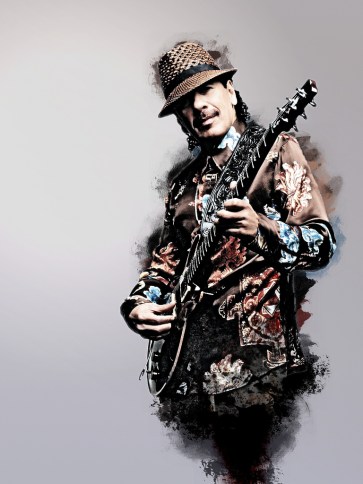
Carlos Santana by Flickr User Momez
This may be a given but I have to ask: Why is the music of Carlos Santana considered “Chicano music?”
It’s true; I am a fan. And as a fan I never question why I love the music, but I often ask myself what it is specifically about the music that resonates so strongly with me. I could say that I love Santana because I love a soulful electric guitar voice, because I admire the musicianship of the band, because I feel the “sabor” they sing about, because I’ve always loved Santana. But these parts surely do not make up a satisfying the “whole.” There is something else, something about listening to the music that amplifies my sense of identification as a Chicana with other Chicanos and Mexicanos. This happens whether I’m among raza, in the various communities I call home, or whether I find myself feeling very far from Aztlán. I’ve witnessed the effect of the music – maybe you have too – when it comes on the car radio, at backyard family BBQs, and friend’s living room dance floors, the music gets your body up and connects you to your Chicano roots.
In this sense, Santana is forever part of the Chicano sounded imaginary. For Chicanos, identifying with the music of Carlos Santana may have a special meaning that has something to do with a particular Chicano/Mexicano subjectivity. Yet, for non-Chicanos, Santana still retains their quintessential American rock band status. Most of their airplay is on mainstream radio, rarely if ever on Spanish-language stations. So Santana can be thought of at once as “puro” Chicano or “classic rock,” except that Santana is a straight up fusion band. This is why I have to ask, is the music of Santana “Chicano” music? And I further wonder, could I be Chicana without Carlos Santana?
…Oye Como Va…
Before the Rob Thomas & Carlos Santana collaboration on the Grammy award-winning album Supernatural (1999), before the phenomenon of “Smooth,” there was classic Santana. The Santana that produced the self-titled debut album Santana (1969) and Abraxas (1970). The songs “Evil Ways,” “Black Magic Woman,” and “Oye Como Va” from these two albums are on constant rotation on “classic rock” stations well after forty years since they first hit the airwaves. Even if you’re not a fan or a music connoisseur, when listening to “Oye Como Va” or “Smooth” it’s easy to recognize a distinct “Latin-ness” about them. In part, this is because of the fusion of Spanish and English lyrics with rock, blues, jazz, and Afro-Latin musical styles. For Chicanos, this particular fusion of language and sound might also resonate as something familiar and close to home – if sound can be a home. A quick search on YouTube will lead you to the classic 2000 Grammy Awards Performance of “Smooth” and a wealth of competing claims by fans (and foes) in the comments section.
Fan 1: “SANTANA ERES LO MAXIMO, VIVA MEXICO!!!!!!!!”
Fan 2: “Salsa baby, Oye Como Va is universal, Carlos is the man!!!!”
This was a special and high-profile performance so these comments are exceptionally spirited. But, YouTube is full of spontaneous, impassioned, (albeit anonymous) examples like this on any given day. I highlight these two as sort of placeholders for the idea of how sound and music mighty carry significant meaning toward subject formation in an everyday sense. These fans claim Santana both for Mexico and for the world, respectively, because they reflect a strong sense of Mexican or Chicano pride. In the first comment, the very enthusiastic fan could easily be a Mexico City native, maybe a Chicano wanting to sound like a Chilango –“ERES LO MAXIMO” is not a Chicano Spanish expression. The second fan’s comment is all in English and could be Chicano simply based on that—but those are slightly secondary points. As I suggested earlier, for Chicanos, Santana’s music has the potential to reflect a sense of ethnic history and culture. Sound can be a home. After all, the first comment claims Santana’s music for a whole country with “VIVA MEXICO!” helping to affirm the feeling that this fan and Carlos are Mexicanos together, across time and place.
When I was studying music in college, Mexican, Chicano, or Latino music was not part of the curriculum. Instead, in my private piano lessons, I would gravitate toward pieces by Spanish or Latin American composers as a sort of “good enough” way to stay in touch with my latinidad. This helped, but the fact is that Latin American art songs have much more in common with the Western musical canon than they do with my experiences and Chicana consciousness. In other words, it was a reach to identify with these composers solely because we shared a language. What would I miss in a too quick move to identify with the Latin-ness of Santana’s music this way? Would I hear only the Spanish spoken in the song? If so, then gaining a sense of my Chicana/o subjectivity by claiming “Oye Como Va” (for Aztlán?) relies on partially subsuming the specific Caribbean contexts and poetics of the song. Is this song originally Cuban, Puerto Rican? It’s really just a party song. “Oye como va, mi ritmo, bueno pa’ gozar, mulatta” Eso! Does it really matter now if Santana’s version has re-defined it for all time?
In a way, the second fan expresses a more complex desire: “Oye Como Va is universal.” Everyone knows that Carlos Santana is Mexican, some know that he is also an immigrant, and still others may have read that he grew up in Tijuana. As part of American rock music history, Santana’s roots are firmly planted in San Francisco and the Bay Area and it is well known that Santana played at the historic Woodstock Festival of 1969. Clearly, amongst other identities, Santana is a classic American rock band with long and wide appeal. But from the beginning, along with creative fusions of rock, jazz, blues, and salsa, it has been the distinctly Afro-Latino percussion core that defines their emblematic sound. And this is exactly how and why dwelling on these details in the sound of Santana matters. If Santana comes to mean or signify something like “pur0 Mexicano” or “pur0 Chicano” (in a brown pride or brown power sense) then that purity is already so productively and interestingly troubled because there is nothing remotely “pure” about Santana’s music.
Therefore, to identify with the music means confronting those complex fusions of language, race, and music that make up the Santana “sound.” To partly answer my earlier question, “Oye Como Va” is a composition by the renowned Puerto Rican timbalero and band leader Tito Puente, but the musical form, a basic cha-cha-cha, is Cuban. The song has other authors as well, that both Santana and Puente name. But ultimately, this song and indeed much of Santana’s music, comes in wake of much older histories of African diaspora, migration, colonization, artistry and spirituality.
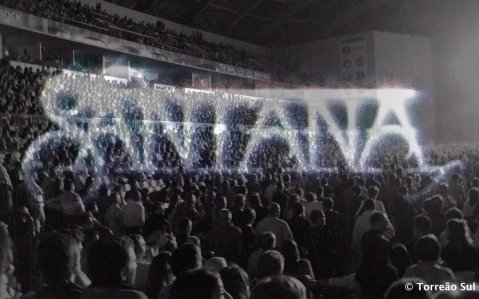
Santana fans. Image by Torreãu Sul.
…Sounding Home…
In a way, I’ve always felt that Santana’s music was making a black/brown connection, that racial boundaries were necessarily crossed or brought together because of the many histories that flow through the music. As a child of Mexican immigrant parents, I grew up listening to a wide repertoire of Afro-Latino music – elegant danzónes, romantic boleros, joyous cumbias, mad mambos, as well as more traditional Mexican music. Maybe that is also part of why listening to Santana reminds me of home. But this is perhaps too simple a response.
Santana’s music and popular image has been engaged in positive but also problematic ways in Chicana/o cultural production. Most recently, I noted this in a performance of the play New Fire, by Cherrie Moraga, in San Francisco. At a critical point in the drama, the evocative love song “Samba Pa’ Ti” is used to introduce a male character and a difficult, sexually violent scene. Moraga’s larger critique is of violent Chicano patriarchy and masculinity. The play is offered as a healing ceremony. But the association of this song, which features a famous guitar solo, with that specific scene is profoundly jarring. My sense was that Moraga selected Santana for the play’s soundscape it served as a shorthand for “Chicano.” Here, it was made to bear the history of violence of brown men against brown women and girls. This made it difficult for me to identify as a Chicana–queer and feminist–with Carlos Santana at that moment, and some time after. Surely this is also part of what “home” means.
Santana’s music interests me for these reasons, which go beyond the sounded Chicano imaginary in my headphones. What I find worthwhile in thinking further about Santana’s “sound” is how in the many acts of claiming Santana for oneself, one’s country, or one’s community, I can trace the way in which Chicano and Caribbean histories, both racialized and gendered, touch and cross in the music. That is, I see this as an invitation for the listener to reimagine notions of race, nation, gender, and sexuality even while dancing and singing along. In these ways, I see meaningful possibilities for imagining Chicana/o as a sounded subjectivity. I am certain that my sense of who I am, how I think, and how I walk in the world has been shaped by a life-long relationship with music and sound. And although being “Chicana” to me is not the same for anyone else, Santana’s music helps me to imagine a connection, a musical lineage I can trace and take part in. Santana is not my parent’s music. It’s not even my generation’s music. And, it’s not my only musical identity. But, even so, I couldn’t imagine being Chicana without Carlos Santana. Because when I listen, I do hear it, I hear how it all goes, together, and that is so, so good. “Give me your heart, make it real, or else forget about it!”
—
Wanda Alarcón is a PhD student in Ethnic Studies at UC Berkeley where her research involves reading Chicana and Caribbean “stories” together in a decolonial feminist vein. When she’s not living the glamorous grad student life she likes to make zines about po’try, learning new songs on her childhood piano, cooking for her loved ones, and exploring NorCal with her main squeeze. A native Los Angelena, she is beginning to appreciate thinking and writing about her beloved hometown from afar. Music helps bridge that distance. So do the trees and ocean breezes. She lives and loves kibbutz-style in Santa Cruz with her partner por vida, Cindy, their two sassy cats Lucy & Mona, and dear housemate, Ella.
Share this:

Music Meant to Make You Move: Considering the Aural Kinesthetic

“Dance!” by Flickr user Clearly Ambiguous, under Creative Commons License 2.0
In the two weeks prior to my drafting this piece, the world lost Adam “MCA” Yauch, Robin Gibb, Donna Summer, and Chuck Brown. In their wake they leave a profound legacy of music, yes, but of dance music particularly. MCA declared your right to party while demonstrating that white MCs aren’t always gimmicks. The BeeGees gave you a new strut courtesy of the bounce-funky soundtrack to Saturday Night Fever. The goddess Donna Summer seduced your ears with her orgasmic whispers, then pumped up the pulsating synthetic beats that brought the discotech from its urban centers directly to you. And go-go’s blaze, though not as far-reaching as disco’s, grew out of Chuck Brown’s musical sensibility, and burned deep in the hearts of Chocolate City natives. For all of these artists, moving to the music isn’t merely a possibility or inclination, but a deeply irresistible impulse. Altogether, these artists brought music that not only called out to people to dance, but if you didn’t dance you missed something essential: the inextricable ties between music and movement. One acts as a key that opens up a dimension to understanding the other.
Seeing people dance to a live go-go band taught me how to appreciate their music. When I finally heard go-go for the first time at a club in 1995, it challenged my musical sensibilities, which were more attuned to smooth R&B and jazzy Hip Hop. By then, go-go music seemed so fast, and coupled with the multiplicity of drums that I didn’t know how to get inside of the groove. In the midst of the bubbling fervor I stood noticeably still as the young woman next to me ripped the shirt off her sweaty body and whipped it above her head (like a flag at carnival), never once missing a beat in her frantic jumping and pumping to the live drums while wearing only her bra and a pair of jeans. The dancing bodies of the whole club fueled my understanding, and by extension appreciation, of what go-go does. Without them, I would have missed out on something deeper.
I am drawing your attention both to music meant to make you dance and dancing that is necessarily done to music—i.e the arena of social dance. Julie Malnig, in Ballroom, Boogie, Shimmy Sham, Shake: A Social & Popular Dance Reader, defines “social dancing” by “a sense of community often derive[d] less from preexisting groups brought together by shared social and cultural interests than from a community created as a result of the dancing” (4, emphasis in original). That might include social dances that correspond to particular songs, or called and standardized steps, like the twist or the electric slide. My focus is more broadly on a visceral, embodied, kinesthetic response to dance music in a particular social space, which is not explicitly directed by the lyrics or a set of moves but by the feel of a song as a whole. In the Hip Hop social dances I write about, rather than a finite set of moves there are infinite possibilities for improvisational play within a particular style (like b-boying or popping) that the music draws out of the dancer. As David F. García states in his piece on mambo titled “Embodying Music/Disciplining Dance: The Mambo Body in Havana and New York City,” “the embodied experience of sound and movement [are] merged through the body” (172).
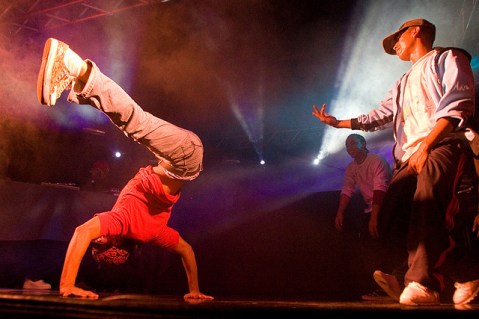
Break Dancing en Costa Rica, 2009 by Flickr User Néstor Baltodano, under Creative Commons License 2.0
I have come to name the frame for analyzing the simultaneity of social dance and music (and sound broadly) as aural-kinesthetics. While these words capture sound and movement separately, together I am looking to engage more than just the sensory response of moving to what one hears. The term develops out of works by music scholars like Kyra Gaunt (The Games Black Girls Play: Learning the Ropes From Double Dutch to Hip Hop), Kodwo Eshun (More Brilliant Than the Sun: Adventures in Sonic Fiction), and Kai Fikentscher (“You Better Work!”: Underground Dance Music in New York City), who shift our orientation to music and rhythm by drawing on our kinesthetic responses to it. Aural kinesthetics recognize that social dance practices are kinesthetic forms within the all-encompassing aurality of an environment. I use spatial terms to acknowledge sound’s omni-directionalality, coming at you from all sides and helping to actually produce the social dance place. In other words, the aural kinesthetic is also a kind of spatial practice (along the lines of Henri Lefebvre’s The Production of Space). For example, consider how a bomba dancer orchestrates the primary bomba drummer’s rhythms within the rhythmic arena created by the second and tertiary drummers; or how loud music in street dance performances fills the immediate surroundings and bleeds out into other areas, attesting to their capacity to claim public spaces (the volume has volume). Music in particular plays a fundamental role in establishing the conceptual performance arena that ultimately makes the physical space functional for certain dance practices.
Despite the fact that social dances necessarily have a musical component, dance is typically overdetermined by the visual, which in Western cultures we are better equipped to address. The sound and feel of dance experiences are often overridden by the spectacle of dancing, which the following clip demonstrates. In this clip showcasing the final battle from the 2007 Freestyle Sessions in Los Angeles, the spectacle of these amazing dancers distracts you from the actual social dynamics of their battle, of which music is central.
.
The exchange between dancers is truncated, spliced together for dramatic effect. You focus on the center of the cypher, lost in the visual thrill of it all. The song they were actually dancing to is replaced by another that, though danceable, prevents us from appreciating a particular song’s nuances as well as the crowd and emcee’s involvement in the event. Overdubbing songs that you do not have clearance for is in compliance with copyright laws that force the video’s producers to instead play songs to which they have legal access, in sacrifice of aural-kinesthetic experiences the videos attempt to capture. Yet even in cases of the below clip where we hear the original song, the recording cannot capture the quality of the force of the music that is loud enough to feel throughout your entire body, thereby promoting a shared sensorial experience in the room. Whether one is recording with a camera or in writing, capturing the aural-kinesthetic can be tricky.
2009 Dutch B-Boy Championships Semi-Finals between Hustle Kids and Rugged Solutions
For me, the aural-kinesthetic is useful insofar as it opens up creative space for me in writing the simultaneity of sound and movement. Scholars like Mary Fogarty (Dance to the Drummer’s Beat: Competing Tastes in International B-Boy/B-Girl Culture) have approached the topic by distinguishing between notions of musical taste and musical competency in clarifying the contours of b-boying’s dance-music relationship. In my own writing, I’ve tended toward storytelling and descriptive analyses. In contrast, considerations such as those of Roland Barthes’ “The Grain of the Voice” (in Image, Music, Text) propose to expand the language on (vocal) music in general by shifting the object of analysis to create new ways of writing music, which we can extend to writing social dance.
So what is a productive approach for writing the aural-kinesthetic? I’m not prescribing a method, but I do want to consider the possibilities of shifting the focus of analysis in such a way that it allows for the simultaneity of music and movement. For example, there may be value in examining a gesture repeatedly made to a particular part of a song to understand what that song is doing; or examining the physical layout of a room and how that space gets used through the song that fills it. Perhaps coming at social dance indirectly and on multiple fronts makes for a richer depiction.
For now, let’s take advantage of this digital space and collectively consider our options. Here’s a task I hope you might take up: post a link to a song or a video clip that makes you move. Describe some quality of your visceral response to the song and place your thoughts in the comments section below. Include the multiple fronts that help you to articulate your experience. While music and dance have the capacity to “speak” in ways that verbal language cannot always reach, my hope is that a range of possibilities might get us there. or at least much closer.
—
Dr. Imani Kai Johnson is a Ford Dissertation Fellow, who has just completed a three year postdoctoral fellowship at NYU’s Performance Studies Department. She received her PhD in American Studies & Ethnicity at the University of Southern California in 2009, where she wrote a dissertation titled,”Dark Matter in B-Boying Cyphers: Race and Global Connection in Hip Hop,” which considers the cultural and performative dimensions of Hip Hop dance as a global phenomenon through cyphers (dance circles), and the invisible forces of the collaborative ritual. Dr. Johnson is currently completing a manuscript based on her dissertation.
Share this:


Current Top Posts





April 2021

January 2020

November 2019

October 2019

August 2019

April 2014

November 2017

March 2015

December 2017

October 2015
 Sounding Out!
Recent Comments