
Experiments in Aural Resistance: Nordic Role-Playing, Community, and Sound
DOI: https://doi.org/10.59350/168jz-17295
Editor’s Note: Welcome to Sounding Out!‘s fall series titled “Sound and Play,” where we ask how sound studies, as a discipline, can help us to think through several canonical perspectives on play. While Johan Huizinga had once argued that play is the primeval foundation from which all culture has sprung, it is important to ask where sound fits into this construction of culture; does it too have the potential to liberate or re-entrench our social worlds? SO!’s Multimedia editor Aaron Trammell reflects upon using sound in role-playing games as a form of resistance. Ready, players?
—
When we play with sound, how does it influence the ways in which we understand, configure, and experience the world? I have already argued that non-diegetic sound can produce a visceral and emotive effect when connected to player interaction within a game world, that sounds are often structured within games to construct a sort of feedback between player and system, and that often within this feedback loop the narrative voice perpetuates problematic tropes of sexism and racism through its scripting. While I focused on the often dystopic production efforts of large and middle sized game companies in those prior essays, here I will be focusing on autonomous and grassroots examples of how sound is used as a way to stage social experiments which resist these often hegemonic ways that these dominant narratives constrict our views of the world.
Role-playing games, the focus of my post today, offer a more viable path of social resistance than better-known video games. Nordic larp style-games, for example, are written and played within not-for-profit communities, and they utilize themes of social inequality, transformation, and activism within their very scripts. Second, role-playing games, unlike computer games, do not require that their developers are able to code. Instead, games are often circulated by word-of-mouth, or in script format through player communities. In this sense, the genre itself is untethered from many of the problems of consumer capitalism. Many underground role-playing games are designed both around social issues and for local community needs as opposed to the market demands that necessitate big budgets, big programming teams, and few risks in the video game industry today. Finally, because role-playing games necessitate neither big budgets, the ability to code, nor mass audiences, they are an ideal site wherein game designers and referees can stage social experiments that speak to the unique wants and desires of the communities within which they are run.
In The Larpfactory Book Project, a forthcoming book containing several ready to play examples of Nordic larp (a big shout out to Lizzie Stark for hooking me up with an advance copy of this portion of the manuscript!), larpwrights Matthijs Holter and Fredrik Hossmann propose a game entitled “Before and After Silence,” focused on thinking through the collective experience of silence. From the game description:
In a world of more and more sound, silence is becoming more valuable. Before and After Silence is about limitations and listening, and about doing almost nothing. It is non-verbal and uses silence as its starting point. It is about shifting the point of view from “what is” to “what is not,” about shifting the focus from “the sounds” to “the spaces between the sounds,” from “the actions” to what is “between the actions,” and to “what is not done.” Rather than playing characters, we examine how we look at ourselves and how different filters can change how we see ourselves and others.
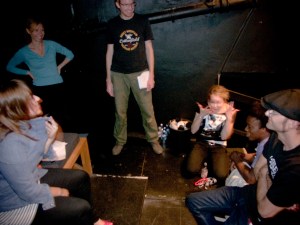
The game is structured as a social experiment for five to twelve players who are made to select two cards, one of which prompts players with an action they must complete only once during the hour of silence (one example reads “Go over to someone and whisper something in a language you don’t know”), and another which prompts players with a setting through which they should interpret the actions of the other players in the room (one example suggests a player imagine themselves in a community of prisoners, another makes a player imagine themselves as one in a society of telepaths). Before the game there are a set of workshops aimed at orienting players to the scope and silence of the game, and afterward there is a debriefing session where players compare their experiences of silence during the game.
Unlike American larps, which often take place in high-fantasy settings and direct their action around combat scenarios, Nordic larps often focus on the everyday and comparatively mundane, and as such tend to be more concerned the problems of the everyday as well. Even those that take place in more exotic environments, such as System Danmarc, a game set in the cyberpunk future of Copenhagen, engage players in real issues regarding class and poverty. After living in a shanty-town simulating the future streets of Copenhagen for a week of game-time (In Nordic-style larps, game-time is often equivalent to real time, and so a week in-game is equivalent to a week out of game) players are shown a documentary about the actual slums of Copenhagen where they realize that their experience within the space of play was made to mirror the experience of those struggling with the these very issues in the real world.
In the case of “Before and After Silence,” it is interesting to consider the ways in which the game designers here play with sound, and how these experiments in sonic game design might provoke new modes of subjectivity. As described earlier, players are both given a particular action and or noise to perform, but also are prompted with a way to imagine the actions that the rest of the players in the room are performing. The resulting group performance is an acid dream of sorts wherein each player is made to imagine the room’s soundscape in a very different way. Is the setting a long-lost silent film, or are you drifting through an ether of emotions and past romances? The game focuses on playing with silence in a way that makes the din of communication an unfamiliar and distant memory. The game affords players an opportunity to imagine the world sound. In doing this, “Before and After Silence” displaces the dominance of the voice as a mode of communication and through this questions the ways in which we imagine the world.
Not all is perfect, however, in this utopia of resistance. As Lisa Blackman (2009) argues in her essay “Embodying Affect: Voice-hearing, Telepathy, Suggestion and Modelling the Non-Conscious,” play with the exchange of subjectivities and sound marks an ontological shift from a praxiology of what bodies are to what bodies can do (p. 170). Moving forward from her work in understanding the ritual practices of voice-hearing communities, Blackman explains that similar forms of sonic play (including play with silence) allow for the experience, embodiment, and trade of desire, fear, and trauma. In the context of “Before and After Silence,” this means that as players sculpt and adjust the sonic space of the room, they run the risk of also shaping and altering each others psychic conditions, in unpredictable and perhaps dangerous ways.
The conflation which occurs between these spaces of real emotion and play emotion is, in fact, well documented, and referred to in larp communities as “bleed.” As role-playing scholar Sarah Bowman (2013), explains in her essay “Social Conflict in Role-Playing Communities: An Exploratory Qualitative Study,” even though bleed does occasionally create rifts in relationships (some participants that she has interviewed reported in-game events disturbing their out of game relationships), others seek it out as a form of extreme play. For this reason Nordic larps require ethical behavior on the parts of their players, and because of the nature of the psychic and social sculpting which can occur within the play spaces of the game, the possibility exists that a single unethical player could create a negative and perhaps concerning experience for many others. That said, there are several ways the community mitigates the possibility of this problem including meticulous casting processes, before-game workshops, after-game debrief sessions, and safe words for use during play.
“Before and After Silence” is a valuable cultural artifact that lies at the intersection of scholarship on sound studies and serious play. At the same time that it promises several new ways to think through how sound, communication, and silence influence the how we frame and approach the world, it also raises deeper questions regarding the nature of social control and the viability of autonomous modes of organization. As silence allows players to explore and interact with a world where the soundscape takes on an increased prominence, do sexist, racist, and homophobic modes of socialization still manage to creep into the play space? And does the voice, along with its physiological and cultural embodiment of race, class, and gender, offer an escape from these experiments in silence if and when they turn dystopic?
—
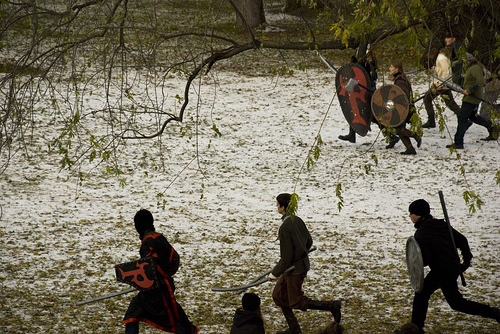
Featured image: “Larp” by Flickr user marten vaher, CC-BY-NC-SA 2.0
—
Aaron Trammell is co-founder and Multimedia Editor of Sounding Out! He is also a Media Studies PhD candidate at Rutgers University. His dissertation explores the fanzines and politics of underground wargame communities in Cold War America. You can learn more about his work at aarontrammell.com.
—

REWIND! . . .If you liked this post, you may also dig:
Goalball: Sport, Silence, and Spectatorship— Melissa Helquist
GLaDOS, The Voice of Postfeminist Control— Aaron Trammell
Video Gaming and the Sonic Feedback of Surviellance: Bastion and the Stanley Parable— Aaron Trammell
—
Share this:

“Welles,” Belles, and Fred Allen’s Sonic Pranks: Making a Radio Auteur Laugh at Himself
DOI: https://doi.org/10.59350/zxgkz-kr310

Welcome back to From Mercury to Mars, our series of posts (in conjunction with Antenna) that reflect on Orson Welles’s radio career, and the upcoming anniversary of its highlight, “The War of the Worlds.”
When scholars discuss the effect of that play on people, they often fall into reveries about its most serious dimensions — what the Martian Panic says about human susceptibility, about the power of the media, about sound and the unknown. But it’s important to realize that, besides being terribly humorless, this approach also isn’t historically just. Although Welles was — like some of his listeners — spooked the night of the event, in the days that followed he and many others came to recognize some humor in the the whole thing, too. Later in life, Welles focused on that dimension of his memory, repeatedly recalling with laughter that when the actor John Barrymore (something of a “grand old man” of the American stage in 1938), heard the Martian invasion broadcast he tearfully decided to free his beloved dogs, so they could taste freedom before meeting the inexorable doom.

Such tall tales aren’t trivial. Actually, we misunderstand the WOTW escapade if we don’t recognize that immediately adjacent to modern America’s propensity for panic stood its equally fascinating capacity to laugh at itself. Both tendencies do cultural work, often in concert with one another. With that in mind, this week our Mercury to Mars series moves from the macabre (see Debra Rae Cohen’s piece on Welles and Dracula) to the ridiculous, focusing on the relationship between Welles’s puffed-up fame and how it was lampooned by Fred Allen, one of the great absurdist comics in modern entertainment, and perhaps the most creative radio comedian of his era.
To introduce this crucial entertainer and to explain why his relationship to Welles matters so much, we are lucky to have one of the most important voices in radio studies today: Kathleen Battles, Associate Professor of Communication at Oakland University, author of a paradigm-shifting study of the relationship between radio and policing, Calling All Cars: Radio Dragnets and the Technology of Policing (Minnesota, 2010). Battles is also one of the co-editors of a book you should all be reading, assigning, and handing out like Halloween candy — War of the Worlds to Social Media: Mediated Communication in Times of Crisis (Peter Lang, 2013).
Here’s a taste, just to get you started.
– nv
—

Contemporary public memory of Orson Welles seems bent on remembering him as mercurial, imperious, haughty genius, driven in equal parts by ambition and artistic vision. It is hard to remember that this image of the auteur – not Welles but “Welles” – was one crafted not by the man alone, but by a host of actors and other performers, all with their own interest in attaching themselves to such a “genius.” As Welles’s reputation grew in the wake of the “War of the Worlds” broadcast, furthering his transformation into “Welles,” it was simply a matter of time before he became a fodder for another kind of auteur, the radio comedian. One of the most popular was Fred Allen, who made a career archly satirizing the cultural conventions of the day, with the radio industry itself being one of his favorite targets. “Welles” was too rich a subject to forego.
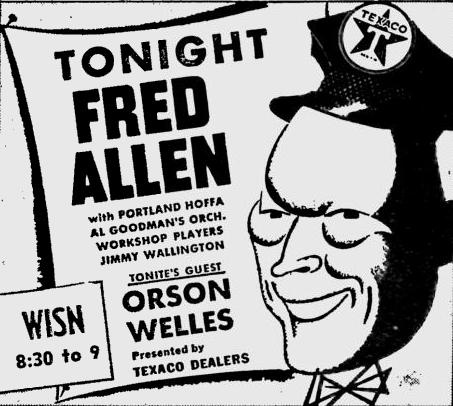
This post explores two key moments of Allen’s satire. The first came on November 9, 1939, when Allen’s show featured a comic skit, entitled “The Soundman’s Revenge, or, He Only Pulled the Trigger a Little, Because the Leading Man was Half Shot Anyway,” a radio skit that deftly mimes the Mercury/Campbell style to comic effect. The second is from three years later, October 18, 1942, when Welles himself appeared on Allen’s show, joining in the fun as the pair rehearse Les Miserables, with Welles gamely mocking “Welles.” In these two short skits, Allen and his team of writers and performers quickly dismantle what had become the more recognizable elements of the Mercury/Campbell style–as exemplified in Welles’s version of A Tale of Two Cities–including the elevation of Welles to the genius “author” of the plays, its narrative and performance techniques, and the use of sound effects.

Mercury Theater was strongly marked with the authorial imprint of the real Welles, but the legend of “Orson Welles” was also crafted quite deliberately by CBS, and then later by show sponsor Campbell’s Soup, for their own aims at cultural legitimacy. As Michele Hilmes argued, such moves were key to legitimizing the medium as operating in the “public interest” (183-88). Here is a clip from just after Campbell Soup began sponsoring the Welles program:
As other writers have pointed out, such as Debra Rae Cohen in her entry to this series, Neil Verma, and Paul Heyer, the show was among the best in emphasizing the sonic properties of radio to maximum effect in storytelling. The quality acting of members of the Mercury Theater, the music of Bernard Herrmann, the ambitious use of sound effects, and some stellar examples of adapting literary tales make the show worthy of praise.
The emotional and narrative power of Welles himself is evident in the Mercury Theater dramatization of A Tale of Two Cities. Taking on Dickens’ sprawling classic in one hour certainly demanded some creative choices. One was to open with Dr. Mannette’s letter from the Bastille prison, with Welles as Mannette emotionally dictating the words that would later serve to betray his own family.
This is contrasted against the later reading of the same letter in a courtroom scene, where the emotional poignancy of Welles’s performance is counterpointed against its dry reading as a piece of evidence.

Dynamic use of sound effects was another key element of the Mercury/Campbell style. From his work in March of Time and The Shadow, which both used sound effects to enact key narrative devices (Time varied times and locations, the Shadow’s invisibility), Welles used his own radio program to push the boundaries of what such effects could achieve. In A Tale of Two Cities, sound effects are used to punctuate key moments, none to greater effect than the final scene in which the sound of the guillotine serves as the morbid backdrop to Carton’s final, famous speech of self sacrifice:

All of these tendencies are key to Allen’s “Soundman’s Revenge,” in which Orson Welles and the Campbell’s Playhouse become “Dorson Belles” and “Finnegan’s Playhouse,” with the evening’s entertainment an adaptation of Jack and Jill fetching a pail of water.
Belles, acted by Fred Allen, tells his listeners that “My program is famous, and rightly so, for my sound effects, conceived in solitude by me.” The skit reaches ridiculous heights during a dramatization of “Jack’s” first meeting with “Jill.” As Jack and Jill wax enthusiastically at each other merely by repeating each others’ names, the host breaks in to tell listeners that “This dialogue, ladies and gentleman, is not to be found in the original Mother Goose version. It has been interprellated by Dorson Belles. We return you now to the play.”
The always potential high culture pretentiousness of Mercury/Campbell aesthetic choices are brought to the fore by the ridiculous choice of a Mother Goose nursery rhyme as the “play” within the skit. But other things do as well. The skit opens in typical Mercury first person narrative style, where Jack tells the tale from his own perspective in a ponderous, overwrought dramatic fashion. Jack does not live in postcard ready New England, he lives in a “land of penury and misery.” He does not merely make a mess while preparing his dinner, but “licks the albumen of owl’s egg off his fingers.”’
In its most pointed reference to Mercury style, the skit directly plays off a memorable moment in War of the Worlds when, as Professor Pierson narrates his travels in New Jersey, he states that “I saw something crouching in a doorway, and it rose up and became a man. A man armed with a large knife.” Here is the clip:
In similar dramatic style, Jack narrates his journey up the hill, hauling his “heavy oaken pail” and asks “What was that huddled form crouching in my path? Was it a girl? It was!”
The comic tour-de-force, however, comes with its satire of sound effects. Allen’s team goes for broke as listeners laugh along to the gradual undoing of the hapless Theodore Slade, Welles’s sound effects engineer in the skit, who is driven to madness by the excessive number of effects. Slade makes many mistakes throughout, but his errors really add up when Jack kills his father and he describes the “long arm of the law” reaching out, coming from the north on horseback, the east by train, the west by “aeroplane,” and the north by sleigh. Each description is punctuated by its appropriate sound; hooves, whistles, engines, and of course, sleigh bells.
It works the first time, but when Jack dramatically asks if he and Jill can escape each of these modes of capture, Slade plays the wrong effects. When Jack tells us he stabbed the Sherriff, Slade plays a gunshot. This time, when Belles chastises him, Slade lets loose, telling Belles that he is going “nuts,” then trying to rectify the mistake by killing the Sherriff again. Belles yells out that “this is confusing!” to which Slade retorts, “you’re telling me!” As Jill tries to continue the scene, telling us she is shooting herself, Slade plays the train whistle. Finally Jack narrates that Jill, the Sherriff, and his father are dead, and that “I alone live.” Slade replies, “yeah, but not for long,” and after listing off years worth of complaints, shoots Belles. Belles, in a pitch perfect rendition of Welles’s weekly closing of his radio show, says “This is Dorson Belles, signing off permanently. Pending rigor mortis, I remain, obediently yours.”

Perhaps Welles was offended, or perhaps he yearned to be in on the joke. He certainly seemed to relish the chance for that opportunity, when he appeared as a guest on Allen’s show, 3 years later on October 18, 1942. Here he plays along in the skewering of his own genius image, tied to his authorial control over all his projects. As the cast nervously awaits the arrival of the great “Welles,” Allen tries to calm them. Once “Welles” enters the studio, Allen himself comes in for his own ribbing. “Welles” tells him that they will be performing a new version of one of Welles’s early radio dramatizations, Les Miserables. Here Welles successfully mocks both “Welles” and Allen, insisting on sole authorship, giving an overwrought performance, using the first person singular mode of delivery, and most humorously by reducing Allen’s contribution to a few sound effects.
In those few moments where Welles himself cannot help from laughing along with the mockery, “Welles” becomes Welles, and we in the audience get to laugh with, not at, the man.
While CBS, Campbell Soup, and the press turned Welles into “Welles,” Allen undermined that move, puncturing the grandiose myth, a project in which Welles himself was only too willing to participate. By breaking it down to its constituent elements, the “Soundman” and Les Miserables skits celebrate the unique style of the Mercury/Campbell radio productions. Yet, they also pierce its cultured veneer by pointing to the unsung efforts of the always-necessary team to make radio performances work, and skewering the pretentiousness of the program’s extra-textual discourses. In the process Welles and Allen mutually constructed and deflated each other’s reputation as radio geniuses.
—
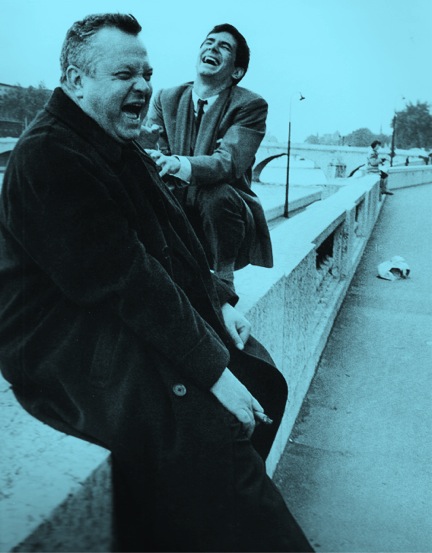
Featured Image: Orson Welles and Anthony Perkins sharing a laugh on the set of The Trial.
—
Kathleen Battles is Associate Professor and Graduate Director in the Department of Communication and Journalism at Oakland University (MI not CA). She is recently co-editor (with Joy Hayes and Wendy Hilton-Morrow) of War of the Worlds to Social Media: Mediated Communication in Times of Crisis (Peter Lang, 2013), a volume that seeks to draw connections between the War of the Worlds broadcast event and contemporary issues surrounding new media. She is also the author Calling All Cars: Radio Dragnets and the Technology of Policing (University of Minnesota Press, 2010). Her research interests include Depression era radio cultures, the interrelationship between radio, telephones, and automobiles, media and space/time, the historical continuities between “old” and “new” media, and contemporary issues surrounding sexuality and the media.
—
Want to catch up on the Mercury to Mars series?
Click here to read Tom McEnaney’s thoughts on the place of Latin America in Welles’s radio work.
Click here to read Eleanor Patterson’s reflections on recorded re-releases of the “War of the Worlds” broadcast.
Click here to read Debra Rae Cohen’s thoughts on vampire media in Orson Welles’s “Dracula.”
And click here to read Cynthia B. Meyers on the challenges and rewards of teaching WOTW in the classroom.
While I’ve still got you here … be sure to join our WOTW anniversary Facebook group. Next month we’re planning exciting events around the anniversary of the Martian Panic on October 30, 2013 from 7-10 EST, and hoping to get as many of you as we can to liveTweet the Invasion broadcast. Sign up to join in!
—
Share this:




Current Top Posts





April 2021

January 2020

November 2019

October 2019

August 2019

April 2014

November 2017

March 2015

December 2017

October 2015


Recent Comments