
DIANE… The Personal Voice Recorder in Twin Peaks
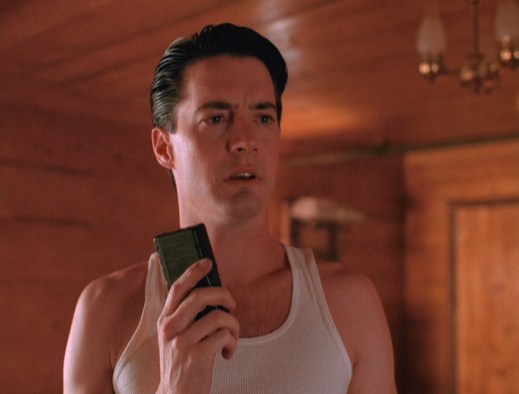

READERS. 9:00 a.m. April 2nd. Entering the next installment of SO!’s spring series, Live from the SHC, where we bring you the latest from the 2011-2012 Fellows of Cornell’s Society for the Humanities, who are ensconced in the Twin Peaks-esque A.D. White House to study “Sound: Culture, Theory, Practice, Politics.” Enjoy today’s offering from Tom McEnaney, and look for more from the Fellows throughout the spring. For the full series, click here. For cherry pie and coffee, you’re unfortunately on your own. –JSA, Editor in Chief
“I hear things. People call me a director, but I really think of myself as a sound-man.”
—David Lynch
DOI: https://doi.org/10.59350/y2411-y9p10
From March 6-April 14 of this year, David Lynch is presenting a series of recent paintings, photographs, sculpture, and film at the Tilton Gallery in New York City. The event marks an epochal moment: the last time Lynch exhibited work in the city was in 1989, just before the first season of his collaboration with Mark Frost on the ABC television series Twin Peaks. At least one painting from the exhibit, Bob’s Second Dream, harkens back to that program’s infamous evil spirit, BOB, and continues Lynch’s ongoing re-imagination of the Twin Peaks world, a project whose most well known product has been the still controversial and polarizing prequel film Twin Peaks: Fire Walk With Me.
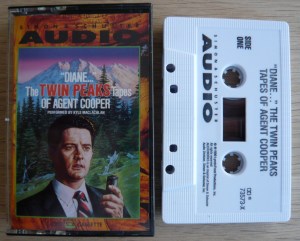
These forays into the extra-televisual possibilities of Twin Peaks began with the audiobook Diane…The Twin Peaks Tapes of Agent Cooper (1990). An example of what the new media scholar Henry Jenkins and others have labeled “transmedia storytelling,” the Diane tape provided marketers with another way to cash in on the Twin Peaks craze, and fans of the show a means to feed their appetite for FBI Special Agent Dale Cooper, aka Kyle Maclachlan’s Grammy nominated voice praising the virtues of the Double R Diner’s cherry pie.
Based on the reminders Cooper recorded into his “Micro-Mac pocket tape recorder” on the show, the cassette tape featured 38 reports of various lengths that warned listeners about the fishy taste of coffee and wondered “what really went on between Marilyn Monroe and the Kennedys.” As on the program, each audio note was addressed to Diane, whose off-screen and silent identity remained ambiguous. For the film and audio critic Michel Chion, Diane is an abstraction, or the Roman goddess of the moon. Others claim “Diane” is Cooper’s pet name for his recorder. The producers delivered their official line in the 1991 book The Autobiography of Special Agent Dale Cooper: My Life, My Tapes, “as heard by Scott Frost,” (the brother of Lynch’s co-creator), where Cooper says, “I have been assigned a secretary. Her name is Diane. I believe her experience will be of great help.”
Whatever her identity, on the show Diane became the motive for Cooper’s voice recordings, and these scenes laid the groundwork for the audiobook. However, unlike the traditional audiobook, which reads a written text in its entirety, Cooper’s audio diary cuts away parts of the story, and includes additional notes and sounds not heard on the show.
The result is something like a voiceover version of Twin Peaks. And without the camera following the lives of the other characters, listeners can only experience the world of Twin Peaks as Diane would: through the recordings alone. Strangely, the inability to hear anything more than Cooper’s recordings opens up a new dimension: even as eavesdroppers we come closer to understanding Diane’s point of audition, the point towards which Cooper speaks in the first place.
Back on the show, Cooper’s notes to Diane track his movements as he tries to solve the mystery of who killed the Twin Peak’s prom queen Laura Palmer. Strangely—and not much isn’t strange in Lynch’s work— in some sense this mystery has already been solved by the show’s second episode, where Laura whispers the name of her killer to Cooper in a dream.
However, Laura’s whisper remains inaudible to the audience, and Cooper forgets what she said when he wakes up in the next episode. Much of the remainder of the program, full of Cooper’s reports to Diane, was spent trying to hear Laura’s voice. Thus, Diane, the off-screen and silent listener, became the narrative opposite to Laura, whose prom queen photograph closed each episode, and whose voice became the show’s central fetish object. Moreover, this silent relationship changes how the audience hears Cooper’s voice. Rather than a chance to relish in its sound, Cooper makes his recordings because of Laura’s voice from the grave, and directs them to Diane’s ears alone. In other words, Cooper and his recordings become a conduit to Laura/Diane rather than a solipsistic memoir about his time in Twin Peaks.

This triangulation becomes more obvious, if no less complicated in a typically labyrinthine Lynchian plot twist. As I mentioned, the Diane tape makes Cooper’s reports into a kind of voiceover. Critics have interpreted them as a parody of film noir, a genre whose history Ted Martin argues in his dissertation is defined by the relationship between voiceover and death: “Noir’s speaking voice moves from being on the verge of death to being in denial of death to emanating immediately, as it were, from the world of the dead itself.” Fascinated by this history, Lynch tweaks it through the introduction of a mina bird, famed for its capacity to mimic human voices. Discovered in a cabin at the end of episode 7, season 1, the police find the bird’s name—Waldo—in the records of the Twin Peaks veterinarian, Lydecker. The combined names—Waldo Lydecker—happen to identify the attempted murderer of Laura Hunter responsible for the voiceover in Otto Preminger’s classic noir film Laura (1944). On Twin Peaks, Cooper’s voice-activated dictaphone records Waldo the bird’s imitation of Laura Palmer’s last known words, which also happen to be Waldo’s last words, as he is shot by one of the suspects in Laura’s death.
If we follow this convoluted path of listening, we can trace a mediated circuit—from Laura to Waldo to Cooper’s voice recorder—which locates the voice of the (doubled) dead in the Dictaphone, thereby returning that voice to its noir origins in another classic of the genre: Double Indemnity (1944) (see SO! Editor’s J. Stoever-Ackerman’s take on the Dictaphone in this film here). More than a mere game of allusions, this scene substitutes Cooper’s voice with the imitation of Laura’s voice, inverting the noir tradition by putting the victim’s testimony on tape. And yet, while Waldo tantalizes the audience with an imitation of the sound of Laura’s voice, it ultimately only reminds the listener of the silent voice: Laura’s voice in Cooper’s dream.
The longer this voice remained out of range of the audience’s ears, the more it produced other voices—from Cooper’s recordings to Waldo to the dwarf in the Red Room.
Eventually, however, the trail of tape and sound it left behind ended with the amplification of Laura’s whisper, which became as much the “voice of the people” as Laura’s voice. After all, ABC instructed Lynch and Frost to answer the show’s instrumental mystery (“Who killed Laura Palmer?”) because of worries about the program’s declining ratings 14 episodes after Laura’s first inaudible whisper. The audience’s entrance into the show through the mediation of marketers mimicked the idea behind the Dianetape, but with a crucial difference: now the audience tuned in to hear their own collective voice, rather than to hear what and how Diane heard. Laura’s audible voice was audience feedback. It was the voice they called for through the Nielsen ratings. The image of her voice, on the other hand, was an invitation to listen. And Cooper’s voice-activated recorder, left on his bedside, placed in front of Waldo, or spoken into throughout the show remained an open ear, a gateway to an inaudible world called Diane. Although critics and Lynch himself have compared the elusive director to Cooper, perhaps its Diane who comes closest to representing Lynch as a “sound-man.”
—
Tom McEnaney is an Assistant Professor of Comparative Literature at Cornell University. His work focuses on the connections between the novel and various sound recording and transmission technologies in Argentina, Cuba, and the United States. He is currently at work on a manuscript tentatively titled “Acoustic Properties: Radio, Narrative, and the New Neighborhood of the Americas.”
—
Share this:

Orality and Cybernetics in Battleship
DOI: https://doi.org/10.59350/m6c6f-gts43
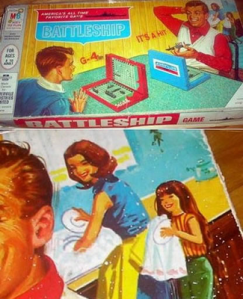
His moment has come. After having scoured each vector of a ten by ten grid, the young tactician makes his move. “G-4,” he announces, possessing some intelligence of a large ship in the south-west quadrant of enemy territory. There is a moment of tension, as his dad sizes up the situation. “It’s a hit,” Dad admits, smiling, as he resignedly lifts a token from his board. The women in the family beam proudly from the kitchen. For a brief moment the social hierarchy is undermined as the house patriarch on the front of the Battleship box concedes victory to his progeny.
Sound has been integrated in different ways into the production of simulated warfare after World-War II. Simulated warfare involves, namely, the cybernetics of paper machines (as board games have been coined by Matthew Kirschenbaum), and the gradual effacement of oral mediation therein. As technologies of interactivity improve, the need for oral communication amongst the games participant’s decreases. The following is a case study of four Battleship commercials that aims to chronicle a set of shifting cultural tendencies parallel to the integration of sound-effects within the material game-form.
As Ong (1982) has noted, writing is powerful because it mediates the vastness of imagination. Once spoken words become grounded in text and inscribed on paper, they become, “locked in our visual fields forever” (p. 11). This is not as totalizing as it sounds, for as words are recirculated in oral cultures, the trace of writing yields slowly to the performative nature of ritual, oral culture. The rules of tabletop games, such as Battleship, although first established in the manual included with the game, are passed through oral ritual more often than not (Fine, 2002; Bowman, 2010). The oral maintenance of game rules is a practice which lends itself, critically, to the cultural attitudes of the group which maintains them. As is evident in the box art above, the game of Battleship is a gendered space where the rules have likely been explained (and maintained) by the household patriarch, then shared with his enthusiastic son.
There is an ideological element at play here as well. The box art for Battleship is unmistakably American. From Milton Bradley’s strong red-and-blue branding to the white trim of the son’s shirt, dad’s sweater and the soap suds in the kitchen. After all, the company owed its success to America and the war effort. A 1940s bailout saw Milton Bradley producing landing gear for fighter planes and gunstock for soldiers alongside portable game kits for soldiers seeking diversions in their down-time. The production of board games in post-World War II America owes as much to the military-industrial complex, as the production of video games does today (Dyer-Witherford and dePeuter, 2009). The relationship between the military production and simulation has been well documented by Crogan (2011), who has argued that the production of game interfaces, from the start, has been the by-product of a military desire to map real space onto the virtual in the design of ballistics. To this point, the bombastic introduction to a late-1960s commercial for Battleship (see video below) should come as no surprise. The sonic blast of a real-world battleship is calculated to lure consumers into believing that the game is an authentic simulation of maritime warfare.
The players in this commercial are actively engaged in a discussion amongst themselves. They laugh, and joke as they engage one-another in a tactical crossfire. In some cuts, the players seem particularly engrossed in the games strategy. Even though the commercial showcases two players actively engaged in oral communication, it is important to note that the players are both white males, and that the winner callously gloats as his opponent tumbles into the water. Milton Bradley’s connection to the American military is distinct here, and it plays out as a set of social relationships between the players. Reminiscent of Cold-War politics, the games action plays out as a series of tactical exchanges. Consumers are urged to practice at winning in their living-rooms, or on the go. The portable elements of Battleship are played down in an advertisement about 15 years later. Here, Battleship is situated as a centerpiece of family life.
Also integrating stock footage of real-world military battleships the narrative in this mid 1980s commercial begins with a squabble over domestic space. The actors are (at first) two boys (10 and younger), playing Battleship in the bedroom. After winning, the older boy banishes his younger brother, presumably forever, from his bedroom. Although this act could easily be imagined as selfish, in the context of the 1985 nuclear family, competition is fostered and encouraged. In a second skit, the older boy emerges again victorious at Battleship, his opponent (and father) slouches, consoled by the mother while the grandfather eagerly congratulates the young victor. Electronic Battleship is introduced here as a product as well, and the players are depicted commanding the electronic elements of the game. Feedback is given to the players sonically, as programmed game moves result in dynamic military explosions. There is still a residue of oral communication here, notably the father lamenting, “You sunk my battleship,” as the older boy lets out a strong cheer. Even though the embarrassed father is a commercial trope designed to stimulate the consumer imagination of aspiring child tacticians, it also functions as an in-joke for caring parents looking to instantiate intellectual (mathematical) competition as a centerpiece of domestic life in the age of Reagan’s Star Wars economics and family values.
Ten years later, the commercial narrative has more to do with overt warfare than family life. The competing children are spliced alongside clips of competing Navy officers performing various technical tasks on a real Battleship. As the background music takes on a tense, and somewhat militaristic tone, a command to “Man your battle stations,” is echoed as the two boys careen into their chairs. No longer is the narrative established as a civil exchange between two military masterminds, Electronic Talking Battleship uses sound to enhance the player experience of the simulation. When a hit is scored, a quick shot of the player pumping their fist and shouting is quickly replaced by stock footage of a battleship-explosion. Even wavy radio-lines are used to enhance the over-the-top comic feel of the product’s sound. A number of shots showcase the players programming their battle-stations. The commercial explicitly connects the discourse of soldier-controlled military technology, to player controlled information technology. Good players are able to program on their toes, the only conversation between players is a series of taunts and cheers. At one point, a player refers to the rules. Electronic Talking Battleship is evidence of the increasing capital of information technologies, and deterioration of orality in electronic games in the mid-1990s.
A final, 1997, commercial for Electronic Talking Battleship disposes entirely of the oral element of gameplay. The commercial begins with a child in what seems like an office conference room. After he presses a green button, a virtual matrix appears before him, and two navy officers materialize across the table from him. The viewer is to assume that one is an officer, and the other his superior. The narrative has the Navy officers desperately trying strategies against a hooting and smiling child. The Navy officers are a metaphor for the game’s computer, which can, at this point, serve as a virtual Battleship opponent. The affective work of companionship, which was once performed by one’s friends and family is now, in at least this commercial, replaced by a machine interface. The oral communication, which once governed the rule-set in a social space, has been outsourced to a machine which governs the rules, precisely, in cybernetic space
As computers begin to take a more active role in our culture, a by-product is the exchange of oral ritual for cybernetic participation. This odd shift can be read as having both positive and negative potential. One positive aspect is the estrangement of the social hierarchies which have been a necessary for the ritual infrastructure of oral communication dating back to Homeric times. While the children in the commercials (and on the original box) seem increasingly autonomous, they also begin to dialogue less with themselves, and more with the game. This, unfortunately, is the negative potential of this cybernetic shift. Where the early advertisements of the game depicted a product which provided a potential escape from a war-ravaged world, later advertisements seek to situate the consumer in the center of the action. A common thread amongst these social, and technical shifts is the instantiation of an electronic voice and interface as keeper of the rules. And, with this shift, the military discursivity of the game-form and its accompanying electronics is inscribed, and made to seem innocent in our imagination and understanding of childhood games and play.
—
Aaron Trammell is co-founder and multimedia editor of Sounding Out! He is also a Media Studies PhD student at Rutgers University.
—
Share this:




Current Top Posts





April 2021

January 2020

November 2019

October 2019

August 2019

April 2014

November 2017

March 2015

December 2017

October 2015


Recent Comments