
Snap, Crackle, Pop: The Sonic Pleasures Of Food
DOI: https://doi.org/10.59350/acq6w-y9a72
After a rockin’ (and seriously informative) series of podcasts from Leonard J. Paul, a Drrty South banger dropped by SO! Regular Regina Bradley, and a screamtastic meditation from Yvon Bonenfant, our summer Sound and Pleasure series serves up some awesomeness on a platter this week with the return of Steph Ceraso, who makes us wish all those food pics on instagram came with recordings. Take a big bite out of this! –-JS, Editor-in-Chief
—
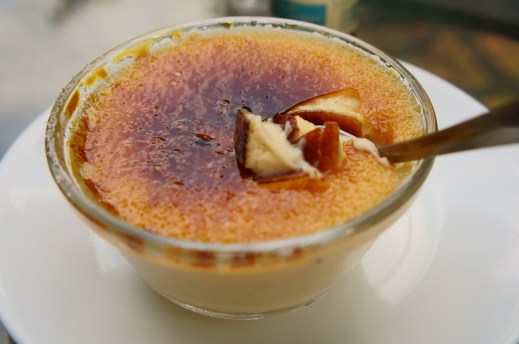
Lightly I tap the burnt surface with a cold metal spoon until it cracks; it fractures like a fine layer of sugary glass; silent, smooth custard mixes with the sticky sweet crunch of the caramelized shards.
An otherwise bland and unmemorable dessert, crème brûlée is always my go-to treat. The sonic pleasures of this indulgence keep me coming back: the tapping, cracking, crunching.
Though the taste and visual presentation of food usually get most of the hype, it’s no secret that sound can amplify the enjoyment and delight of eating. Indeed, sound has become an increasingly important ingredient in the design, advertising, and experience of food: from “junk” food to gourmet dining. What is especially fascinating and disconcerting about this strategic use of sound is the powerful connection between pleasure and sensory manipulation. To my mind, the myriad ways sound is employed to manipulate perceptions of food underscores the need to pay more attention to when, how, and why sound influences our thoughts, feelings, and sensory experiences.
* * *
Food engineers and marketing teams have been taking advantage of the pleasures of sound for years. Rice Krispies’ “Snap, Crackle, Pop” trademark has been around since the late 1920s. And of course there are Pop Rocks, my favorite sounding retro product. The carbonated sugar crystals were invented in the 1950s, but thanks to commercials that celebrated the candy in all of its sonic glory, Pop Rocks’ popularity reached a fever pitch in the 1970s and it’s still going strong today. The official Pop Rocks website boasts that the product continues to be the “leading popping candy brand worldwide.”
Sound is a crucial part of the pleasurable experience of food’s packaging, too. Consider Pringles’ famous “Once you pop you can’t stop” slogan. A neatly stacked chip cylinder with a pleasant-sounding lid is marketed as a refreshing alternative to crinkly chip bags.
Designing sound for the things that contain food may seem like a silly marketing gimmick, but the sounds of packaging can make or break the product. For instance, in an attempt to make its SunChips brand more environmentally friendly, in 2010 Frito-Lay introduced a compostable chip bag. Consumers found it to be ridiculously noisy and complained. The bag had so many haters, in fact, that a facebook group called “SORRY I CAN’T HEAR YOU OVER THIS SUN CHIPS BAG” attracted nearly 30,000 fans. Sales fell, and the financial loss caused Frito-Lay to go back to the un-environmentally friendly bags. Just this year, the company introduced yet another version of the compostable bag. It’s too early to tell if consumers will deem its sound acceptable.
While many companies strive to hit the right note when it comes to the pleasurable sounds of food and its packaging, recent research on taste and sound has been more focused on how external sounds affect the experience of eating. In a noteworthy study, the food company Unilever and the University of Manchester found that the experience of sweetness and saltiness in food decreased in relation to high levels of background noise (perhaps one of the reasons that airplane food generally sucks). They also identified a correlation between the increased volume of background noise and the eater’s perception of crunchiness and freshness.
Additionally, the Crossmodal Laboratory at Oxford University run by professor Charles Spence got a lot of press for discovering that low-pitched sounds tend to bring out bitter flavors while high-pitched sounds heighten the sweetness of food. Go grab a snack (chocolate or coffee work best) and you can try this experiment for yourself.
Armed with scientific knowledge, many chefs and entrepreneurs have been teaming up to put these ideas into practice. For a limited time London restaurant House of Wolf served what they called a “sonic cake pop.” The treat came with a phone number that presented callers with the choice of pushing 1 for sweet (to hear a high-frequency sound) and 2 for bitter (to hear a low-frequency sound). The experiment was a success. People seemed to want to hear their cake and eat it too. The same Guardian article reports that Ben and Jerry’s plans to put QR codes on its packaging so that customers can use their smartphones to access sounds that compliment the flavor of ice cream they are eating.
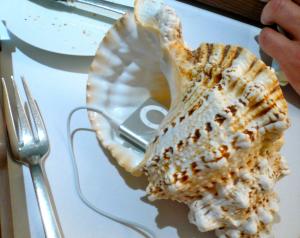
For some, making sound a more prominent feature of eating experiences is more than a fun experiment or savvy marketing strategy: it’s a full-blown artistic performance. World-renowned chef Heston Blumenthal uses sound to draw attention to the holistic sensory experience of dining. His dish “Sound of the Sea,” for example, consists of seafood, edible seaweed, tapioca that looks like sand, decorative shells, and an iPod so that diners can listen to the sounds of the ocean.
Blumenthal has also performed sound experiments while eaters spooned up his bacon and egg ice cream (Yep. That’s a thing!). When the sound of bacon frying in a pan was played, people rated the bacon flavor of the ice cream to be more intense than the egg flavor, and vice versa when the sound was clucking chickens.
In a similar vein, Boston chef Jason Bond and composer Ben Houge have paired up to create food operas, or what they call “audio-gustatory events.” They use real-time musical scoring techniques based off of Houge’s work in video games to design eating experiences that explicitly link sound and taste.
Clearly, when it comes to the pleasures (and displeasures) of eating, sound matters. I’ll admit that I’m a fan of the more imaginative, experimental uses of sound in experiences like the food opera or Blumenthal’s edible sonic creations. There is a sense of play and discovery in these designed experiences; and, people know what they are signing up for and willingly choose to participate. Such endeavors have the potential to heighten participants’ sensitivity to how sound figures into eating and other kinds of everyday activities.

Yet, along with the sonic branding and marketing of edible products, these experiments raise some troubling questions about the relationship between pleasure and sensory manipulation: When is it wrong or unethical to use sensory manipulation to create pleasurable experiences? At what point does manipulation become pleasurable? Is all pleasure a form of manipulation?
Perhaps more significantly, the ways that people are applying scientific knowledge about sound and taste opens up another can of worms: What are the implications of trying to standardize pleasurable sounds via commercial products? What kinds of bodies are invited to participate in pleasurable sensory experiences, or not? I’m thinking particularly of individuals who are deaf and hard-of-hearing, or who have different cultural cues when it comes to recognizing a sound as “pleasurable.”
The sounds of food do not necessarily have to be engineered to be pleasurable. However, because new information about the relationship between sound and other senses is being used to explicitly and implicitly manipulate our experiences, it seems that there is a real need for cultivating a keener, more critical sensory awareness. This means questioning when, how, and why sound is being employed to create pleasurable experiences in a range of products and environments; it means paying careful attention to the ways that sound interacts with all of our senses to influence everyday experiences. So, the next time you’re having what seems to be a simple “feel good” eating experience, be sure to open your ears along with your mouth.
—
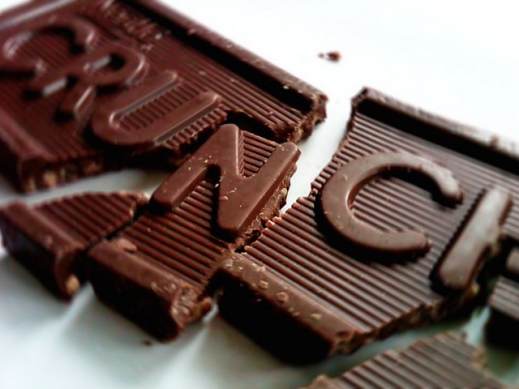
Featured image by Flickr user Wizetux, CC BY 2.0
—
Steph Ceraso received her doctorate in 2013 from the University of Pittsburgh, specializing in rhetoric and composition, pedagogy, sound studies, and digital media. In addition to being a three-peat guest writer for Sounding Out!, her work has been featured in Currents in Electronic Literacy, HASTAC, and Fembot Collective. She is also the coeditor of a special “Sonic Rhetorics” issue of Harlot. Her current book project, Sounding Composition, Composing Sound, examines how expansive, consciously embodied listening and sonic composing practices can deepen our knowledge of multimodal engagement and production. Steph will be joining the faculty in the English department at the University of Maryland, Baltimore County this fall. You can find more about her research, media projects, and teaching at http://www.stephceraso.com.
—

REWIND! . . .If you liked this post, you may also dig:
Tofu, Steak, and a Smoke Alarm: The Food Network’s Chopped & the Sonic Art of Cooking— Seth Mulliken
On Sound and Pleasure: Meditations on the Human Voice— Yvon Bonenfant
‘Corn-ing’ the Suburbs on Halloween, a Sonic Trick and Treat— Steph Ceraso
—
Share this:

Goalball: Sport, Silence, and Spectatorship
DOI: https://doi.org/10.59350/7avz8-1m494
Editor’s Note: Today, SO! kicks off our summer series on “Sound and Sport,” an interrogation of the roles that sound and listening play in the interconnected aspects of many sports: athletic skill, spectatorial experience, laws of physics challenged and exploited, and politics expressed and created. Often, the true play in sports involves power–and sound is a key venue to help us understand its flows and snags, and parse out the actual winners and losers. And, perhaps more directly than other venues, sports is a heightened arena that helps us understand just how important sound is in our everyday lives, even if (and especially because) we take it for granted.
One of my favorite personal “sports metaphors” for sounds’ unacknowledged centrality involves the precise 3.5 seconds I snowboarded with an iPod before I hit an ice patch full speed and had one of the worst falls I have suffered in my 15+ years of the sport. While I was laying on the hard packed snow gasping for breath and trying to piece together what happened, I realized exactly how much I depended on my listening to provide me with crucial, even-life saving, information. With my ears overwhelmed with treble-y punk, I had charged straight into an icepatch that I would have deftly avoided as soon as I heard the inevitable and unmistakeable scratching sound signalling its location. That kinesthetic lesson has continued to inform my everyday, every day since it happened and has led me to ever deeper understandings about sound’s power and the various forms of power that it clarifies–and are clarified by it in turn. I hope that this series will do the same for you, but without the blood and the bruises, even as some of our writers will remind you about the complex and dubious relationship sports can draw between “pain” and “gain.”
Batting first up on our line-up is Melissa Helquist, who describes how the Paralympic sport Goalball challenges the norms of the spectator/athlete relationship. Look for a post on Muhammad Ali in June (Tara Betts), skateboarding in July (Josh Ottum) and an all-out Olympic extravaganza in August, including a podcast discussing the sonic transformations of Brazil’s favelas in anticipation of the world’s ears in 2016 (Andrea Medrado). This summer, it is Sounding Out! FTW. –-J. Stoever-Ackerman, Editor-in-Chief
—
it’s oh so quiet
it’s oh so still
you’re all alone
and so peaceful until
you ring the bell
bim bam
you shout and yell
hi ho ho
you broke the spell
–Bjork, “It’s Oh So Quiet”
During the London 2012 Olympics, the Copper Box venue, which hosted handball, was dubbed “the box that rocks.” The moniker was also, perhaps, a way to drum up interest in handball, a still obscure sport. And indeed, raucous spectators and the pulse and bounce of balls and shoes created a sonic spectacle.
.
When the Paralympics began a few weeks later, much was made of the transformation of “the box that rocks” into “the box that rocks you to sleep.” The game that supposedly will rock you to sleep is Goalball.
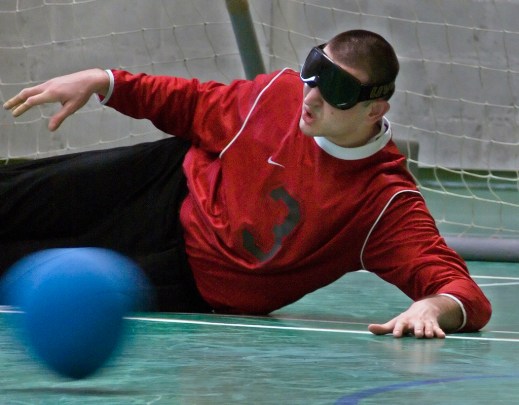
Goalball is a 3-a-side game, played in two 12-minute halves. The offensive team rockets the ball down the court (it must be rolling by mid-court), trying to gain the low and wide net on the other side. As the ball rolls toward the net, the defending players lie on their sides in front of the net, blocking the ball with their bodies. As the ball is pummeled back and forth across the court, it jingles—a simple, clear bell emanating from eight holes in the ball’s surface. In this sport, sound is quite literally a game changer.
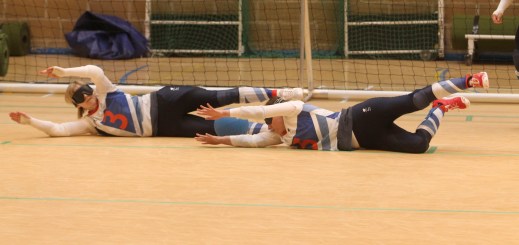
All goalball players are blind or low vison and wear blackout eyeshades to equalize the playing field and to ensure that any residual vision doesn’t get in the way of the gameplay’s sound. A pre-game equipment check includes referees ensuring that eyeshades don’t let in any light. Penalties include touching one’s eyeshades or making noises that disrupt the other team’s ability to hear the movement of the ball.
Goalball, a game first invented as a way to rehabilitate soldiers blinded in WWII, has been a Paralympic sport since 1976. It is one of the few sports designed specifically for blind athletes, rather than adapted from an existing sport. It is a game of sound and touch, a contrast to the visual perception typically associated with team-based ball games. The game, like many others in the Paralympics, expands the sensory experience of sport. The court’s borders are demarcated with tape-covered twine. Sonically, players orient themselves by calling out the position of the on-coming ball, rapping knuckles on the floor, and of course the jingle of the ball.
“Goalball” Courtesy of Perkins School for the Blind Archives
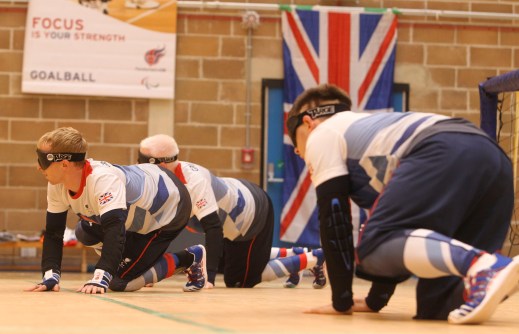
The game is high impact; at the Paralympic level, the ball is thrown at speeds up to 60mph. Players launch the ball with high-velocity spins, something like a cross between a discus throw and bowling. Defenders block the ball with their entire bodies—hands, feet, torso. The game is intense, but it is also quiet.
The players’ reliance on sound demands new expectations of the audience. As spectators, we are watchers, but we are also noisemakers—shouters, shriekers, trashtalkers. Goalball spectators can (and do) cheer when a goal is scored, but when gameplay begins, silence is the rule. Before gameplay begins, referees demand, “Quiet Please!”
The Copper Box “was quite specifically designed to achieve a low background noise level so the blind athletes could play” (Soundscape, Issue 3, 38), enabling the venue to be transformed into an atypical space for the sound of sport and spectatorship, a place to challenge our assumptions and expectations.
Goalball? A description? from Daphnee Denis on Vimeo.
Goalball spectatorship doesn’t demand pure silence, but it is not the unfettered cacophony that we often expect in sports spectatorship. At the London 2012 Paralympics, Bjork’s “It’s So Quiet” was played during breaks in gameplay to remind spectators of their obligation. The song’s ebb and flow of silence and exuberance captures the sonic rhythm of Goalball, its pulsing cadence of silent attention and energetic eruption.
.
The nickname, “the box that rocks you to sleep” captures the discomfort spectators may have with Goalball’s soundscape. The silence during play is tense, but the scoring of a goal offers a sudden release. Spectators do not create a persistent cacophony, but rather a pulse, a constant pattern of lull and explosion. The silence of Goalball can feel disconcerting for spectators unfamiliar with the game. The sound of the crowd—the cheers, the clapping, the screams, the groans, the chants–often seem fundamental to the experience of sport.
Silent spectatorship, of course, is an expectation for other sporting events such as golf and tennis. Here, the demand for silence is linked ostensibly to concentration, but also invokes questions of tradition, class, and (in the case of tennis) gender. These sports are individualized demonstrations of skill, and we are admirers, observers.
Team sports invite identification from the crowd. We extend ourselves, making ourselves part of the team, often through sonic exuberance. Speaking about the crowd sounds of the London Olympics, Mike Goldsmith, author of Discord, notes:
Individual athletes commented that the crowd sound was a great source of energy to then, but could also distract. Their comments suggested that some of them used the crowd sound as a resource, that they could tap into or not as the moment demanded (Soundscape, Issue 3, 36).
Sound can feel like participation. Through sound, we make ourselves part of the game, cheering to support our team, hollering to distract a shot. Sound can make sport feel communal, and thus silence can feel like separation, a wall between spectator and team.
But the seeming silence of Goalball spectatorship offers an opportunity to pay attention to the sound of play, sounds that often get subsumed by the roar of the crowd. The meeting of disability and sport offers a “prime space to reread and rewrite culture’s makings” (Tanya Titchkosky, Reading and Writing Disability Differently, 2007), a space to hear sport differently. The culture of sport is rife with ableist assumptions about how we move, how we watch, how we play. Even when sound is part of sport, it is often an afterthought, an addition—sound might be distracting, it may affect play, but the center sensory preoccupation of sport is frequently visual. We watch, we spectate, we keep our eye on the ball. Sport is sight, but it is also sound. Spectatorship is raucous, but it is also silent.
zing boom shhhh.
—
Featured Image, “Goal Ball” by Flickr User BLac
—
Melissa Helquist is an Associate Professor of English at Salt Lake Community College and a PhD Candidate in Technical Communication and Rhetoric at Texas Tech University. Her dissertation research focuses on digital literacy and blindness and explores the use of sound to read, write, and interpret images. She is a 2012-13 HASTAC scholar and the recipient of a 2012-2013 CCCC Research Initiative Grant. She lives in Salt Lake City, where she hikes, camps, and canoes with her husband and daughter.
—
REWIND! . . .If you liked this post, you may also dig:
Eye Candy: The Absence of the Female Voice in Sports Talk Radio–Liana Silva
The Plasticity of Listening: Deafness and Sound Studies–Steph Ceraso
Taking Me Out of the Ball Game: Advertising’s Acoustic Pitch–Osvaldo Oyola
—
Share this:




Current Top Posts





April 2021

January 2020

November 2019

October 2019

August 2019

April 2014

November 2017

March 2015

December 2017

October 2015


Recent Comments