
Optophones and Musical Print

DOI: https://doi.org/10.59350/td9d4-4b038
In 1912, British physicist Edmund Fournier d’Albe built a device that he called the optophone, which converted light into tones. The first model—“the exploring optophone”—was meant to be a travel aid; it converted light into a sound of analogous intensity. A subsequent model, “the reading optophone,” scanned print using lamp-light separated into beams by a perforated disk. The pattern of light reflected back from a given character triggered a corresponding set of tones in a telephone receiver. d’Albe initially worked with 8 beams, producing 8 tones based on a diatonic scale. He settled on 5 notes: lower G, and then middle C, D, E and G. (Sol, do, re, mi, sol.) The optophone became known as a “musical print” machine. It was popularized by Mary Jameson, a blind student who achieved reading speeds of 60 words per minute.
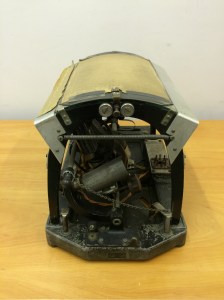
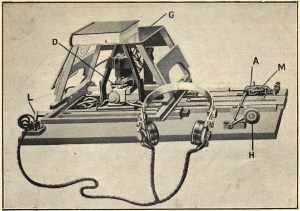
In the field of media studies, the optophone has become renowned through its imaginary repurposings by a number of modernist artists. For one thing, the optophone finds brief mention in Finnegan’s Wake. In turn, Marshall McLuhan credited James Joyce’s novel for being a new medium, turning text into sound. In “New Media as Political Forms,” McLuhan says that Joyce’s own “optophone principle” releases us from “the metallic and rectilinear embrace of the printed page.” More familiar within media studies today, Dada artist Raoul Hausmann patented (London 1935), but did not successfully build, an optophone presumably inspired by d’Albe’s model, which he hoped would be employed in audiovisual performances. This optophone was meant to convert sound into light as well as the reverse. It was part of a broader contemporary impulse to produce color music and synaesthetic art. Hausmann also wrote optophonetic poetry, based on the sounds and rhythms of “pure phonemes” and non-linguistic noises. In response, Francis Picabia painted two optophone portraits in 1921 and 22. Optophone I, below, is composed of lines that might be sound waves, with a pattern that disorders vision.

Theorists have repeatedly located Hausmann’s device at the origin of new media. Authors in the Audiovisuology, Media Archaeology, and Beyond Art: A Third Culture anthologies credit Hausmann’s optophone with bringing-into-being cybernetics, digitization, the CD-ROM, audiovisual experiments in video art, and “primitive computers.” It seems to have escaped notice that d’Albe also used the optophone to create electrical music. In his book, The Moon Element, he writes:
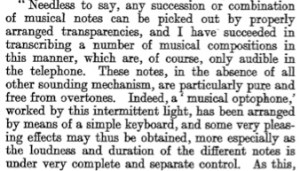
d’Albe’s device is typically portrayed as a historical cul-de-sac, with few users and no real technical influence. Yet optophones continued to be designed for blind people throughout the twentieth century; at least one model has users even today. Musical print machines, or “direct translators,” co-existed with more complex OCR-devices—optical character recognizers that converted printed words into synthetic speech. Both types of reading machine contributed to today’s procedures for scanning and document digitization. Arguably, reading optophones intervened more profoundly into the order of print than did Hausmann’s synaesthetic machine: they not only translated between the senses, they introduced a new symbolic system by which to read. Like braille, later vibrating models proposed that the skin could also read.
In December 1922, the Optophone was brought to the United States from the United Kingdom for a demonstration before a number of educators who worked with blind children; only two schools ordered the device. Reading machine development accelerated in the U.S. around World War II. In his position as chair of the National Defense Research Committee, Vannevar Bush established a Committee on Sensory Devices in 1944, largely for the purpose of rehabilitating blind soldiers. The other options for reading—braille and Talking Books—were relatively scarce and had a high cost of production. Reading machines promised to give blind readers access to magazines and ephemeral print (recipes, signs, mail), which was arguably more important than access to books.
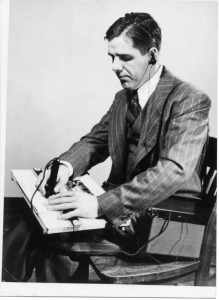
At RCA (Radio Corporation of America), the television innovator Vladimir Zworykin became involved with this project. Zworykin had visited Fournier d’Albe in London in the 19-teens and seen a demonstration of the optophone. Working with Les Flory and Winthrop Pike, Zworykin built an initial machine known as the A-2 that operated on the same principles, but used a different mechanism for scanning—an electric stylus, which was publicized as “the first pen that reads.” Following the trail of citations for RCA’s “Reading Aid for the Blind” patent (US 2420716A, filed 1944), it is clear that the “pen” became an aid in domains far afield from blindness. It was repurposed as an optical probe for measuring the oxygen content of blood (1958); an “optical system for facsimile scanners” (1972); and, in a patent awarded to Burroughs Corporation in 1964, a light gun. This gun, in turn, found its way into the handheld controls for the first home video game system, produced by Sanders Associates.
The A-2 optophone was tested on three blind research subjects, including ham radio enthusiast Joe Piechowski, who was more of a technical collaborator. According to the reports RCA submitted to the CSD, these readers were able to correlate the “chirping” or “tweeting” sounds of the machine with letters “at random with about eighty percent accuracy” after 60 hours of practice. Close spacing on a printed page made it difficult to differentiate between letters; readers also had difficulty moving the stylus at a steady pace and in a straight line. Piechowski achieved reading speeds of 20 words per minute, which RCA deemed too slow.
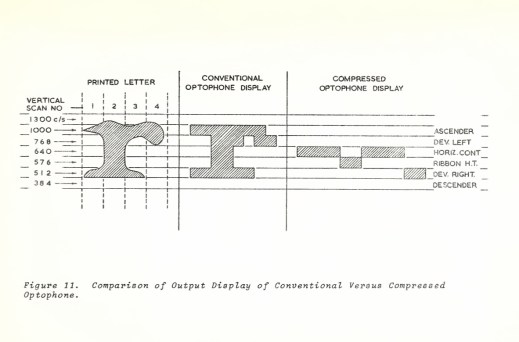
Attempts were made to incorporate “human factors” and create a more efficient tonal code, to reduce reading time as well as learning time and confusion between letters. One alternate auditory display was known as the compressed optophone. Rather than generate multiple tones or chords for a single printed letter, which was highly redundant and confusing to the ear, the compressed version identified only certain features of a printed letter: such as the presence of an ascender or descender. Below is a comparison between the tones of the original optophone and the compressed version, recorded by physicist Patrick Nye in 1965. The following eight lower case letters make up the source material: f, i, k, j, p, q, r, z.
Original record in the author’s possession. With thanks to Elaine Nye, who generously tracked down two of her personal copies at the author’s request. The second copy is now held at Haskins Laboratories.
Because of the seeming limitations of tonal reading, RCA engineers re-directed their research to add character recognition to the scanning process. This was controversial, direct translators like the optophone being perceived as too difficult because they required blind people to do something akin to learning to read print—learning a symbolic tonal or tactile code. At an earlier moment, braille had been critiqued on similar grounds; many in the blind community have argued that mainstream anxieties about braille sprang from its symbolic difference. Speed, moreover, is relative. Reading machine users protested that direct translators like the optophone were inexpensive to build and already available—why wait for the refinement of OCR and synthetic speech? Nevertheless, between November 1946 and May 1947, Zworykin, Flory, and Pike worked on a prototype “letter reading machine,” today widely considered to be the first successful example of optical character recognition (OCR). Before reliable synthetic speech, this device spelled out words letter by letter using tape recordings. The Letter-Reader was too massive and expensive for personal use, however. It also had an operating speed of 20 words per minute—thus it was hardly an improvement over the A-2 translator.
Haskins Laboratories, another affiliate of the Committee on Sensory Devices, began working on the reading machine problem around the same time, ultimately completing an enormous amount of research into synthetic speech and—as argued by Donald Shankweiler and Carol Fowler—the “speech code” itself. In the 1940s, before workable text-to-speech, researchers at Haskins wanted to determine whether tones or artificial phonemes (“speech-like speech”) were easier to read by ear. They developed a “machine dialect of English,” named wuhzi: “a transliteration of written English which preserved the phonetic patterns of the words.” An example can be played below. The eight source words are: With, Will, Were, From, Been, Have, This, That.
Original record in the author’s possession. From Patrick Nye, “An Investigation of Audio Outputs for a Reading Machine” (1965). With thanks to Elaine Nye.
Based on the results of tests with several human subjects, the Haskins researchers concluded that aural reading via speech-like sounds was necessarily faster than reading musical tones. Like the RCA engineers, they felt that a requirement of these machines should be a fast rate of reading. Minimally, they felt that reading speed should keep pace with rapid speech, at about 200 words per minute.
Funded by the Veterans Administration, members of Mauch Laboratories in Ohio worked on both musical optophones and spelled-speech recognition machines from the 1950s into the 1970s. One of their many devices, the Visotactor, was a direct-translator with vibro-tactile output for four fingers. Another, the Visotoner, was a portable nine-channel optophone. All of the Mauch machines were tested by Harvey Lauer, a technology transfer specialist for the Veterans Administration for over thirty years, himself blind. Below is an excerpt from a Visotoner demonstration, recorded by Lauer in 1971.
Visotoner demonstration. Original 7” open reel tape in author’s possession. With thanks to Harvey Lauer for sharing items from his impressive collection and for collaborating with the author over many years.
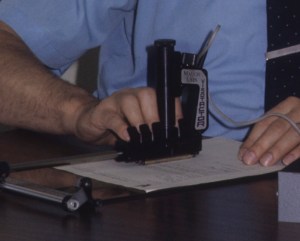
Later on the same tape, Lauer discusses using the Visotoner to read mail, identify currency, check over his own typing, and read printed charts or graphics. He achieved reading speeds of 40 words per minute with the device. Lauer has also told me that he prefers the sound of the Visotoner to that of other optophone models—he compares its sound to Debussy, or the music for dream sequences in films.
Mauch also developed a spelled speech OCR machine called the Cognodictor, which was similar to the RCA model but made use of synthetic speech. In the recording below, Lauer demonstrates this device by reading a print-out about IBM fonts. He simultaneously reads the document with the Visotoner, which reveals glitches in the Cognodictor’s spelling.
Original 7” open reel tape in the author’s possession. With thanks to Harvey Lauer.
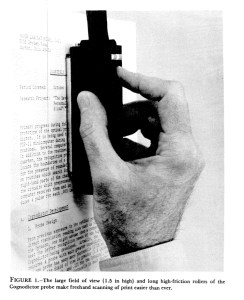
In 1972, at the request of Lauer and other blind reading machine users, Mauch assembled a stereo-optophone with ten channels, called the Stereotoner. This device was distributed through the VA but never marketed, and most of the documentation exists in audio format, specifically in sets of training tapes that were made for blinded veterans who were the test subjects. Some promotional materials, such as the short video below, were recorded for sighted audiences—presumably teachers, rehabilitation specialists, or funding agencies.
Mauch Stereo Toner from Sounding Out! on Vimeo.
Video courtesy of Harvey Lauer.
Mary Jameson corresponded with Lauer about the stereotoner, via tape and braille, in the 1970s. In the braille letter pictured below she comments, “I think that stereotoner signals are the clearest I have heard.”

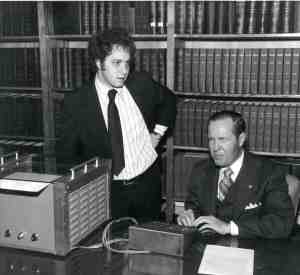
In 1973, with the marketing of the Kurzweil Reader, funding for direct translation optophones ceased. The Kurzweil Reader was advertised as the first machine capable of multi-font OCR; it was made up of a digital computer and flatbed scanner and it could recognize a relatively large number of typefaces. Kurzweil recalls in his book The Age of Spiritual Machines that this technology quickly transferred to Lexis-Nexis as a way to retrieve information from scanned documents. As Lauer explained to me, the abandonment of optophones was a serious problem for people with print disabilities: the Kurzweil Readers were expensive ($10,000-$50,000 each); early models were not portable and were mostly purchased by libraries. Despite being advertised as omnifont readers, they could not in fact recognize most printed material. The very fact of captchas speaks to the continued failures of perfect character recognition by machines. And, as the “familiarization tapes” distributed to blind readers indicate, the early synthetic speech interface was not transparent—training was required to use the Kurzweil machines.
Original cassette in the author’s possession.
Lauer always felt that the ideal reading machine should have both talking OCR and direct-translation capabilities, the latter being used to get a sense of the non-text items on a printed page, or to “preview material and read unusual and degraded print.” Yet the long history of the optophone demonstrates that certain styles of decoding have been more easily naturalized than others—and symbols have increasingly been favored if they bear a close relation to conventional print or speech. Finally, as computers became widely available, the focus for blind readers shifted, as Lauer puts it, “from reading print to gaining access to computers.” Today, many electronic documents continue to be produced without OCR, and thus cannot be translated by screen readers; graphical displays and videos are largely inaccessible; and portable scanners are far from universal, leaving most “ephemeral” print still unreadable.
—
Mara Mills is an Assistant Professor of Media, Culture, and Communication at New York University, working at the intersection of disability studies and media studies. She is currently completing a book titled On the Phone: Deafness and Communication Engineering. Articles from this project can be found in Social Text, differences, the IEEE Annals of the History of Computing, and The Oxford Handbook of Sound Studies. Her second book project, Print Disability and New Reading Formats, examines the reformatting of print over the course of the past century by blind and other print disabled readers, with a focus on Talking Books and electronic reading machines. This research is supported by NSF Award #1354297.
—
Share this:

Sound at SEM 2014

DOI: https://doi.org/10.59350/9zhx1-avs45
Hot on the heels of the American Musicological Society and Society for Music Theory’s joint annual meeting in Milwaukee, the Society for Ethnomusicology will hold its 59th Annual Meeting in Pittsburgh, November 13-16, 2014, hosted by the University of Pittsburgh. SEM is arguably one of the conferences most hospitable to sound studies, and several panels feature strong papers.
On Wednesday, Nov. 12, the “Music and Labor” pre-conference symposium features some fascinating papers of interest to sound scholars and includes a keynote address by Dr. Marcus Rediker, Distinguished Professor of Atlantic History at the University of Pittsburgh. With panels titled “(Re) Conceptualizing Music and Labor,” “The Labor of Music in Transitioning Economies,” “Art as Work: Defying Capitalist Hegemony and National Narrative through Musical Activism and Creative Adaptation,” and “Transformation of Music Labor Regimes in Socialist and Post-Socialist Southeastern Europe,” even the papers that aren’t especially sound studies-related have the potential to demonstrate deft interdisciplinary approaches that would be applicable (and fruitful) in sound studies research.
One of the first sound studies events of the conference program is the annual meeting of the Sound Studies Special Interest Group. Dr. Allen Roda, Jane and Morgan Whitney Research Fellow at the Metropolitan Museum of Art in New York City, and I are currently co-chairs of the SIG; anyone interested in sound studies will not want to miss our meeting on Thursday, November 13 at 12:30-1:30 PM in the Duquesne Room. This year’s meeting will mark the SIG’s 6th anniversary since it was formed in 2009. The group now has over 100 members and is represented on several panels at the 2014 conference in Pittsburgh. One co-chair seat will become vacant this year, and the group will hold elections to fill this position at the meeting; we also plan to discuss plans for more visibility online and among the academic community.
Before the meeting, come early to the 8:00-10:30 AM session in that same room to catch Molly McBride’s paper, “The Sounds of Humor: Listening to Gender in Early Barn Dance Radio,” or see a whole sound studies panel titled “Auditory Histories of the Indian Ocean: Hearing the Soundworlds of the Past” in the Alleghany Room.
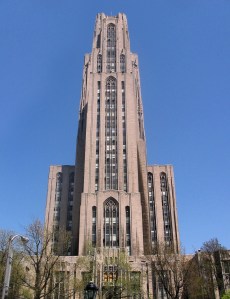
If you can’t make those early panels on the first day, the convention boasts numerous, high-quality sound studies sessions, many of which convene simultaneously. There have been several sound studies-related panels and individual papers at past meetings, but the number of high-quality papers is certainly trending in favor of more sound studies.
Also, the last several annual meetings have featured a soundwalk hosted by the Sound Studies SIG. This year is no different; however, rather than having a guided walk around the host city, this year’s soundwalk will be self-guided. Using the Twitter hashtag #semsoundwalk, participants will listen to Pittsburgh, the acoustic environment of the conference itself, the coffee shop where they stop for refreshment, or wherever they happen to find themselves between 1:15 – 6:00PM on Friday, Nov. 14. Be sure to follow the hashtag – even if you’re not in Pittsburgh – to “listen” along with conference participants.
I am delighted to see that this year’s conference unites the SEM’s commitment to the study of world musics and cultures and sound studies, particularly in panels such as “Auditory Histories of the Indian Ocean: Hearing the Soundworlds of the Past,” “Contemplating Voice in Cross-Cultural Perspective,” and “Regulating Space, Regulating Sound: Musical Practice and Institutional Mediation in São Paulo, Brazil.” This year also highlights the SEM’s strong interdisciplinary bent and makes even more room at the epistemological table for the examination of technoculture and its implications for sound studies and the larger ethnomusicological community.
Because of the sheer volume of sound studies activities, rather than listing my “picks” for the conference, I’ve listed most of the relevant papers and sessions, leaving the hard decision up to you. In fact, there are so many genuine sound studies panels and papers (or papers on closely related topics) its easy to see why the blurry line that demarcates “sound studies” from “music studies” seems blurriest at SEM. For those who cannot attend the conference, some of this year’s panels will be live-streamed. The Special Interest Groups for Sound Studies and Ecomusicology are also co-hosting a roundtable on Saturday morning. For more information about the conference and to catch the live-streamed sessions, visit the conference website at http://www.indiana.edu/~semhome/2014/.
—
Michael Austin is Assistant Professor of Media, Journalism, and Film and coordinator of the Interdisciplinary Studies Program in the School of Communications at Howard University where he teaches courses in music production, sound design for film and audio production. He holds a Ph.D. in Humanities – Aesthetic Studies (with a specialization in Arts and Technology) from the University of Texas at Dallas and music degrees from UT-San Antonio and UT-Austin. He is also affiliated with the Laboratoire Musique et Informatique de Marseille, an audio/music technology and informatics lab in Marseille, France, and is co-chair of the Society for Ethnomusiciology’s Special Interest Group for Sound Studies.
—
Featured image: “Musician” by Flickr user Joanna, CC BY-NC 2.0
—
WEDNESDAY, November 12
8:00 am – 8:00 pm
Ballroom 3, Wyndham Grand Pittsburgh Downtown Hotel
Pre-Conference Symposium: “Music and Labor”
THURSDAY, November 13
8:30 – 10:30 am
Duquesne Room
“The Sounds of Humor: Listening to Gender on Early Barn Dance Radio,” Molly McBride, Memorial University of Newfoundland
Alleghany Room
Session: Auditory Histories of the Indian Ocean: Hearing the Soundworlds of the Past
“Wonders and Strange Things: Practices of Auditory History before Recorded Sound,” Katherine Butler Schofield, King’s College London
“Notes in the Margins: Sumatran Religious Hybridity and the Efficacy of Sound, “ Julia Byl, King’s College London
“Contact, Contestation and Compromise: Sound and Space in 19th-Century Singapore,” Jenny McCallum, King’s College London
“A ‘Wayang of the Orang Puteh’?: Theatres, Music Halls and Audiences in High-Imperial, Calcutta, Madras, Penang and Singapore,” David Lunn, King’s College London
10:45am -12:15 pm
Sterling 3 Room
“Sounding Neoliberalism in the Richmond City Jail,” Andrew C. McGraw, University of Richmond
Heinz Room
“The Color of Sound: Timbre in Ralph Ellison’s Invisible Man,” Sydney A. Boyd, Rice University
12:30 – 1:30 pm
Duquesne Room
Special Interest Group for Sound Studies
1:45 – 3:45 pm
Sterlings 1 Room
“Radio Archives and the Art of Persuasion: Preserving Social Hierarchies in the Airwaves of Lima” Carlos Odria, Florida State University
Ft. Pitt Room
Session: Mediated Musics, Mediated Lives
“Uploading Matepe: The Role of Online Learning Communities and the Desire to Connect to Northeastern Zimbabwe,” Jocelyn A. Moon, University of Washington; Zachary Moon, Independent Scholar
“Staging Overcoming: Disability, Meritocracy, and the Envoicing of Dreams,” William Cheng, Dartmouth University
“As Time Goes By: Car Radio and Spatiotemporal Manipulations of the Travel Experience in 20th-Century America,” Sarah Messbauer, University of California, Davis
“’How Can We Live in a Country Like This?’ Music, Talk Radio, and Moral Anxiety,” Karl Haas, Boston University
Sterling 3 Room
Session: Oxide and Memory: Tape Culture and the Communal Archive
Oxide and Memory: Tape Culture and the Communal Archive
“Magnetic Tape, Materiality, and the Interpretation of Non-Commercial Cassette and Reel-to-Reel Recordings from Quebec’s Gaspé Peninsula,” Laura Risk, McGill University
“Family Sense and Family Sound: Home Recordings and Greek-American Identity,” Panayotis League, Harvard University
“The Memory of Media: Autoarchivization and Empowerment in 1970s Jazz,” Michael C. Heller, University of Massachusetts, Boston
“Reimagining the Community Sound Archive: Cultural Memory and the Case for ‘Slow’ Archiving in a Gaspesian Village,” Glenn Patterson, Memorial University of Newfoundland
4:00 – 5:30 pm
Sterlings 1 Room
Panel: Contemplating Voice in Cross-Cultural Perspective
“The Gravest of Female Voices: Women and the Alto in Sacred Harp,” Sarah E. Kahre, Florida State University
“Re-sounding Waljinah: Aging and the Voice in Indonesia,” Russ P. Skelchy, University of California, Riverside
“Katajjaq: Between Vocal Games, Place and Identity,” Raj S. Singh, York University
Sterlings 3 Room
Session: Rumors, Sound Leakages and Individual Tales: Disruptive Listening in Zones of Conflict
“From the Struggle for Citizenship to the Fragmentation of Justice: Reflections on the Place of Dinka Songs in South Sudan’s Transitional Justice Process,” Angela Impey, School of Oriental and African Studies (SOAS), University of London
“Internet Rumors and the Changing Sounds of Uyghur Religiosity: The Case of the Snake Monkey Woman,” Rachel Harris, School of Oriental and African Studies (SOAS), University of London
“The Cantor and the Muezzin’s Duet at the Western Wall: Contesting Sound Spaces on the Frayed Seams of the Israel-Palestine Conflict,” Abigail Wood, University of Haifa
Heinz Room
Session: Historiography, Historicity, and Biography
“A Sonic Historiography of Early Sample-Based Hip-Hop Recordings,” Patrick Rivers, University of New Haven
“Biography as Methodology in the Study of Okinawan Folk Song,” Kirk A. King, University of British Columbia
“Sounding the Silent Image: Uilleann Piper as Ethnographic Object in Early Hollywood Film,” Ivan Goff, New York University
FRIDAY, November 14
7:00 – 8:00 am
Special Interest Group for Voice Studies
8:30 – 10:30 am
Commonwealth 1-2 Room, live streaming
Session: Sound Networks: Socio-Political Identity, Engagement, and Mobilization through Music in Cyberspace and Independent Media
*Sponsored by the Popular Music Section and Special Interest Group for Sound Studies
“Technological Factors Conditioning the Socio-Political Power of Music in Cyberspace,” Michael Frishkopf, University of Alberta
“Cyber-Mobilization, Informational Intimacy, and Musical Frames in Ukraine’s EuroMaidan Protests,” Adriana Helbig, University of Pittsburgh
“Countering Spirals of Silence: Protest Music and the Anonymity of Cyberspace in the Japanese Antinuclear Movement,” Noriko Manabe, Princeton University
“Living (and Dying) the Rock and Roll Dream: Alternative Media and the Politics of ‘Making It’ as an Iranian Underground Musician,” Farzaneh Hemmasi, University of Toronto
Sterling 1 Room
Session: Affective Environments and the Bioregional Soundscape
*Sponsored by the Special Interest Group for Ecomusicology
“’Landscape is Not Just What Your Eyes See’: Battery Radio, the Technological Soundscape, and Sonically Knowing the Battery, Kate Galloway, Memorial University of Newfoundland
“Re-sounding Caribou: Musical Posthumanism in Being Caribou,” Erin Scheffer, University of Toronto
“Cold, Crisp, and Dry: Inuit and Southern Concepts of the Northern Soundscape,” Jeffrey van den Scott, Northwestern University
Discussant, Nancy Guy, University of California, San Diego
Duquesne Room
“The Sound of Affective Fact,” Matthew Sumera, University of Minnesota
1:15 – 6:30 pm
Soundwalk: A Sonic Environmental Survey of the SEM Annual Meeting
*Sponsored by the Special Interest Groups for Sound Studies and Ecomusicology. Follow the walk on Twitter: #semsoundwalk
(Meet in Wyndham Grand main lobby at 1:15pm. Reconvene in lobby at 6:00)
1:45 – 3:45 pm
Smithfield Room
Session: Strident Voices: Material and Political Alignments
*Sponsored by the Special Interest Group for Voice Studies
“Registering Protest: Voice, Precarity, and Assertion in Crisis Portugal,”Lila Ellen Gray, University of Amsterdam
“Quiet, Racialized Vocality at Fisk University,” Marti Newland, Columbia University
“’The Rough Voice of Tenderness’: Chavela Vargas and Mexican Song,” Kelley Tatro, North Central College
Discussant: Amanda Weidman, Bryn Mawr College
4:00 – 5:30 pm
Heinz Room
Session: Celebratory Sounds and the Politics of Engagement
“Creating Zakopower in Postsocialist Poland,” Louise J. Wrazen, York University
“Merry-Making and Loyalty to the Movement: Conviviality as a Core Parameter of Traditionalism in Aysén, Chile,” Gregory J. Robinson, George Mason University
“Sounding the Carnivalesque: Changing Identities for a Sonic Icon of the Popular,” Michael S. O’Brien, College of Charleston

SATURDAY, November 15
8:30 – 10:30 am
Sterlings 1 Room
Roundtable: Sound Studies, Ecomusicology, and Post-Humanism In/For/With Ethnomusicology
*Sponsored by the Special Interests Groups for Ecomusicology and for Sound Studies
P. Allen Roda, The Metropolitan Museum of Art
Jennifer Post, University of Arizona
Mark Pedelty, University of Minnesota
Michael Silvers, University of Illinois at Urbana-Champaign
Ben Tausig, Stony Brook University
Zeynep Bulut, King’s College London
10:45 am – 12:15 pm
Benedum Room, live streaming
Musical Instruments, Material Cultures, and Sound Ecologies
“Bulgarian Acoustemological Tales: Narrativity, Agrarian Ecology, and the Kaval’s Voice,” Donna A. Buchanan, University of Illinois at Urbana-Champaign
Sterling 1 Room
Session: Theorizing Sound
“Water Sounds: Distance Swimmers and Ecomusicology,” Niko Higgins, Columbia University
“Telephone, Vacuum Cleaner, Couch: Senses and Sounds of the Everyday in Postwar Japan,” Miki Kaneda, Boston University
Discussant: Benjamin Tausig, Stony Brook University
SUNDAY, November 16
8:30 – 10:30 am
Birmingham Room
Session: Regulating Space, Regulating Sound: Musical Practice and Institutional Mediation in São Paulo, Brazil
*Sponsored by the Latin American and Caribbean Section
“Music under Control? São Paulo’s Anti-Noise Agency in Action,” Leonardo Cardoso, University of Texas at Austin
“Music Producers in São Paulo’s Cultural Policy Worlds,” Daniel Gough, University of Chicago
“’Small Universes’: The Creation of Social Intimacy through Aesthetic Infrastructures in São Paulo’s Underground,” Shannon Garland, Columbia University
Discussant, Morgan Lurker, Reed College
Heinz Room
“Hear What You Want: Sonic Politics, Blackness, and Racism-Canceling Headphones,” Alex Blue, University of California, Santa Barbara
Alleghany Room
“Sound and Silence in Festivals of the French Revolution: Sonic Analysis in History,” Rebecca D. Geoffroy-Schwinden, Duke University
10:45 am – 12:15 pm
Liberty Room
Session: Sounding Nations
“Building the Future through the Past: The Revival Movement in Iranian Classical Music and the Reconstruction of National Identity in the 1960s and the 1970s,” Hadi Milanloo, Memorial University of Newfoundland
“Sounding Citizenship in Southern Africa: Malawian Musicians and the Social Worlds of Recording Studios and Music Education Centers,” Richard M. Deja, University of Illinois
“Unity in (Spite of) Diversity: Tensions and Contradictions in Performing Surinamese National Identity,” Corinna S. Campbell, Williams College
Share this:




Current Top Posts





April 2021

January 2020

November 2019

October 2019

August 2019

April 2014

November 2017

March 2015

December 2017

October 2015


Recent Comments