Optophones and Musical Print

DOI: https://doi.org/10.59350/td9d4-4b038
In 1912, British physicist Edmund Fournier d’Albe built a device that he called the optophone, which converted light into tones. The first model—“the exploring optophone”—was meant to be a travel aid; it converted light into a sound of analogous intensity. A subsequent model, “the reading optophone,” scanned print using lamp-light separated into beams by a perforated disk. The pattern of light reflected back from a given character triggered a corresponding set of tones in a telephone receiver. d’Albe initially worked with 8 beams, producing 8 tones based on a diatonic scale. He settled on 5 notes: lower G, and then middle C, D, E and G. (Sol, do, re, mi, sol.) The optophone became known as a “musical print” machine. It was popularized by Mary Jameson, a blind student who achieved reading speeds of 60 words per minute.
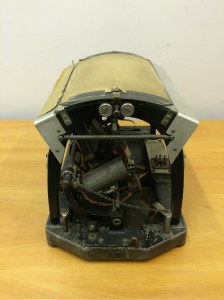
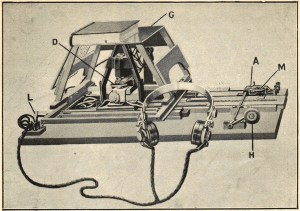
In the field of media studies, the optophone has become renowned through its imaginary repurposings by a number of modernist artists. For one thing, the optophone finds brief mention in Finnegan’s Wake. In turn, Marshall McLuhan credited James Joyce’s novel for being a new medium, turning text into sound. In “New Media as Political Forms,” McLuhan says that Joyce’s own “optophone principle” releases us from “the metallic and rectilinear embrace of the printed page.” More familiar within media studies today, Dada artist Raoul Hausmann patented (London 1935), but did not successfully build, an optophone presumably inspired by d’Albe’s model, which he hoped would be employed in audiovisual performances. This optophone was meant to convert sound into light as well as the reverse. It was part of a broader contemporary impulse to produce color music and synaesthetic art. Hausmann also wrote optophonetic poetry, based on the sounds and rhythms of “pure phonemes” and non-linguistic noises. In response, Francis Picabia painted two optophone portraits in 1921 and 22. Optophone I, below, is composed of lines that might be sound waves, with a pattern that disorders vision.

Theorists have repeatedly located Hausmann’s device at the origin of new media. Authors in the Audiovisuology, Media Archaeology, and Beyond Art: A Third Culture anthologies credit Hausmann’s optophone with bringing-into-being cybernetics, digitization, the CD-ROM, audiovisual experiments in video art, and “primitive computers.” It seems to have escaped notice that d’Albe also used the optophone to create electrical music. In his book, The Moon Element, he writes:
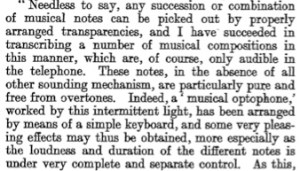
d’Albe’s device is typically portrayed as a historical cul-de-sac, with few users and no real technical influence. Yet optophones continued to be designed for blind people throughout the twentieth century; at least one model has users even today. Musical print machines, or “direct translators,” co-existed with more complex OCR-devices—optical character recognizers that converted printed words into synthetic speech. Both types of reading machine contributed to today’s procedures for scanning and document digitization. Arguably, reading optophones intervened more profoundly into the order of print than did Hausmann’s synaesthetic machine: they not only translated between the senses, they introduced a new symbolic system by which to read. Like braille, later vibrating models proposed that the skin could also read.
In December 1922, the Optophone was brought to the United States from the United Kingdom for a demonstration before a number of educators who worked with blind children; only two schools ordered the device. Reading machine development accelerated in the U.S. around World War II. In his position as chair of the National Defense Research Committee, Vannevar Bush established a Committee on Sensory Devices in 1944, largely for the purpose of rehabilitating blind soldiers. The other options for reading—braille and Talking Books—were relatively scarce and had a high cost of production. Reading machines promised to give blind readers access to magazines and ephemeral print (recipes, signs, mail), which was arguably more important than access to books.
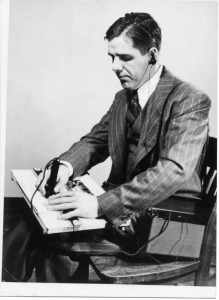
At RCA (Radio Corporation of America), the television innovator Vladimir Zworykin became involved with this project. Zworykin had visited Fournier d’Albe in London in the 19-teens and seen a demonstration of the optophone. Working with Les Flory and Winthrop Pike, Zworykin built an initial machine known as the A-2 that operated on the same principles, but used a different mechanism for scanning—an electric stylus, which was publicized as “the first pen that reads.” Following the trail of citations for RCA’s “Reading Aid for the Blind” patent (US 2420716A, filed 1944), it is clear that the “pen” became an aid in domains far afield from blindness. It was repurposed as an optical probe for measuring the oxygen content of blood (1958); an “optical system for facsimile scanners” (1972); and, in a patent awarded to Burroughs Corporation in 1964, a light gun. This gun, in turn, found its way into the handheld controls for the first home video game system, produced by Sanders Associates.
The A-2 optophone was tested on three blind research subjects, including ham radio enthusiast Joe Piechowski, who was more of a technical collaborator. According to the reports RCA submitted to the CSD, these readers were able to correlate the “chirping” or “tweeting” sounds of the machine with letters “at random with about eighty percent accuracy” after 60 hours of practice. Close spacing on a printed page made it difficult to differentiate between letters; readers also had difficulty moving the stylus at a steady pace and in a straight line. Piechowski achieved reading speeds of 20 words per minute, which RCA deemed too slow.
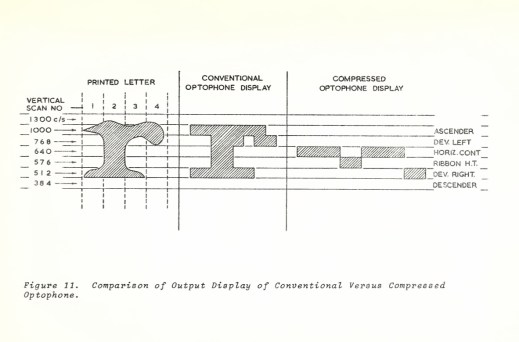
Attempts were made to incorporate “human factors” and create a more efficient tonal code, to reduce reading time as well as learning time and confusion between letters. One alternate auditory display was known as the compressed optophone. Rather than generate multiple tones or chords for a single printed letter, which was highly redundant and confusing to the ear, the compressed version identified only certain features of a printed letter: such as the presence of an ascender or descender. Below is a comparison between the tones of the original optophone and the compressed version, recorded by physicist Patrick Nye in 1965. The following eight lower case letters make up the source material: f, i, k, j, p, q, r, z.
Original record in the author’s possession. With thanks to Elaine Nye, who generously tracked down two of her personal copies at the author’s request. The second copy is now held at Haskins Laboratories.
Because of the seeming limitations of tonal reading, RCA engineers re-directed their research to add character recognition to the scanning process. This was controversial, direct translators like the optophone being perceived as too difficult because they required blind people to do something akin to learning to read print—learning a symbolic tonal or tactile code. At an earlier moment, braille had been critiqued on similar grounds; many in the blind community have argued that mainstream anxieties about braille sprang from its symbolic difference. Speed, moreover, is relative. Reading machine users protested that direct translators like the optophone were inexpensive to build and already available—why wait for the refinement of OCR and synthetic speech? Nevertheless, between November 1946 and May 1947, Zworykin, Flory, and Pike worked on a prototype “letter reading machine,” today widely considered to be the first successful example of optical character recognition (OCR). Before reliable synthetic speech, this device spelled out words letter by letter using tape recordings. The Letter-Reader was too massive and expensive for personal use, however. It also had an operating speed of 20 words per minute—thus it was hardly an improvement over the A-2 translator.
Haskins Laboratories, another affiliate of the Committee on Sensory Devices, began working on the reading machine problem around the same time, ultimately completing an enormous amount of research into synthetic speech and—as argued by Donald Shankweiler and Carol Fowler—the “speech code” itself. In the 1940s, before workable text-to-speech, researchers at Haskins wanted to determine whether tones or artificial phonemes (“speech-like speech”) were easier to read by ear. They developed a “machine dialect of English,” named wuhzi: “a transliteration of written English which preserved the phonetic patterns of the words.” An example can be played below. The eight source words are: With, Will, Were, From, Been, Have, This, That.
Original record in the author’s possession. From Patrick Nye, “An Investigation of Audio Outputs for a Reading Machine” (1965). With thanks to Elaine Nye.
Based on the results of tests with several human subjects, the Haskins researchers concluded that aural reading via speech-like sounds was necessarily faster than reading musical tones. Like the RCA engineers, they felt that a requirement of these machines should be a fast rate of reading. Minimally, they felt that reading speed should keep pace with rapid speech, at about 200 words per minute.
Funded by the Veterans Administration, members of Mauch Laboratories in Ohio worked on both musical optophones and spelled-speech recognition machines from the 1950s into the 1970s. One of their many devices, the Visotactor, was a direct-translator with vibro-tactile output for four fingers. Another, the Visotoner, was a portable nine-channel optophone. All of the Mauch machines were tested by Harvey Lauer, a technology transfer specialist for the Veterans Administration for over thirty years, himself blind. Below is an excerpt from a Visotoner demonstration, recorded by Lauer in 1971.
Visotoner demonstration. Original 7” open reel tape in author’s possession. With thanks to Harvey Lauer for sharing items from his impressive collection and for collaborating with the author over many years.
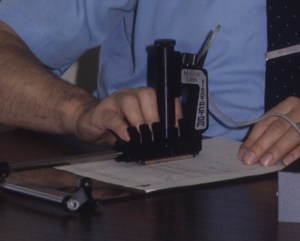
Later on the same tape, Lauer discusses using the Visotoner to read mail, identify currency, check over his own typing, and read printed charts or graphics. He achieved reading speeds of 40 words per minute with the device. Lauer has also told me that he prefers the sound of the Visotoner to that of other optophone models—he compares its sound to Debussy, or the music for dream sequences in films.
Mauch also developed a spelled speech OCR machine called the Cognodictor, which was similar to the RCA model but made use of synthetic speech. In the recording below, Lauer demonstrates this device by reading a print-out about IBM fonts. He simultaneously reads the document with the Visotoner, which reveals glitches in the Cognodictor’s spelling.
Original 7” open reel tape in the author’s possession. With thanks to Harvey Lauer.
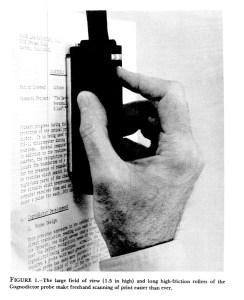
In 1972, at the request of Lauer and other blind reading machine users, Mauch assembled a stereo-optophone with ten channels, called the Stereotoner. This device was distributed through the VA but never marketed, and most of the documentation exists in audio format, specifically in sets of training tapes that were made for blinded veterans who were the test subjects. Some promotional materials, such as the short video below, were recorded for sighted audiences—presumably teachers, rehabilitation specialists, or funding agencies.
Mauch Stereo Toner from Sounding Out! on Vimeo.
Video courtesy of Harvey Lauer.
Mary Jameson corresponded with Lauer about the stereotoner, via tape and braille, in the 1970s. In the braille letter pictured below she comments, “I think that stereotoner signals are the clearest I have heard.”

In 1973, with the marketing of the Kurzweil Reader, funding for direct translation optophones ceased. The Kurzweil Reader was advertised as the first machine capable of multi-font OCR; it was made up of a digital computer and flatbed scanner and it could recognize a relatively large number of typefaces. Kurzweil recalls in his book The Age of Spiritual Machines that this technology quickly transferred to Lexis-Nexis as a way to retrieve information from scanned documents. As Lauer explained to me, the abandonment of optophones was a serious problem for people with print disabilities: the Kurzweil Readers were expensive ($10,000-$50,000 each); early models were not portable and were mostly purchased by libraries. Despite being advertised as omnifont readers, they could not in fact recognize most printed material. The very fact of captchas speaks to the continued failures of perfect character recognition by machines. And, as the “familiarization tapes” distributed to blind readers indicate, the early synthetic speech interface was not transparent—training was required to use the Kurzweil machines.
Original cassette in the author’s possession.
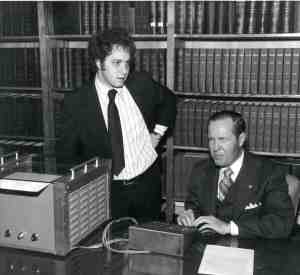
Lauer always felt that the ideal reading machine should have both talking OCR and direct-translation capabilities, the latter being used to get a sense of the non-text items on a printed page, or to “preview material and read unusual and degraded print.” Yet the long history of the optophone demonstrates that certain styles of decoding have been more easily naturalized than others—and symbols have increasingly been favored if they bear a close relation to conventional print or speech. Finally, as computers became widely available, the focus for blind readers shifted, as Lauer puts it, “from reading print to gaining access to computers.” Today, many electronic documents continue to be produced without OCR, and thus cannot be translated by screen readers; graphical displays and videos are largely inaccessible; and portable scanners are far from universal, leaving most “ephemeral” print still unreadable.
—
Mara Mills is an Assistant Professor of Media, Culture, and Communication at New York University, working at the intersection of disability studies and media studies. She is currently completing a book titled On the Phone: Deafness and Communication Engineering. Articles from this project can be found in Social Text, differences, the IEEE Annals of the History of Computing, and The Oxford Handbook of Sound Studies. Her second book project, Print Disability and New Reading Formats, examines the reformatting of print over the course of the past century by blind and other print disabled readers, with a focus on Talking Books and electronic reading machines. This research is supported by NSF Award #1354297.
—
Share this:

The Acoustics of Passing: Harriet Beecher Stowe’s Uncle Tom’s Cabin as Supremacist Remix

DOI: https://doi.org/10.59350/q25wq-ywc51
Editor’s Note: Sound Studies is often accused of being a presentist enterprise, too fascinated with digital technologies and altogether too wed to the history of sound recording. Sounding Out!‘s last forum of 2013, “Sound in the Nineteenth Century,” addresses this critique by showcasing the cutting edge work of three scholars whose diverse, interdisciplinary research is located soundly in the era just before the advent of sound recording: Mary Caton Lingold (Duke), Caitlin Marshall (Berkeley), and Daniel Cavicchi (Rhode Island School of Design). In examining nineteenth century America’s musical practices, listening habits, and auditory desires through SO!‘s digital platform, Lingold, Marshall, and Cavicchi perform the rare task of showcasing how history’s sonics had a striking resonance long past their contemporary vibrations while performing the power of the digital medium as a tool through which to, as Early Modern scholar Bruce R. Smith dubs it, “unair” past auditory phenomena –all the while sharing unique methodologies that neither rely on recording nor bemoan their lack. Last week, the series began with Mary Caton Lingold‘s exploration of the materialities of Solomon Northup’s fiddling as self-represented in 12 Years a Slave. This week, Caitlin Marshall treats us to a fascinating new take on Harriet Beecher Stowe’s listening practice and dubious rhetorical remixing of black sonic resistance with white conceptions of revolutionary independence. —Jennifer Stoever, Editor-in-Chief
—

Harriet Beecher Stowe: novelist, anti-slavery agitator, antebellum DJ? In 1852, Stowe penned one of the most famous works of fiction in American history: Uncle Tom’s Cabin. A sentimental work, the novel dramatized the lives of fictional slaves searching for freedom. Eager to achieve a national hearing of her anti-slavery agenda, Stowe’s novel required a voice that could “speak” in morally efficacious tones against slavery. To stage this voice, one that hinged on a sonic appeal to inter-racial sympathy, Stowe sampled and mixed two powerfully persuasive, if diametrically opposed, cultures of speaking and listening in the United States.
The first of these cultures revolved around revolutionary American understandings of political rhetoric. According to Jay Fliegelman, this tradition of republican oratory drew upon 18th century philosophical principles to recast Declaring Independence as a speech act. In his Declaration, Jefferson announced the ‘self-evidence’ of an American people by performing a nationally specific common sense in two important ways. First, he displayed a breed of American moral feeling in direct contrast to that of the colonial British; second, he did so through an oratorical style that inaugurated a common, American modality for articulating and hearing truth. The felt and sounded show of a common ‘self’ evidenced Americans’ natural rights to independence, and installed a markedly white revolutionary acoustics of freedom.
Stowe’s second sample was a misappropriation of a new mode of hearing in the 1845 Narrative of the Life of Frederick Douglass, An American Slave. As Sounding Out! Editor in Chief Jennifer Stoever-Ackerman has argued in “The Word and the Sound: Listening to the Sonic Colour-line in Frederick Douglass’s 1845 Narrative,” Douglass’s narrative was a direct attempt to bend and subvert what she terms “the sonic colour-line” (21). An acoustic schema that racialized sound and recruited the ear in black subjection, the sonic color line was epitomized by the republican oratorical tradition wherein meaning was linked to white articulation, and meaninglessness to black utterance, heard simply as ‘noise.’

Contrastingly, the reformed sonic model presented in the Narrative sought to position black sound as a site of meaning and resistance, and challenged Northern readers to question and remap both their hearing of such sounds and their ethical relationship to black meaning. Jonathan Cruz, in Culture on the Margins, terms this new mode of hearing “ethnosympathy” and defines it as an “interpretive ethos of pathos” (3). Importantly, Stoever-Ackerman highlights that Douglass did not seek to cast black sound as “a sentimental appeal to truth,” but “rather [as] a challenge to dominant notions of truth produced and disseminated through the ear” (31). Stowe however, did not hear Douglass’s message so subtlety, and like many Abolitionists, was quick to commandeer black sound for a white social justice platform wherein it served as the innately moral (and romantically racialized) sound of sentimental suffering. Thus, it was this mishearing of the strains of black resistance that Stowe remixed with the white tones of revolutionary independence to spin a brand new soundtrack for the antebellum era. I term this soundtrack the acoustics of passing.
A vocal melodrama (a literal speech act) in black and white, the acoustics of passing was an amalgamated grid of sonic intelligibility invested in the political power of voice that encapsulated the seemingly antithetical (to white America) tones of republican virtue and black experience, and was deployed by Stowe to narrate the fantastical passage of African Americans from bondage to freedom. Composed first through Uncle Tom’s Cabin, and propagated later in her paternalistic relationships with black female artists, Stowe’s acoustics was ostensibly a powerful tool in the fight against slavery, but was ultimately used by the author to recapitulate her whitewashed vision of America.
Stowe’s acoustics appear in Uncle Tom’s Cabin in novel’s first passing scene: George Harris’s Spanish masquerade. Stowe frames this scene prominently with the fugitive slave advertisement that George’s master, Mr. Harris, has posted. Many scholars have pointed to the way in which the visual organizes the practice of passing, but it is important to note that in this scene, the oral/aural is equally emphasized as key to a passing performance; Mr. Harris, for one, notes in his advertisement that George’s keen eloquence and literacy are the fugitive’s distinguishing features. Moreover, the advertisement seems to warn, in combination with George’s European complexion, he is rendered seemingly indistinguishable from a white man. Mr. Harris expects George to attempt such a passing ruse, and therefore clearly identifies the marks that will testify to George’s slave status. George
is deeply scarred on his back and shoulders; has been branded in his right hand with the letter H (95).
Contrary to Mr. Harris’ predictions, however, George enters the roadhouse disguised as a Spanish gentleman. To pull off this guise George darkens his skin and hair. In the essay, “Spanish Masquerade and the Drama of Racial Identity in Uncle Tom’s Cabin,” Julia Stern argues that George’s third term identity, “nonblack, nonwhite,” is radical because it upsets the logic of the antebellum racial dichotomy. However, we should note that this dark masquerade allows Stowe to symbolically align George, a mixed race man, with both his black and white parentage. In darkening his skin George pays tribute to his slave mother, while by adopting a well-known Anglican slaveholding surname, Henry Butler, George references his absentee father. Thus, the Spanish disguise is Stowe’s reminder that George is passing for who he claims to be.

Tailpiece illustration by Hammat Billings for Uncle Tom’s Cabin; or, Life Among the Lowly, by Harriet Beecher Stowe. Illustrated Edition. Original Designs by Billings; Engraved by Baker and Smith. (Boston: John P. Jewett and Company, 1853). George Harris, Mr. Wilson. Clifton Waller Barrett Collection, University of Virginia.
Yet before George can break from the tavern on his way towards Canada, he must reveal himself to his former employer, Mr. Wilson, who, George believes, has recognized him. In the long speech that follows, George must convince Mr. Wilson to discard a juridical sense of right in favor of an ethical one. Carefully arranged through Stowe’s acoustics of passing, George’s oratory presents equal parts white republican sentiment and black pathos, sentimentally persuading Wilson (and a listening America) of the moral justice in permitting him to pass to freedom.
Well aware that her readers at home would have been reciting the text of Uncle Tom’s Cabin aloud, Stowe is careful score George’s speech for both sonic whiteness and blackness–leaving intertextual clues that act like dynamic musical notation to indicate how George’s performance should sound. To begin, Stowe spells out her source material for George’s speech by directly citing Jefferson’s “Declaration” in a footnote to George’s opening salvo. Stowe wants readers to hear George’s speech as the realization of the American Republican promise. Americans, Stowe argues, are in a state no better than the British of the 1770’s: like the tyrannical father/monarch King George, Americans are “deaf to the voice of justice & of consanguinity.” A lengthy address, George’s monologue is an account of the domestic crimes of slavery, and, like the Declaration, is a complaint of personal injury at the hands of a nation that has been as negligent in looking after its blood kin as has George Harris’s father. Concluding with the passionate exclamation, “I’ll fight for my liberty to the last breath I breathe! You say your fathers did it; if it was right for them, it is right for me!” (102), George’s Declaration claims the rhetorical, and therefore natural, rights that are his white, paternal inheritance.
The sonic difference in George’s speech however, is the pathos of it, the “tears, and flashing eyes, and despairing gesture,” here meant to index the orator’s audible black suffering. Though setup as racially inscrutable in this scene, Stowe takes great pains to ‘out’ George’s hidden blackness. Not only does Stowe symbolically darken George to cite his mother’s race, but she draws attention to the black body through repeated citation of his scars. This figuration of speaking wounds was prevalent in the popular imagination of Stowe’s day, and represented the white fantasy that black speech was the ‘playback’ of slave experience as recorded in the grooves of the traumatized and marked black body. Frederick Douglass, for example, recounts in My Bondage and My Freedom that he was first introduced as a speaker to the Abolitionist lecture circuit as a “graduate from the peculiar institution…with my diploma written on my back!” (359).
Miraculously, at the climax of George’s sonically mixed oration, Mr. Wilson is overcome with a revised sense of justice, one consonant with George’s bid for freedom. In this overdetermined acoustic schema, Stowe aligns progressive white ethos and republican sentiment with the distinct sounds of black pathos, and positions any mode of hearing contrary to this inter-racial sonic sympathy as un-Christian, un-patriotic, and detrimental to the future of the Union.
Yet Stowe’s acoustics of passing is decidedly supremacist. To begin, George’s mixed sound is haunted by the specter of forced conception and familial alienation ubiquitous to slavery. Additionally, while Stowe deploys the acoustics of passing towards an anti-slavery platform, her sonic schema ultimately preserves the social and political function of whiteness. Thus, while George’s sonic blackness is essential for playing out the moral justice of Stowe’s cause, it is this same audible blackness that permits Stowe to ultimately write the political problem of inter-racial integration off to Liberia with the entire Harris family.

Herein is the problem of Stowe’s acoustics: its sonic inter-racial sympathy at once promised speakers of color the agency of a sounded path to freedom (that which George performs and narrates) while ultimately deploying white practices of containment. And Stowe indeed dramaturged the lives of several mixed race artists through these acoustics, most notably the Dramatic Reader, Mary Elizabeth Webb and the concert vocalist Elizabeth Taylor Greenfield.

As I continue to investigate the careers of women of color like Greenfield and Webb, I think about how Stowe’s acoustics could have empowered and constrained their bids for resistance, rights and recognition.
—
Featured Image: “Representative Americans” Image of Harriet Beecher Stowe surrounded by characters from Uncle Tom’s Cabin, 1893, Remixed by Jennifer Stoever-Ackerman
—
Caitlin Marshall is a PhD Candidate in Performance Studies at UC Berkeley. A vocalist herself, Caitlin applies her practice-based knowledge of voice towards the study of what it meant to ‘sound American’ during the nation’s first independent century. Focusing on ‘Othered’ American vernaculars at the intersections of race, disability, gender, and ethnicity, her dissertation, ‘Power in the Tongue’: Crippled Speech & Vocal Culture in Antebellum America, takes seriously the metaphor of voice in American democracy, and works at the confluence of Performance, Sound, and Disability Studies to mobilize speech impairment as a broad material and theoretical category for investigating how American citizenship was established as an exclusionary vocal limit in the antebellum era.
—

REWIND! . . .If you liked this post, you may also dig:
“Como Now?: Marketing ‘Authentic’ Black Music,” –J. Stoever-Ackerman
Hearing the Tenor of the Vendler/Dove Conversation: Race, Listening, and the “Noise” of Texts –Christina Sharpe
How Svengali Lost His Jewish Accent––Gayle Wald
—
Share this:




Current Top Posts


April 2021
January 2020
November 2019

October 2019

August 2019

April 2014

November 2017
March 2015
December 2017

October 2015


Recent Comments