
SO! Reads: Roshanak Khesti’s Modernity’s Ear

 “I drifted to another place and time,” reminisces drummer and musicologist Mickey Hart in his 2003 book about salvaging indigenous musical traditions, Songcatchers: In Search of the World’s Music. He continues, “Every day I rushed home, put on the sounds of the Pygmies [on the old RCA Victrola], and melted into their very being.” For the Grateful Dead drummer and world music producer, this experience of disorientation would eventually shape his transformation into a “songcatcher,” or one who seeks to preserve the intangible cultural heritage of indigenous music. In Modernity’s Ear: Race and Gender in World Music, author Roshanak Kheshti interrogates the “origin myth” presented by Hart, along with other collective fantasies and historical narratives that urge listening to world music. She argues that we must look beyond the political and economic exploitation of actual musicians to consider the economy of desire in which the conditions of possibility for such exploitation are formed. In contrast to a critical discourse on musical appropriation and exploitation among ethnomusicologists, one that Martin Stokes acknowledges is “marked by an anxious awareness of complexity and complicity” with world music (835), Kheshti deftly tunes into racialized and gendered yearnings for the recorded sounds of others.

Sounds in bodies
Crucial to Kheshti’s argument is her radical proposition for what occurs as, to briefly return to Hart’s aural memories, the sounds of others “melt” into our “very being.” In a crucial maneuver that focuses on how what is being heard is shaped by the embodied experience of listening, Kheshti proposes that “the object [of listening] becomes a part of the self by being taken into the body” (41). Thus when “sound, the listener’s body, escape, and affect fold into one another” (54-56) in the act of listening (a Derrida-derived encounter that Kheshti dubs “invagination”), selfhood is performatively constituted through the aural other. Moreover, the pleasure of imagining the other through listening, writes Kheshti, is not only the hegemonic form of listening within the world music industry but an experience of desire that Western media markets have historically capitalized upon.

“Whispers” by Flickr user Nicola Colella, CC BY-NC-SA 2.0
Given the ways in which listening embodies an economy of desire, Kheshti tells the history of this libidinal economy through a narrative in which modern selfhood is constructed through the racialized and gendered aural other. The Godzilla in this narrative is the World Music Culture Industry (WMCI), an entity conjured by Kheshti in reference to the historical juncture of comparative musicologists in the early twentieth century with the popular music recording industry, a coupling that she argues spawned the globalized product of modern media known as world music. As a set of hybrid musical practices designed by and large for Western media markets, world music is the key object of her inquiry (in contrast to the diversity of musical practices worldwide).
The imagined listener
 Though the book does not proceed chronologically, the first chapter seeks to interweave memory with history by opening with the early twentieth century. Stressing the pioneering role of white female sound archivists, this chapter is crucial for setting up the historical significance of the feminization of listening, a process familiar to readers of Jonathan Sterne, Louise Michele Newman, and William Howland Kenney. Kheshti puts Songcatcher (2000), a feature film about a fictional comparative musicologist who dives into Appalachian country and “discovers” Scottish and Irish ballads thought to have gone extinct, into conversation with the iconic images of Frances Densmore, an ethnologist affiliated with the Bureau of American Ethnology in the 1910s, who famously staged phonographic recordings of the Blackfoot chief, Mountain Chief (Nin-Na-Stoko). The point of convergence between these materials is the gendered and racialized politics of who was sent where to record whose sounds: white female sound archivists, spurned by their male colleagues and sent to the periphery of their respective fields to practice their craft. Once in the field, these comparative musicologists, one fictional and one real, committed acts of racial appropriation and erasure. The song catcher deracinates Appalachia by stripping the region of its Native American and African-American histories in favor of the ‘collective origin fantasy’ that links European and American genealogies, while Densmore, among others, domesticates indigenous sounds in her work for the Bureau.

Frances Densmore recording Mountain Chief. Picture by Harris & Ewing [Public domain], via Wikimedia Commons
Though the book tends to favor intensive re-readings of critical and psychoanalytic theory (from Adorno and Benjamin to Freud and Lacan) over thick ethnographic description, Kheshti touches upon key encounters in this culture industry to explain how listening to world music engenders modernity’s ear. For instance, she transcribes segments from a radio show in Northern California in which the host, a middle-aged white female, discusses what constitutes “African rhythms” with a record label executive. The two banter about this misnomered subject for some length. The host interprets what she is hearing as “African rhythms coming through.” Her visitor, an expert in world music, affirms and clarifies this attribution: “Yeah, absolutely. The rhythm on this particular song… is from a style of music called Afro-beat… that rhythm you’re hearing is definitely African, so, you don’t know nothing, you’re learning” (52). Kheshti interprets this banter as an example of how world music listeners “cherish” the experience of listening to sonic difference as a moment to live out “fantasy and imaginative play” (54), in other words, that the pleasures experienced through aurality have become definitive of twentieth-century modernity.

“world music 2” by Flickr user wayne marshall, CC BY-NC-SA 2.0
In other chapters, she details how record labels fulfill this fantasy through the production of hybrid sound media. The orchestration of these sounds in the studio not only enables the listener to feel “lost” and transcend the contingencies of the listening event, they also “pronounce and suppress presences and absences of all sorts of bodies and grains” (77). Drawing on phenomenological descriptions of her own listening experiences as well as liner notes and other commercial media, she describes how non-Western sounds are encoded as feminine, whereas the synthetic production and digital manipulation of sounds are rendered techno-logically modern and masculine. Racialized and feminized bodies are put to work in constituting the modern cosmopolitan listener. Furthermore, Kheshti argues that market mobility and aesthetic mobility are gendered male and alterity is gendered female in ways that link, for her, to miscegenation. The listening self reproduces dominant forms of heteronormativity in the consumption of modern sound media.
The listening self reproduces dominant forms of heteronormativity in the consumption of modern sound media.
Kheshti offers a radical alternative to these normative listening practices by turning to field recordings taken by Zora Neale Hurston between 1933 and 1939. Trained by Franz Boas in the traditions of nascent cultural anthropology, Hurston is kin to Densmore and those who worked for the Bureau of American Ethnology a few decades earlier. Like them, she goes to record America’s aural others, or “black folk.” But unlike her white foremothers, Hurston does not attempt to splice out the “noise” of the recordings. She “refuses fidelity” (126). Instead of staging field recordings, she made studio recordings of herself performing songs and discussing rituals. When recording her interlocutors, she interrupts, interjects, and poses directorial cues that Kheshti reads as an attempt to resist the desire to faithfully (re)produce an archive of phonographic subjects.

ca. June 1935, Eatonville, Florida, USA — Author and anthropologist Zora Neale Hurston sitting on a porch in Eatonville, Florida with two musicians, Rochelle French and Gabriel Brown. — Image from Stuff Mom Never Told You
Recommended for advanced graduate students and faculty, this virtuosic and tightly rehearsed tour through critical and psychoanalytic theory offers an ambitious and groundbreaking retake on an industry that we thought we understood, perhaps too intimately. Kheshti asks her readers to hold themselves accountable to their own forms of aural pleasure. In so doing, she offers a fresh perspective on the role of embodiment in relation to knowledge production. Rather than embracing somatic methods of inquiry as a welcome challenge to inductive reasoning, she argues that taking pleasure in listening enables the commodification of desire that sustains the world music culture industry.
Kheshti shifts the discussion of world music qua music (aesthetics, history, representation) towards issues of alterity and sound. As such, this book contributes to sound studies by holding the field accountable for difference, and, by inscribing this accountability within the history of the field itself. Indeed, Modernity’s Ear is about how the forces of desire that constitute the modern listening self are enveloped in the aural other as phonographic subject.
—
Featured image: “ear” by Flickr user Leo Reynolds, CC-BY-NC-SA 2.0
—
Shayna Silverstein is an assistant professor of Performance Studies at Northwestern University. Her research generally examines the performative processes of politics, culture, and society in relation to sound and movement in the contemporary Middle East. Her current book project examines the performance tradition of Syrian dabke as a means for the strategic contestation of social class, postcolonial difference, and gender dynamics in contemporary Syria. She has contributed to peer-reviewed journals and several anthologies including The Arab Avant-Garde: Music, Politics, and Modernity, Islam and Popular Culture, the Sublime Frequencies Companion, and Syria: From Reform to Revolt. Previously a Mellon Postdoctoral Fellow in the Penn Humanities Forum, Shayna received her PhD in Ethnomusicology from the University of Chicago and her BA in History from Yale University.
—
 REWIND!…If you liked this post, you may also dig:
SO! Reads: Daniela Cascella’s F.M.R.L. (Finding Materials for Remembering and Listening) — Kyle D. Stedman
Lokananta: Sounds of Crisis and Recovery from Indonesia’s National Record Company — Ian Coss
Saving Sound, Sounding Black, Voicing America: John Lomax and the Creation of the “American Voice” — Toniesha L. Taylor
Share this:

Sounding Out! Podcast #57: The Reykjavik Sound Walk

CLICK HERE TO DOWNLOAD: The Reykjavik Sound Walk
SUBSCRIBE TO THE SERIES VIA ITUNES
ADD OUR PODCASTS TO YOUR STITCHER FAVORITES PLAYLIST
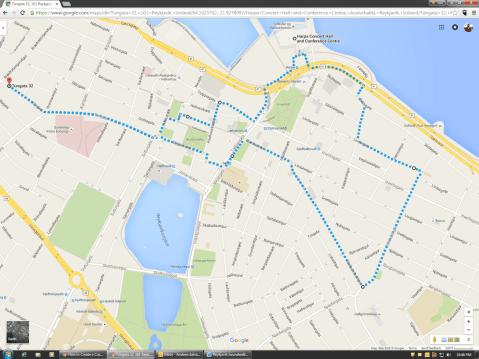
Standing in front of our rented apartment in Túngata, a residential street just a few blocks from central Reykjavík, I am struck by the stillness of the city that surrounds me. Having lived most of my life in the densely-populated suburbs of northern New Jersey, my experience of urban soundscapes has typically been frenetic and noisy. Here, even the busiest parts of town seem subdued. It’s a pleasant contrast. At 8AM on a weekday, the quietness is eerily enveloping, broken only occasionally by a gust of arctic wind, a passing car, or a neighbor closing her door and setting off for work.
Quiet tranquility and natural beauty have attracted a growing number of tourists to Iceland in recent years, my wife and I included. With only 330,000 people inhabiting an area roughly the size of Kentucky (and two-thirds of those settled in and around Reykjavík), one needn’t venture far out into Iceland’s otherworldly landscape to feel far removed from civilization – like exploring a distant planet. While the island may be still now, the belated realization that Iceland’s bizarre terrain, its vast lava fields, meandering fissures, and Dr. Seuss rock formations are the result of earth-shattering eruptions – like Eyjafjallajökull in 2010, Bárðarbunga in 2014-15, or the more recent rumblings around Katla – can be a little unnerving. Travelling through the Icelandic countryside, one imagines the thundering cracks, seething magma, and the infernal growl of the awesome geophysical forces that churned up these vast panoramas.
To a certain extent, the absence of sound here heightens a sense of the sublimity of the world around us; that from certain perspectives, nature is fundamentally ineffable – incapable of being fully represented by language, data, or art. Sound, I think, can complicate this experience. On the one hand, the extraordinary sounds of earthquakes and volcanic eruptions, of great storms, or the roiling of heavy seas, contribute to the overwhelming experience of the grand and fantastic. On the other, these sounds, like perhaps the everyday noise of a busy street corner, may also break the spell by yielding up the audibly familiar. Wandering around Reykjavík at this early hour, a settlement that has clung defiantly to a desolate rock in the North Atlantic for over 1000 years, I become acutely aware of each new sound to disrupt the ethereal silence. Each of these, even the most mundane and urban, seems to take on larger significance and intention as audible signs of the ways in which human beings have forged order and meaning from a wild and indifferent world.
But for now, all remains quiet, and the island’s primordial silence seems to reach even into the capital itself. Of course, Reykjavík is a vibrant international city resonating with the familiar sounds of urban life. But at certain times the quietness that seems to subsume everything else – a subtle reminder of the relatively small scale and frailty of the human compared to the geological.
Soon enough however, as I walk up Túngata there’s a siren in the distance, and the neighborhood begins to echo with the sounds of children playing in the yard at Landakotsskóli, one of Iceland’s oldest schools. I follow the street as it arcs towards the city center, passing several foreign embassies and the imposing gothic edifice of Dómkirkja Krists Konungs. A few other cars motor past and there’s a brief gust of cold wind, but these are momentary disruptions. Soon enough the world returns to the now-familiar stillness.

Grafitti in Reykjavik. Image by Rog01 @Flickr CC-BY-NC-SA.
But the sounds of morning traffic pick up a bit as I walk further down the hill – the rush of passing cars, the groan of a utility truck turning off a side street, and the muffled sounds of a radio floating from a car window. At its end, Túngata bends to the left at the bottom of the hill, where I see a large excursion bus stopped in front of a hotel, and a knot of tourists quietly talking nearby. It’s time for morning pickups, and the idling of these busses, and the hushed, expectant voices of day-trippers outside hotels and guesthouses around the city turn out to be common vignettes along my morning walk. They’re a reminder of the vast growth in tourism this year, which is expected to increase 29% over 2015 to 1.6 million foreign visitors.
Continuing straight onto Kirkjustrӕti, I pass the Alþingishúsið (Parliament House) on my right, and Austurvӧllur, a large public square on my left. The place is relatively quiet now. The cafes lining Vallarstrӕti and Pósthússtrӕti are closed, and there are only a handful of people walking through the square. Later on, the cafes will be buzzing with patrons enjoying the balmy (for Iceland) weather and the long hours of sunlight.
But aside from the nightlife, Austurvӧllur’s proximity to Parliament means that historically it’s been a focal point of political protest in Reykjavík. Two months before our visit, some 24,000 people crowded into this space to demand the resignation of Prime Minister Sigmundur Davíð Gunnlaugsson, who was revealed by the Panama Papers to have undisclosed connections with an offshore shell company with interest in failed Iceland banks. Walking past the square today, I can only imagine the chants, claps, whistles, shouts, barricade-banging, and yogurt-throwing of Icelanders expressing their collective frustration with corrupt officials.

Construction in Reykjavik. Image by Patrick Rasenberg @Flickr CC BY-NC.
This morning however, apart from the early morning sound of chirping birds and pedestrian commuters, there’s a bit of construction going on here – I can hear a few landscapers and a pair of contractors clanking and clunking as they lay out equipment for work on a building next to the Alþingishúsið. From these men and others I pass along this stretch of road, I hear the hushed and slightly groggy speech of early morning. The talk is all in Icelandic of course, a language whose place and street names I valiantly try to pronounce when I visit. Icelandic is a notoriously difficult language for foreigners in general, and its tongue-twisting staccato and subtle consonants, not to mention its intimidating alphabet, usually leave my mouth sounding a bit too awkwardly Jersey (as you can hear for yourself in this podcast!).
Continuing on my walk, I follow Pósthússtrӕti as it threads around Dómkirkjan and out to Lӕkjargata, the main avenue in this section of town. Here, the soundscape is more typically urban. The sound of trucks and cars passing, a bus groaning into gear as it pulls out into traffic, the multi-lingual chatter of pedestrians at a crosswalk, a group of teenage volunteers chatting in Icelandic as they do groundskeeping work near the Stjórnarráðið government offices, all speak the language of a city’s morning routine.

Street art in Reykjavik. Image by Toni Syvänen @Flickr CC BY-NC-SA.
Bankastrӕti, the main commercial district, is also coming to life. It’s still early, and most shops are closed, but heading east up the street, I hear a few snatches of conversations in Icelandic and American English – and there seems to be more of the latter than I remember from the last time we visited, testament to Iceland’s growing attraction for U.S. tourists. All along Bankastrӕti, the sounds of lively conversation, music, and the clinking of tableware floats out of open doors as people pop in and out of cafes and restaurants for breakfast and morning coffee. As I bear right on Skólavӧrðustigur and up the hill towards Hallgrímskirkja – the Lutheran church that dominates the city skyline like an art deco rocket ship – these sounds start to thin out again. Apart from a passing car or pedestrian, and the occasional rumbling of a tour bus or ATV, I am left in the comforting hush of a Reykjavík morning.
At the top of the hill, the large stone plaza before Hallgrímskirkja echoes with the clattering sounds of workers hammering at the roof of a nearby building, as the great green statue of Leifur Erikíksson silently watches on. I turn left on Frakkastígur and head downhill towards Faxa Bay, which looms in the middle distance. Frakkastígur turns out to be the noisiest stretch of my walk: there’s the roofers; the slapping of lanyards on the flagpoles that surround Hallgrímskirkja; the busy bakery where I buy morning croissants surrounded by Beatles music, the English and Icelandic chatter of customers, and the pounding, rolling, and cutting of dough; and finally the two large construction sites that I pass between Laugavegur and Hverfisgata streets. Here, the motoring of earthmovers, the shrieking of a circular saw, and the pounding of a massive pile driver jar the neighborhood with an intense mechanized racket.
I’ve noticed a fair amount of construction around Reykjavík this trip. The skyline bristles with cranes. It’s another marker of the booming tourism industry, and its complicated place in the Icelandic economy. Since the financial collapse of 2008, there’s been pent-up demand for residential housing. But with the local construction industry strained from the current spate of hotel building, it’s been difficult to find builders to work on residential projects. What I hear around me is a sign that Iceland’s economy has improved, but it’s also a reminder that improvement sometimes makes life more difficult for local residents.

Sculpture on the shore of Reykjavik. Image by Ainhoa Sánchez Sierra @Flickr CC-BY-NC-SA.
The sounds of heavy construction fade as I wind my way down to the bay and cross over Sӕbraut to the promenade that lines the shore. Like any highway, at this point in the morning Sӕbraut fairly hums with commuter traffic; here, the ambient sound of suburbanites making the morning drive to work, complete with attendant sound of brakes, horns, and Icelandic drive-time radio mix with the rushing sound of wind rolling off the waterfront. Walking along the promenade now, I pass a few joggers and bicyclists as a walk over to Harpa, the newly-built glass and steel concert hall that is home to the Icelandic Symphony Orchestra and which, every autumn, becomes a focal point of the week-long Iceland Airwaves music festival. It’s this annual event, I muse, that should be the subject of a future sound walk (for me or someone else) – five days in which Reykjavík pulsates with the sound and music of dozens of bands playing formal and informal shows at venues, cafes, bookstores, and basements around the city.
From a large dig site next to Harpa (the possible site of yet another hotel), I cross back over Sӕbraut to the clicking sounds of a crossing signal for blind pedestrians. I pass Bӕjarins Beztu Pylsur (The Best Hot Dog in Town), which is closed for the morning, and walk back into the city center, which is by now clearly awake and buzzing with locals and tourists. After stopping in a 24-hour supermarket for some morning milk, I walk east on Austurstrӕti past the Laundromat Café and other restaurants that are now busy serving the breakfast crowd.
Up through Ingólfstorg square (which appears to double as a skate park, but is right now a stopping point for a walking tour group), south on Aðalstrӕti, and around the turn by the Reykjavík Settlement Museum, I’m soon walking back up through the quiet neighborhood lining Túngata.
—
Featured Image by SambaClub | Camisetas com conteúdo (a t-shirt site) @Flickr CC BY.
—
Andrew J. Salvati is a Media Studies Ph.D. candidate at Rutgers University. His interests include the history of television and media technologies, theory and philosophy of history, and representations of history in media contexts. Additional interests include play, authenticity, the sublime, and the absurd. Andrew has co-authored a book chapter with colleague Jonathan Bullinger titled “Selective Authenticity and the Playable Past” in the recent edited volume Playing With the Past (2013), and has written a recent blog post for Play the Past titled “The Play of History.”
—
REWIND!…If you liked this post, you may also dig:
SO! Podcast #37: The Edison Soundwalk–Frank Bridges
This is What it Sounds Like……..On Prince and Interpretive Freedom–Benjamin Tausig
Soundwalking New Brunswick, NJ and Davis, CA–Aaron Trammell
Share this:


Current Top Posts





April 2021

January 2020

November 2019

October 2019

August 2019

April 2014

November 2017

March 2015

December 2017

October 2015
 Sounding Out!
Recent Comments