
Six Years in Nodar: Sound Art in a Rural Context
My family comes from a tiny village called Nodar in northern Portugal, part of the European Union-funded project “Tramontana” which focuses on preserving the immaterial heritage of mountain regions of southern Europe. In Nodar, centuries of isolation and self-sufficiency have created a unique blend of cultural expressions, ways of living, and inhabited landscapes. Like much of the Portuguese countryside, Nodar is undergoing a process of abandonment, which leaves rural communities with a weakened sense of identity. The agrarian paradigm, which has been central to the history and social fabric of rural communities, is arriving to an almost hopeless vanishing point, and the guardians of that memory are also disappearing. With this as formative part of my background, and considering my artistic interest in community-oriented projects, I felt almost a duty to direct much of my work to Nodar, a place that means so much to me and where I thought I could make a difference. In 2004 my brother Luis and I founded Binaural/Nodar, an arts collective based in the village and operating in the surrounding region of the Gralheira mountain range.
Since March 2006, the Nodar Rural Art Lab has invited both local and international artists who work in the areas of sound, video, and intermedia arts to address issues such as collective memory, identity, gender, age, life, death, geography, topography, music, sound heritage, landscape, vegetation, consumption and leisure dynamics, myths, traditions, crafts, agriculture, and shepherding. During their stay, the resident artists give public presentations in the region and are encouraged to establish interactions with the place and its inhabitants, geographic spaces, and social memory. Many of the artworks held in Nodar cross different artistic practices, often blending borders.
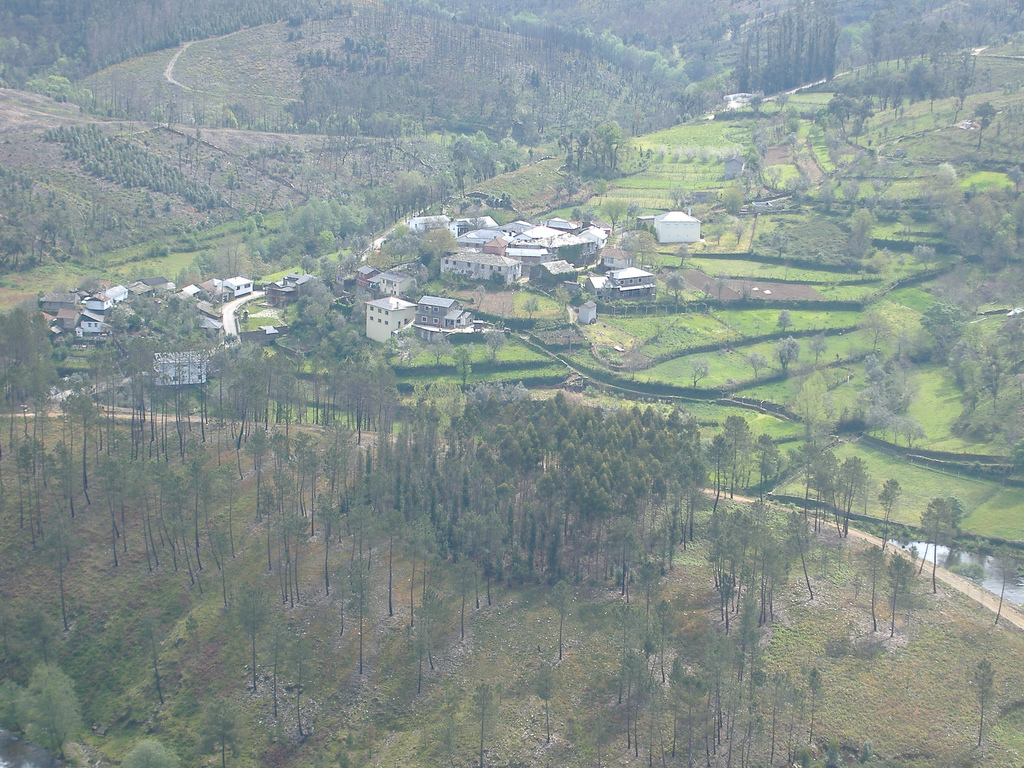
Nodar, Portugal. Photo by Carina Martins. All rights reserved by Binaural/Nodar
The decision to initiate an artist residency center in Nodar was motivated by my desire to deepen the investigation of exploratory artistic practices in close interaction with a specific rural context and its social and cultural possibilities. Throughout the year, the Nodar Rural Art Lab programs various residency modules in order to stimulate a collaborative environment between artists from different artistic fields and geographic origins. During the course of the residencies, several parallel activities are organized, such as conferences, lectures and educational activities, namely youth-oriented. At the end of each residency module, there is a public presentation organized in the village in which the art projects are presented and discussed by the artists and the organization.
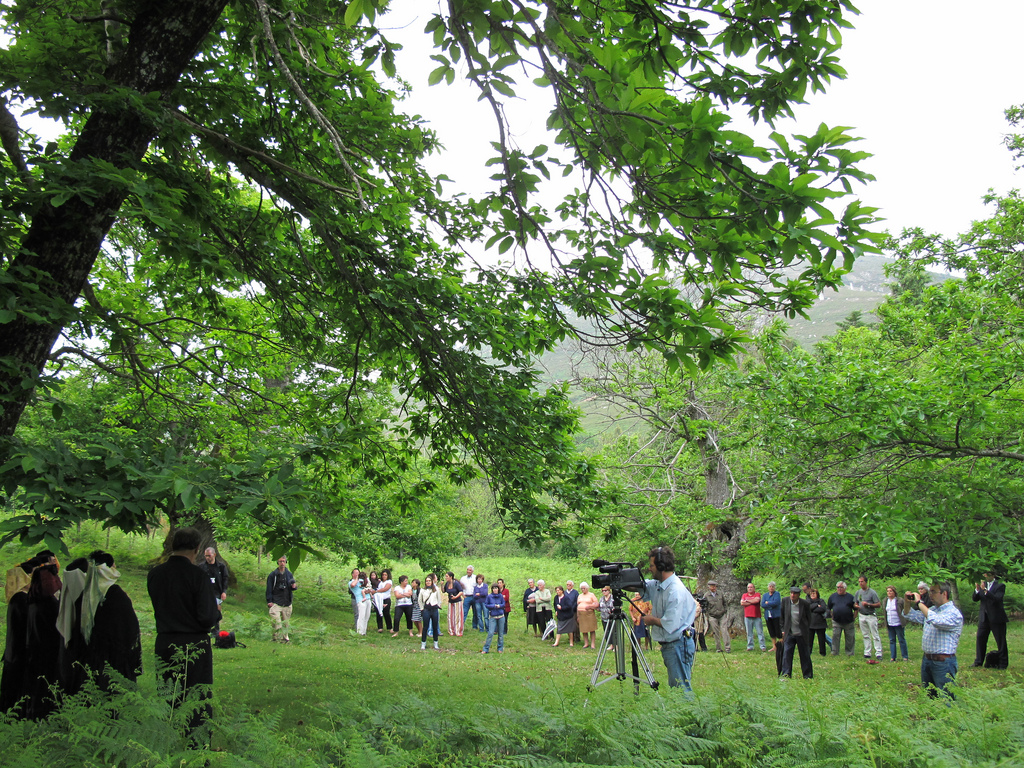
Public presentation of an art project in Nodar. Photo by Carina Martins. All rights reserved by Binaural/Nodar
The sonic dimension has a critical role in the model we have developed in Nodar, especially because it operates as a powerful metaphor for the intimate and personal discovery of a place. Artists have documented the area’s soundscapes and oral heritage in Nodar since 2006. There are three central lines of artistic interaction that converge here: Sound, Space and People:
SOUND (Interaction with the acoustic environment): Some sound artists, who work with the acoustic dimension in an experimental way, are part of the team that runs the Nodar Rural Art Lab. The Lab has always been active in the international theoretical and artistic domains of the so-called soundscapes, and it has hosted some of the most respected sound artists of today, who–using idiosyncratic techniques for sound capturing, editing and manipulation–have created works based on particular aspects of the local acoustic context.
One of our approaches is what we call “sound interventions,” where we use field recordings and performance in order to “activate the space” and establish a dialogical approach between what is activated and what just “is,” which can incorporate body, gesture, sound, object, space and voice in this process. An example of this approach was the “Revenant : Paiva” project, conceived in 2009 by Patrick McGinley, Marjia-Liisa Plats, Luís Costa and Tiago Carvalho, in which a series of performative actions were staged in a section of the river Paiva that crosses Nodar. Using materials found in-situ as instruments, in addition to the artists’ own voices, to generate sounds that interacted with the acoustic environment itself, all activity was purely acoustic, with no amplification. The resulting work was presented live with the artists and audience spread out across the space with no preferential “point of listening”, which created subtle overlaps between the artists’ work and the space.
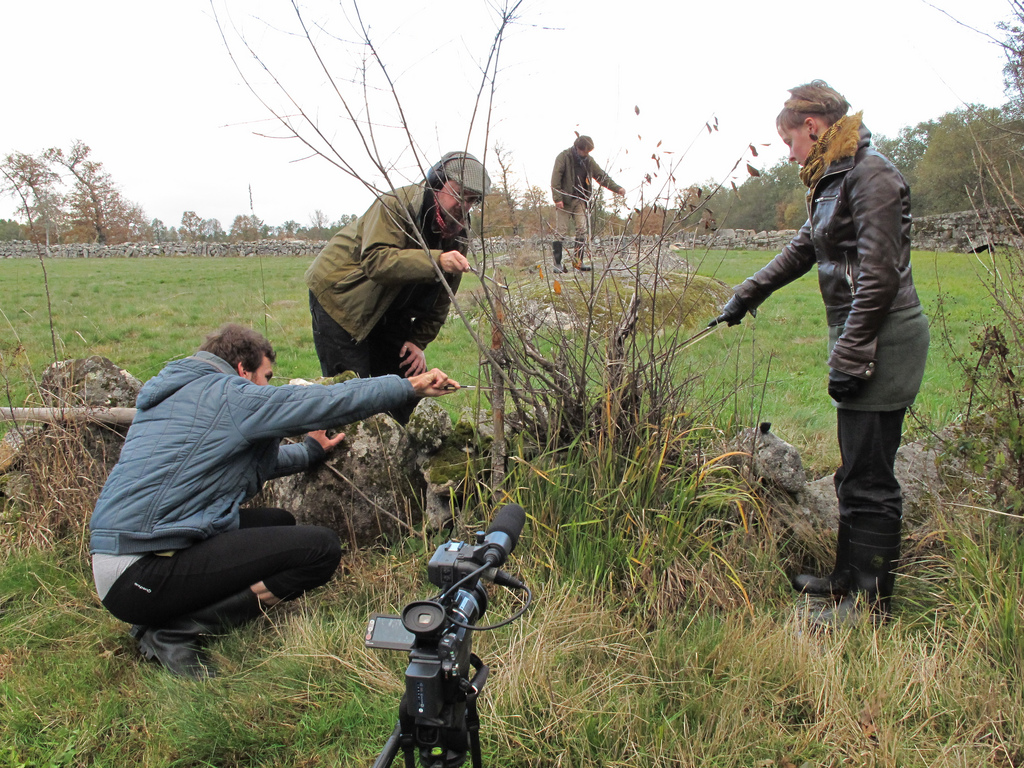
Working on “Revenant : Paiva.” Photo by Carina Martins. All rights reserved by Binaural/Nodar
SPACE: Interaction with the geographic space. The landscape surrounding Nodar is beautiful and diverse; there are mountains, rivers, caves, slate stone architecture, terraced fields, and so much more. Moreover, we are witnessing an irreversible process of transformation of rural space. These two elements form fertile ground for the creation of works within nature, which either capture the dreamlike and timeless aspects of the landscape or question possible future uses for the same landscape.
Of particular interest to us is the use of geography as a means for projecting sound in which specific variables of the territory, such as topography and meteorology, intersect with instrumental or subjective aspects of artistic creation, namely the position occupied in the space and the choice of sound recording and reproduction tools and techniques. A good example of this approach was Lisa Premke’s project “Aural Lookout,” developed in 2012, in which she built a canvas lookout on the top of a hill that allowed the visitors to be sheltered from the environment while listening to the nature sounds acoustically amplified, as if being inside a large drum.
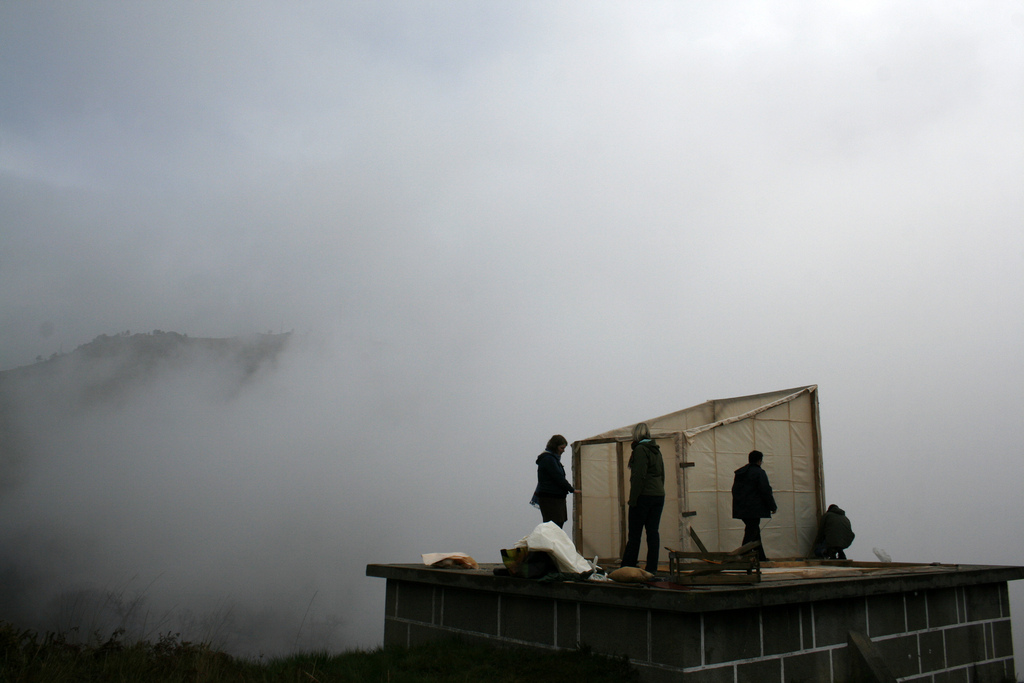
Working on “Aural Lookout.” Photo by Carina Martins. All rights reserved by Binaural/Nodar
PEOPLE: Interaction with local inhabitants. Since the beginning of our activities, we have been encouraging artists to interact, question and to some extent “provoke” local populations. As a result of these communication processes, various art projects have been developed reflecting and expressing aspects of the region’s collective memory and new habits and experiences.
Working on the subject of the anthropological voice may involve direct conversation with the local communities based on topics proposed by the artists and related to everyday life and local memory, as well as it may focus on linguistic aspects such as accents, musicality of the voice, etc. Maile Colbert’s “Over the Eyes,” created in 2007, was a very successful example of this sort of “conversational” project, where she organized a knitting circle with the village women, recorded the conversations with them, their songs and stories and incorporated them into the sound design of a multimedia installation, along with field recordings of the area, and text on physiological, biological, and psychological aspects to memory creation and destruction in humans. The projection screen was composed of raw wool and the knitted cloths made during the circle, which created an interesting dialogue with the immaterial nature of the audiovisual element of the piece.
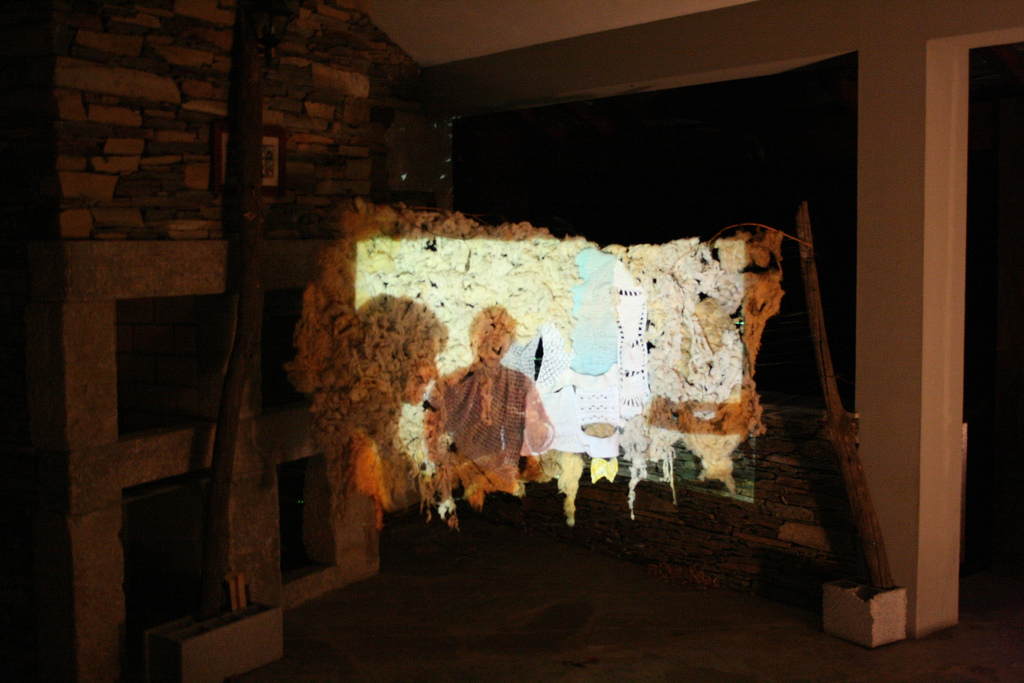
Maile Colbert’s “Over the Eyes.” Photo by Carina Martins. All rights reserved by Binaural/Nodar
We have always emphasized a type of sound art that enhances the context within which a specific sound work is produced, escaping a purely acoustic, or “sound-in-itself” approach. We believe that this emphasis on subjectivity and context is necessary, because sound–and the practice of field recording in particular—sometimes carries a burden of “objectivity” because it stems from the documentation of reality. The subjectivity inherent to the sound recollection –for instance, the choice of the point of listening and of the technological means of sound capturing–is often not sufficient to alleviate this burden.
When we host sound artists in Nodar, we always try to convey the idea that the region’s landscape is fundamentally an “inhabited landscape.” Trying to avoid the human presence in order to get “wilder and more natural” recordings is purely illusory. The landscape is inhabited in several simultaneous ways: by the marks of historical occupation of the territory, by the existence of vital spaces for each inhabitant–often lying far beyond the boundaries of the villages–by the very presence of the artists and by the audiences of the art works’ final presentations.
In summary, there are several methodological, instrumental and aesthetic approaches that Binaural/Nodar is working to further in the area of sound art. These approaches are anything but sealed; intersections, complementarities, unions and differences exist, which make each work of art unique.
—
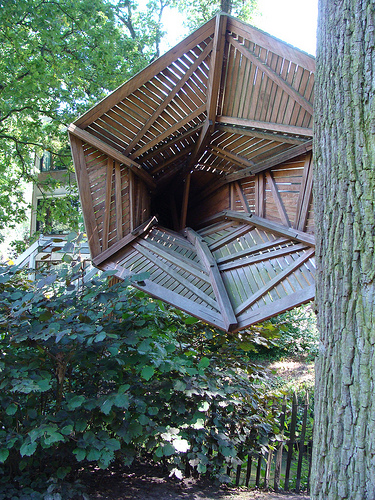
Featured Image: “Oor van Noach” by Flickr user ines saraiva under Creative Commons 2.0 License.
—
Rui Costa is a sound artist from Lisbon, Portugal. He is a founding member and artistic director of Binaural/Nodar, an arts organization founded in 2004 and dedicated to the promotion of context-specific and participatory art projects in rural communities of the Gralheira mountain range, northern Portugal. Rui has been performing and exhibiting his work since 1998 in festivals, galleries and museums across Portugal, Spain, Italy and the United States and has been collaborating regularly with the Italian vocal performer Manuela Barile and the American intermedia artist Maile Colbert. Rui Costa is also a regular speaker in conferences and gives workshops dedicated to sound art. For more from Binaural/Nodar, please check out the organization’s soundcloud, vimeo, and flickr.
Share this:

Park Sounds: A Kansas City Soundwalk for Fall

Fall refuses to stay put in Kansas City. The past month Kansas City temperatures have skyrocketed to 70 comfortable degrees fahrenheit and plummeted to 20 chilly degrees. I decided to partake of a wonderfully mild Sunday afternoon last Thanksgiving weekend to do another one of my Kansas City soundwalks, this time the fall edition. Fortunately the weather was cooperating, and I didn’t have to worry about how long I could resist standing in the cold.
Even though the weather was wonderful for a soundwalk, I couldn’t choose where to go. I have blogged about three soundwalks so far, and for each of them the choice seemed more organic: for my first soundwalk, in 2010, I wanted to walk around my new neighborhood and begin to understand it from an aural point of view. For my second soundwalk (in 2011) I went to one of my favorite places in Kansas City, the Country Club Plaza, and provided a snapshot of the sounds of spring in this busy area of Midtown. On my personal blog, in time for World Listening Day 2011, I talked about sounds from my own porch for a summer edition of my KC Soundwalks series, in order to think about the soundscape where I live. However, for this fourth soundwalk my only requirement was that it be a place I had not been to before. I wanted to venture out to somewhere new and encounter it not just with my eyes but also with my ears. Technically, I could go anywhere in Kansas City and do a soundwalk, but that was the one thing keeping me from doing a soundwalk: I couldn’t choose.

View of Kansas City Midtown Skyline from Southwest Boulevard by Liana Silva.
Last Sunday I decided I had to just get in the car and go. I had planned (and postponed) several soundwalks up until that day (I had even tweeted that I was leaving the house, in hopes of that forcing me to commit), so that day I planned to finally take some time to do my soundwalk before I went back to work. I got in the car with my daughter, destined for the West Bottoms neighborhood. I figured I’d take the long route instead of the quick and easy highways. As we drove along the side streets, I saw a park—a park neither of us had been to before, Jarboe Park—and I figured we could stop there, play for a while, and then drive off for my soundwalk. In any case, she might be good and tired by the time we arrived at our final destination, and I could put her in the stroller while I recorded and took notes.
That’s not what happened.
Once we arrived at the park, a moment of inspiration hit when I saw some musical instruments of sorts as part of the jungle gym, something I hadn’t seen before.
LISTEN: Walking_to_Jarboe_Park._Cars_coming.
When we arrived, Jarboe Park was deserted. The bare trees didn’t make it any more inviting, but the park is in newly minted condition and full of bright colors. It showed no signs of life, or wear and tear; in fact, the jungle gym and the swings seemed new. (According to The City of Kansas City, MO’s website, this park was remodeled in 2011.) Jarboe Park is located in a residential neighborhood, across from Primitivo García Elementary School. During the semester it surely gets more use. Perhaps it was too early on a Sunday for families to be out and about at the park. Coincidentally, a family appeared about an hour after we arrived, but they went to the basketball court across the street.

Jarboe Park swings, still. Picture by Liana Silva.
LISTEN: Swings._A_Child’s_Laughter._
The first thing that caught my attention at the park was the presence of musical instruments set up at the entrance. I do not remember seeing anything similar before at a children’s jungle gym. There was a set of bells, a xylophone, some rainmakers, a whistle, and a drum set. Their presence seemed to indicate that making sounds/music/noise was also part of the experience of being in the park as well as part of the experience of growing up. Sound, specifically making sounds, became part of play, in this context.
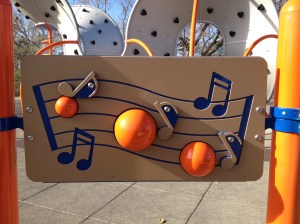
Bells. By Liana Silva
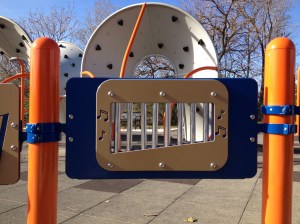
Xylophone. By Liana SIlva

Rainmaker. By Liana SIlva

Drum kit. Picture by Liana Silva
In the quietude of the noon time the sounds these instruments made felt a little sad instead of happy; the fact that there was only one child (ok, two, including myself!) playing with these instruments made their sounds stand out more, in relation to, say, the sounds of the trains and the highways (which I will discuss below). At the same time they drew attention to the fact that they were the only sounds that the park was making. If the park were busy, the sounds of the instruments would probably fade into the soundscape instead of being the loudest sound. However, the fact that we were playing with these instruments–versus playing instruments–made the park seem less lonely. We were part of the sounds, we were making sounds, and that seemed to distract me from the fact that we were the only people there making sounds. Although the plastic and metal instruments were not like traditional instruments, I wondered what their purpose in the jungle gym were. If the spider web and the swings are meant to exercise certain parts of the body and practice certain ways of socializing, what did the instruments teach? Perhaps the instruments are meant to teach children that instruments produce sounds, and they produce them in different ways. Lastly, the instruments and the act of creating sounds must use a different part of the brain–and my daughter was quite excited to play with the drum set!
LISTEN: Playing_musical_instruments_at_Jarboe_Park
Other than the sounds of the instruments, I also noticed the sounds of the highway and the train. I found a corner of the park where I could stand and record the sounds of the city:

If you look at the bottom of the V-shaped branches, you can see train cars. Picture by Liana SIlva
LISTEN: Train_whistles._Miss_E_calls._
Kansas City is intersected by train tracks, and it almost feels like if you pay close attention, you can hear a train in the distance at any corner of the city. In fact, in the dead of a lazy afternoon or the quiet of the wee hours of the night I can hear the trains’ whistles, announcing their passing through the city, from my neighborhood of Rosedale in Kansas City, Kansas. If soundwalks can be a sonic ethnography of a city, my soundwalks have so far revealed that the sound of trains are an essential part of the KC soundscape as well as a reminder of the city’s history: the Kansas City Stockyards. I could also hear the low buzzing of the cars on the highway, another sound I’ve come to recognize as uniquely Kansas Citian, or at least part of my soundsscape. The murmur of the traffic ways is like the sound of Kansas City’s blood coursing through its veins.
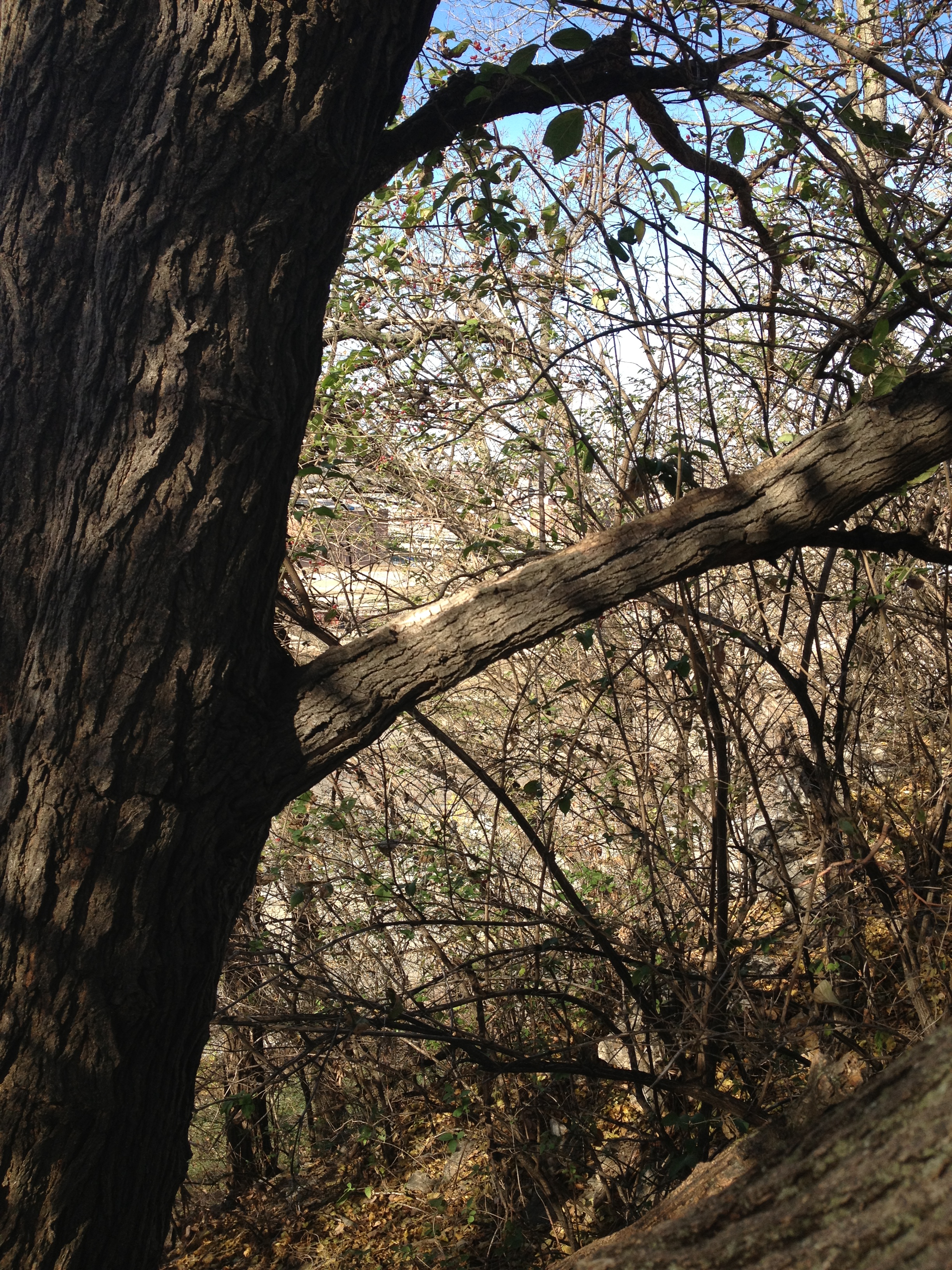
In between the branches, Interstate 670. Picture by Liana Silva.
LISTEN: Hum_of_the_highway._A_car._Train._
This spur-of-the-moment soundwalk made me think of how listening and sound can prompt reflection about the identity of a neighborhood and of a city. As I wrote down notes, I wondered: how do parks add to a community’s soundscape? The sounds add to the community’s identity as a residential area as an area that is amenable to the presence (physically and in aural terms) of other people. Soundscapes are connected to our ideas of what constitutes a neighborhood, and specifically how important common spaces like parks are, with all the sounds that may ensue. On a broader level, my Kansas City soundwalks are helping me piece together a soundscape of Kansas City, and to think through sound as a way to understanding the urban culture of this city, with its music, its fountains, its sports, and its trains, among other things. I feel like my listening practices are directly tied to my developing connection to this Midwestern city.
Postscript: I never did make it to the West Bottoms that Sunday. But it’s still on my list of KC spots to visit.
Featured Image: “Downtown from Top of Liberty2″ by Wikimedia user Hngrange, under Creative Commons 3.0 license.
–
Liana M. Silva is co-founder and Managing Editor of Sounding Out!
Share this:


Current Top Posts





April 2021

January 2020

November 2019

October 2019

August 2019

April 2014

November 2017

March 2015

December 2017

October 2015
 Sounding Out!

Recent Comments