
Post-Soul Pusherman: Curtis Mayfield’s “Pusherman” and The Hangover 2

DOI: https://doi.org/10.59350/b8y2w-d6q29
My husband and I looked forward to seeing The Hangover 2 for our weekly movie date. A sequel to the wildly popular The Hangover, The Hangover 2 centers around Stu’s wedding (played by Ed Helms), bachelor party and its aftermath. Following the first film’s bottom line, The Hangover 2 unfolds after a drugged and drunken stupor leaves the friends unsure of the previous night’s events—and a missing brother-in-law. Sleazy motels, drug deals, homosexual encounters, and a monkey are the friends’ only clues about what happened and where Stu’s missing brother-in-law is located. Considering the awkward and absurd plot trying to pass for humor in The Hangover 2, I wasn’t surprised to see the monkey was a drug dealer. I was struck, however, by one of the monkey’s scenes where he completes a drug transaction. Sitting atop a light pole, a buyer signals for the monkey’s attention. The monkey struts across the wire and completes the transaction. After taking the buyer’s money, the monkey drops it off to his masters (two French men), eats an apple, goes back to his post, and lights a cigarette. The dope boy, er, monkey worked to the sonic backdrop of Curtis Mayfield’s “Pusher Man.” My husband laughed. I cocked my head to the side.
One of the most recognizable tracks from Mayfield’s extensive body of work, “Pusher Man” (which is street slang for “drug dealer”) was on the Super Fly soundtrack released in 1971. In its original context, “Pusher Man” provided insight into the purpose and agency of drug dealing in the inner city. However, in The Hangover 2 “Pusher Man” is subverted for comic relief and consumption by a multicultural audience. The result is that the film neutralizes “Pusher Man” and overrides the cultural significance behind the song for the film’s comedic purposes.
In order to discuss the subversion of “Pusher Man” in The Hangover 2, one must consider its original context as a sonic complement to Super Fly. A blaxploitation film directed by Gordon Parks, Jr. (son of famed African American photographer and Shaft producer Gordon Parks, Sr.), Supafly focused on the tug-and-pull of poverty, drugs, and the urban black experience in the immediate aftermath of the Civil Rights and Black Power movements. The plot revolves around the narrative of Priest, a dope dealer who wants to reform his ways and “do good.” Priest is continuously tempted throughout the movie by associates and friends who see drug dealing as the only way out of a hard inner city life. The film highlights drug dealing as a coping mechanism instead of an illegal activity. Although critics argue that the film glorifies pathological blackness through drug culture, Mayfield’s soundtrack provided hard-hitting social commentary that followed suit of similar themed albums like Marvin Gaye’s What’s Going On (1971).
Borrowing from and building upon a blues aesthetic showcasing an instrumental ensemble of percussions, horns, and guitars Mayfield updates the “bad man” trope to reflect the post-Civil Rights urban black experience. (By post-Civil Rights I’m suggesting that urban blacks encounter in this period more subtle forms of discrimination that are deemed irrelevant or non-existent due to the Civil Rights legislation put in place.) The immediate update to the trajectory of the bluesy/folkloric trouble man to reflect this shift is the drug dealer, whom is celebrated and highlighted in many of the 1970s blaxploitation films. Previous manifestations of the bad man reflected an opposition to open racial discrimination held in place by Jim Crow laws and other forms of white supremacy. In blaxploitation films, this type of racism is signified by “The Man,” an anonymous, “hands off” yet omniscient body of white (male) supremacy.
“Pusher Man,” complicates an anonymous drug dealer’s narrative by weaving introspective thoughts with popular and accepted characteristics of a drug dealer. The track opens with the latter, essentializing the power of a drug dealer in the inner city:
I’m your mama
I’m your daddy
I’m that nigga in the alley
I’m your doctor when in need
Want some coke?
Have some weed
You know me
I’m your friend
Your main boy
Thick and Thin
I’m your pusher man
The pusher man’s depiction of himself as a universal power – parent, healer, friend, brother – is established through hard hitting percussion and guitars. His delivery, however, is “cool,” signified in Mayfield’s soft voice. Aside from direct suggestions of black cool, i.e. “Ain’t I clean/bad machine” and “super cool/super mean,” Mayfield’s voice is critical in establishing this coolness. His smooth delivery symbolizes the tension between popular definition and the drug dealer’s humanity as well as opposing the hardness of the song’s sonic backdrop. The steady, quiet aggression of Mayfield’s voice – he never raises his voice – further solidifies the coolness of the track. The drug dealer’s reasoning for pushing illegal drugs, “silent life of crime/a man of odd circumstance/a victim of ghetto demands,” is afforded space through Mayfield’s voice and delivery. The loudness and “noise” of the instrumentals substitutes Mayfield’s voice as a gauge of the chaos and instability of the inner city. The song signifies the frustration of being urban, poor, and black with few options in a moment where racial equality should be heralded but has not yet been achieved. “Pusher Man” is tethered to the understanding that the laws changed but the social practices remained intact.
Yet this connection between the song and the social context is distorted if not lost by how The Hangover 2 situates the track into the plot. While the film maintains the surface narrative – drug dealing – numerous other signifiers have shifted to reflect this more contemporary moment of American culture and history. The track is globalized by providing background to a drug deal taking place in Bangkok (which, I hope, is not strictly for comedic purposes). It helps situates the reality that poverty is not necessarily black or American but global. The African American male drug dealer is replaced with a chain-smoking monkey. While it is possible that the film uses the track to emphasize the monkey’s drug dealing ways, it is also quite possible that the track’s original intentions and context are watered down in order to resonate with a multicultural audience.
Instead of making the audience think about the angst of the African-American working class, the song becomes a comedic prop. The humanity of Mayfield’s drug dealing protagonist, emphasized through the juxtaposition of Mayfield’s cool voice and gritty lyrics is overwhelmed by the inhumanity of the drug dealing monkey—not to mention the absurd situations the characters face. Even more disturbing, “Pusher Man” serves as a sonic signifier of the audience’s racial and social-economic detachment from the seriousness of the scene (and song) instead of an indicator of its social relevance. Instead of the focus being Mayfield’s attempt to shed light on the drug dealer’s harsh realities, the focus shifts to the monkey’s illegal activities as humorous.
Indeed, Curtis Mayfield certainly wrote his fair share of songs for films – Claudine and Sparkle immediately come to mind – but this particular song was a sharp piece of social commentary put to music.“Pusher Man” is reduced to background noise instead of a complement to the discourse struggling to remain intact despite the film’s efforts.
–
R.N. Bradley is a PhD candidate in African American Literature at Florida State University. She writes about African American literature, race and pop culture, Hip Hop, and her own awesomeness. She earned her BA in English from the Unsinkable Albany State University (GA) and a MA in African American and African Diaspora Studies from Indiana University Bloomington. Her dissertation project looks at negotiations of white hegemonic masculinity and race consciousness in 21st century African American literature and popular culture. You can read her work atAllHipHop, Newsone, TheLoop21, or her monthly column “The Race to Post” over atPopMatters. Scholar by day, unapologetic Down South Georgia Girl 24/7/365. Catch up with her awesomeness via twitter: @redclayscholar and her blog Red Clay Scholar (http://redclayscholar.blogspot.com).
Share this:

Play it Again (and Again), Sam: The Tape Recorder in Film (Part Three on the 1980s)

[If you missed the first two installments, hit “pause” and rewind to June’s piece on Noir, and July’s discussion of Walter Murch].
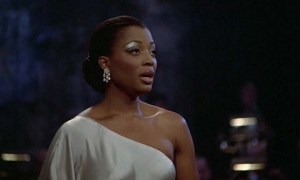
The Diva (Wilhelmenia Fernandez) Sings
At the center of this lust is the female voice, turned fetish in the 1980’s films Diva and Blow Out. Whether screaming in terror, singing the heights of the sublime, or confessing the depths of a passionate hatred, both movies construct women as emotive objects to be recorded, often against their will, and the recordists in these films clamor for and are repelled by the female sounds they capture. (For additional Sounding Out! of the “problem” of women’s voices in contemporary media culture see last week’s post, Liana Silva’s “Eye Candy” and Aaron Trammell’s recent “GLaDOS, the Voice of Postfeminist Control“). In fact, this series has traced the cultural construction of the “sound man”: how mainstream films naturalize recording as the province of men (and, with the exception of Touch of Evil, of white men). The tape recorder’s increasing accessibility should have meant that women were using the equipment in greater numbers, but according to Hollywood, tape recorders continued to mediate power relationships between (white) men. Think Walter Neff and Barton Keyes. Harry Caul and his anonymous boss. Ferris and Principal Rooney..

Christina Aguilera and Alicia Keys at the console recording "Impossible" (VH1)
With such a proliferation of representations of male recorders, it can be difficult to imagine a female hand twiddling the knobs, so much so that 95% of the professional recording industry is now male, according to the nonprofit organization Women’s Audio Mission, that works to increase the number of women behind the boards through youth outreach and training programs. While the sole responsibility for this chronic and widespread underrepresentation does not rest entirely on the shoulders of America’s dream factory—an NPR story from 2003 on Women Music Producersby Neda Ulaby discusses additional reasons “Why Female Producers Are a Rare Breed”—we must also acknowledge that cinematic images actively shape reality, they do not just passively reflect it. Representations limit our imaginations as much as as they embolden them. The images of recording in 1980s films remind us that the mere presence of women’s voices is not enough to enable gender equity in our increasingly mediated and technologized public sphere, women must also “man” recording equipment, structuring (and shifting) the conditions under which their voices are recorded, framed, heard, and remixed into public consciousness.

Changing the Face of Sound: Lauren Tabak Punches in (courtesy of Women's Audio Mission)
Okay, for all the completists out there, a quick recap, the first two films are: 1. Double Indemnity (1944) and 2. Blackboard Jungle (1955), with a little Mike Hammer for good measure: Kiss Me Deadly (1955). The second two are: 3. Touch of Evil (1958) and 4. The Conversation (1974), and a leap into the 1980s: Ferris Bueller’s Day Off (1986).
5. Diva (Les Films Galexie, 1981, Dir. Jean-Jacques Beineix):
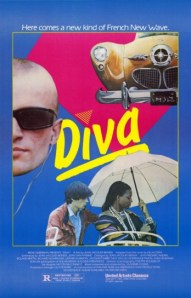 The global sex trade. Transatlantic circulation of music and capital. International piracy rings. The Vietnamese diaspora. Imperialist fetishizing of the bodies (and voices) of women of color. Taiwan as a rising force in the international economy. Police stings and gangland killings. Operatic performance and fan worship. Described by Frederic Jameson as “the first French postmodernist film” in Signatures of the Visible (1990), Diva is a rich, multilayered narrative that locates the tape recorder at the center of the vast cultural flows and postcolonial power struggles of late capitalism. As much fun Diva sometimes has with copies—there are duplicate cars, convenient doppelgangers, random mannequins, multiple decoy tapes—it also explores the melancholic cultural loss caused by a medium that holds out the promise of saving everyone, at the rate of 38.1 centimeters per second.
.
Well, it was secret. Until Jules lends it out to impress a preteen roller skating, record-stealing Vietnamese fashionista named Alba (Thuy An Luu) who plays it for the (way) older man she lives with in a creepy ambiguous arrangement, a fortysomething Zen Buddhist hipster tough guy named Gorodish (Richard Bohringer), who then tries to arrange a deal with two nameless, emotionless, mirrored-sunglass wearing, carbon copy Taiwanese business men (yellow peril much?) who are willing to pay top dollar for the tape. As Cynthia’s manager eventually warns her in the most realistic moment of an otherwise over-the-top film, “the quality of the recording is perfect. . .and Taiwan never signed any international copyright agreement!”
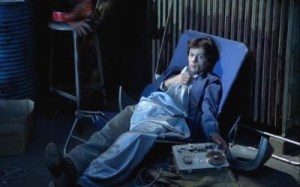
Jules (Frédéric Andréi) and his Nagra
Diva asks audiences to imagine that Cynthia has never been recorded—she wants to preserve the aura of her performances as “unique moments”—and she considers pirated recordings as akin to “theft, rape even.” The metaphor is uncomfortably extended by the sexualized recording sequence when Jules finally captures her voice, squirming and fiddling with his recorder, hidden underneath a jacket on his lap, as tears stream down his face. After the show, he steals the Diva’s dress and returns to his apartment to clutch it while listening, over and over, to her voice. Eventually even the illicit sonic reproduction cannot contain Jules’s desire to possess Cynthia; he tries to create a reproduction-in-the-flesh by seeking out a black prostitute and paying her to wear the stolen gown.
Through unsettling images such as these, Diva depicts the tape recorder as a technological phallus. It isn’t only that women are fetishized recording objects, but they are actively chased away from the machine.When an excited Alba reaches out to grab Jules’s Nagra, he pushes her away, barking “Don’t touch my stuff. It is precious. Don’t touch it. . .The levels were precisely set.” She backs off, sighing, “You and your Nagra,” in a tone that is both taunting and resigned. The only woman to make her own recording, Nadia, ends up dead, although grateful that her tape will at least allow her to “pick the time and place to die. There will be witnesses and evidence.” At least she hopes so.
.
6. Blow Out (MGM 1981, Directed by Brian DePalma):
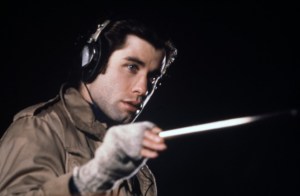
Jack Terry (John Travolta) and his shotgun mic
Fresh off the success of Grease and Urban Cowboy, 70s hearththrob John Travolta brings macho swagger to the role of Jack Terry, a burned out sound designer who is complacent about getting the “perfect” female scream for B-grade horror flicks. When his director busts his chops about finding some “new wind”—he had been squeaking by with library sounds—he finds himself doing some midnight lurking in a Philadelphia park. Armed with his trusty shotgun microphone, he is ready when an out-of-control car careens around a corner and plunges off a bridge. Instantly casting his equipment to the ground—oh! not The Nagra III!!!—he pulls a drowning woman from the car, the woefully vulnerable Sally (Nancy Allen). As if this isn’t bad ass enough to beef up the rep of “sound guys” for eternity, Jack cockily lets the investigating detective have it when he insinuates that Jack misheard what happened on the bridge: “I know what an echo sounds like, all right? I’m a sound man! The bang was before the blow out, all right?”
Carrying overtones of Chappaquiddick, the incident that Jack earwitnessed involved the death of a very prominent governor who was headed to the White House. The powers that be want to silence Sally and erase all traces of her presence in the passenger seat, so they turn a deaf ear toward Jack’s insistence that he has a tell-tale shot on tape that proves the “accident” was really murder. Ostensibly about the tenuous relationship between politics and “the truth,” Blow Out also asks audiences to press pause and consider the disposability of women in our contemporary culture–how their real lives are often mixed down, edited out, and even erased, while their recorded representations are hyperamplified and hungrily consumed.

Terry, listening for the telltale shot
Inspired by The Conversation and Michelangelo Antonioni’s 1966 Blow Up—in which a swinging London photog enlarges a photo to reveal a killer—Blow Out depicts Jack on an obsessive rewind rampage, listening and re-living the incident on the bridge trying to prove the murder. The tape recorder is a both a necessary foundation of the film’s plot and a figurative device sparking audiences to listen again and to listen differently, to simultaneously question what they hear and to stake their lives on it. Interestingly, in a movie obsessed with sound and depictions of careful listening, audio itself cannot tell the whole story; it is only after Jack merges his soundtrack with a DIY film reconstructing the murder via newspaper photos that he feels his voice will finally be heard. Ultimately, however, the brash and principled sound man fails to find a listener. The haunting ending of the film, which I will not reveal, suggests that American culture mainly values “reality” and “truth” when it comes packaged as throwaway entertainment and that the female voice in terror is at the very heart of this titillating cycle of consumption.
.
And in a supporting role. . .
Real Genius (Tristar, 1986, Director Martha Coolidge. This film is notable for having five women on the sound team, editors Anna Boorstin, Virginia Cook-McGowan, Julia Evershade, Roxanne Jones, and assistant editor Christy Richmond).

"Math on tape is hard to follow, so please listen carefully!"
The tape recorder slyly appears in the midst of this sarcastic blast to the late cold war that chronicles the revenge exacted by a band of brilliant college students (led by a young Val Kilmer) when they find out that the laser they developed for their university was intended for use by the U.S. government as an airborne weapon. Appearing in the first of two iconic 80s montages—this one set to the Comsat Angels’ “I’m Falling”—the vector-like proliferation of tape recorders silently communicates much anxiety about the technological landscape of the 1980s. When our irrepressible uber-nerd protagonist Mitch (Gabriel Jarrett) first begins his semester, he arrives at a full math lecture, barely noting the peppering of small personal recorders nudged to the corners of his classmate’s desks. As time passes, the camera revisits Mitch, still earnestly scribing notes alongside what is now only a handful of other students; he is surrounded by a sea of boom boxes the size of bread boxes and flat black slimline recorders, with a few candy apple red models thrown in for ‘80s hipness.
Finally, the earnest Mitch arrives alone, notebook in hand, only to find a completely empty lecture hall, save for the spinning spools of various tape recorders. The professor, too, has left the building—a reel to reel drones on at the head of the classroom, in front of a chalkboard that states, “Math on tape is hard to follow: so please listen carefully.” The pained look on Mitch’s face says it all: the meritocratic world of ideas that he once expected to inherit quite simply no longer exists, if it ever had. And, in a contemporary moment where online courses and “webinars” are the rule of the day and we stockpile podcasts like we have thousands of years to live, the humor of the tape-to-tape lecture cuts a little too closely. Suddenly I want to tap the mic and ask: “is this thing on? Bueller? . . .Bueller?”


Share this:




Current Top Posts





April 2021

January 2020

November 2019

October 2019

August 2019

April 2014

November 2017

March 2015

December 2017

October 2015


Recent Comments