
Sonic Spirituality: Meditations on Eminem’s “Beautiful” and “My Darling”

Guest writer Marcia Alesan Dawkins’s new book on rapper Eminem, Eminem: The Real Slim Shady is now available. We here at Sounding Out! are thrilled, so for this week’s post we asked Dr. Dawkins to give us a glimpse into a side of the notorious rapper that few may have heard: the intersection between artist and spirituality. This comes just in time too, considering Kanye West’s latest release, Yeezus, not to mention Touré’s recent biography of Prince, I Would Die 4 U: Why Prince Became an Icon (2013), which examines the confluence of celebrity and spirituality for a generation of Prince fans. Without further ado, give it up for Dr. Dawkins! Pump it up pump it up pump it up! —Liana M Silva-Ford, Managing Editor
Eminem caught my ear a year before The Slim Shady LP hit record stores in 1999, when I came across a single released by Rawkus Records called “5 Star Generals” (1998) on which he made a guest appearance. I would later learn that this was an old track the rapper recorded for cash while he was unsigned and then forgot. Nevertheless, Em’s first lines about sinning boldly, shooting nuns in Bible class, and damning hell itself hit me like a ton of bricks. I knew that lines like his, which were sure to enrage anyone within earshot, would make him (in)famous.
To my surprise, I learned a year later that my 89-year-old Cuban American grandfather, a poet and a reverend, had been listening to Eminem too. This struck me as strange for two reasons. First, my grandfather wasn’t fluent in English. Second, he’d never expressed much interest in rap music other than commenting that he noticed kids rapping in the parks near his house in Hollis, Queens every now and then. Of course, I knew that many of those boom-box-toting kids were now superstars like Run-DMC and LL Cool J, but my Grandfather didn’t.
When I entered the living room to the sound of Slim Shady, my grandfather sat transfixed. After the song ended, I asked him if he knew what he was hearing. Sitting up in his blue La-Z-Boy recliner he said, “I’m listening to some guy who calls himself Eminem. I can tell he’s probably a heathen and I don’t care. I love what he’s doing with his words.” I was shocked. My grandfather went on to tell me that despite the obvious language and experiential barriers that stood between him and Eminem, he was in awe of the way the rapper was using his voice and his words as instruments. What really got me was when my grandfather said that Eminem’s unapologetic tone reminded him of many preachers’ fiery delivery over the years. I could not believe it. Grandpa’s encounter with Eminem was not just sonic. It was spiritual.
 Fifteen years later I am still listening for what my grandfather heard. In the process, my ears have been captivated by Eminem’s sonic spirituality, open to its every sound. So open, in fact, that I dedicated three chapters in my forthcoming book to understanding how his music can be seen as a dynamic sphere of spiritual activity in terms of guilt-purification-redemption, love-hate, and relationship-awareness. While paying attention to Eminem’s sonic spirituality began as a personal exercise, it now represents an important part of understanding how spirituality operates culturally and is just like sound: recognizable, uncontainable and elusive.
In other words, I’ve finally understood what my grandfather was trying to tell me — how, rather than simply what, he heard in Eminem’s music. Here’s the revelation: sonic spirituality is a listening attitude, a personalized relationship with music that allows us to mark time, experience the intangible, track movement, engage otherness and, in the end, encounter more honest versions of ourselves. Sonic spirituality, then, might be characterized as open instead of closed, exploratory and experimental rather than static. Eminem’s spiritual themes play out in terms of solidarity with the supernatural, a mistrust of organized religion due to its inherent hypocrisy, a desire for redemption from guilt through purification, and an intense personal battle between love and hate. Following are two potent examples of what I’ve found in Eminem’s oeuvre from 2009’s Relapse: Refill, examples that showcase the development of his sonic spirituality over the decade since my grandfather first introduced it to me.
In “Beautiful” (2009), Eminem poses a powerful question: What would you think if you saw someone important, like a government official or celebrity, digging around in the trash? The answer: you’d probably think that this kind of behavior was suitable for beggars only and certainly not for yourself or someone very important. But this is exactly what the rapper does in “Beautiful.” He looks for himself, others, and their fallen world or Eden (aka Detroit, Michigan) and finds everyone and everything in the garbage. In this way, “Beautiful” is a lovely parable. As with any parable, its objective is to illustrate a moral or a spiritual lesson using a simple human relation. The lesson in this case is looking for something or someone that has been lost. In Eminem’s parable, there are seven ideas expressed about how to find what we have lost and develop our spiritual selves along the way: loss (the starting point of humanity’s spiritual condition), light (a force created through words), movement (standing in another person’s shoes), discovery (finding what’s lost in low places), salvation (anyone can be redeemed), connection (exchange traditional religion for a new culture of communication with the supernatural), and celebration (that everyone can be made beautiful again).
These seven images are evoked by the lyrics and music. The slow and deliberate beat invites listeners to connect the subject and object; the song and themselves, the song and the rapper. The release provided as Eminem sings the chorus doesn’t just change the course of the song, but converts the shared loss into an opportunity for discovery, salvation, connection and celebration. Just as the discovery begins, the drums suddenly increase in volume; the bass and guitar begin to cry out as a background harmony in a major key builds and adds to the intensity. The sounds remind us even if we choose to shield our eyes, we cannot shield our ears from the plight of our fellows and that this is a call to action, salvation and celebration. In “Beautiful” Eminem listeners become aware of others’ oppression while remembering that they are no stronger or more beautiful than anyone else. In this way listeners are engaged not just with the sounds, but also with the spirits of the people who produce them in active relationship.
The experiences and encounters inherent in Eminem’s alternative spiritual portrait, “My Darling” (2009), still emphasize the same spiritual themes I pointed out earlier: personal struggles between light and darkness, finding a purpose in suffering, and seeing a connection between societal and supernatural powers. Only this time, the supernatural power belongs to the Devil. Yet, unlike other songs in which Eminem does battle with the Devil or suffers for his sins through eternal damnation, “My Darling” is about a soul living in hell on earth. In this way, “My Darling” is both a lamentation and a dark parable whose moral complements that of “Beautiful.” Eminem shares this moral in “My Darling” through six ideas about what happens when a person is losing his or her battle with the demons he or she carries inside. These ideas are uncertainty (never being sure about redemption), possession (selling one’s soul), darkness (force maintained by the absence of words), harm (effects of love turning to hate), wholeness (spiritual relationships based on labor and exchange rather than on salvation and forgiveness), and lament (mourning one’s losses of self and loved ones).
As in “Beautiful,” the lyrics and the music evoke spiritual elements. The song is set to a minor key, which communicates penitential lamentation, intimate conversation with the Devil, and echoes with sighs of disappointment, divorce and disillusion. Possession, darkness and harm are communicated through call and response between Eminem and the Devil, who hears and accepts Eminem’s invitation and appears in his mirror where he whispers seductively for Eminem to draw close. The increasing intensity and harm of the spiritual exchange between Mathers and the Devil is reflected in their verbal back-and-forth. Their “souls, minds and bodies” are increasingly connected as they exchange more and more words. And the words become more desperate and cruel. At the end of the song, Eminem submits. Listeners come to understand that Eminem and the Devil are one and whole as the Devil’s final solo becomes the pair’s solemn duet. The two have become one spirit through a relationship of exchange and possession.
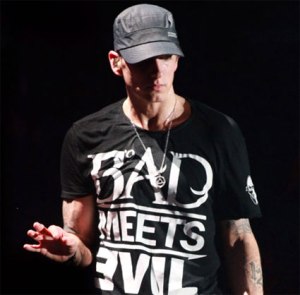
“Eminem, Lil Wayne Named ‘Gods Of Rock’ By GQ” by Flickr usermp3waxx.com, CC-BY-NC-SA-2.0
The recurrence of spiritual themes in Eminem’s soundscape suggests that music is a way to communicate with the other who is both present and hidden. Sometimes the other is God. Sometimes the other is the Devil. Sometimes the other is other people. Sometimes the other is the other within. The tones, rhythmic patters, key changes, intensity and release patterns combine with Eminem’s lyrics to create an experience within which listeners can be still, in which their souls can take refuge, and the other can be encountered. However, though sonic spirituality exists in Eminem’s music, and rumors abound regarding his “born again” status, it cannot be argued that Eminem adheres to a particular religion. Rather, the sonic spiritual element suggests that Eminem communicates a genuine awareness of supernatural powers, guilt-redemption-purification and love-hate that allows him to relate to the world at large. In this way Eminem is one of many artists whose pop culture content carries a strong spiritual dimension that is sonic, confirming results of Chris Rojek’s study, entitled “Celebrity and Religion,” which argues that “celebrity culture is secular society’s rejoinder to the decline of religion and magic” (393).

“DJ Hero party – Eminem 2” by Flickr user monsieurlam, CC-BY-NC-SA-2.0
As “Beautiful” and “My Darling” demonstrate, the spiritual reflections heard in Eminem’s music are not just harmonic, they are also discordant, revealing how conflicted we often are about ourselves and the supernatural. Just as Eminem walks with God in “Beautiful” and dances with the Devil in “My Darling,” audiences listening to his music are able to escape from their own worlds and find temporary refuge in sonic spirituality. This idea didn’t start with Eminem, or with the Judeo-Christian tradition, as many faiths across time and space utilize the power of music to evoke higher powers and acquire spiritual insight through prayers, storytelling, meditation, chanting, mantras, singing, silent vows, etc. But Eminem has added his own unique touch by using his personas Slim Shady and Marshall Mathers to speak with demonic and godly authority, respectively. As Peter Ward writes in Gods Behaving Badly, the spiritual power of Eminem’s music for audiences lies in its representations of a “conflicted and complex self clothed in the metaphors of the divine and reflected back to us” (107). In other words, sonic spirituality is about engaging with something beyond the world around us while grappling with the personas and situations into which we’re immersed. As the music plays we are challenged to develop a listening heart.
The popularity of Eminem’s music supports the conclusion that his brand of sonic spirituality is set to the same rhythm as the hearts of fans that buy and listen to his messages. But his work can also speak to those who consider themselves spiritually committed, even if that commitment is often not manifested in traditional religious activities. In this way the dynamic nature of sonic spirituality manifests as a way of listening that allows for communication and communion through music and language. If the above is true, then we can take Eminem’s claim, expressed via tweet, that “music has the power to heal” as a spiritual declaration. And we can also take a fan’s response to this tweet as an Amen: “All Eminem songs has [sic] a spiritual connection… you have to have the ear to find that for yourself.”
—
Featured Image: “Slim Shady” by Flickr user Walt Jabasco, CC BY-NC-ND 2.0
—
Marcia Alesan Dawkins, PhD is an award-winning writer, speaker, educator, and lecturer at the University of Southern California’s Annenberg School for Communication and Journalism. She is the author of Clearly Invisible: Racial Passing and the Color of Cultural Identity (Baylor UP, 2012) and Eminem: The Real Slim Shady (Praeger, 2013).
Marcia writes about racial passing, mixed race identities, media, popular culture, religion and politics for a variety of high-profile publications. She earned her PhD in communication from USC Annenberg, her master’s degrees in humanities from USC and NYU and her bachelor’s degrees in communication arts and honors from Villanova. Contact: www.marciadawkins.com
—
 REWIND! . . .If you liked this post, you may also dig:
The Victoria’s Secret Fashion Show and the Soundtrack of Desire–Marcia Alesan Dawkins
Love and Hip Hop: (Re)Gendering The Debate Over Hip Hop Studies–-Travis Gosa
“I Love to Praise His Name”: Shouting as Feminine Disruption, Public Ecstasy, and Audio-Visual Pleasure—Shakira Holt
Share this:

Love and Hip Hop: (Re)Gendering The Debate Over Hip Hop Studies
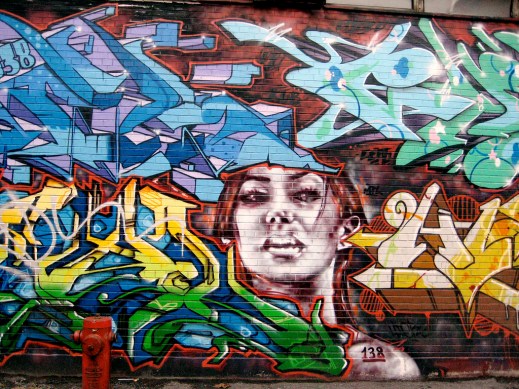

Today’s post from Cornell professor Travis Gosa (Africana Studies) marks the return of our “Sound and Pedagogy” Forum for a spring semester refresher course. It’s a hard time of the school year–fatigue can creep up in exponential relation to the sudden increase in sunshine. We at SO! want to put some spring back into your classroom with Gosa’s discussion of the relationship between hip hop and the university classroom–to sample De La Soul, stakes is high–followed up next week with Emmanuelle Sonntag and Bronwen Low‘s (McGill) exploration of hip hop pedagogies in the urban classroom in their joint post on “The Student as Broadcaster and DJ of Her Listening,” and rounded out with a hands-on self-assessment of how sound media can be a productive classroom tool in teaching black political history by Carter Mathes (Rutgers). Grab a new notebook, sharpen some pencils, and enjoy some (funky) fresh perspectives this spring. And now, I pass the mic to Dr. Travis Gosa–Editor-in-Chief Jennifer Stoever-Ackerman
—
The three-year appointment of DJ Afrika Bambaataa at Cornell University has caused me to think about the sexual politics of sound created by the artist-centered hip hop studies movement. College students have been reading hip hop textbooks since the early 1990s, and Arizona University students can now earn a minor in hip hop studies. However, the recent professorial appointments of artists like Bambaataa, Bun-B of UGK (Rice University), M1 of dead prez (Haverford College), Wyclef Jean (Brown University), and 9th Wonder (Harvard University) is shaping how hip hop is heard.
The embodied collision of instrumentation, lyricism, and experience in the artist-centered classroom can create spaces for empowerment and emancipatory learning. There is also a risk, however, that the artist-professors trend will reproduce the same sexist logic about hip hop and women that recirculates in mass-mediated rap music.
Since Common’s 1994 song “I Used to Love H.E.R,” the bodies of women of color have served as the sonic battlefield for wars over the authentic boundaries of hip hop culture. On the track, Common falls out of love with H.E.R (“hip hop”) when White corporations and West-Coast emcees gangbang his once virgin, “untampered” girl, and turn her into a promiscuous, weed-smoking “gangsta bitch.”
.
Compared to Lil’ Wayne’s lyrics about “beating the pussy up like Emmett Till,” or Rick Ross’ molly-infused date rap anthem, Common’s nostalgic back-in-the-day rhymes are tame. The love affair is sonically wrapped in the thick intertexuality of George Benson’s mellow jazz guitar of “The Changing World,” timeless emcee clichés like “yes yes ya’ll,” and classic quotables like Easy-E’s “Easily I approach…” (minus the punchline about having sex with your momma).
Rap legends Scarface and Nas use the H.E.R. trope to frame the appropriation of hip hop by colleges. On the DJ Khaled assisted track “Hip Hop,” they describe hip hop as a “middle-aged cougar,” and threaten to murder the “bitch” for being a gold digging “whore.”
.
According to Scarface, he has fallen out of love with Ms. Hip Hop because she is sleeping around with everyone, including college professors:
Now you all in the lectures
Being studied by the college’s professors
Now I regret the day I met ya, Bitch
I’ll be the first one to say it
She ain’t the one you want to play with
I fucked Hip Hop
When the imaginary borders of hip hop are expanded or violated by academia, Scarface defends hip hop by slut shaming Black women. The hegemonic masculine frame perpetuates the virgin/whore dichotomy of womanhood, justifies violence against women, and evaluates women (“hip hop”) according to their ability to fulfill the needs of men. DJ Khaled’s production reinforces the message by sampling Mott The Hoople’s “She Does It.” The 1975 British glam rock song is a little ditty about cocaine and/or rough sex with groupies.
Too often, loving hip hop involves remaining uncritical about sexualized violence and the silencing of women in the culture. “Sentimental attachment” to music, as Barry Shank described at the 2013 IASPM conference, is not the same as “interrogative listening,” the recognition that musical pleasure can involve dominance and oppression. Interrogative listening begins by acknowledging that being a member of a musical community comes with responsibility.
Hip hop studies professors face the monumental task of reeducating students in the art of interrogative listening. As scholar Tricia Rose noted in her keynote address at the opening of the Cornell Hip Hop Collection in 2008, the commercial rap industry has trained young people to nod to the beat while passively accepting misogyny and oppression. Rose writes in her book The Hip Hop Wars that pointing to real life “tricks” and “hoes” is often a strategy used to absolve male hip hop artists of their culpability in profiting from rape culture.
I have been impressed by the ability of pre-rap, 1970s hip hop artists to demonstrate a love for the culture without reproducing the woman-hating narrative found in rap music. The South Bronx DJs (i.e., BreakBeat Lou), graffiti artists (i.e., Carlos “Mare 139” Rodriguez), photographers (i.e., Joe Conzo, Jr.), and break-dancers (i.e., Richard “Crazy Legs” Colon and Jorge “Popmaster Fabel” Pabon) who make guest appearances in my courses explicitly disassociate themselves from the logic of commercial rap industry. Not surprisingly, it has been most intriguing to listen to the sexual politics created by the Afro-futuristic DJ Bambaataa.
Bambaataa is known for transforming the notorious Black Spades gang into the fledgling 1970s South Bronx hip hop scene. His Universal Zulu Nation has forcibly removed drug dealers from neighborhoods, rallied around political prisoners, and just last month, warned WorldStarHipHop.com to stop pandering violent and sexual images to youth.

Image by Pete Best, Courtesy of Cornell News
Less obvious is Bambaataa’s political work through sound performance. His signature soulsonic soundspace mocks the boundaries of music genre and the specificities of race, social class, and place, in favor of the universal. For example, when asked to explain early hip hop to my undergraduate class last fall, he sat back and played Ray Steven’s 1969 hit “Gitarzan” and The Music Man’s “Ya Got Trouble.” Hilarity and cognitive dissonance ensued, as the country-rock and Broadway tunes shattered the commonsense of hip hop as “rap music,” “black,” “youth,” or “urban.”
His universalism is not meant to obscure the contributions of women with a generic masculine narrative. Bambaataa has spent the first year of his appointment mapping out the centrality of women’s role in creating hip hop culture. Like Kyra Gaunt in Games Black Girls Play: Learning The Ropes from Double-Dutch to Hip Hop, Bambaataa traced rap and dance to double-dutch, hand-clipping, and rhythm games played by Black girls. To demonstrate how women pioneered rapping, he played Shirley Ellis’ The Name Game and The Clapping Song. During his first official sound lecture, a DJ set at an Ithaca nightclub, the music of Aretha Franklin and Miriam Makeba were interwoven into the more recognizable hip hop staples like James Brown.
Observing Bambaataa’s musical performances at Cornell gives me hope that sound and listening can be used to disrupt dominant modes of gender politics in the hip hop classroom. However, the ability of Black male artists to articulate the contributions of women is in no way a replacement for creating spaces which are actually inhabited by those who are not Black, male, or heterosexual. There is nothing universal about male bodies, thoughts, or voices. Unfortunately, this new trend of artists in the classroom is being constructed almost exclusively around Black/Brown, heterosexual men.
To date, no “b-girls,” “femcees,” or “flygirls” have been appointed to high profile positions in the academy. I struggle with this at my home institution, as Cornell’s “Born in the Bronx” archival project risks perpetuating the myth of a woman-less birth. This gender-limited vision of hip hop’s roots has been compounded by the silencing of legendary battle emcee Roxanne Shanté, whose relationship with Cornell ended after a witch-hunt surrounding her academic credentials back in 2009. MC Sha-Rock, an early female emcee, will end the four-year estrogen drought when she participates in Cornell’s 2013 Unbound From the Underground hip hop celebration on April 4-7, 2013.
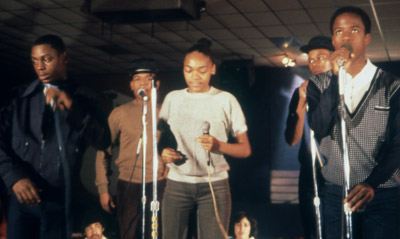
MC Sha-Rock in 1982’s Wild Style, Charlie Ahearn/Cornell Hip Hop Collection
Our efforts to connect academic hip hop studies to its cultural practitioners must honor women and empower female agency. The critical praxis has already been constructed by Black feminist scholars, such as Tricia Rose, Joan Morgan, Patricia Hill-Collins, Gwen Pough, Kyra Gaunt, Ruth Nichole Brown, and countless others. Hip hop feminism or “Crunk feminism” dictates that academic spaces support emancipatory gender politics, which starts with teaching and celebrating a truthful history focused on the agency of women of color. It does not involve participating in Black male violence under the guise of loving hip hop.
Every university that claims to teach or “preserve” hip hop should appoint female/feminist/queer artists. No doubt, fierce emcees like Yo-Yo, MC Lyte, Missy Elliott, and Lauryn Hill should be on the short list at many colleges. Still, we have to be wary of gender tokenism; the end-game should not be finding a honorary female artist to provide “a woman’s point of view.” Rather, the goal should be to create opportunities for women to narrate history, redefine the spaces occupied by hip hop, and to rearticulate the logic of critical listening.
Regendering hip hop studies will require a paradigm shift and a new soundtrack about love. Perhaps we can begin the work by replacing the H.E.R. tracks with Akua Naru’s “The World is Listening.” It is a dope, feminist homage to women’s journey through hip hop history, without all the slut shaming.
—
Featured Image by Flickr User LizSpikol
—
Travis L. Gosa is an Assistant Professor at Cornell University’s Africana Studies & Research Center. He teaches courses on hip hop culture, African American families, and education. He is an advisory board member of Cornell’s Hip Hop Collection, the largest archive on early hip hop culture in the United States. He can be reached at tlg72@cornell.edu and on Twitter @basedprof.
—
REWIND! . . .If you liked this post, you may also dig:
“‘I’m on my New York s**t’: Jean Grae’s Sonic Claims on the City”––Liana Silva
“Ill Communication: Hip Hop Studies & Sound Studies @ Show And Prove”— J. Stoever-Ackerman
“The Victoria’s Secret Fashion Show and the Soundtrack of Desire“— Marcia Dawkins
Share this:


Current Top Posts





April 2021

January 2020

November 2019

October 2019

August 2019

April 2014

November 2017

March 2015

December 2017

October 2015
 Sounding Out!
Recent Comments