
Resounding Silence: Learning to Hear the Hysteric’s Voice


This week we are pleased to welcome Guest Editor Karly-Lynne Scott kick off the last Thursday Series that Sounding Out! is running in 2015. Over the last ten months, this stream has reconsidered historical figures from radio preacher Elder Michaux to folklorist Alan Lomax, found new ways to tune in the weird voices in literature from Joseph Conrad to H.P. Lovecraft, and featured unsettled soundscapes from Vancouver to Havana.
All year, our Thursday authors have been challenging sonic archives and remaking historical and contemporary problems. That trend continues with Scott’s exciting work and that of her authors in Hysterical Sound.
— Special Editor Neil Verma.
—
Hysteria, the infamous and now-discredited psychological disorder that was a common diagnosis for women during the 19th century, has important sonic dimensions that have often been overlooked. Indeed, sound holds a prominent place in both the symptoms and treatment of hysteria: from the silence of hysterical aphonia to the hysteric’s vocal ejaculations, from fits triggered by sound to auditory hallucinations, from the hysteric giving up speech to the implementation of the talking cure.
Our four part series Hysterical Sound brings together writers and artists to explore hysteria’s sonic dimensions, as well as its continued legacy and importance for sound studies. In the coming weeks, Gordon Sullivan will consider the video art series Hysterical Literature in relation to a long history of women’s vocalizations serving as aural fetishes of female sexuality for the pleasure of male listeners. Veronica Fitzpatrick will explore the hysterical quality of the horror film soundtrack in its rejection of verbocentrism—the privileging of language and meaning. Finally, John Corbett, Terri Kapsalis and Danny Thompson share an excerpt from their performance art project The Hysterical Alphabet.
Today, I kick off this series with a discussion of what it means to listen to the silence of the hysteric. Looking at Sam Taylor-Johnson’s silent film Hysteria I argue that the hysteric is not mute, rather her vocalizations go unheard because we have tuned them out.
— Guest Editor Karly-Lynne Scott
—
The silence of Sam Taylor-Johnson’s eight-minute film Hysteria announces itself loudly. As the film holds in close-up the face of a woman as she cries and laughs indiscriminately, and with abandon, it is difficult to ignore that the woman’s voice is missing.
Today, Taylor-Johnson is famous for directing feature films like Nowhere Boy (2009) and Fifty Shades of Grey (2015), but she first rose to prominence in 1990s as a fine art photographer, film and video artist creating works like Hysteria. In the film, the image and absent soundtrack function together to conflate the two sonic extremes symptomatic of hysteria: the loss of voice (including dysphonia, aphonia and aphasia), and the sound of hysterical fits, irrepressible yet inarticulate vocal ejaculations—moans, cries, murmurs and screams— that we might call hysterical vocalizations. The resulting silent scream recalls Jean-Martin Charcot’s Iconographie photographique de la Salpêtrière, in particular Plate XV “Onset of the Attack—Scream.”
In this post, I want to consider these two works together, asking not only how they figure the silent hysteric each in its own way, but also how we can ‘learn to listen’ to this silence in both cases.

Plate XV “Début de L’attaque—Cri” (Onset of the Attack—Scream) from Iconographie photographique de la Salpêtrière, public domain
Jean-Martin Charcot was a celebrated nineteenth century French neurologist and professor of pathological anatomy, best known today for his work with hysteria at the Salpêtrière Hospital in Paris. Describing himself as a visuel, or a “man who sees,” Charcot demonstrated little concern for the sounds of hysteria (11). “You see how hysterics shout,” Charcot said, “Much ado about nothing” (53). Focusing on the visual dimensions of hysteric’s symptoms at the expense of her voice, Charcot photographed the physical symptoms of hysteria, creating an archive of still, silent women. Martha Noel Evans tells that Charcot “would have the patients brought into his office and stripped naked; he would observe them, ask them to perform certain movements, stare, meditate, and then have them led out. … he rarely exchanged words with the patients” (20).
As Janet Beizer explains in Ventriloquized Bodies: Narratives of Hysteria in Nineteenth Century France, because the hysteric’s vocalizations were nonverbal they were considered meaningless in themselves. It was deemed necessary for someone to speak for her in order to make sense of her incoherence, to interpret and translate her nonverbal communication into meaningful speech. Medical professionals exhibited a verbocentrism—a bias privileging language and meaning over other types of vocalizations—that not only caused the voice of the hysteric to go unheard, but also led to her being ventriloquized by others, particularly male doctors.
To rectify this history Beizer asserts, “I cannot hope to reintegrate the nineteenth-century hysterical body with its voice; I can only mouth the voicelessness and strive to expose the discourse that spoke in its place” (12). This is precisely the approach taken by Taylor-Johnson’s film. It does not attempt to reintegrate the hysterical body with its voice, a gesture that might function only to further ventriloquize the hysteric. Instead, in removing the soundtrack, it mouths the hysteric’s voicelessness, emphasizing it to the point that it can be heard.
In Iconographie, the stillness of the photographs allows their silence to be easily ignored, not only because we are accustomed to still photography’s absence of sound, but because silence, stillness, and death go hand-in-hand. The living body, however, is never truly silent. For that reason, the uncanniness of the silent, moving body in Taylor-Johnson’s film draws attention to not only the film’s absence of sound, but the silencing of the hysteric.
 .
.
Although Hysteria is without a soundtrack, to say that it is silent misses something crucial. As Michel Chion asserts in The Voice in Cinema what we call silent cinema, films without soundtracks, might be better termed “deaf cinema” (7). “It’s not that the film’s characters were mute,” Chion explains, “but rather that the film was deaf to them” (8). As he explains, spectators watching a film without a soundtrack know that the characters are speaking, even in the absence of sound, because they see them speak. We not only see the woman of Hysteria shout and laugh, scream and cry, but close-ups of her mouth agape make visible the movement of her tongue and pharynx. Thus, although we cannot hear the noise she is making, we see that she is making it. Chion quotes filmmaker Robert Bresson, who speaking to this idea said, “For the characters did in fact talk, only they spoke in a vacuum, no one could hear what they were saying’” (8). It is not that the hysterical woman is silent, but that we, like Charcot, have tuned her out.
Reframing the hysteric’s silence this way, it is no longer she that is deficient for being unable to speak in a meaningful way. Rather, it is we who lack the ability, or willingness, to listen. She screams and shouts, moans and laughs, but her vocalizations are lost on us. What Hysteria makes perceptible through its image-track is that the hysteric is speaking—we cannot hear her because she has been stripped of her voice, as the film has been stripped of its soundtrack, but she is not silent. The film encourages us to learn to perceive vocalizations that have been silenced with our other senses, to recognize and acknowledge their existence even when we cannot hear them. In bringing our attention to the hysteric’s silence Hysteria helps us learn to listen her and, in doing so, reveals that this silence in fact speaks volumes.
—
Karly-Lynne Scott is a Ph.D. candidate in Screen Cultures at Northwestern University. Her dissertation considers pornography in relation to philosophical conceptualizations of the body and the history of sexology. Her work appears or is forthcoming in Porn Studies, In Media Res, and World Picture, where she is an assistant editor.
—
 REWIND! . . .If you liked this post, you may also dig:
Vocal Gender and the Gendered Soundscape: At the Intersection of Gender Studies and Sound Studies — Christine Ehrick
Quiet on the Set?: The Artist and the Sound of a Silent Resurgence — April Miller
Eye Candy: The Absence of the Female Voice in Sports Talk Radio — Liana M. Silva
Share this:

The Sweet Sounds of Havana: Space, Listening, and the Making of Sonic Citizenship

 Welcome to the third and final installment of Unsettling the World Soundscape Project, a series in which we critically investigate the output of early acoustic ecology and assess its continuing value for today’s sound studies. In our first post, Mitchell Akiyama addressed the WSP’s ten-hour Soundscapes of Canada radio series from 1974 to situate the broadcast’s innovative work historically and explore how it attempted to represent a diverse nation by way of sound. In my follow-up post, I focused on the WSP’s Vancouver research, their only output since returning from Europe in 1975, assessing shifts in the ideologies and practices over its two official releases and arguing for the best path that future iterations of the project might follow.
In this final entry, Vincent Andrisani puts the “world” back into the World Soundscape Project by carrying his experience as the recordist for the WSP’s last archiving mission in Vancouver out into his solo doctoral research in Havana, Cuba. Andrisani lends an unsettled ear to one of the city’s most beloved sounds, the tune of the ice cream vendor, unpacking its social and historical significance to make an argument about the role that sound plays in local self-definitions of citizenship. Inspired by the WSP’s continuing quest to discover how people’s relationship to places can be defined through sound, Andrisani’s work offers an example of what contemporary soundscape research can be while demonstrating how to deal with many of the concerns raised about the WSP’s output over the course of this series.
It has been a great pleasure acting as editor for this series over the past few weeks and it is our hope that these posts will provide further fuel for celebrating, expanding, critiquing and rethinking the work of acoustic ecology in the broader context of contemporary sonic research.
— Guest Editor Randolph Jordan
—
To conceive of Havana in sound is to think not of the material spaces of the city, but rather, across them. From inside the home, residents participate in conversations taking place in the streets, while those in the streets often call for the attention of their friends or family indoors. Through windows, open doors, and porticoes, residents engage in interpersonal exchanges that bring neighbourhood communities to life. To listen across these spaces is to listen trans-liminally from the threshold through which sounds must pass as they animate the vibrant social life of the city. Such an act is made most apparent by the voices of vendedores ambulantes, or, mobile street vendors. “¡El buen paquete de galleta!” (“The good packs of cookies!”), “¡Se compran y se vendan libros!” (“I’m buying and selling books!”), and most famously, “¡Mani! ¡Mani!” (“Peanuts! Peanuts!”) are some of the pregones—the musical cries—heard through the streets and into the home.
But not all vendors are pregoneros. El heladero, the ice cream vendor, uses the jangly melodies of the electronic music box to make ears perk up, mouths water, and children’s shoes hit the ground running. The sound signals a respite from the sweltering Caribbean heat and is symbolic of a novelty food item for which Cubans have a strong cultural affinity. But most of all, the ice cream vendor’s melodic tunes bring people out of their homes and into the street, giving life to a moment that is as social, participatory, and convivial as it is savory.
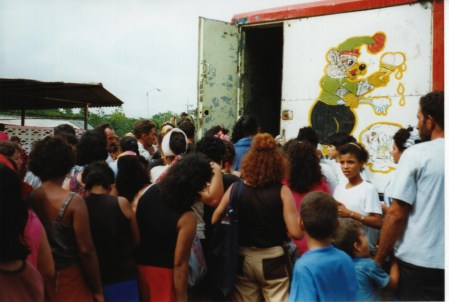
Ice Cream Vendor in Cuba, 2008, Courtesy of Flickr User berg_chabot
For over a century, ice cream vendors have been heard on the streets of Havana. Throughout this time, the city’s spaces have been contested by external regimes of power that include the Spanish Crown, U.S. business interests, Cuba’s own socialist government, the Soviet Union, and since the 1990s, Cuba’s resurgent tourist economy. Yet, in spite of the exclusionary logic imposed by each of these systems of power, the sound of the ice cream vendor still remains. To listen to it is to listen to Havana according not to the agenda of outside interests, but rather, according to the collective interests of residents themselves.
Borrowing from the work of Saskia Sassen (2006) who maintains that “citizenship practices have to do with the production of ‘presence’ of those without power and a politics that claims rights to the city” (315), I regard the tacit, communicative, trans-liminal act of listening as a means through which residents assert their embodied presence amidst both the spatial and political landscapes of the city. Listening to the sound of the ice cream vendor, I argue, constitutes an act of citizenship—an act of sonic citizenship—that momentarily claims Havana’s spaces according to the aims, aspirations, and desires of those who live there.
Citizenship, in this sense, is conceived of not as an institution bound to the political-juridical architecture of the nation-state, but rather, as a place-based “practice and project” (Sassen, p281) that, over time, has the potential to condition changes in the formalized institution itself. It emerges in the everyday, rather ordinary moments during which the city’s spaces are produced and given meaning by those with unequal access to political power. Just as Jennifer Stoever (2011) and Michael Francis O’Toole (2014) have discussed elsewhere, I too contend that citizenship is articulated in sound, but in order to hear it, we must listen historically to—and through—the spaces of Havana’s built environment.
The above clip, which I captured while conducting fieldwork in Havana, represents a moment of everyday life in the municipality of Centro Habana. While speaking about it with friends, colleagues, and acquaintances, I came to realize that only recently had the ice cream vendor’s heralding music become part of the local soundscapes. “Where was it before that?”, I asked. “Before that,” they all said, “it was gone.” In 1990, the Soviet Union collapsed and brought Cuba’s economy along with it. Shortages of food, petrol, and material resources were so severe that satisfying basic needs took precedence over the delivery of frozen novelties. The result was the loss of the ice cream vendor—and its corresponding sound—which, for decades, was part of the ongoing, everyday life of the city.
Fittingly, the collective sentiment surrounding that loss is captured in song. “Helado Sobre Ruedas,” or “Ice Cream on Wheels” by Gema y Pavel was released in 1994, during the height of Cuba’s economic crisis. In it, the duo lament the disappearance of the ice cream vendor from the streets of Havana and reflect on what it meant not only to them, but to all residents of the city. They speak about the presence of the ice cream vendor as a ‘refreshing’ event on hot days; as a source of joy, pleasure, and happiness that offered much more than a simple respite from the heat, but as one that “made family problems disappear.” The “sweet melody” of the vendor was the cause for celebration in neighbourhoods across the city, and is a sound that the duo recalls with both warmth and affection.
Throughout most of the twentieth century, ice cream sales in Havana looked and sounded much like it did in the United States. Minnesota-based Nichols Electronics developed the technology of the electronic music box in the mid-1950s, and within a few years, its chime-y sounds were heard on the streets of Havana. The frozen novelty itself can be traced back to 1920 in Youngstown, Ohio. Harry Burt, the eventual founder of the Good Humor brand paired, first, the lollipop’s wooden stick with chocolate covered vanilla ice cream, and subsequently, ice cream sales and automobility. In Havana, brands such as Hatuey, Guarina, and El Gallito borrowed Burt’s developments, and by the time the city underwent its westward suburbanization in the 1940s and ’50s, mobile ice cream sales were booming.
But if we listen further still into Havana’s past, we can discern the ways in which the ice cream vendor’s music echoes the complex history of the city. During Cuba’s struggle for independence in the late 1800s, American traditions and customs such as baseball, Protestantism, and new habits of hygiene began emerging in Havana. At once a rejection of the perceived backwardness of Spanish culture and an appeal to modernizing the island, this cultural appropriation was, as both Louis A. Pérez Jr. (1999) and Marial Iglesias-Utset (2011) have carefully observed, a way for residents to perform acts of citizenship with the intent of defining the customs of the impending nation.
It is perhaps no coincidence, then, that the practice of street side ice cream vending arrived in Havana at this very moment following its proliferation in cities such as Barcelona, London, and notably New York. These vendors performed a series of decisive functions amidst the city’s political geography, the most discernible of which was that they offered an opportunity for the working class to indulge in what historically was a bourgeois delight. Of equal importance however, was that ice cream vendors were also participants in Havana’s project of cultural modernization, and their street side presence enabled locals to inhabit the acoustic spaces of the city on their own terms and not those of the Spanish Crown.

Ice cream vendor on the streets of Havana between 1890 and 1910. Courtesy of the Library of Congress Archives.
This photograph, taken in Havana some time between 1890 and 1910, can be read not only as a silent image, but as an audiovisual text. Without any visible technology with which to herald his presence, it’s likely that this vendor relied on his own voice in the form of a pregón. We might imagine the slow rumble of the cart’s wooden wheels as they rolled over the unpaved road, glass cups jangling as the cart bounced along, and enthusiastic voices congregating in the street to buy what was known as a “penny lick.” Each of these sounds moved across the liminal spaces of the built environment, each marking a moment of savory indulgence and neighborly dialogue in the life of the city—as they do again today.
Listening to, documenting, and as historian Bruce R. Smith (2004) terms it, “un-airing” the history of Havana’s ice cream vendors offers a means through which to cultivate unexplored encounters with the city. It animates a narrative grounded not in political rupture, but in historical continuity; it locates a geography characterized not by unequivocal exclusion, but one that, quite simply, belongs to those who live there; and in so doing, it develops an account of the city not from the top-down, but rather, from the bottom-up. Such an approach renders audible the enactment of citizenship by listening for the sounds that firmly ground citizens in the very spaces that, time and again, have been destabilized by forces imposed from above.
To hear the ways in which citizens inhabit the city of Havana, we must simultaneously listen trans-liminally, across the open spaces of the built environment, and into the city’s history, which resonates through the sounds of neighbourhood communities, interpersonal dialogue, and social interaction. The heralding music of the ice cream vendor is one sound that does precisely that: for some, it offers a sense of childhood nostalgia, for others, it conjures the taste of a delicious frozen snack. But in every case, to listen to it is to enact a form of civic memory that orients residents according to both the spaces they inhabit, and the social and cultural history to which they belong. It comprises a moment, liminal as it may be, during which the city is lived, experienced, and imagined according to the interests of no one other than citizens themselves.
Acknowledgements: A sincere thanks to my extended family in Havana, to the academic community at Fundación Fernando Ortiz, and in particular, to Dr. Aurelio Francos Lauredo for his time, guidance, and for his attentive and compassionate ear.
—
Vincent Andrisani is a PhD Candidate and an instructor in the School of Communication at Simon Fraser University. He has written and lectured on the topics of popular music, broadcast media, and the politics of audio documentation in the context of Soundscape Studies, and has presented his research in a number of artistic and academic venues; the most recent of which was at the Pan-American Mobilities Conference in Santiago, Chile in 2014. Intersecting the areas of Sound Studies, Urban Geography, and Cuban Studies, Vincent’s doctoral research explores the relationship between sound, space, and citizenship in the city of Havana. In addition to the ice cream vendor, the sounds of water pipes, international travelers, and street musicians performing “Guantanamera” and other likely tunes form the basis of the study. http://www.vincentandrisani.com.
—
Featured image:Ice cream vendor in Havana, courtesy of University of Miami Libraries, Cuban Heritage Collection.
—
REWIND! . . .If you liked this post, you may also dig:
Radio de Acción: Violent Circuits, Contentious Voices: Caribbean Radio Histories — Alejandra Bronfman
Snap, Crackle, Pop: The Sonic Pleasures of Food — Steph Ceraso
Listening (Loudly) to Spanish-Language Radio — Doloris Inés Casillas
Share this:


Current Top Posts





April 2021

January 2020

November 2019

October 2019

August 2019

April 2014

November 2017

March 2015

December 2017

October 2015
 Sounding Out!
Recent Comments