
“People’s lives are at stake”: A conversation about Law, Listening, and Sound between James Parker and Lawrence English

Lawrence English is composer, media artist and curator based in Australia. Working across an eclectic array of aesthetic investigations, English’s work prompts questions of field, perception and memory. He investigates the politics of perception, through live performance and installation, to create works that ponder subtle transformations of space and ask audiences to become aware of that which exists at the edge of perception.
James Parker is a senior lecturer at Melbourne Law School, where he is also Director of the research program ‘Law, Sound and the International’ at the Institute for International Law and the Humanities. James’ research addresses the many relations between law, sound and listening, with a particular focus at the moment on sound’s weaponisation. His monograph Acoustic Jurisprudence: Listening to the Trial of Simon Bikindi (OUP 2015) explores the trial of Simon Bikindi, who was accused by the International Criminal Tribunal for Rwanda of inciting genocide with his songs (30% discount available with the code ALAUTHC4). James is also a music critic and radio broadcaster. He will be co-curating an exhibition and parallel public program on Eavesdropping at the Ian Potter Museum of Art in Melbourne between July and October 2018.
Lawrence English: James, thanks for taking the time to correspond with me. I was interested in having this conversation with you as we’re both interested in sound, but perhaps approaching its potential applications and implications in somewhat different ways. And yet we have a good deal of potential cross over in our sonic interests too. Particularly in the way that meaning is sought and extracted from our engagements with sound. How that meaning is constructed and what is extracted and amplified from those possible, meaningful readings of sound in time and place. I read with great interest your work on acoustic jurisprudence, specifically how you almost build a case for an ontological position that’s relational between sound and the law. I wondered if you could perhaps start with a summary of this framework you’re pushing towards? I am interested to know how it is you have approached this potentiality in the meaning of sound and the challenges that lie in working around an area that is still so diffuse, at least in a legal setting.
James Parker: Let me begin by saying a sincere thank you for the invitation. As a long-time fan of your work, it’s a pleasure. It’s also symptomatic in a way, because – so far at least – the art world has been much more interested in my research than the legal academy. When I’m in a law faculty and I say that my work is about law’s relationship(s) with sound, people are mostly surprised, sometimes they’re interested, but they rarely care very much. I don’t mean this as a slight. It’s just that their first instinct is always that I’m doing something esoteric: that my work doesn’t really ‘apply’ to them as someone interested in refugee law, contract, torts, evidence, genocide, or whatever the case may be. As you point out though, that’s not the way I see it at all. One of the things I’ve tried to show in my work is just how deeply law, sound and listening are bound up with each other. This is true in all sorts of different ways, whether or not the relationship is properly ‘ontological’.

Image by Flickr User Frank Hebbert, (CC BY-NC-ND 2.0)
At the most obvious level, the soundscape (both our sonic environment and how we relate to it) is always also a lawscape. Our smartphones, loudspeakers, radios and headsets are all proprietary, as is the music we listen to on them and the audio-formats on which that music is encoded. Law regulates and fails to regulate the volume and acoustic character of our streets, skies, workplaces, bedrooms and battlefields. Courts and legislatures claim to govern the kinds of vocalizations we make – what we can say or sing, where and when – and who gets to listen. As yet another music venue, airport, housing development or logging venture receives approval, new sounds enter the world, others leave it and things are subtly reconstituted as a result.
What’s striking when you look at the legal scholarship, however, is that how sound is conceived for such purposes gets very little attention. There are exceptions: in the fields of copyright and anti-noise regulation particularly. But for the most part, legal thought and practice is content to work with ‘common sense’ assumptions which would be immediately discredited by anyone who spends their time thinking hard about what sound is and does. So as legal academics, legislators, judges, and so on, we need to be much better at attending to law’s ‘sonic imagination’. When an asylum seeker is denied entry to the UK because of the way he pronounces the Arabic word for ‘tomato’ (which actually happened…the artist Lawrence Abu Hamdan has done some fantastic work on this), what set of relations between voice, accent and citizenship is at stake? When a person is accused of inciting genocide with their songs (in this instance a Rwandan musician called Simon Bikindi), what theory or theories of music manifest themselves in the decision-making body’s discourse and in the application of its doctrine? These are really important questions, it seems to me. To put it bluntly: people’s lives are at stake.
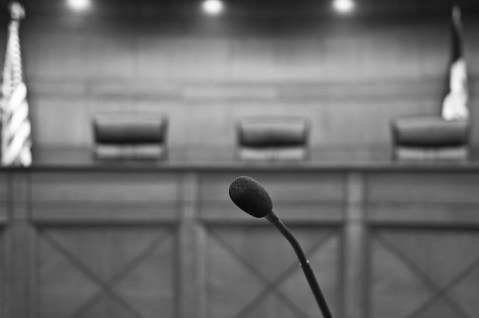
microphone where attorneys present arguments at the Iowa Court of Appeals, Image by Flickr User Phil Roeder, (CC BY-NC-ND 2.0)
Another way of thinking about the law-sound relation would be to think about the role played by sound in legal practice: in courtrooms, legislatures etc. For a singer to be tried for genocide, for instance, his songs must be heard. Audio and audio- video recordings must be entered as evidence and played aloud to the court; a witness or two may sing. How? When? Why? The judicial soundscape is surprisingly diverse, it turns out. Gavels knock (at least in some jurisdictions), oaths are sworn, judgment is pronounced; and all of this increasingly into microphones, through headsets, and transmitted via audio-video link to prisons and elsewhere. This stuff matters. It warrants thinking about.
Outside the courtroom, sound is often the medium of law’s articulation: what materialises it, gives it reality, shape, force and effect. Think of the police car’s siren, for instance, or a device like the LRAD, which I know you’re also interested in. Or in non-secular jurisdictions, we could think equally of the church bells in Christianity, the call to prayer in Islam or the songlines of Aboriginal Australia. The idea that law today is an overwhelmingly textual and visual enterprise is pretty commonplace. But it’s an overstatement. Sound remains a key feature of law’s conduct, transmission and embodiment.
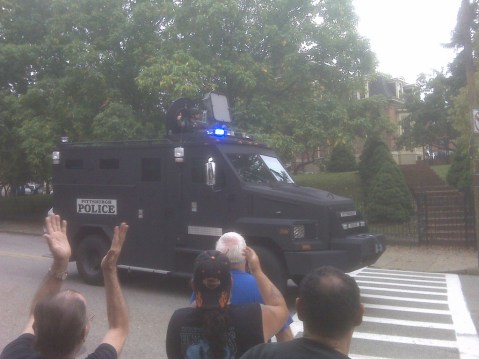
“Area Man Cheers for LRAD Arrival,” Pittsburgh G-20 summit protests, 2009, Image by Flickr User Jeeves, (CC BY-NC-ND 2.0)
And to bring me back to where I started, I feel like artists and musicians are generally better tuned in to this than us lawyers.
English: Given the fact that the voice, and I suppose I mean both literally and metaphorically, reigns so heavily in the development and execution of the law it’s surprising that the discourses around sound aren’t a little more engaged. That being said, it’s not that surprising really, as I’d argue that until recently the broader conversations around sound and listening have been rather sparse. It’s only really in the past three decades have we started to see a swell of critical writings around these topics. The past decade particularly has produced a wealth of thought that addresses sound.

Early Dictophone, Museum of Communication, Image by Flickr User Andy Dean, (CC BY-NC-ND 2.0)
I suppose though that really this situation you describe in the law is tied back into the questions that surround the recognition of sound and the complexities of audition more generally. I can’t help but feel that sound has suffered historically from a lack of theoretical investigation. Partly this is due to the late development of tools that provided the opportunity for sound to linger beyond its moment of utterance. That recognition of the subjectivity of audition, revealed in those first recordings of the phonograph must have been a powerful moment. In that second, suddenly, it was apparent that how we listen, and what it is we extract from a moment to moment encounter with sound is entirely rooted in our agency and intent as a listener. The phonograph’s capturing of audio, by contrast, is without this socio-cultural agency. It’s a receptacle that’s technologically bound in the absolute.
I wonder if part of the anxiety, if that’s the word that could be used, around the way that sound is framed in a legal sense is down to its impermanence. That until quite recently we had to accept the experience of sound, as entirely tethered to that momentary encounter. I sense that the law is slow to adapt to new forms and structures. Where do you perceive the emergence of sound as a concern for law? At what point did the law, start to listen?
Parker: Wow, there’s so much in this question. In relation to your point about voice, of course lawyers do ‘get it’ on some level. If you speak to a practitioner, they’re sure to have an anecdote or two about the sonorous courtroom and the (dark) arts of legal eloquence. You may even get an academic to recognise that a theory of voice is somehow implicit in contemporary languages of democracy, citizenship and participatory politics: this familiar idea that (each of us a little sovereign) together we manifest the collective ‘voice’ of the people. But you’ll be hard pushed to find anyone in the legal academy actually studying any of this (outside the legal academy, I can thoroughly recommend Mladen Dolar’s incredible A Voice and Nothing More, which is excellent – if brief – on the voice’s legal and political dimensions). One explanation, as you say, might be that it’s only relatively recently that a discourse has begun to emerge around sound across the academy: in which case law’s deafness would be symptomatic of a more general inattention to sound and listening. That’s part of the story, I think. But it’s also true that the contemporary legal academy has developed such an obsession with doctrine and the promise of law reform that really any inquiry into law’s material or metaphysical aspects is considered out of the ordinary. In this sense, voice is just one area of neglect amongst many.
As for your points about audio-recording, it’s certainly true that access to recordings makes research on sound easier in some respects. There’s no way I could have written my book on the trial of Simon Bikindi, for instance, without access to the audio-archive of all the hearings. Having said that, I’m pretty suspicious of this idea that the phonograph, or for that matter any recording/reproductive technology could be ‘without agency’ as you put it. It strikes me that the agency of the machine/medium is precisely one of the things we should be attending to.
English: I may have been a little flippant. I agree there’s nothing pure about any technology and we should be suspicious of any claims towards that. It seems daily we’re reminded that our technologies and their relationships with each other pose a certain threat, whether that be privacy through covert recording or potential profiling as suggested by the development of behavioral recognition software with CCTV cameras.
Parker: Not just that. CCTV cameras are being kitted out with listening devices now too. There was a minor controversy about their legality and politics earlier this year in Brisbane in fact.
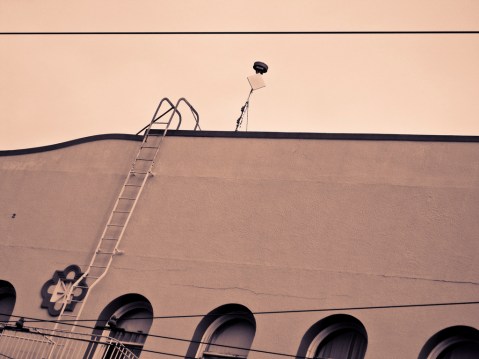
“Then They Put That Up There”–Shotspotter surveillance mic on top of the Dolores Mission, Image by Flickr User Ariel Dovas, (CC BY-NC-ND 2.0)
English: Thinking about sound technologies, at the most basic level, the pattern of the microphone, cardioid, omni and the like, determines a kind of possibility for the articulation of voice, and its surrounds. I think the microphone conveys a very strong political position in that its design lends itself so strongly to the power of singular voice. That has manifest itself in everything from media conferences and our political institutions, through to the inane power plays of ‘lead singers’ in 1980s hard rock. The microphone encourages, both in its physical and acoustic design, a certain singular focus. It’s this singularity that some artists, say those working with field recording, are working against. This has been the case in some of the field recordings I have undertaken over the years. It has been a struggle to address my audition and contrast it with that of the microphone. How is it these two rather distinct fields of audition might be brought into relief? I imagine these implications extend into the courtroom.
Parker: Absolutely. Microphones have been installed in courtrooms for quite a while now, though not necessarily (or at least not exclusively) for the purposes of amplification. Most courts are relatively small, so when mics do appear it’s typically for archival purposes, and especially to assist in the production of trial transcripts. This job used to be done by stenographers, of course, but increasingly it’s automated.
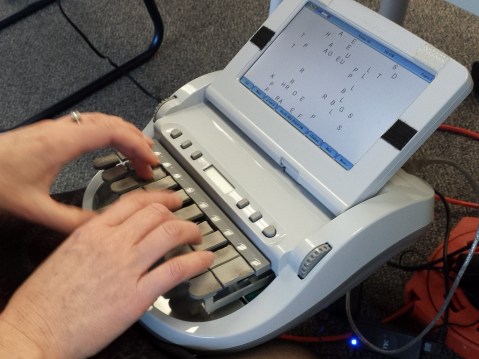
Stenographer, Image by Flickr User Mike Gifford, (CC BY-NC-ND 2.0)
So no, in court, microphones don’t tend to be so solipsistic. In fact, in some instances they can help facilitate really interesting collective speaking and listening practices. At institutions like the International Criminal Tribunal for Rwanda, or for the Former Yugoslavia, for instance, trials are conducted in multiple languages at once, thanks to what’s called ‘simultaneous interpretation’. Perhaps you’re familiar with how this works from the occasional snippets you see of big multi-national conferences on the news, but the technique was first developed at the Nuremberg Trials at the end of WWII.
What happens is that when someone speaks into a microphone – whether it’s a witness, a lawyer or a judge – what they’re saying gets relayed to an interpreter watching and listening on from a soundproof booth. After a second or two’s delay, the interpreter starts translating what they’re saying into the target language. And then everyone else in the courtroom just chooses what language they want to listen to on the receiver connected to their headset. Nuremberg operated in four languages, the ICTR in three. And of course, this system massively affects the nature of courtroom eloquence. Because of the lag between the original and interpreted speech, proceedings move painfully slowly.

Council of Human Rights of the United Nations investigates possible violations committed during the Israeli offensive in the band Gaza, 27 December to 18 January 2008. Image courtesy of the United Nations Geneva via Flickr (CC BY-NC-ND 2.0)
Courtroom speech develops this odd rhythm whereby everyone is constantly pausing mid-sentence and waiting for the interpretation to come through. And the intonation of interpreted speech is obviously totally different from the original too. Not only is a certain amount of expression or emotion necessarily lost along the way, the interpreter will have an accent, they’ll have to interpret speech from both genders, and then – because the interpreter is performing their translation on the fly (this is extraordinarily difficult to do by the way… it takes years of training) – inevitably they end up placing emphasis on odd words, which can make what they say really difficult to follow. As a listener, you have to concentrate extremely hard: learn to listen past the pauses, force yourself to make sense of the stumbling cadence, strange emphasis and lack of emotion.
On one level, this is a shame of course: there’s clearly a ‘loss’ here compared with a trial operating in a single language. But if it weren’t for simultaneous interpretation, these Tribunals couldn’t function at all. You could say the same about the UN as a whole actually.
English: I agree. Though for what it’s worth it does seem as though we’re on a pathway to taking the political and legal dimensions of sound more seriously. Your research is early proof of that, as are cases such as Karen Piper’s suit against the city of Pittsburgh in relation to police use of an LRAD. As far as the LRAD is concerned, along with other emerging technologies like the Hypershield and the Mosquito, it’s as though sound’s capacity for physical violence, and the way this is being harnessed by police and military around the world somehow brings these questions more readily into focus.
Parker: I think that’s right. There’s definitely been a surge of interest in sound’s ‘weaponisation’ recently. In terms of law suits, in addition to the case brought by Karen Piper against the City of Pittsburgh, LRAD use has been litigated in both New York and Toronto, and there was a successful action a couple of years back in relation to a Mosquito installed in a mall in Brisbane.
On the more scholarly end of things, Steve Goodman’s work on ‘sonic warfare’ has quickly become canonical, of course. But I’d also really recommend J. Martin Daughtry’s new book on the role of sound and listening in the most recent Iraq war. Whereas Goodman focuses on the more physiological end of things – sound’s capacity both to cause physical harm (deafness, hearing loss, miscarriages etc) and to produce more subtle autonomic or affective responses (fear, desire and so on) – Daughtry is also concerned with questions of psychology and the ways in which our experience even of weaponised sound is necessarily mediated by our histories as listeners. For Daughtry, the problem of acoustic violence always entails a spectrum between listening and raw exposure.
These scholarly interventions are really important, I think (even though neither Goodman nor Daughtry are interested in drawing out the legal dimensions of their work). Because although it’s true that sound’s capacity to wound provides a certain urgency to the debate around the political and legal dimensions of the contemporary soundscape, it’s important not to allow this to become the only framework for the discussion. And that certainly seems to have happened with the LRAD.
Of course, the LRAD’s capacity to do irreparable physiological harm matters. Karen Piper now has permanent hearing loss, and I’m sure she’s not the only one. But that shouldn’t be where the conversation around this and other similar devices begins and ends. The police and the military have always been able to hurt people. It’s the LRAD’s capacity to coerce and manage the location and movements of bodies by means of sheer acoustic force – and specifically, by exploiting the peculiar sensitivity of the human ear to mid-to-high pitch frequencies at loud volumes – that’s new. To me, the LRAD is at its most politically troubling precisely to the extent that it falls just short of causing injury. Whether or not lasting injury results, those in its way will have been subjected to the ‘sonic dominance’ of the state.
So we should be extremely wary of the discourse of ‘non-lethality’ that is being mobilised by to justify these kinds of technologies: to convince us that they are somehow more humane than the alternatives: the lesser of two evils, more palatable than bullets and batons. The LRAD renders everyone before it mute biology. It erases subjectivity to work directly on the vulnerable ear. And that strikes me as something worthy of our political and legal attention.
English: I couldn’t agree more. These conversations need to push further outward into the blurry unknown edges if we’re to realise any significant development in how the nature of sound is theorised and analysed moving forward into the 21st century. Recently I have been researching the shifting role of the siren, from civil defence to civil assault. I’ve been documenting the civil defence sirens in Los Angeles county and using them as a starting point from which to trace this shift towards a weaponisation of sound. The jolt out of the cold war into the more spectre-like conflicts of this century has been like a rupture and the siren is one of a number of sonic devices that I feel speak to this redirection of how sound’s potential is considered and applied in the everyday.
—
Featured Image: San Francisco 9th Circuit Court of Appeals Jury Box, Image by Flickr User Thomas Hawk, (CC BY-NC-ND 2.0)
—

REWIND! . . .If you liked this post, you may also dig:
Sounding Out! Podcast #60: Standing Rock, Protest, Sound and Power (Part 1)–Marcella Ernest
The Noises of Finance–N. Adriana Knouf
Learning to Listen Beyond Our Ears: Reflecting Upon World Listening Day–Owen Marshall
Beyond the Grandiose and the Seductive: Marie Thompson on Noise
Share this:

Technological Interventions, or Between AUMI and Afrocuban Timba

 Editors’ note: As an interdisciplinary field, sound studies is unique in its scope—under its purview we find the science of acoustics, cultural representation through the auditory, and, to perhaps mis-paraphrase Donna Haraway, emergent ontologies. Not only are we able to see how sound impacts the physical world, but how that impact plays out in bodies and cultural tropes. Most importantly, we are able to imagine new ways of describing, adapting, and revising the aural into aspirant, liberatory ontologies. The essays in this series all aim to push what we know a bit, to question our own knowledges and see where we might be headed. In this series, co-edited by Airek Beauchamp and Jennifer Stoever you will find new takes on sound and embodiment, cultural expression, and what it means to hear. –AB
—
In November 2016, my colleague Imani Wadud and I were invited by professor Sherrie Tucker to judge a battle of the bands at the Lawrence Public Library in Kansas. The battle revolved around manipulation of one specific musical technology: the Adaptive Use Musical Instruments (AUMI). Developed by Pauline Oliveros in collaboration with Leaf Miller and released in 2007, the AUMI is a camera-based software that enables various forms of instrumentation. It was first created in work with (and through the labor of) children with physical disabilities in the Abilities First School (Poughkeepsie, New York) and designed with the intention of researching its potential as a model for social change.

AUMI Program Logo, University of Kansas
Our local AUMI initiative KU-AUMI InterArts forms part of the international research network known as the AUMI Consortium. KU-AUMI InterArts has been tasked by the Consortium to focus specifically on interdisciplinary arts and improvisation, which led to the organization’s commitment to community-building “across abilities through creativity.” As KU-AUMI InterArts member and KU professor Nicole Hodges Persley expressed in conversation:
KU-AUMI InterArts seeks to decentralize hierarchies of ability by facilitating events that reveal the limitations of able-bodiedness as a concept altogether. An approach that does not challenge the able-bodied/disabled binary could dangerously contribute to the infantilizing and marginalization of certain bodies over others. Therefore, we must remain invested in understanding that there are scales of mobility that transcend our binary renditions of embodiment and we must continue to question how it is that we account for equality across abilities in our Lawrence community.
Local and international attempts to interpret the AUMI as a technology for the development of radical, improvisational methods are by no means a departure from its creators’ motivations. In line with KU-AUMI InterArts and the AUMI Consortium, my work here is that of naming how communal, mixed-ability interactions in Lawrence have come to disrupt the otherwise ableist communication methods that dominate musical production and performance.
The AUMI is designed to be accessed by those with profound physical disabilities. The AUMI software works using a visual tracking system, represented on-screen with a tiny red dot that begins at the very center. Performers can move the dot’s placement to determine which part of their body and its movement the AUMI should translate into sound. As one moves, so does the dot, and, in effect, the selected sound is produced through the performer’s movement.
Could this curious technology help build radical new coalitions between researchers and disabled populations? Mara Mills’s research examines how the history of communication technology in the United States has advanced through experimentation with disabled populations that have often been positioned as an exemplary pretext for funding, but then they are unable to access the final product, and sometimes even entirely erased from the history of a product’s development in the name of universal communication and capitalist accumulation. Therefore, the AUMI’s usage beyond the disabled populations first involved in its invention always stands on dubious historical, political, and philosophical ground. Yet, there is no doubt that the AUMI’s challenge to ableist musical production and performance has unexpectedly affected and reshaped communication for performers of different abilities in the Lawrence jam sessions, which speaks to its impressive coalitional potential. Institutional (especially academic) research invested in the AUMI’s potential then ought to, as its perpetual point of departure, loop back its energies in the service of disabled populations marginalized by ableist musical production and communication.
Facilitators of the library jam sessions, including myself, deliberately avoid exoticizing the AUMI and separating its initial developers and users from its present incarnations. To market the AUMI primarily as a peculiar or fringe musical experience would unnecessarily “Other” both the technology and its users. Instead, we have emphasized the communal practices that, for us, have made the AUMI work as a radically accessible, inclusionary, and democratic social technology. We are mainly invested in how the AUMI invites us to reframe the improvisational aspects of human communication upon a technology that always disorients and reorients what is being shared, how it is being shared, and the relationships between everyone performing. Disorientations reorient when it comes to our Lawrence AUMI community, because a tradition is being co-created around the transformative potential of the AUMI’s response-rate latency and its sporadic visual mode of recognition.
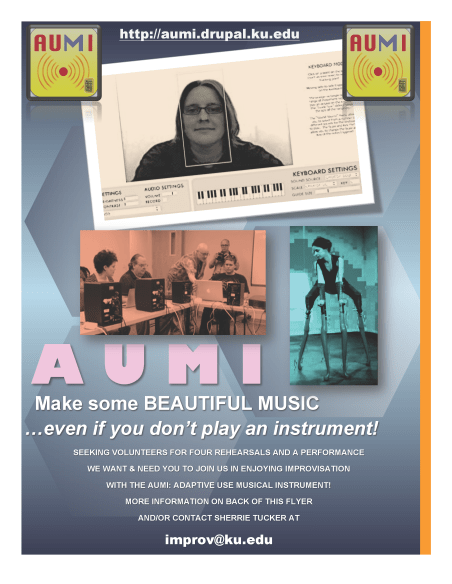
In his work on the AUMI, KU alumni and sound studies scholar Pete Williams explains how the wide range of mobility typically encouraged in what he calls “standard practice” across theatre, music, and dance is challenged by the AUMI’s tendency to inspire “smaller” movements from performers. While he sees in this affective/physical shift the opportunity for able-bodied performers to encounter “…an embodied understanding of the experience of someone with limited mobility,” my work here focuses less on the software’s potential for able-bodied performers to empathize with “limited” mobility and more on the atypical forms of social interaction and communication the AUMI seems to evoke in mixed-ability settings. An attempt to frame this technology as a disability simulator not only demarcates a troubling departure from its original, intended use by children with severe physical disabilities, but also constitutes a prioritization of able-bodied curiosity that contradicts what I’ve witnessed during mixed-ability AUMI jam sessions in Lawrence.
Sure, some able-bodied performers may come to describe such an experience of simulated “limited” mobility as meaningful, but how we integrate this dynamic into our analyses of the AUMI matters, through and through. What I aim to imply in my read of this technology is that there is no “limited” mobility to experientially empathize with in the first place. If we hold the AUMI’s early history close, then the AUMI is, first and foremost, designed to facilitate musical access for performers with severe physical disabilities. Its structural schematic and even its response-rate latency and sporadic visual mode of recognition ought to be treated as enabling functions rather than limiting ones. From this position, nothing about the AUMI exists for the recreation of disability for able-bodied performers. It is only from this specific position that the collectively disorienting/reorienting modes of communication enabled by the AUMI among mixed-ability groups may be read as resisting the violent history of labor exploitation, erasure, and appropriation Mills warns us about: that is, when AUMI initiatives, no matter how benevolently universal in their reach, act fundamentally as a strategy for the efficacious and responsible unsettling of ableist binaries.
The way the AUMI latches on to unexpected parts of a performer’s body and the “discrepancies” of its body-to-sound response rate are at the core of what sets this technology apart from many other instruments, but it is not the mechanical features alone that accomplish this. Sure, we can find similar dynamics in electronics of all sorts that are “failing,” in one way or another, to respond with accuracies intended during regular use, or we can emulate similar latencies within most recording software available today. But what I contend sets the AUMI apart goes beyond its clever camera-based visual tracking system and the sheer presence of said “incoherencies” in visual recognition and response rate.
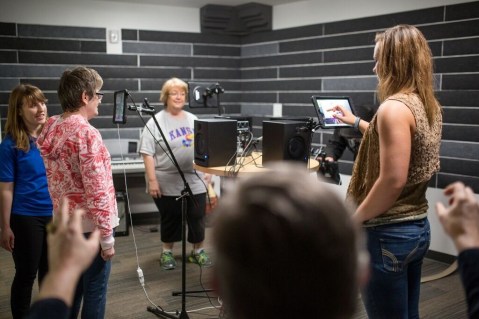
Image by Ray Mizumura-Pence at The Commons, Spooner Hall, KU, at rehearsals for “(Un)Rolling the Boulder: Improvising New Communities” performance in October 2013.
What makes the AUMI a unique improvisational instrument is the tradition currently being co-created around its mechanisms in the Lawrence area, and the way these practices disrupt the borders between able-bodied and disabled musical production, participation, and communication. The most important component of our Lawrence-area AUMI culture is how facilitators engage the instrument’s “discrepancies” as regular functions of the technology and as mechanical dynamics worthy of celebration. At every AUMI library jam session I have participated in, not once have I heard Tucker or other facilitators make announcements about a future “fix” for these functions. Rather, I have witnessed an embrace of these features as intentionally integrated aspects of the AUMI. It comes as no surprise, then, that a “Battle of the Bands” event was organized as a way of leaning even further into what makes the AUMI more than a radically accessible musical instrument––that is, its relationship to orientation.
Perhaps it was the competitive framing of the event––we offered small prizes to every participating band––or the diversity among that day’s participants, or even the numerous times some of the performers had previously used this technology, but our event evoked a deliberate and collaborative improvisational method unfold in preparation for the performances. An ensemble mentality began to congeal even before performers entered the studio space, when Tucker first encouraged performers to choose their own fellow band members and come up with a working band name. The two newly-formed bands––Jayhawk Band and The Human Pianos––took turns, laying down collaboratively premeditated improvisations with composition (and perhaps even prizes) in mind. iPad AUMIs were installed in a circle on stands, with studio monitor headphones available for each performer.
Jayhawk Band’s eponymous improvisation “Jayhawks,” which brings together stylized steel drums, synthesizers, an 80’s-sounding floor tom, and a plucked woodblock sound, exemplifies this collaborative sensory ethos, unique in the seemingly discontinuous melding of its various sections and the play between its mercurial tessellations and amalgamations:
In “Jayhawks,” the floor tom riffs are set along a rhythmic trajectory defiant of any recognizable time signature, and the player switches suddenly to a wood block/plucking instrument mid-song (00:49). The composition’s lower-pitched instrument, sounding a bit like an electronic bass clarinet, opens the piece and, starting at 00:11, repeats a melodically ascending progression also uninhibited by the temporal strictures of time signature. In fact, all the melodic layers in “Jayhawk,” demonstrate a kind of temporally “unhinged” ensemble dynamic present in most of the library jam sessions that I’ve witnessed. Yet unexpected moves and elements ultimately cohere for jam session performers, such as Jayhawk Band’s members, because certain general directions were agreed upon prior to hitting “record,” whether this entails sound bank selections or compositional structure. All that to say that collective formalities are certainly at play here, despite the song’s fluid temporal/melodic nuances suggesting otherwise.
Five months after the battle of the bands, The Human Pianos and Jayhawk Band reunited at the library for a jam session. This time, performers were given the opportunity to prepare their individual iPad setup prior to entering the studio space. These customized setup selections were then transferred to the iPads inside the studio, where the new supergroup recorded their notoriously polyrhythmic, interspecies, sax-riddled composition “Animal Parade”:
As heard throughout the fascinating and unexpected moments of “Animal Parade,” the AUMI’s sensitivity can be adjusted for even the most minimal physical exertion and its sound bank variety spans from orchestral instruments, animal sounds, synthesizers, to various percussive instruments, dynamic adjustments, and even prefabricated loops. Yet, no matter how familiar a traditionally trained (and often able-bodied) musician may be with their sound selection, the concepts of rhythmic precision and musical proficiency––as they are understood within dominant understandings of time and consistency––are thoroughly scrambled by the visual tracking system’s sporadic mode of recognition and its inherent latency. As described above, it is structurally guaranteed that the AUMI’s red dot will not remain in its original place during a performance, but instead, latch onto unexpected parts of the body.
Simultaneously, the dot-to-movement response rate is not immediate. My own involvement with “the unexpected” in communal musical production and performance moulds my interpretation of what is socially (and politically) at work in both “Jayhawks” and “Animal Parade.” While participating in AUMI jam sessions I could not help but reminisce on similar experiences with the collective management of orientations/disorientations that, while depending on quite different technological structures, produced similar effects regarding performer communication.
Being a researcher steeped in the L.A. area Salsa, Latin Jazz, and Black Gospel scenes meant that I was immediately drawn to the AUMI’s most disorienting-yet-reorienting qualities. In Timba, the form of contemporary Afrocuban music that I most closely studied back in Los Angeles, disorientations and reorientations are the most prized structural moments in any composition. For example, Issac Delgado’s ensemble 1997 performance of “No Me Mires a Los Ojos” (“Don’t Look at Me In the Eyes”)– featuring now-legendary performances by Ivan “Melon” Lewis (keyboard), Alain Pérez (bass), and Andrés Cuayo (timbales)—sonically reveals the tradition’s call to disorient and reorient performers and dancers alike through collaborative improvisations:
Video Filmed by Michael Croy.
“No Me Mires a los Ojos” is riddled with moments of improvisational coalition formed rather immediately and then resolved in a return to the song’s basic structure. For listeners disciplined by Western musical training, the piece may seem to traverse several time signatures, even though it is written entirely in 4/4 time signature. Timba accomplishes an intense, percussively demanding, melodically multifaceted set of improvisations that happen all at once, with the end goal of making people dance, nodding at the principle tradition it draws its elements from: Afrocuban Rumba. Every performer that is not a horn player or a vocalist is articulating patterns specific to their instrument, played in the form of basic rhythms expected at certain sections. These patterns and their variations evolved from similar Rumba drum and bell formats and the improvisational contributions each musician is expected to integrate into their basic pattern too comes from Rumba’s long-standing tradition of formalized improvisation. The formal and the improvisational function as single communicative practice in Timba. Performers recall format from their embodied knowledge of Rumba and other pertinent influences while disrupting, animating, and transforming pre-written compositions with constant layers of improvisation.
What ultimately interests me the most about the formal registers within the improvisational tradition that is Timba, is that these seem to function, on at least one level, as premeditated terms for communal engagement. This kind of communication enables a social set of interactions that, like Jazz, grants every performer the opportunity to improvise at will, insofar as the terms of engagement are seriously considered. As with the AUMI library jam sessions, timba’s disorientations, too, seem to reorient. What is different, though, is how the AUMI’s sound bank acts in tandem with a performer’s own embodied musical knowledge as an extension of the archive available for improvisation. In Timba, the sound bank and knowledge of form are both entirely embodied, with synthesizers being the only exception.
Timba ensembles and their interpretations of traditional and non-Cuban forms, like the AUMI and its sound bank, use reliable and predictable knowledge bases to break with dominant notions of time and its coherence, only to wrangle performers back to whatever terms of communal engagement were previously decided upon. In this sense, I read the AUMI not as a solitary instrument but as a partial orchestration of sorts, with functions that enable not only an accessible musical experience but also social arrangements that rely deeply on a more responsible management of the unexpected. While the Timba ensemble is required to collaboratively instantiate the potential for disorientations, the AUMI provides an effective and generative incorporation of said potential as a default mechanism of instrumentation itself.

Image from “How do you AUMI?” at the Lawrence Public Library
As the AUMI continues on its early trajectory as a free, downloadable software designed to be accessed by performers of mixed abilities, it behooves us to listen deeply to the lessons learned by orchestral traditions older than our own. Timba does not come without its own problems of social inequity––it is often a “boy’s club,” for one––but there is much to learn about how the traditions built around its instruments have managed to centralize the value of unexpected, multilayered, and even complexly simultaneous patterns of communication. There is also something to be said about the necessity of studying the improvisational communication patterns of musical traditions that have not yet been institutionalized or misappropriated within “first world” societies. Timba teaches us that the conga alone will not speak without the support of a community that celebrates difference, the nuances of its organization, and the call to return to difference. It teaches us, in other words, to see the constant need for difference and its reorganization as a singular practice.
The work started with the AUMI’s earliest users in Poughkeepsie, New York and that involving mixed-ability ensembles in Lawrence, Kansas today is connected through the AUMI Consortium’s commitment to a kind of research aimed at listening closely and deeply to the AUMI’s improvisational potential interdisciplinarily and undisciplinarily across various sites. A tech innovation alone will not sustain the work of disrupting the longstanding, rooted forms of ableism ever-present in dominant musical production, performance, and communication, but mixed-ability performer coalitions organized around a radical interrogation of coherence and expectation may have a fighting chance. I hope the technology team never succeeds at working out all of the “discrepancies,” as these are helping us to build traditions that frame the AUMI’s mechanical propensity towards disorientation as the raw core of its democratic potential.
—
Featured Image: by Ray Mizumura-Pence at The Commons, Spooner Hall, KU, at rehearsals for “(Un)Rolling the Boulder: Improvising New Communities” performance in October 2013.
—
Caleb Lázaro Moreno is a doctoral student in the Department of American Studies at the University of Kansas. He was born in Trujillo, Peru and grew up in the Los Angeles area. Lázaro Moreno is currently writing about methodological designs for “the unexpected,” contributing thought and praxis that redistributes agency, narrative development, and social relations within academic research. He is also a multi-instrumentalist, composer, and producer, check out his Soundcloud.
—
REWIND! . . .If you liked this post, you may also dig:
Introduction to Sound, Ability, and Emergence Forum –Airek Beauchamp
Unlearning Black Sound in Black Artistry: Examining the Quiet in Solange’s A Seat At the Table — Kimberly Williams
Experiments in Agent-based Sonic Composition — Andreas Duus Pape
Share this:


Current Top Posts





April 2021

January 2020

November 2019

October 2019

August 2019

April 2014

November 2017

March 2015

December 2017

October 2015
 Sounding Out!
Recent Comments