
Teach Me How To Dougie Like A Mediocre White Man

In the third episode of Twin Peaks: The Return (2017), we meet Dougie Jones, a new character who is, as an otherworldly being will tell him, “manufactured.” Dougie’s sonic presence on the show is primarily marked by repetition, as the majority of his dialogue involves him parroting those around him. Though Dougie has been received as a symbol of purity or a magical conduit for others’ best selves (14:53-19:00), a close listen to his repetitions suggests that he is instead what Sarah Hagi has dubbed the “mediocre white man.”
DAILY PRAYER TO COMBAT IMPOSTOR SYNDROME: God give me the confidence of a mediocre white dude
— Sarah Hagi (@geekylonglegs) January 21, 2015
Hagi’s so-called prayer is a brilliantly concise instance of intersectional analysis that can also provide a framework for understanding Dougie Jones. In a few short words, she’s able to 1) demonstrate how white supremacist patriarchy makes her life more difficult, 2) call into question the achievements of those who hold so much power that it’s doled out to the most mediocre among them, and 3) situate the entire critique in a systemic framework. That is, though one possible reading of this tweet is that Hagi suffers from a shortcoming she is responsible to correct–a lack of confidence–the fact that she frames her critique as a prayer suggests that this confidence isn’t so much an inner belief in oneself as it is a privilege granted to some but not others. Twin Peaks: The Return offers, in the vocal interactions of Dougie, an extended meditation on the systemic mechanizations that produce the kind of mediocre white man Hagi laments.
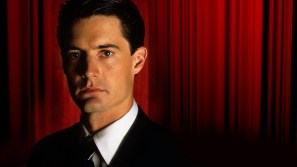
“Twin Peaks Returns to Television in 2016” by Flickr user BagoGames, CC BY 2.0.
For readers who aren’t Twin Peaks viewers, hang on: explaining the origin of Dougie Jones requires a few sentences that may read as something bordering on nonsense outside the show’s bizarre universe. Dougie is played by Kyle MacLachlan, who also plays the show’s main character, Agent Dale Cooper, as well as The Return’s Mr C, Cooper’s evil doppelganger who overcame Cooper in an extradimensional realm in the Season 2 finale and who has been living in the “real world” ever since, while Cooper is stuck in another dimension. The show implies that Mr C has only 25 years–roughly the amount of time since the show’s first run in the early 90s–before Cooper switches places with him (extradimensional bureaucracies, amiright?). As a ploy to stay in the real world, Mr C “manufactures” Dougie Jones so that when Cooper is finally released from extradimensional detention, he replaces Dougie, not Mr C. For the bulk of The Return, Mr C continues wreaking havoc across the Midwest and Western US, while Cooper, adversely affected by his transit across dimensions, is trapped in Dougie’s life, barely able to function beyond the level of a small child. Technically, then, the character called Dougie Jones is really Dale Cooper, but Cooper’s episodes-long inability to regain control of himself leads to an extended case of mistaken identity, where everyone in Dougie’s life believes Cooper to be Dougie.
Significantly, Dougie’s family and co-workers are barely phased by his ineptitude. At worst, like when he doesn’t know how to use the bathroom, people are annoyed by Dougie. But, more often than not, Dougie’s moments of silence and often erratic behavior — including befuddlement over how to feed or dress himself — are interpreted as quirky, humble, and endearing. More than that, Dougie’s boss believes him to be a courageous and principled whistle-blower whose cryptic drawings on insurance forms outs one of his co-workers for defrauding the company’s clients.

Screenshot of Twin Peaks: The Return
Dougie is beyond mediocre, yet over the course of the season, he falls into hundreds of thousands of dollars, a luxury car, a family life that seems to be fulfilling for his wife and son, and the respect and gratitude of his boss. Confidence isn’t something this mediocre white man possesses; rather, it’s a trait projected onto him by everyone around him. In riffing on the way people exist in systems of inequity, Sylvia Wynter notes in On Being Human As Praxis (2015) that we end up keeping “the reality of our own agency opaque by attributing that agency to extrahumanly mandating entities” (45). Put another way, the god who would grant us the confidence of a mediocre white man isn’t a deity but a system of patriarchal white supremacy that makes itself opaque behind the rationale that a person like, say, Dougie Jones couldn’t possibly be as successful in his life if he hadn’t earned it.
The primary marker of the mechanization of Dougie’s confidence is a sonic one: we can hear his ascendence in moments of repetition. Twin Peaks is a show comprised of overlapping aural and visual loops, recurring sounds, and doubled and tripled characters, so keying in on the sound of Dougie’s repetition fits into the series’ aesthetic. Early in Dougie’s presence in the series, when Cooper is fresh from the other dimension, his repetition is delayed, partial, and generally out of synch with regular patterns of conversation; people react to this repetition with concern. The following scene occurs in the moments just after Cooper has replaced Dougie Jones; his scene partner, Jade, was in the shower when the switch happened.
This clip is cut so that the phrase “Jade give two rides” happens back-to-back, but in the episode, there’s over a minute of a screen time between Jade saying (a grammatically correct version of) it and Dougie repeating it. Dougie’s imprecise and ill-timed repetition suggests to Jade that something may be wrong with him, and she rightly advises him to find some help. A similar interaction occurs in Episode 6, which opens with Dougie standing outside his work at night, unaware of what people do when work is over. When a police officer tries to shoo him away, Dougie is able to repeat back information he had heard several days earlier, and his delayed reaction again elicits concern from the person he’s with. A few scenes later, “Jade gives two rides” returns.
As the season progresses, however, Dougie begins to repeat back exact phrases or words that have just been spoken to him. The effect is one of understated agreement or even prescience, as if he’s repeating something he’s known for some time and has been waiting for others to realize, too. Note the way Dougie responds in the following two videos. In the first, he’s asked a question, which rises in pitch in the final syllables, and Dougie repeats the phrase with a falling pitch figure, which his conversants interpret to be confirmation. In the second, he’s given advice, and he responds by repeating the last word in uptalk, which his conversants interpret as a hilarious joke rather than the limitations of a person whose interdimensional travel has left his verbal skills lacking.
As Dougie’s repetition locks into a quicker, more immediate responsorial pattern, the people around him no longer worry about his well-being and, in fact, begin to project onto him a confidence he’s incapable of possessing. This repetition, the kind that immediately plays with or confirms what his boss or potential murderers say, suggests a couple different theoretical constructions of repetition. Butler, in describing the performativity of gender, notes that gender norms are “the stylized acts of repetition through time,” the rehearsed and rehashed ideas that we ascribe, in this case, to white men: well-timed humor on the one hand, and wise confirmation on the other (520). Sara Ahmed underscores a similar idea, noting that “compulsory heterosexuality” is “the accumulative effect of the repetition of the narrative of heterosexuality as an ideal coupling” (145). Here, Dougie’s white masculinity isn’t all that makes him the target of others’ projections of confidence and competence; his nuclear family also marks him as a productively repetitive person, a person capable of reproduction. To modify Hagi’s tweet a bit, the world projects onto Dougie the confidence of a mediocre, white, reproductive man.
Both Butler and Ahmed also gesture toward distinctly sonic phenomena present in Dougie’s repetitions. Repetition accumulating over time becomes not just distinct events happening in succession but a discrete, singular thing unto itself. When thinking in terms of systemic oppression like white supremacy or cisheteropatriarchy, the repetitive privileging of white masculinity congeals into a continuous power flow. In musical terms, we hear the accumulative, rapid retriggering of a sound as pitch rather than many distinct events. Timing matters here: if the repetition is delayed or metered just so, we can perceive instances of the same events as moving in concert either melodically or harmonically. The shift in Dougie’s repetitions over the course of The Return is the sound of institutional privilege tuning white masculinity, retriggering moments of repetition–which sounds like a rise in pitch as the repetitions move closer together, a literal ascent–until those around Dougie stop worrying about him and start believing that this mediocre white straight man must have earned the success he seemingly enjoys.
Though a perusal of Twin Peaks: The Return analyses and recaps demonstrates that viewers and critics have been far more interested in the archetypal Jekyll/Hyde duality of Dale Cooper and Mr C than they have been in the nature of Dougie Jones, Dougie’s relative lack of drive or desire offers the opportunity to hear how white male mediocrity is made. The Return checks in on Dougie regularly from his introduction in the third episode until he transforms back into Cooper, then is remanufactured and sent home to his family in the sixteenth and eighteenth episodes. What we’re privy to in that time is a different kind of manufacturing, where Dougie is constructed by his surroundings to be wise, caring, attentive, upright, and brave, though we know he’s none of those things. The slow burn of Twin Peaks: The Return means that we’re stripped of any easy excuses for Dougie’s upward momentum in the season beyond the obvious explanation that the gods of mediocre white men have gifted him with treasures out of reach for others. Dougie repeats what he hears, and what he hears is that his mediocrity is good enough.
—
Featured image: Screenshot from “‘Dougie’ Cooper – All Phrases (Twin Peaks Compilation)” by Youtube user AKA.
—
Justin Adams Burton is Assistant Professor of Music at Rider University. His research revolves around critical race and gender theory in hip hop and pop, and his book, Posthuman Rap, is available now. He is also co-editing the forthcoming (2018) Oxford Handbook of Hip Hop Music Studies. You can catch him at justindburton.com and on Twitter @j_adams_burton. His favorite rapper is one or two of the Fat Boys.
—

REWIND! . . .If you liked this post, you may also dig:
DIANE… The Personal Voice Recorder in Twin Peaks-Tom McEnaney
Malcolm Gladwell’s Bad Aesthetics–Justin Burton
Listening to Sounds in Post-Feminist Pop Music-Robin James
Share this:

becoming a sound artist: analytic and creative perspectives

Recently, in a Harvard graduate seminar with visiting composer-scholar George Lewis, the eminent professor asked me pointedly if I considered myself a “sound artist.” Finding myself put on the spot in a room mostly populated with white male colleagues who were New Music composers, I paused and wondered whether I had the right to identify that way. Despite having exploded many conventions through my precarious membership in New York’s improvised/creative music scene, and through my shift from identifying as a “mrudangam artist” to calling myself an “improviser,” and even, begrudgingly, a “composer” — somehow “sound artist” seemed a bit far-fetched. As I sat in the seminar, buckling under the pressure of how my colleagues probably defined sound art, Prof. Lewis gently urged me to ask: How would it change things if I did call myself a sound artist? Rather than imposing the limitations of sound art as a genre, he was inviting me to reframe my existing aesthetic intentions, assumptions, and practices by focusing on sound.
Sound art and its offshoots have their own unspoken codes and politics of membership, which is partly what Prof. Lewis was trying to expose in that teaching moment. However, for now I’ll leave aside these pragmatic obstacles — while remaining keenly aware that the question of who gets to be a sound artist is not too distant from the question of who gets to be an artist, and what counts as art. For my own analytic and creative curiosity, I would like to strip sound art down to its fundamentals: an offering of resonance or vibration, in the context of a community that might find something familiar, of aesthetic value, or socially cohesive, in the gestures and sonorities presented.
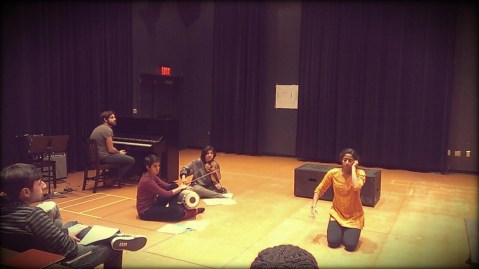
Rehearsing for “Meena’s Dream” (2013) by playwright Anu Yadav – original score by Rajna and Anjna Swaminathan and Sam McCormally.
I have spent most of my musical life wondering how the sounds I produce intersect with specific vectors of social belonging. The sounds emanating from my primary instrument — the mrudangam, a South Indian drum — are situated within a complex lattice of social difference, resonating within and across communities as disparate as the predominantly privileged-caste audiences of Chennai’s elite Karnatik sabha-s and the cosmopolitan connoisseurs who show up to find a home in New York City’s myriad intercultural and experimental music spaces. The sounds I produce are also inflected by the multivalent referentiality of my own socially situated body — as a queer, privileged-caste, Indian-American woman — simultaneously slicing through and answering to sonic environments organized around particular notions of rigor, virtuosity, and beauty.
For me, what began as a creative path rooted in the mimesis of an artistic lineage eventually settled in a versatile expressive voice, shaped by a decade of aesthetic (and ethical) nomadism. From my vantage point as a female percussionist in the South Asian diaspora, I have always been aware of the cracks in the veneer of tradition and other normative structures, and perhaps this fueled my musical vagrancy. Over time, my sound has accumulated the resonances of Karnatik music, ‘jazz’ drumming, bharatanatyam footwork, and Afro-Cuban rhythms, among others.

The author performing with Vijay Iyer, Graham Haynes, and Marcus Gilmore. The Stone, NYC. July 2013.
Certainly, this convergence of sonic layers is mediated by the rich specificity of interpersonal relationships and positionalities within larger networks. Power and positionality mediate the shape, audibility, and versatility of sounds as they become coupled with the implied (or actual) encounter of socially situated bodies. Yet, sounds somehow continue to exist in excess of the mechanisms and bodies that attempt to explain, produce, and contain them: idiom, tradition, space, culture, nation, race, gender, and sexuality. Therein lies their potency and mystery, and I intend to briefly explore the sensation of sonic excess in the hopes of honing a more sensitive analytic and creative perspective.
I am yet to become comfortable thinking in terms of sound, due to the longtime privileging of structure and technique in my musical upbringing. However, this is beginning to unravel as I am forced to deal with sound, particularly the sound of what Patrice Pavis and Jason Stanyek have called the “intercorporeal” aspect of intercultural performance. The predominantly improvised sounds that resonate through my mrudangam often emerge on the edge of my dynamic embodied consciousness, arranging themselves chaotically in real-time, interacting with others’ emergent soundings and sensory yearnings. Some of it may be mediated by parallel perceptual and idiomatic forms, but achieving a core interactive flow involves a fundamental immersion in sound.
Mat Maneri, feat. Rajna and Anjna Swaminathan
Tongues Series, curated by Amirtha Kidambi
ISSUE Project Room — June 18, 2016
For instance, take this impromptu piece presented by violist Mat Maneri, violinist Anjna Swaminathan (my sister), and me in 2016. It took place in the wonderfully resonant vaulted space of ISSUE Project Room, in front of an unsuspecting audience that had convened to hear the back-to-back juxtaposition of two improvisational “tongues” — a set of Maneri’s rich microtonal experiments, followed by a Karnatik concert of voice, violin, and mrudangam. However, this impromptu ludic exchange of sonic offerings — particularly Maneri’s incredible, chameleon-like ability to confound the sounds of Karnatik ornamentations with his own microtonal reflections — guided attention away from comparison and toward the sounds as they bounced eerily around the resonant architecture. Faced with the technically daunting Karnatik repertoire that Anjna and I were to play subsequently with vocalist Ashvin Bhogendra, the echoes of our interstitial collaboration allowed us to reorient ourselves and breathe a little easier.
From an analytic perspective, it is irresponsible to distill these sounds, to capture and conceptualize them as distinct from the bodies, histories, and discourses that participate in their co-creation and interpretation. Yet, riddled as they are with generations of power asymmetries and complex emotions, it is clear that these resonances have a secret life of their own. As musicians, we are not often given the opportunity to explore these clandestine, almost Baudelairean, correspondences, except perhaps when we discover them by accident. For instance, sonic ambiguities like those spun during the trio encounter play on sonic excess to spur new ways of listening and relating, with a direct ethical impact on the ensuing music.

Performing in Vijay Iyer’s large ensemble project, “Open City,” named after Teju Cole’s award-winning novel. October 2013.
John Blacking’s definition of all music as “humanly organized sound” is perhaps an early articulation of this idea, although the word ‘organized’ contains a bias toward formal structure and stability. To be sure, organizing principles always exist at the local level of socially situated perception and expression, which Nina Sun Eidsheim calls the ‘figure of sound.’ However, the kind of sound art I’m proposing revels in excess, or as Eidsheim puts it — “not only aurality, but also tactile, spatial, physical, material, and vibrational sensations [that] are at the core of all music” (5). We can even turn to how Jacques Attali poetically describes composition — as “a labor on sounds, without a grammar, without a directing thought, a pretext for festival, in search of thoughts,” a practice wherein “rhythms and sounds are the supreme mode of relation between bodies once the screens of the symbolic, usage and exchange are shattered,” one that neither marks nor produces the body, but allows for “taking pleasure in it” (143). By focusing on the multi-sensory, pleasurable valences of sound, and on the ways in which sonic excess allows for new patterns of coexistence, we can outline a ‘sound art’ practice and analytic that aren’t circumscribed by Western institutional definitions and technological/perceptual biases.
Thinking in this way about sound and vibration helps to eradicate the mind-body problem that continues to plague certain areas of music studies and music making. Sound forms an elusive common denominator that doesn’t rely heavily on colonial taxonomies of form or hierarchical theories of art. It even accounts for the subversive or incommensurable resonances that tend to emerge at the unstable threshold between so-called ‘producers’ and ‘receivers’ of music. After all, sound is in the ear of the beholder, and social asymmetries are embedded in the way we hear and listen. Through the notion of vibration, we are further attuned to the visceral space in which it reverberates, and the ways in which its echoes live on in the bodies of those who experience it.

performing at the Banff International Workshop for Jazz and Creative Music. June 2013. Photo credit: Don Lee, Image courtesy of author
Finally, there is the other definition of sound in English, which indicates a level of trust and holism. Taking this path to becoming ‘sound artist’ focuses attention on the artist. I don’t intend to focus on the ‘chops’ conventional to a field of aesthetic practice. Rather, I am interested in the more obscure meaning: a ‘sound artist’ as one that ethically occupies space as an artist.
How might this emerging sound art, as analytic and creative practice, work to interrogate the very ethics and politics of art, while succumbing to the contingency and volatile excess of sound? I don’t claim to hold the answers, but if we are in any way sounding out against the grain of dominant modalities, then at some level we must attend seriously to sound: in its excess, as it overwhelms bodies and spaces, and as it stretches the realm of the known.
—
Featured Image: “The great Rajna Swaminathan,” from Teju Cole tweet, 5 October 2013.
—
Rajna Swaminathan is an accomplished mrudangam (South Indian percussion) artist, a protégé of mrudangam legend Umayalpuram K. Sivaraman. She has performed with several renowned Indian classical musicians, most notably mentor and vocalist T.M. Krishna. Since 2011, she has been studying and collaborating with eminent musicians in New York’s jazz and creative music scene, including Vijay Iyer, Steve Coleman, Miles Okazaki, and Amir ElSaffar. Since 2013, Swaminathan has led the ensemble RAJAS, which explores new textural and improvisational horizons at the nexus of multiple musical perspectives. Swaminathan is active as a composer-performer for dance and theatre works, most notably touring with the acclaimed company Ragamala Dance and collaborating with playwright/actress Anu Yadav. Swaminathan holds degrees in anthropology and French from the University of Maryland, College Park, and is currently pursuing a PhD in cross-disciplinary music studies at Harvard University.
—
REWIND! . . .If you liked this post, you may also dig:
Sounding Out Tarima Temporalities: Decolonial Feminista Dance Disruption–Iris C. Viveros Avendaño
Gendered Soundscapes of India, an Introduction –Praseeda Gopinath and Monika Mehta
Tape Hiss, Compression, and the Stubborn Materiality of Sonic Diaspora–Chris Chien
“This Liquid Dream”: An Interview with Aquaphoneia Composer Navid Navab–Eshter Bourdages
Share this:


Current Top Posts





April 2021

January 2020

November 2019

October 2019

August 2019

April 2014

November 2017

March 2015

December 2017

October 2015
 Sounding Out!
Recent Comments