
“A Sinister Resonance”: Joseph Conrad’s Malay Ear and Auditory Cultural Studies

 Welcome to the first part of Sonic Shadows, a new SO! series featuring essays drawn from a recent symposium on the question “what does it mean to have a voice” held last April at The New School, and featuring organizers Dominic Pettman, Pooja Rangan and Julie Beth Napolin, as well as invitees Mara Mills (NYU), Gustavus Stadler (Haverford), Rey Chow (Duke), and James Steintrager (UC Irvine). I am happy to serve as Guest Editor, bringing some work developed for, during and after that event, beginning with my own article below.
Participants in “Sonic Shadows” focused on the voice’s shadowy or coded qualities as it stands on the border of the animal, human, and machine. Our motivating question was one shared by literary studies (authorship, the voice of writing, narration), technology studies (recording, storing, and transmitting voices), and media studies, particularly documentary studies (giving voice and objectivity). This question of having a voice, among the oldest questions of philosophy and literature, is also at the intersection of musicality, ontology, epistemology, phenomenology, psychoanalysis and history. Our discussions aimed to carve out a new trajectory for voice studies today, and in this series for Sounding Out! our authors will begin to lay out where that trajectory might lead.
— Guest Editor Julie Beth Napolin
—
As readers of this blog are well aware, historically, sound has been the “other” to more ensconced objects of music and voice. Brian Kane’s Sound Unseen has recently urged for an auditory cultural studies that might move us away from a reified category of sound: “Although it seems a truism to even say it, music studies is a species of sound studies and auditory culture” (226). By this same token, “voice” does not merely become “sound” at its limit, when words fray or dissolve, but rather begins that way. More importantly, auditory cultural studies would (and does) revolve around modes of listening, which are necessarily grounded in questions—and the always open question—of difference and the social. With that in mind, this article argues for the central role of the novel—and the voice in and of the novel—in an auditory cultural studies.
Poetry has enjoyed a longstanding dialogue around sonorousness, while the novel seems more immune to questions of the auditory. In “The Storyteller,” Walter Benjamin called the novel “the birthplace of the solitary individual,” meaning that writing and reading happen in silence, without a listening other. We don’t “listen” to the novel in the same way we might listen to poetry, which often demands that we read it aloud. But if the novel is, in its most basic sense, a combination of description and dialogue, then the human speaking voice—and how to represent it—is central to its definition, as well as how to represent sounds in the world. William Faulkner describes “the Chuck. Chuck. Chuck.” of an adze in As I Lay Dying, and novelists like Zora Neale Hurston wrote in an “eye-dialect” that would try to approximate for the eye the sounds of African American vernacular voice, as did Charles Dickens with English vernacular—each of these practices tell us about the unstable relationship between writing and listening. The novel has always been haunted by this gap, and it tells us important things about what we think it means to communicate across distance.
“2015-03-18 adrift” by Flickr user Robert Couse-Baker, CC BY 2.0
The modernist novel in particular is a fecund territory for modes of listening, and such works as Mark Goble’s Beautiful Circuits have shown to what extent auditory practices shaped by technology had conditioned writing practices and its imaginary in the long 20th century. But the question of “having a voice,” still lingers, even after Friedrich Kittler has shown to what extent the writer felt robbed of and haunted by voice in the wake of the invention of the gramophone in the late 19th century. Was the experience of voice in “modernity” only its disembodiment? And doesn’t the emphasis upon disembodiment obscure the place of the body in the signifying social practices of auditory culture? Is reading a wholly disembodied or silent experience?
In a recent essay on Joseph Conrad, I addressed these questions, pointing out that the history of the novel, as a “silent” genre, feels quite different if we begin with Conrad’s physical voice as mediated by his vexed relationship to the English language. He had spent his childhood in exile in Russia and his adult life as a merchant marine, steeped in colonial locations. Conrad would only ever write fiction in English, his third language after Polish and French, and he learned English by overhearing it aboard ships, never shedding a foreign accent he once described as “gibberish.” His sentiment in a letter to confidant, “l’ Anglais m’est toujours une langue etrangère,” registers a double displacement from a home in written and spoken language.
Conrad once wrote that the “power of sound has always been greater than the power of sense.” Often in his novels, characters hear when they cannot see, and “action,” is reduced to characters’ listening to distant sounds—like the drumming that comes from the jungle in Heart of Darkness. Dialogue is rarely a simple matter of transcribing words on the page. He tried to represent the fact that people often mishear each other or stutter and shout in the midst of noise—those representations changed what was possible for “dialogue” in the process. I’m reminded here of how in several of Jean Luc Godard’s films, viewers can’t hear what characters are saying because the noise in a café is too loud, or a train passes by at a crucial moment. These issues of communication in the novel are especially important for auditory cultural studies to ponder—the inner voice of writing and reading, the voice that is supposed to make the most immediate sense to a person, is suddenly hijacked by sounds.

“Joseph Conrad” by Flickr user Dan Strange, CC BY-NC-ND 2.0
Conrad would never speak English without a sense of shame, his own wife often couldn’t understand him, and his prose is marked by oddities that reveal thinking in one language while writing in another. In The Secret Agent, Steven G. Kellman briefly notes, Conrad writes the phrase “pulled up violently the venetian blind,” an error in word order that carries what Kellman calls “the traces of incomplete translingualism” (11). I’m also thinking of the unidiomatic word “moonshine” in the opening paragraphs of Heart of Darkness. Moments like this are important because they betray the extent to which Conrad was “passing” in his voice as an English writer.
Heart of Darkness is nothing if not a series of voices and sounds. It begins with an English merchant ship waiting for the turn of the tide and to dock in London. To pass the time, Marlow, a sailor aboard ship, tells an extended story of a previous journey along the Congo River (as reported by Marlow’s anonymous listener in the present). This story is rife with misheard voices and distant sounds. Chinua Achebe seminally attacked Conrad’s racism in his representation of African people as being without voice, as only making noise and speaking broken English. But this reading is complicated by Conrad’s own struggle with English. We have to hear “behind” or “through” his claim to speaking as an Englishman via the voice of Marlow. Conrad also crafted scenes were Englishmen have to confront being baffled by difference—they have to sit and listen, and confess they don’t understand the meanings of sounds.
The development of Marlow, Conrad’s recurring English avatar, was tied up in the desire for an idealized English voice. His relationship to English continually mediated his ambivalent feelings about the act of writing, his place in English literary society, and what it meant to speak—physically and symbolically—as a naturalized citizen. These ambivalences, I describe, all collide in the moment of Conrad’s first encounter with the x-ray and the phonograph in 1898 when he will discover that “all matter” is simply waves and vibrations. Though Conrad is most remembered for writing that the task of the novel is “to make you see”, auditory cultural studies would do well to remember that with Heart of Darkness, Conrad felt he had struck upon a novel with “a sinister resonance, a tonality of its own, a continued vibration that, I hoped, would hang in the air and dwell on the ear long after the last note had been struck.”

“Heart of darkness” by Flickr user Egui, CC BY-NC 2.0
Heart of Darkness is preoccupied with what I call the “vibrational monad,” as a theory of the continuity of all things and actions. Vibration—as action at a distance—allowed Conrad to imagine the novel as a material force overcoming of national and linguistic difference. As a sound-effect that reached others without speech, vibration for Conrad dissolved the difficulties of embodied communication. The drumming of the Congo is one such resonance, but so are moments like “moonshine.” These resonances remain “sinister,” though, because communication is not absolute or guaranteed. Conrad also wanted his readers to experience an emotional pall of the horrors of colonialism, communicated best not in words or “sense” but by the way obscure sounds and nonsense linger and haunt the reader’s inner ear after putting down the novel.
In my essay, I do not distinguish greatly between vibration and resonance in their material differences. In Conrad’s imaginary these forces are intertwined, and that intertwining—in the nature of the literary in its turn of phrases—marks a place for literature in auditory cultural studies. It is difficult to distinguish these tropes in his writing partly because they pose an emotional and physical tie; both link body to body. Historically, electronic technologies of vibration involve a colonizing impulse to conquer space and time. But in Conrad, vibration remains uncertain and ambiguous in that it often reverses its course to become its opposite and separate bodies as a means of distance and difference.
In his early fictions, vibration and resonance register translingual fault lines, reminding us that Conrad’s acquisition of voice was an embodied process, an uneven and ongoing one. Conrad begins his first novel Almayer’s Folly with a vocal fragment, a shout in two languages, neither of them English. These two words would have appeared strange and completely unfamiliar to his readers in England: “Kaspar, makan!” As we only later learn, this unidentified shout to Kaspar Almayer, a Dutch trader, has been issued by his Sulu wife who calls him to dinner.
“Joseph Conrad drawing and books” by Flickr user Ben Sutherland, CC BY 2.0
What does Conrad’s Malay voice mean for the definition of Anglophone modernism (from James Joyce to Jean Rhys) and what “other” voices and sounds define it from within? It is significant that Conrad’s 1895 romance does not begin with any description of characters or even the world. In this Victorian moment, a reader would expect fiction to begin with some sort of utterance in close proximity to authorial speech, as a voice-over (in the first or third person) that overlays the world of the novel. This voice tells us who we are about to meet and where, grants access. This shout is a puzzling beginning for a writer who would worry so much about reaching his readers. We—readers in English—don’t know what this voice is saying. No reader knows where this voice is coming from, who is shouting, and where. It won’t be translated for several pages, and then only indirectly. Again, Conrad hijacks the inner voice of reading to trouble English self-certainty.
That reminds me of the critique of voice-over and translation in the writings and films of Trinh T. Minh-ha, who often forces her viewers to confront languages they cannot understand and to sit with that non-understanding. Conrad gives up that authorial impulse; he drops its armature to become another voice—of a woman and colonized subject captured and brokered—as the opening gesture of his fiction. He speaks in her voice—rather than for her—and lets it take over what should be the first, authorial utterance. The shout carries an unspoken agony of colonization. She was, we later learn, kidnapped by Captain Lingard in the seizure of her village, and while he will call her “daughter,” she must endure his nightly visits, only to be passed to Almayer along with the failed promise of material wealth. His “folly” is inherent to the colonial rage for identity. This first authorial utterance is marred by the audible specter of sexual violence in colonialism.
What does this specter mean for the place of the novel in auditory cultural studies? Conrad destabilizes the white reader’s claim to “encountering” a world at a distance through the inner voice, a voice that is supposedly spontaneous, close and natural. The novel is also a technology of voices, but in this case, rather than bringing the other close, these vocal fragments mark an important place for distance. Conrad wrote Almayer’s Folly during his last journey as a merchant marine. Remarkably, one of few drafts of a letter home from that trip in Polish survives on a verso page of the manuscript. That material manuscript is too a space of difference—voices within voices, languages within languages, voices recorded but also obscured. The “sinister resonance” is one name for this founding disparity in the novel as an act of communication.
—
Julie Beth Napolin is Assistant Professor of Literary Studies at The New School, a musician, and radio producer. She received a PhD in Rhetoric from the University of California, Berkeley. Her work participates in the fields of sound studies, literary modernism and aesthetic philosophy, asking what practices and philosophies of listening can tell us about the novel as form. She served as Associate Editor of Digital Yoknapatawpha and is writing a book manuscript on listening, race, and memory in the works of Conrad, Du Bois, and Faulkner titled The Fact of Resonance. Her work has appeared in qui parle, Fifty Years After Faulkner (ed. Jay Watson and Ann Abadie), and Vibratory Modernism (ed. Shelley Trower and Anthony Enns).
—
Featured image: “Joseph Conrad” by Flickr user Phoca2004, CC BY-NC-ND 2.0
—
 REWIND! . . .If you liked this post, you may also dig:
Hello, Americans: Orson Welles, Latin America, and the Sounds of the “Good Neighbor” — Tom McEnaney
This Is How You Listen: Reading Critically Junot Díaz’s Audiobook — Liana M. Silva
How Svengali Lost His Jewish Accent — Gayle Wald
Share this:

SO! Reads: Daniela Cascella’s F.M.R.L. (Finding Materials for Remembering and Listening)


***
Before I read F.M.R.L., I didn’t know Daniela Cascella or her work. I hadn’t read her first book or her blog or her Tweets; I hadn’t seen any exhibits she had curated or attended a reading. Instead, the words in her book introduced us.
Here’s how she was introduced, here in this exploration of how sound and writing intertwine:
- A wanderer, traveling the globe to meet friends, attend conferences, read books (and more books, and more books)
- An archivist, saving physical and digital boxes of sounds and words and quotes, all blended with her own notes and ideas
- A listener, noticing the sounds of words as much as their meanings
- A cave-explorer, digging ever deeper through layers of earth to find echoes of what has been buried—which is another way to say a wanderer, an archivist, a listener
How odd to meet someone through words alone, not knowing what she sounds like, what she would say if we met.
***

“you know you’re a Mac user when…” by Flickr user Nick Normal, CC BY-NC-ND 2.0
I’ve never told anyone this: I sometimes imagine descendants and friends sifting through my digital archives after I die, meeting me through my words and my collections.
“Collections” is too organized of a word, really. I save files, sometimes in clearly named folders, but just as often not: pdfs, docs, txts, sometimes containing my own words and sometimes others’. On 3.5” floppies, CDs, DVDs, in the cloud. Poems, essays, quotations, scans—I don’t even know what these people from the future might find, how these archives would introduce me to them.
Once, my first year in college, a girl I liked called me to complain about her boyfriend, and her words were so layered with meaning that I opened up a window of Word and started typing her words, verbatim. She was going fast, though, so when I got behind, I just hit enter and kept going. She must have heard the keyboard clicking, but she never said anything.
I haven’t read that file for years, but it must be somewhere in the cave of my collections.
***
 A colleague sees Cascella’s F.M.R.L. on my desk. His face scrunches as he tries to make sense of the letters on the cover.
“It’s a book I’m reviewing,” I offer.
“No, it’s just. . . .” He reads the subtitle. “I thought it was a play on the phrase FML or something.”
I know how he feels. Every time I see the book sitting there, new words and letters come to mind. I eventually heard it as ephemeral, but always after others:
Formerly. Fame, really. Female roll. F my real life. FM Radio, Live!
Here’s what it actually says on the cover: Footnotes, Mirages, Refrains and Leftovers of Writing Sound. When my colleague sees that subtitle, he experiences the tiny pleasure of “getting it,” of seeing what the letters “really” stand for, of feeling like these words now make sense in the way they were supposed to.
But inside the book, you quickly learn that in 1926, Louis Aragon also re-voiced ephemeral as F.M.R.L., but the letters stood for something different to him: frenzy, madness, reverie, love.
Cascella takes it further: the next page lists the other things that F.M.R.L. could stand for: footnotes, false starts, frenzy, and so on, each list of words ending in delightful ellipses, which seem to say, “And what does this F mean to you?”

“The Letter F for Flickr and Friends” by Flickr user Denise Womack-Avila, CC BY-NC 2.0
***
From Cascella’s blog: “The title is ‘F.M.R.L.’: not ‘Ephemeral’. I chose this title because of its ambiguity and because it calls to be sounded. I chose it to draw the attention toward language as material; to stay away from any literal understanding of sound as ephemeral, as if unworthy of attention; and to prompt other departures from and into words and letters.”
***
A note I wrote in the margin: “So much of this book is an explanation of this book.”
Consider:
“I have a habit with listening. It makes me write even when I don’t now [sic?] what to say. . .” (9). Do you hear? she seems to say. I’m writing, and you’re listening in, but I’m not sure what it will mean to you, or to me. That’s how sound works.
“Each cluster of words is not created anew but cast from words that were before, recalled from archival layers. I don’t want to explain them, but rearrange them and hand them over to you before they expire” (118). Do you hear? she continues. Will you listen? Can’t you make meanings without my explanations?
“SOUND: You should not have called me Sound, but told me of the sounds in s-s, addressed me with incoherent stories and undecipherable acoustic traces, signifiers whose sense is uncertain and that yet mean” (2).
That last is from the dialogue that opens the book: SOUND and WRITER are “walking in a circle, anticlockwise and diametrically opposite” as they try to figure each other out. Or, really, as Writer tries to figure out Sound, trying to grasp and understand and explain. Sound seems ok living in the moment, singing.
As I read the rest of the book, I kept remembering that tension between writing and sound. It’s infused in the pages of the book like strong tea.
And I kept thinking of myself, as a writer and teacher of writing who is also a listener and a maker of sounds. I’m dedicated to writing and sounds, both. Maybe Cascella’s solution is the best: to love words, to read and memorize and archive them, but to never stop at what they signify, to always attend to the sounds they suggest as well, the puns of meaning hidden throughout all languages.
***
By writing about this book, I feel I’m writing against some of its core ideas.
Writing about is so descriptive, explaining, clarifying, cleaning up, setting the table for dinner because something important is going to happen soon, so wash your hands. When I write about, I take notes in the margins, but not the kind of notes where I exclaim in wonder or shock, or record my emotional reactions. Instead, when I’m in writing about mode, I jot marginal notes that summarize, explain, organize, keep track of everything.
An example: here’s a list of the page numbers where I noticed Cascella using the word ephemeral:
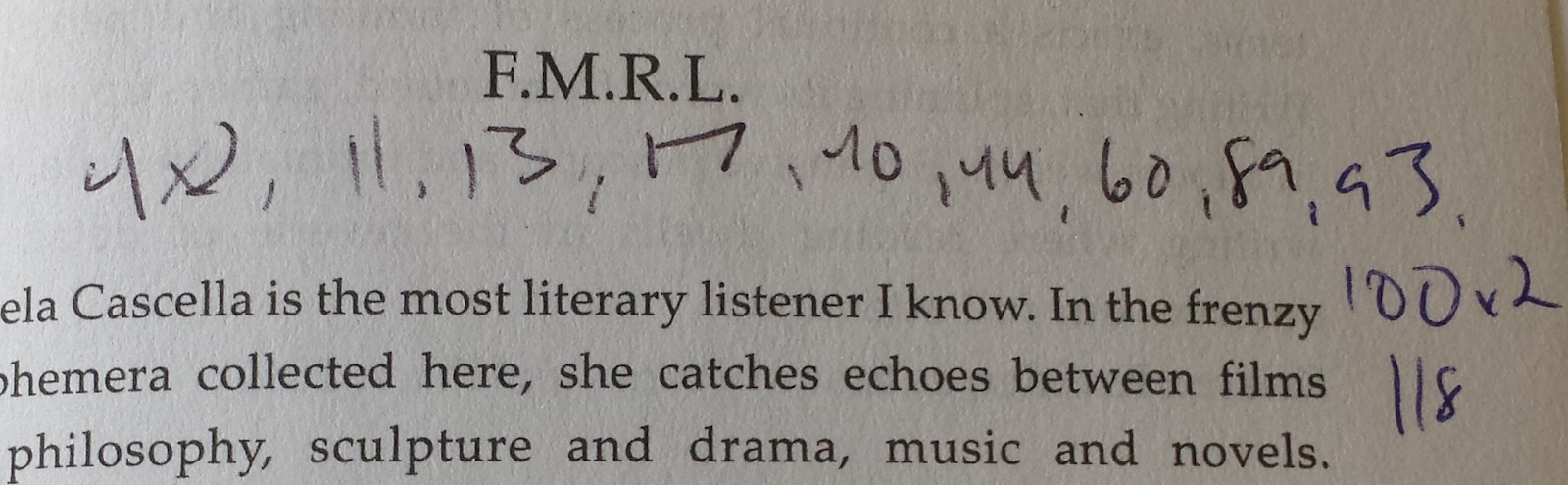
Ah, now I have some ownership over this book. Ah, now I am on my way to understanding it.
This is how I feel when reading/annotating poetry: a little embarrassed when I annotate only to explain and clarify, but pleasantly engaged when I annotate my gut reactions, often written in exclamation points or question marks or stars, doubled or tripled when I really mean it.
***
This is a book that asks to be read all in one sitting, even though that’s impossible.
At least it’s impossible for me. Cascella’s soundings (which seems like a better word than writings) are thick with images and quotations and sudden jumps, which seems to suggest a slow attitude, like reading a poem or two a day instead of powering through an entire book as if it were a long sandwich.
But the echoes (and this is very much a book about echoes, and caverns, and geological layers) threaten to disappear from memory if you wait too long to read the next chapter. My longer reading sessions were always rewarded with subtle connections: a circle, an incantation that I’m sure she mentioned just a few pages back, hold on while I find it.
So maybe the best solution is to read it once quickly, attending to the echoes, and then again slowly, attending to the layers. It’s like watching Twin Peaks, like exploring a museum.

“The Lion Man” by Flickr user storebukkebruse, CC BY 2.0
An example: in the final section of the book, she describes The Lion Man, a 40,000-year old sculpture. “I cannot even figure the meaning of 40,000 years ago,” she writes (113). I pause, look up, and bite the end of my pen. I’ve heard these lines before, I realize. Did I read ahead, when I first got the book in the mail? Or did I read about The Lion Man online somewhere, maybe when Thomas Rickert is discussing the Lascaux paintings in his book Ambient Rhetoric? Was I thinking about it when singing R.E.M.’s “Texarkana” the other day in the shower, how the numbers in that song grow from 20,000 to 30,000 to 40,000?
But then, later, I skim through my marginalia and realize I was wrong: Cascella herself told this story, back on page 14, using the same words.
I’m tempted to explain to you the effect of this verbal echo, from sculpture to exhibit to Cascella’s archival notes to Cascella’s book, written in two different places. But right now, I have page 15 open, held down under my arms as I type, and there’s a sentence there that I double-starred, and to me, double-stars are rare and important. I starred: “Perhaps their [ancient art objects’] final appeal is for us to cease to aim at being clear and distinct” (15).
So I’ll hold off my explaining, my desire to clarify. But I’ll add another echo from Cascella: toward the end of the book, she writes the same sentence—”Perhaps their final appeal is for us to cease to aim at being clear and distinct” (120)—but this time, the pronoun their is describing sounds, bottled up and kept in the room of an enchanted child. On this page, I once again double-starred the line, even though I had forgotten that I had read those words before in this book. They affected me the way sounds affect me, with the slam and the flood of standing in the ocean, which then pulls back before repeating the same slam and the same flood.
***

“Lascaux II – Hall of the Bulls” by Flickr user Adibu456, CC BY-NC 2.0
“[W]e can compare the designed use of Lascaux as afforded by its spatial, acoustic, and material properties to musicians’ attempts to get a certain sound by recording in a specific environment.” —Thomas Rickert, Ambient Rhetoric: The Attunements of Rhetorical Being
***
I recently taught Lauren Slater’s memoir Lying in a creative nonfiction class. I reread it on a plane ride to Florida and decided to write about my experience on the plane ride home. But when I opened my laptop, I found myself writing like Slater in little ways: invented scenes mixed into my nonfiction, insistent addresses to the reader (like “you have to believe me on this point”), sentences that drifted on, connected only by comma splices, there’s one there, they’re lovely sometimes, they were everywhere in my sentences.
What’s more, this echoing didn’t feel like a choice. Slater’s writing had become part of my internal archive, bubbling up unbidden.
***
Scholar of writing Peter Elbow emphasizes the importance of teaching students to trust their mouth and ears when making punctuation decisions. He admits that comma splices often feel right when you’re trusting the sound of your words, that there’s a connectedness you want with a comma that you don’t get with a pesky semicolon or period or even a lively dash.
“But,” he reminds us—and I hear some sad music in the background as I write this—”many teachers and readers who know the rules are unforgiving about run-ons.”
Do you see how Cascella is in my brain, connecting my mental archives with synthesizer cables? I can’t stop thinking about the rules of writing and the rules of sound, and how they might sound together if I just try plugging this here. . . .
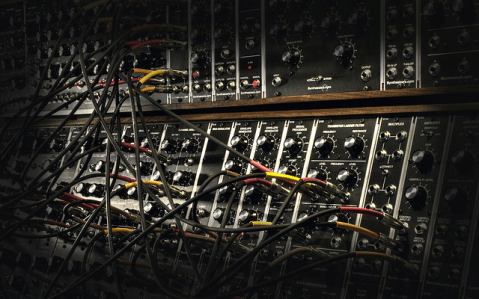
“Modular Synthesizer Desktop HDR” by Flickr user Peter Georges, CC-BY-NC-ND 2.0
***
In one of Cascella’s most fascinating chapters, she describes an experiment she performed on herself: “I learned by heart every week a paragraph from a new text that mentioned sounds, re-wrote it from memory the following week, and interpolated the missing parts with other words heard beside myself—an experiment in layered memory, as it corrodes and actualises my physical and emotional archives while I search for more voices: an echo cast into shape, to fold my enchantment with words round, and back dissolving, and again” (69).
She shares three examples, three “casts,” of these rewritings from memory. And I’ll be honest: when I first read this part of the book, I was excited at the idea of looking up the originals, of trying to catch exactly how much she did and didn’t remember—of reinscribing the authority of an ur-text, instead of allowing the echoes of the her-text envelope me.
So I looked one up. (I mean, Google Books.) And I compared. And I saw similarities and differences. Yep, there they were.
And out of nowhere, I felt ashamed. I felt like I was trying to break her experiment, her art, her practice. So I’ll leave it up to you: read her rewritings from memory—it’s chapter 11, I’ll wait while you find it—and decide for yourself if you want to know how much she changed or didn’t change from the “originals.” Decide for yourself how right/write or wrong it is to play with someone else’s texts. Decide for yourself if this is really how we do everything everyday anyway.
***
Slater’s Lying, the book I read on the plane, mixes truth and lies, a fact that aggravates some readers and enchants others. The thing is, she tells you exactly what she’s doing—I mean, the book is called Lying, and her first chapter, in its totality, is “I exaggerate.” Plenty of other obvious clues remind us that fact and fiction have been put in the blender of this book.
Cascella tells us what she’s doing, too. Eventually, you start to realize that explaining this book is one of the themes of the book—but no, explaining is the wrong word. More like inviting you to enjoy it the way she wants you to enjoy it.
Sometimes that invitation is rather direct: “I seek to reclaim the intermittent incoherence in listening as it urges to move through its residual presence into a marginated writing that is not a site of clarity but edge, horizon, fugue” (24). Bam. Pretty clear.
But often, she’s more invitational, writing in the second person, just to you: “Try and listen to them, one after the other, forget about genealogies and canons, listen to those vocal intertwinements and rhythmic mosaics” (30).
Then it’s back to her again, how she “want[s] words to follow the untidy movements in listening, to be mud and magma” (48), how she’s “drawn to listening to [sounds], to reinvent, recall and divine them in words” (68).
Her, you, her, you. Me. A swing, a dance, a recursive circle between telling and inviting.
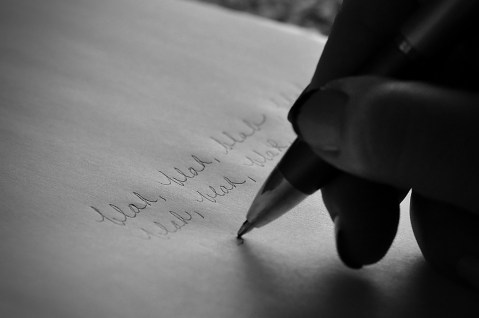
“Blah” by Flickr user Flood G., CC BY-NC-ND 2.0
***
“The moment I begin to write, sound is no longer sound” (39).
***
One reason Cascella writes this way: she’s frustratred with work on sound that ignores the affordances of sound. At sound art conferences, in discussions about sound art—they all seem to be so filled with words and explanations that she couldn’t help but explode words onto these pages in a different mode, like she does in this book.
“[C]oming back from yet another conference on sound,” she writes, “I would feel like I no longer knew how to speak, listen or write” (23). She’s tired of artists who make complex work but then use “trite and worn-out expressions that say no more” when describing it (55), “where sound becomes an apology” (108).
So this book uses sounds, and there’s no accompanying apology. Sorry.
***
I’m sitting outside at an academic conference for scholars in rhetoric and composition. I’ve seen some boundary-breaking stuff today, but I want more.
“I mean, sometimes I don’t want to have to tell the audience everything,” I say. I’m at a table with friends. We’re in Florida, so we’re drinking obscenely bright cocktails. “I want to throw ideas and sounds at them and let them connect the dots. These are smart people, right?”
Paul nods and pauses before speaking. We just met, so I think he’s trying to give good advice in as gentle a way as he can. “Yes. They’re smart. But there’s obviously a line, too, right? If you’re creating scholarship, you have to make moves that signal that you’re part of that community, that conversation. Otherwise, you’re making. . . .”
“You’re making art. Right?”
“Right. And art is important, and I agree that we need more artistic sensibilities in our field. But it’s not scholarship.” He pauses. “You have to play the game, too.”
I nod. I think he’s right. Sometimes, in some places, I need to play the game.
But not always. And in different fields, different modes of expression beyond the scholarly, the game is different, you can see it if you peek around the corner into other rooms. And if you break down walls, it’s all one big room. Which is exciting and terrifying and I want it all, all the ideas and methods and all the sounds.
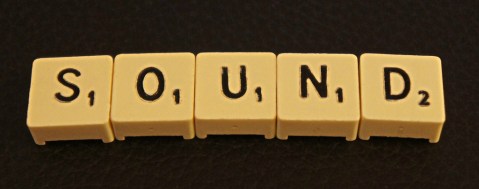
“Sound six points” by Flickr user Sarah Barker, CC BY-NC-ND 2.0
***
How can I tell you anything at all, when all I know are sounds?
But still, you want the point. You want to know what this book will do for you, for your art, for your scholarship.
How can I tell you anything at all, when all I know are sounds?
But ok. You’re not here to be moved. (Are you? I hope you are.) But if you’re not: what will propel your ideas, what will inspire your work after reading Cascella, what the take-aways are:
- “Writing away from sound” as a different way to “write about sound” (44). That is, instead of explaining, to let the nature of sound itself inspire the kinds of work you do.
- “Writing Sound” as an “encounter,” as “transcience” (54).
- Acknowledging our archives and inviting them to the forefront of our writing, even when those encounters are messy or confusing.
- Considering what we’re really doing in our art/theory/writing/sounding. Cascella says she’s not “a writer, a theorist, a critic” but “a handler of words, a listener, a reader” (90). Who are you? Who am I?
But how can I tell you anything at all, when all I know are sounds?
***
“I’m cut through by voices I don’t want to explain” (72).
—
Kyle D. Stedman is assistant professor of English at Rockford University, where he teaches first-year composition, digital rhetoric, and creative nonfiction. His work explores rhetorics of sound and music, intellectual property, and fandom. He tweets at @kstedman and hosts the podcast Plugs, Play, Pedagogy.
—
Featured image: “The Meaning of It All” by Flickr user Nick Webb, CC BY 2.0
—
REWIND! . . .If you liked this post, you may also dig:
Living with Noise — Osvaldo Oyola
“Sound Studies: A Discipline?”: Sound Signatures Winter School, Amsterdam, January 2014 — Melle Kromhout
Sounding Out Podcast #36: Anne Zeitz and David Boureau’s “Retention” — Aaron Trammell
Share this:


Current Top Posts





April 2021

January 2020

November 2019

October 2019

August 2019

April 2014

November 2017

March 2015

December 2017

October 2015
 Sounding Out!
Recent Comments