
Head Games?: The Strategic View of Liveness and Performance
When I tell people that I am an economist and a musician, they usually have one of two reactions. Either they tell me that I must be crazy, or conflicted—that the two things can’t possibly go together—or they immediately start talking about ticket prices, drops in CD sales, 360 deals. I however, refuse both stances. The connection that I see between what I study as an economist and how I perform as a musician is the element of strategy.
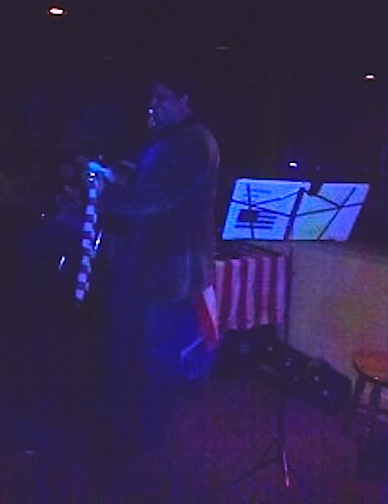
Andreas Pape performs at The Beef, Binghamton, NY, 10/16/10
Performance, in my view, is the willful construction of a series of events to create a particular mental state for the witnesses. This is the strategic view of performance. I am a game theorist, and game theory is the foundation of the strategic view. Game theory is based on the idea that games are a metaphor for human interaction generally. It is essentially the study of strategy: the chess player imagines different actions he can take, and imagines how his opponent will respond in each case, and uses those forecasts to make his original choice; that’s strategic thinking. In “Singing to my Imagined Listener,” I describe rehearsal as playing to an imagined audience member, judging her response, and adjusting accordingly. That is exactly the strategic view.
I got the opportunity to explore this synergy between live musical performance and economics in an intimate and visceral way a couple of weeks ago—February 9th, 2011, to be exact—when I was asked to speak to a small group of students at Binghamton University who study live performance in an English course called “Representation and Popular Music” taught by Jennifer Stoever-Ackerman. I thought I would reproduce some of that talk here, via video clips, in order to breathe elements of aurality and liveness into the words that follow, which meditate on strategic differences between liveness and recording in the game that we call music.
But first, a song.
In this clip, I play the guitar and harmonica and sing a song of mine called “Sittin’ on the Mailtrain.” I strategically start off with a song that has a jarring chord in each line: my intent is to make the audience feel a bit uncomfortable with this shared live experience, so that they are more inclined to look at it with fresh eyes. At minute 7:45, I point out that I am giving a live performance to those in the room, and recording to those in the future. That’s you. As I say at minute 8:07: “There’s an audience here, in the room, and there is an audience out there in the future, who are experiencing this, but clearly in a different way than you are experiencing it.”
And, I think that you are. Even now. However self-aware and live-esque, this recorded object cannot reproduce the physicalness and immediacy of performance.
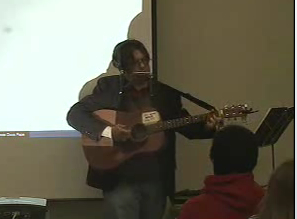
Performance is standing in front of people, feeling nervous or confident, holding a guitar, forming words, reading faces, projecting to the back of the room or getting quiet. Performance is hitting taut strings pulled across a wooden box at specific times and with a certain speed, vibrating vocal chords in a certain way, holding ones hands out to make a point, or inhaling a wail out of a blues harp. It is a series of events that are a part of a human life, in the sense that life is a series of physical moments. Agency in that visceral present moment is the essential difference between live performance and recording. Like Kathleen Hanna (frontwoman of Bikini Kill, Julie Ruin, and Le Tigre) wrote in “On Not Playing Dead” in 1999, “[O]ne thing I do as a performer is to stay physically present on stage, and that means being in the now. (Oh my god, I sound like such a hippie.)”
Halfway through my talk, however, my computer interjects with a pre-programmed dialogue that complicates Hanna’s claims. Watch here:
“Excuse me, I’d like to make a point,” my computer says aloud, for all to hear. “I felt it was important to point out that this is not exactly a live event. This is a recording, in some way.”
“Sure,” I reply, according to script.
“You typed this in to simulate this conversation that you’re having right now.”
“Yes,” I reply, “it’s scripted. Did anyone not know this was scripted?” I look questioningly at the students assembled in front of me.
“But this [lecture],” my computer points out, “is basically a recording. It’s an encoding of a particular process. So [the] physical body and mind [of the performer] decodes this script into a process, just like the CD player decodes the CD into a process! So how is this performance not a recording?”
“A recording encodes a performance, and a performance decodes a recording,” I say.
There is a strong way that any “live” performance has a recorded aspect to it and vice versa. The decoding of a CD is a performance, akin to my live performance. My computer worked from a script in the computer science sense—a set of essentially English-language commands that it followed to reconstruct a set of sounds. That is not a traditional recording, in that it is not direct storage of sound waves in magnetic tape or record grooves. However, it is functionally a recording: the user presses a button and a predictable and pre-specified series of sounds emerge.
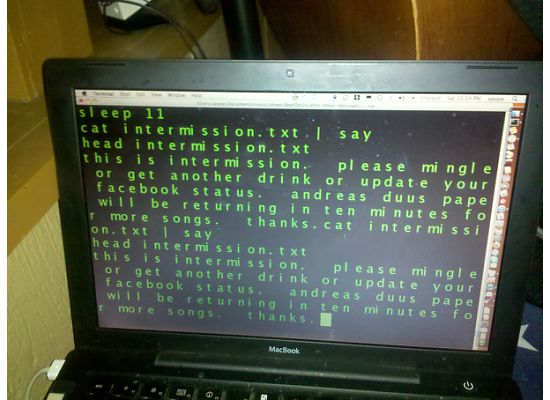
The Computer Performs its Script, The Beef, Binghamton, NY, October 16, 2010
If we agree that this computer script is a recording in this sense, then we are compelled to accept the next step—that if I, a human, am following a script, that I, too, am simply decoding a recording. That is, I had an idea about how “Sittin’ on the Mailtrain” would go and this idea was necessarily encoded in my mind; then I unpacked this encoding by arranging physical objects, namely my fingers and my voice, to create a song. The song followed an encoding in my head, like when you put a CD in a CD player. The encoding is unpacked, and ultimately results in the same thing: some vibrating object that vibrates the air which then vibrates the audience’s ears in a relentlessly physical way.
The future of performance lies in acknowledging the interrelationship of liveness and recording and further blurring the boundaries between them. The podcasts produced by the lo-fi movement are a key part of this new relationship. I am part of this artistic movement, which asserts the primacy of performance over recordings while also using recording technology to foster and promote liveness. Lo-fi’s hallmarks are: smaller numbers of performers in groups (often solo acts), an emphasis on live recordings complete with audience noise, low production quality (“Background hiss”), and a large number of recordings that often include many versions of the same song. The primacy of performance means the definitive versions of lo-fi songs are not located in recordings that live performances then try (and often fail) to recreate. Rather, the most recently performed version is the “master.” The performance you just watched of the song “Sittin’ on the Mailtrain” for example, was the most definitive version on February 9th. Today just may bring a new definitive version.
Lo-Fi Picture of Pape performing at The Beef, Binghamton, NY 10/16/10
In the aesthetics of the lo-fi movement, the life of the performer is treated not as a series of objects, but rather a series of events, which can be attended or subscribed to, like a podcast. No doubt, each episode is recorded, and the audience receives it as a recording. However, these recordings are meant to be listened to once or twice and let go; they are intended to be ephemeral. A podcast, when viewed as a process over time rather than a possession, is no doubt a performance; the audience can respond from one episode to the next via comments, email, Twitter, etc. and the performer can react. What you are reading and viewing here is simultaneously a lo-fi recording event and a lo-fi performance. This. This blogpost, you reading it, the videos you can watch and listen to, my comments on it here, your comments below that you can post, you sharing it on Facebook or Twitter. You can even follow the traces of this performance through my own Twitter feed.
Strategically, I think the podcast model is the next logical step in the Lo-fi aesthetic. Standup comedy (one of my favorite kinds of live performance) is making this transition as we speak. The old model for the young comedian was to develop “an act” that one (hopefully) toured with, perhaps releasing a comedy CD or landing a role on a sitcom. The new model is a couple of comics releasing a conversational podcast once a week, responding to their biggest fans, giving a raw, intimate, unpolished performance of improvisational humor and riffing, and convincing their fans to become members; a membership that occasionally awards the listener with additional content, but more often only a sense of satisfaction that one gets from supporting something one loves. See, for example, the podcast “empire” of Jesse Thorn at maximumfun.org which includes live comedy podcasts, or the political humor of wearecitizenradio.com, which is also member-supported. What’s interesting, here, is that a pure donation podcast model is enough for some comics to make a living. Ironically, using recording to give primacy to performance, serves the artist. Yesterday’s recording can be taken away from the artist, but tomorrow’s performance cannot.
As for my own future? My own “tomorrow’s performance”? On February 25, 2011, at the Eastern Economics Association Meetings, I will perform a similar event, called this time “Rhetoric, Choice Theory, and Performance.” I will perform music and discuss the strategic view. Economists are not used to thinking seriously about performance nor are they used to thinking seriously about sound. I intend to change that, one strategic moment at a time.
Additional footage in which I define strategy and game theory, and discuss what the strategic view of performance has to say about my references to Dylan and Guthrie:


Share this:

Y2K, Collective Ritual, and Sound in the New Millennium
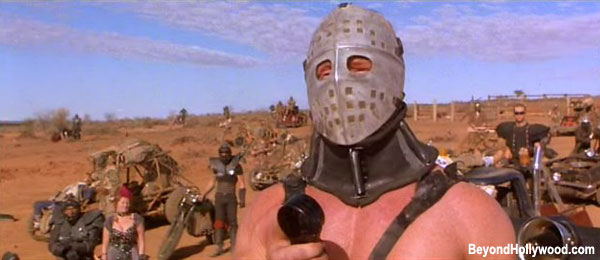 The recent New Year brought back some slightly embarrassing memories of past ball-droppings, 1999 in particular. That was the year, you’ll remember, when the world as we know it was to end due to all the clocks in all computers reading 0000 instead of 2000 – nuclear plants were to implode, bank accounts would be scrambled and a month later, the world would resemble some scene from The Road Warrior. I’ll fess up. I bought into the Y2K hype hook-line-and-sinker. I hunkered down in my living room with some old friends playing Risk that New Year’s Eve, I awaited an event of cataclysmic proportions. As the countdown droned on TV, it seemed every dice roll took me one step closer to the end . . . 10, 9, 8, 7, 6, 5, 4, 3, 2, 1. Upon zero, nothing changed and anxiety slowly began to leak from my body. Sting appeared on TV and introduced the new millennium with his jazzy “Brand New Day.” With lyrics about time and second chances, I grew to associate the song with a sense of profound relief. No matter how hokey Stings lyrics were (he uses the term “fuddy-duddy” at one point), “Brand New Day” will forever remind me of second-chances and possibility. Part of a clever advertising coup designed to reinvigorate Sting’s flagging career, the gospel tropes used in “Brand New Day” fit as a discursive response to the apocryphal (and apocalyptic) conversations circulating about Y2K at the time.
The history of technology is filled with utopian and dystopian visions of the future. Famously depicted in Apple’s “1984” commercial, the technocratic American narrative (Think Reaganomics) goes something like this: While developments in technology can allow for an increased sense of autonomy and individuality, they are unerringly used for evil. This evil strongly resembles a stereotypical Soviet culture where individuality is sacrificed for the good of the collective whole. Therefore, good technology promotes the individual while evil technology supports the collective.
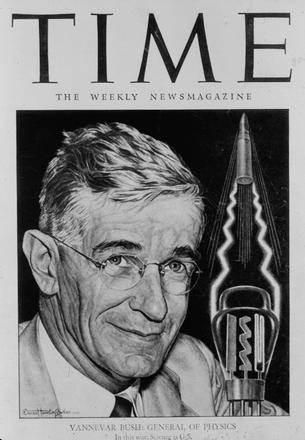 If this seems a little heavy handed, it should be noted that the whole endeavor of mass computing has its roots in American Cold War history. After the atomic catastrophes of Hiroshima and Nagasaki, Vannevar Bush, then Director of the Office of Scientific Research and Development, predicted the Internet with the “memex machine” in his article to The Atlantic, “As We May Think.” Written to an unassuming audience, Bush suggests the destructive potential of atomic weaponry heralded a concrete limit to traditional methods of warfare, because of this the next battlefronts would be informatic. Y2K is a dystopic variation on this theme, atomic blow up by-way-of nuclear power had even become incorporated into some of its myths. These myths were a fantasy, to be sure, but they were rooted in the collective fears of a confused and dysphoric America, an America which had recently overcome Communism and lauded its rapidly developing technological sector as a new source of economic capital on the world stage. Y2K was scary because it played on a cultural fear of technology, which was paradoxically one of America’s key exports at the time.
It is an interesting contrast between the cultural environment of post-Cold War America and the loose backup calls of “brand new day,” with its rhythmic pleas to “stand up!” increasing in frequency and intensity as the song continues. Though the song has nothing to do with Y2K, or even technology, its position as a televised event after the ball dropped December 31, 1999, had solidified it forever in my imagination as a spiritual reaction to the technological paranoia of the time. Sting conveys a baptism narrative; as a country we had mysteriously been absolved of our technocratic sins. I was (and am) a believer. As I sit writing this on my iMac, I consider the many marketing strategies Apple has used in the last decade to convince me of the ways their software and hardware could define me as an individual. Sting redeems the pursuit of individuality through the use of gospel tropes. Instead of an almighty passing the judgement of heaven or hell, a technocratic neoliberal economy threatened the wrath of Y2K to nonbelievers at the turn of the millennium. As the proverbial gates to a new era of prosperity opened, Sting climbed higher in falsetto, “Stand up and be counted every boy and girl/Stand up all you lovers in the world/We’re starting up a brand new day.”
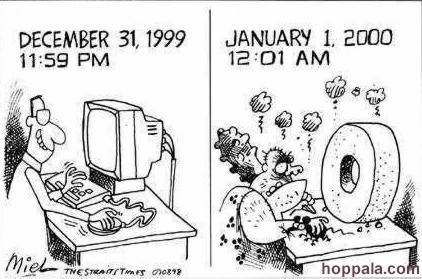
This year, as I watched a web steam of the ball drop January 31, 2010, I was able to later navigate to the MTV website and enjoy a Flaming Lips concert in Oklahoma City live from my computer. In this transition, something struck me. The potentials of computing, particularly video and sound editing (iMovie, Garageband and their disseminatory middle-man YouTube) still rely on an earlier Cold-War rhetoric of individualism and creative innovation to express the potential strengths of technology. Meanwhile any sense of collective ritual is set to the whim of a mouse-click, from New York to Oklahoma in a heartbeat. These new rituals compete with the old in a new context of hyper-individuality; ironically “Brand New Day” has become stuck once more in my head, as it has been routinely on New Years for the past 10 years. From these changes in collective ritual, what will it mean to celebrate the new year in 2011?


Share this:


Current Top Posts





April 2021

January 2020

November 2019

October 2019

August 2019

April 2014

November 2017

March 2015

December 2017

October 2015
 Sounding Out!
Recent Comments