
City Noises, City Sounds
DOI: https://doi.org/10.59350/yymdv-t8302
Last week, I spent a few days in New York City to celebrate Thanksgiving. I stayed in the Bronx, at an apartment a few feet away from the Bedford Park Boulevard stop and a subway train yard. Now, even though I have lived for over five years in a sleepy Upstate town, I have developed an uncanny ability to sleep wherever, whenever. The screeches and huffs of the trains were but a distant murmur to me. In fact, they were almost soothing, a reminder of the sounds of my childhood. My hostess was a bit concerned that the sounds hadn’t let me sleep. I reassured her, telling her, “I lived surrounded by noise in San Juan. The sounds of the trains weren’t really a problem.” She told me other guests hadn’t had such a good night sleep.
That made me think of soundscapes, my soundscape in particular. As someone who has lived in cities, towns, and countryside, I am very aware of the different sounds that characterize each place. I lived in the Bronx as a child, and traveled to Puerto Rico often. My mom likes to remind me that I had trouble sleeping when we would go out to visit the family on the West Coast because I didn’t like the sound of roosters in the morning. Eventually, after we moved to Puerto Rico, I grew accustomed to the sounds of roosters and chickens in the morning, as well as the murmurs of the stillness of the night, and could sleep through either. As an adult, I lived in San Juan. My apartment building stood at one of the busiest corners in Rio Piedras; there was always something to hear. Some nights it was the cackle of drunk college kids headed back to campus. Other nights it was the conversation of cops who had come to the cafe downstairs for breakfast (it opened M-F at 2 am). And sometimes it was the faint tweet of the crossing sign, an alert for the blind. When I moved to Binghamton, I had trouble sleeping: the silence was disconcerting for someone who had spent the last five years falling asleep to the sweet lull of “noise.”
All of this came back to me last week, as I stood in the guest bedroom, making the bed. Many distinct sounds make my soundscape. They follow me wherever I go, and will inevitably color the way I interpret other sounds. They color the way I “listen” in other words. For example, some people will find the sounds of the city abrasive, harsh on the ear. I, on the other hand, always find city sound comforting and exciting. They sound like life to me. Of course, they also remind me of the city of my childhood, the city I always look for when I visit other cities. Can I add other sounds to that soundscape? Certainly. The whirr of the refrigerator in my kitchen that starts and stops at random moments of the night is an example of a sound I have added to my soundscape. I’ve also added the open and shut of the doors in the hallway outside my apartment, a sound I can hear as clear as a bell in my apartment. But I think that the same way that we add sounds to our soundscape we also categorize them according to the sounds we have already stored in our memory bank. The sound of the fridge is the sound of “home” for me, and it sits alongside the sound of roosters and the sound of the city streets. Same could be said for my idea of “noise”: there are sounds that mean “noise” to me, and that definition is inevitably rooted in what I define as “sound.”
Liana Marie Silva
Share this:

The Grain of the Voice or the Contour of the Ear?

DOI: https://doi.org/10.59350/pgkhx-70g14
One of the most exciting possibilities emerging within sound studies is the emphasis on the listener and his/her role in shaping a sound’s meaning and content. Sounds disconnected from their contexts of reception rarely answer our questions about the past, but merely make for new listening experiences in the present. Thinking with our ears is profound, but thinking through our ears can be life-changing—moving us closer to an understanding of sound’s power and its intensive connection to memory and the emotive forces of both life and death.
Until very recently, I had not heard the sound of my Grandmother’s voice in over eight years. I had actually never expected to hear it again, as she died in 2001. It is a clichéd understatement that I loved my grandmother very much; when she died, I was barely a “real” adult and I felt like we had just gotten acquainted. However, I thought I had already made peace with the passing of her beloved throaty crackle into the world of furtive dreams and spotty memory, until one night in 2004, when this loss was suddenly found.
Somewhere around two a.m. on a weekday, the phone rang. Once you are past a certain age, the shrill peal of a telephone after midnight can be downright terrifying. Someone has died. Someone is calling from jail. Someone’s life is in shreds. Nothing good. My hand hovered over the receiver for a second, as I rubbed my tired eyes and steeled myself for whatever might be at the other line.
“Hello,” I mumbled, hesitatingly.
Silence, for a second. And, then, the keen of my sister’s voice, choked through tears, “I found it.”
Inexplicably, my groggy listening ears automatically knew precisely what “it” was : an oral history of my grandmother I recorded in 1998, on teeny-tiny tapes in an itsy-bitsy recorder my sister used to record her professor’s lectures. I borrowed it, and like a good sister, I returned it. Tapes included. At the time, I thought there would be plenty more opportunities to have deep convos with Grandma. I had always assumed my sister recycled it, replacing my grandmother’s words with her bio prof’s. With three little gasped words, I realized she hadn’t.
You’d think my first reaction would be excitement—and I was thrilled, but in the nineteenth-century sense. My heart was pierced by even the thought of hearing my Grandmother’s voice again; the imagined sound tremored through me and, in a moment of pure protective reflex, I immediately cast the receiver away. In a sense, I had heard my grandmother’s ghost. The sounds magnetized on that tape seemed to resurrect her and mock the promise of that hour of conversation, when we had no idea what lay ahead.
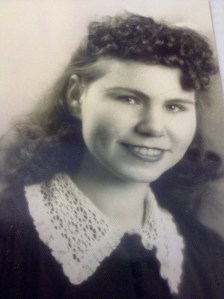
Even though I made the conscious decision not to listen to the tape, I let the thought of her audio presence haunt me for five years. I could not escape the thought of her voice both in my memory and in this new audio embodiment. Oddly enough, I surrounded myself with pictures of my Grandmother as remembrances—cheeky 1940s shots from her youth as well as seasoned photos of us together—but those images brought me cool comfort. Their framed borders demarcated a long-gone past. When my chest got too tight, I could look away. Not so with the vibrations of her voice, which sounded out the contours of her absent body. Her voice threatened too much wonder, and with it, an attendant dose of insatiable longing. Unlike the frozen photographic slices of life, the sound had an animated heft to it. It breathed.
Ultimately, I was unable to listen to the tape through my own ears. It wasn’t until the birth of my son that I even considered playing it. Suddenly, my grandmother wasn’t mine alone, but also the great-grandmother my son would never really know. The new relation between the two of them allowed me to fashion another set of ears; I became a new listener, connected to the voice by life rather than death, by shared possibility rather than the solipsism of grief. So on a snowy night last January, I finally pressed play. With my infant son in my arms, I listened, at long last, to that beautiful crackling voice spinning stories of her childhood in Iowa and adult life in California. Ironically, I almost immediately realized there were actually two dead voices on that tape. I had long since shed the happy-but-halting girlish voice of my youth like an ill-fitting skin, but hadn’t quite realized it until I heard my old nervous laughter fill the speakers. I realized that, someday, I’ll have to introduce my son to that young woman too.
My Grandma and I talk about WWII and the sinking of the Ruben James:
Grandma Maryanne’s Interview Segment 1
My Favorite part of the interview:
Grandma Maryanne’s Interview Segment 2
Jennifer Lynn Stoever
Share this:




Current Top Posts





April 2021

January 2020

November 2019

October 2019

August 2019

April 2014

November 2017

March 2015

December 2017

October 2015


Recent Comments