
Blank Space and “Asymmetries of Childhood Innocence”

In 2015 a video of a child in an Internet café in the Philippines began to trend on social media sites. Titled, Kanta ng isang Anak para sa kanyang inang OFW “Blank Space“ (“Song of a child for her overseas foreign worker mother”), the video shows a girl singing via Skype to her mother who is working in an unnamed location, presumably outside of the Philippines. “Ma kakantahan ulit kita ha?” (I’ll sing for you again mom), she says, and starts singing Taylor Swift’s “Blank Space”. Her mother attentively watches and listens to her song, soon beginning to cry in longing for a daughter she has not seen in a long time. The girl’s attention is divided between the screen that shows the lyrics, the camera that films her singing, and her mother who quietly observes. This video has over 110,000 views and is one of many archived messages from a child singing or speaking to their mother who labours transnationally. Despite the videos’ jittery framing and low quality, the intended message of shared longing across cyber and transnational borders is clear.
The Spanish-American war (1899-1902) resulted in the relinquishment of the colony of the Philippines from Spain to the United States. This transfer of power instituted the imperial specter that continues to grip the archipelago. The many performances of American pop music on Youtube and on stages throughout the Philippines are what Christine Bacareza Balance calls the “musical aftermath of US imperial cultures” (2016). Having amassed over 97 million YouTube views in the Philippines, Taylor Swift’s overwhelming popularity is evidence of this continued imperial presence. In the video, the young Filipinx girl sings lyrics written by Swift: “I’m dying to see how this one ends. Grab your passport and my hand.” When sung by this child these lyrics take on different meaning than Swift likely intended. Perhaps she is anticipating an end to the necessity of separation between mother and daughter.
Using song, the video provides evidence of what Hannah Dyer calls the ‘asymmetries of childhood innocence’ (2019), reminding its audience of the ways transnational labour and global capital impact children’s experiences of kinship and development. Dyer suggests that some children are withheld the protective hold of childhood innocence. She writes:
“Childhood innocence is a seemingly natural condition but its rhetorical maneuvers are permeated by its elisions and attempted disavowals along the lines of race, class, gender and sexuality. That is, despite the familiar rhetorical insistence that children are the future, some children are withheld the benefits of being assumed inculpable (2)”
Ascriptions of childhood innocence thus require a child to replicate social norms including the production of the nuclear family. In the Philippines, where the liberalization of international trade and high levels of unemployment have disproportionately impacted the labour migration of women, structures of the nuclear family are being re-organized (Parreñas 2005; Tungohan 2013). Women who work outside of the Philippines and away from their families are paradoxically celebrated for their “sacrifice” while also subject to disapproval over their absence (Tungohan 2013). When mothers leave the Philippines, the care-arrangements for children are shifted. There is a growing recognition of the changing nature of motherhood within transnational contexts and the concomitant emotional consequences of negotiating “long distance intimacy” (Parreñas 2005). The demands for transnational labour reconfigure Filipinx family formations and necessitate fraught intimacies between parent and child across borders. Cyber technologies like cell phones and the Internet initiate creative opportunities for children to be “virtually present” in the lives of their mothers and vice versa.

“Parenthood” by Flickr user Saúl Alejandro Preciado Farías, CC BY 2.0
Drawing from Dyer, we might think of children who live without the physical presence of their mothers as “queer” to normative theories of childhood development that affirm overwrought expectations of maternal presence. She suggests that discourses of childhood innocence intend to subjugate the queerness of childhood and that these elisions hold bio-political significance. Faced with social inequities, Dyer emphasizes the importance of a child’s symbolic expression. She argues that children express their psychic and social conflicts aesthetically. A child’s imagination elaborates resistances to the enclosure of childhood innocence as a barometer of value. In this way, this article suggests a child’s singing and dancing are aesthetic expressions that take notice of the entangled traces of colonialism and nation, while resisting hierarchal structures that deem some childhoods more valuable than others.
The child’s sonic performance in the YouTube video is a queer offering that creatively procures transnational connection. Her singing registers a queer frequency that destabilizes normative theories of child development that assume a mother’s physical presence as necessary to developmental success. The girl’s performance suggests that psychic and political reparations can occur in the sounds the child makes. The tactile, spatial and physical qualities of her voice forge a new relation to her mother. Her voice is affecting, seemingly moving her mother to tears and rousing the onlookers at the Internet café to reorganize their bodies and sing along. In this video, we are invited to witness a child whose world has been altered by globalization and the continued geo-political violence’s enacted by the American empire. Given these circumstances, her “creative re-interpretation[s] of kinship” serves as a reminder that the affective fortitude of her voice tests physical and emotional borders (Dyer 2019). The restraint of normative conceptions of family is ruptured when the child remakes her relation to her mother in ways that stir joy, collectivity, and pleasure.
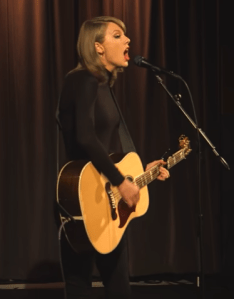
Screenshot from “
By observing and listening to the child’s song more closely, we can listen for its potential to re-sound and re-imagine the parent-child relationship across borders. The sounds of “OFW Blank Space” linger after the clip has ended. By listening for what is in excess of the video’s content, we can consider the affective registers that enunciate alternative understandings of migration, family and belonging. There is a humming that is ubiquitous in the video. Perhaps, it is the sound of the electric fans that run to combat the tropical heat of the Philippines. Maybe it is the collective buzzing from the computers that have been set up to provide the Internet to its cybercafé patrons. The acoustics of the space are at once mundane and haphazard, and at the same time, cogent indicators of the geopolitical truths echoing throughout the scene. With limited access to Internet in the home, the cybercafé has been a site that children frequent to communicate with family working in another country. The convergence of sound, technology and diasporic subjectivity becomes audible when the practice of listening is attuned to these methods of transnational connection.
While listening to the pedagogical potential of the cybercafé more broadly, a focus on the vocal performance of the child reveals my investment in what the sound of her voice tells us. The video starts with greetings spoken in Tagalog, the primary language of the Philippines. When the backing track begins, the child makes a seamless transition into singing in English. In her vocal performance of the lyrics, her Filipino accent is almost undetectable. She sings with a dulcet tone that is clear and appealing. Her voice sounds well-trained and confident. If not for the video, one might believe the child to be a professional American performer. In this scene, it is her voice that is marked and constituted by a narrative of American imperial conquest and Filipino assimilation. But in a creative adaptation of American cultural production, the child re-writes this racialized script and uses American pop songs as a mechanism of care for both herself and her mother.
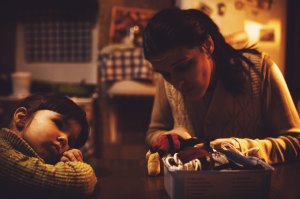
“Mother and daughter at home” by Flickr user Dejan Krsmanovic, CC-BY-2.0
The economic instability in the Philippines has created a state instituted transnational workforce. Women have been disproportionately affected by the demand for work in care industries such as nursing, childcare and care for the elderly (Francisco-Menchavez 2018). These gendered and racialized structures of employment privilege the presence of Filipinx women in families other than their own. The child is withheld a future that assures her the presence of her mother and their physical proximity is denied as a result of the demand for labour and capital exchange between nation-states. However, despite these circumstances, the child uses her voice to summon a beautiful intimacy, one that does not disavow the imperial history that marks its possibility, but instead uses loss as a resource to creatively mourn their separation. For the child, the act of singing is a replacement for her lost object, her mother. In the video we witness a child who is full of joy and whose strength of voice quells, if not, temporarily, whatever longing for her mother she might have. Relatedly, the child is also perceptive of her mother’s needs and uses music as a method of offering her care. Her performance creatively re-routes the presumed directionalities of care (from mother to child) which globalization has fundamentally altered.
—
Featured image: “Children” by Flickr user Clive Varley, CC-BY-2.0
—
Casey Mecija is an accomplished multi-disciplinary artist, primarily working in the fields of music and film. She played in Ohbijou, the Canadian orchestral pop band, and released her first solo album, entitled Psychic Materials, in 2016. Casey is also an award winning filmmaker whose work has screened internationally. She is completing a PhD at The University of Toronto, where she researches sound, performance studies and Filipinx Studies as they relate to queer diaspora.
—
 REWIND! . . .If you liked this post, you may also dig:
Relocating Soundscapes of Schooling: Learning to Listen to Children’s Lifeworlds-Cassie Brownell
Top 40 Democracy: Taylor Swift’s Election Day Victory-Eric Weisbard
Hearing “Media-Capitalism” in Egypt–Ziad Fahmy
Share this:

Youth, Reverberations, and Detroit’s Most Charismatic Rapper
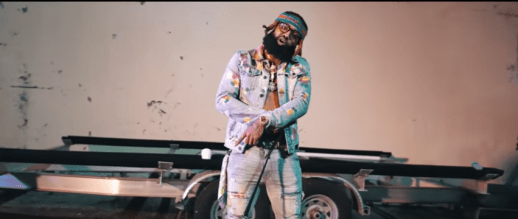
“Type in Sada Baby on the computer and let them hear the difference.”
Devante gives me this advice in the midst of an escalating back-and-forth among his peers about the difference between singing and rapping. Eighteen middle schoolers lounge around two picnic tables inside our local community center for this six-week summer program. We’re still in the first week, and each day they’ve name-checked Sada Baby, a charismatic rapper from the eastside of Detroit. I’m too occupied at the moment—trying to keep the conversation from spilling into an argument—to heed Devante’s advice, so he takes matters into his own voice.
“Rapping is like this,” he tells the group while starting to nod his head to an ear-magined beat. “Oh boy, I ain’t playing no games!” Devante raps the first half-bar of “Oh Boy,” Sada Baby’s 2017 track that narrates his street exploits and threatens his rivals — often with violence to the women they might or might not love. Devante not only raps this opening line but approximates the grain of Sada Baby’s voice, at least as much as he can since his adolescent tone hasn’t yet caught up to his linebacker build. My own ear—from over 20 years as hip-hop DJ, turntablist, and vinyl enthusiast—is more Sadat X than Sada Baby. But Sada’s playful allure is audible even to me, like while bending his cadence into indecipherable sounds over the track’s intro. And he covered “Return of the Mack” into a shirtless gunplay revenge track. So there’s that, too. I can understand the affective draw he has on the young people in the room. And even if couldn’t, this wouldn’t be the last I would hear of him in Yaktown Sounds that summer.
Yaktown Sounds is an emergent space of sound making I curate in and around Pontiac, Michigan. (Pon-ti-Yak = Yaktown, get it?) A postindustrial city halfway between Detroit and Flint, Pontiac is the home of jazz drummer Elvin Jones, hip-hop group Binary Star, and perhaps the most respected battle rapper on the national scene today: JC. Since 2015, I’ve organized an evolving network of artists—usually DJs and beat makers—to make space for youth and community members to play with sound. Of course, play and sound go well together. In Yaktown Sounds, sometimes it’s elementary-age youth at the public library hitting pads and twisting knobs on MIDI controllers until they like what they hear. Other times it’s daddies and daughters scratching a record under the needle to see what comes out. The summer of 2017, I lined up a different musical artist each week from Pontiac and Detroit to visit and share their skills.

Photo at Yaktown Sounds by James Easterly
My curatory approach to this space takes inspiration from Saving Our Lives Hear Our Truths (SOLHOT), a creative, visionary, performative Black girlhood practice. In part, SOLHOT generates from a particular stance on Black girlhood sound. In Hear Our Truths (2013), SOLHOT visionary Ruth Nicole Brown theorizes Black girlhood sound and the ways it resists and improvises around neoliberal youth programming constraints that are intended to “fix” youth. Riffing off Tricia Rose in Black Noise, Brown theorizes Black girlhood as a sound nobody can organize. It bounces off adult listenings that would compress it into binary identity positions like sass/silence or into white mainstream notions of politeness and civility. What follows from this stance are not constrained, prescribed “learning environments” for youth but open, performative, imaginative spaces not always under adults’ control. This is the type of environment I try to facilitate in Yaktown Sounds.
This stance toward space and environment means vulnerability to reverberations and their affects. Reverberation, of course, is a phenomenon and technique that plays a prominent role in Black diasporic sonic expression. As Michael E. Veal writes, its affect/effect is most pronounced through Jamaican dub music: the collisions among sounds through echo, delay, and reverb. Veal’s engagement with dub and reverberation is also conceptual. In Dub (2013), he considers its echoes and ruptures “a sonic metaphor for the condition of diaspora” (197). In Sound Curriculum (2018), Walter Gershon thinks with sound to make a similar argument for reverberation and other physical, metaphysical, and aural phenomena: “Because sounds are already in motion, they are always reverberating, bouncing off of objects from sinus cavities to walls to coral to brush to air to water to stone” (56). In these instances, Veal and Gershon take up reverberation in both aural and environmental settings. Yet these ideas also apply to the spaces where youth and adults co-create together. What collides, bounces, and stays in motion? What counts as a reverberation?
In that summer of Yaktown Sounds, I understand Sada Baby’s aural presence as a kind of reverberation. He stayed in motion, colliding with youth judgments about what counted as rap, how a rapper’s voice should sound, and even my own aspirations for the space. These collisions were most apparent while preparing each week for our visiting artist.
Before a visit from Mahogany Jones, we watched the video for her song “Blue Collar Logic.” Landon was the first to respond while leaning back against the table, feet kicked out in front of him, and retwisting his short bronze locks:
“Can we see another one? That one wasn’t good. I didn’t think it was good. Not as good as I thought it would be. It was too much of that, uh, old time. I just think she didn’t rap enough.”
For Landon, the standard for rapping enough and not sounding “old time” was—you guessed it—Sada Baby. “He actually raps,” Landon noted while explaining. If we consider music and song not only as art but as different organizations of sound (another point from Gershon), Landon has a point. To get specific, some of Sada Baby’s songs are continuous bars of rapping — no hooks, no chorus, no rest. In “Oh Boy,” Sada Baby raps for two minutes and 20 seconds of the song, and guest artist FMB DZ raps a 40 second verse. Straight bars over a trap beat. By comparison, “Blue Collar Logic” is also roughly 3-minutes long but has a fuller song structure. Mahogany Jones raps for 1 minute and 20 seconds across two verses. In the golden era template of DJ Premier, cuts from DJ Los make up the 30-second intro, the two choruses, and the instrumental outro that lasts approximately one minute. If we do the math, Sada Baby’s track has more than double the rapping compared to Mahogany’s.
My point here isn’t to judge which organization of sound is better; there is no wrong way to organize sound. Rather, these details illustrate two very different organizations and how Sada Baby’s made up the basis for Landon’s judgment.
If Landon’s directness that “she didn’t rap enough” rings a bit harsh to our polite adult listenings, then hear Kareem slice through the group conversation after listening to hometown artist Kodac aka M80, who had just returned from a European tour:
“He don’t know how to rap.”
Kareem’s judgment was based upon what he heard as singing and rapping happening in the same song, an organization of sound he classified as “old.” When I asked Kareem what Kodac needed to do to be a better rapper — “in your opinion,” the recommendation was equally direct: “Be more like Sada Baby.”
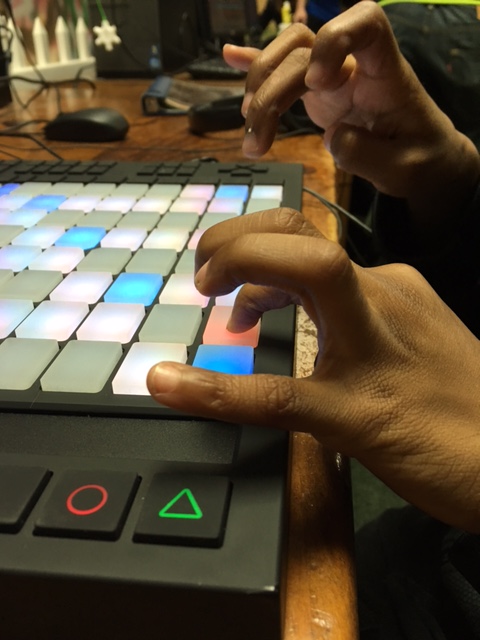
Photo at Yaktown Sounds by Emery Petchauer
These responses from Landon and Kareem show us something else about the movement of reverberations through this space. Sada Baby’s aural presence not only collided with youth preferences and claims about rap. As a reverberation, he was used to berate other artists whose sounds and configurations of sound were heard as “old” through youths’ generationally tuned ears.
Despite the youth-centric stance I take on spaces like Yaktown Sounds, I’m not gonna lie: the strikes and blows of these reverberations hit me too because of the relational ties I hold with these artists. They are part of my own creative community. I’ve DJed on stage for Kodac. I go to all of Mahogany’s shows. As a result, I remain vulnerable to the force of these reverberations. Owning up to that point, I am reminded of what Shakira Holt teaches us about adults and how we listen, particularly in education settings: sometimes we are not as open-eared to youth as we imagine ourselves to be — especially given the ways we have been socialized to censor and silence Black youth, even ones who live through our own cities, schools, and community centers. Though I’m two years removed from this particular iteration of Yaktown Sounds, Sada Baby continues to reverberate with/against me. He stays in motion even now, echoing through my writing as I toggle over to his Soundcloud page, press play on his songs, and wonder if I will hear something that makes me tune in differently to the young people around me.
—
Featured image: Screenshot from “Sada Baby–On Gang”
—
Emery Marc Petchauer makes beats and DJs with kids in and around Pontiac, MI. A former high school English teacher, he works as an associate professor of English and Teacher Education at Michigan State University. His scholarship has addressed the aesthetic practices of hip-hop culture and their connections to teaching, learning, and living. He also studies the high stakes test educators must pass to become certified teachers. He is online at empetch.com and on Twitter at @emerypetchauer.
—
REWIND! . . .If you liked this post, you may also dig:
Deep Listening as Philogynoir: Playlists, Black Girl Idiom, and Love–Shakira Holt
The Sounds of Anti-Anti-Essentialism: Listening to Black Consciousness in the Classroom–Carter Mathes
Can’t Nobody Tell Me Nothin: Respectability and The Produced Voice in Lil Nas X’s “Old Town Road”–Justin Burton
Share this:


Current Top Posts





April 2021

January 2020

November 2019

October 2019

August 2019

April 2014

November 2017

March 2015

December 2017

October 2015
 Sounding Out!
Recent Comments