
Gendered Voices and Social Harmony

 Editor’s Note: Our forum on gender and voice comes to a close today—and what a forum it has been! Last week AO Roberts talked about speech synthesis and why the robotic voices are so often female. That post followed Art Blake’s, where he talked about how his experience shifting his voice from feminine to masculine as a transgender man intersects with his work on John Cage. Before that, Regina Bradley put the soundtrack of Scandal in conversation with race and gender. The week before I talked about what it meant to have people call me, a woman of color, “loud.” The post that started it all? Christine Ehrick‘s selections from her forthcoming book, on the gendered soundscape.
This week Robin James returns to SO! to round out our forum with an analysis of how ideas of what women should sound like have roots in Greek philosophy. So, lean in, close your eyes, and let the voices take you back in time. –Liana M. Silva, Managing Editor
—
Dove and Twitter’s #SpeakBeautiful tries to market its brand by getting Twitter users to rally behind the hashtag. The idea is to encourage women to talk about their bodies and other women’s bodies only in positive terms–and to encourage interaction on Twitter. But why is tweeting, which is entirely text-based, called “speaking”? And what does it mean to speak beautifully, since beauty is usually an issue of body image? In other words, why give this campaign that specific name?
Their promotional video has a clue. As on Twitter, there is no voice, only text; however, there is an instrumental soundtrack throughout. It begins in a minor mode, traditionally associated with negative emotions. Then, around the 0:19 mark, once the blue Dove domino has started knocking down all the white dominoes with negative comments printed on them, the soundtrack shifts to major mode, which is traditionally associated with positive emotions. The video equates social media performance with musical harmony: negative comments are dissonant, positive ones are consonant.
“Speaking beautifully” means adopting the tone or attunement expected of the social media performance. But this still doesn’t tell us why it makes sense for Dove to describe women’s ability to follow social (media) norms as speaking, as making a particular kind of sound. #SpeakBeautiful is just the latest example of a convention that dates back thousands of years: patriarchy moderates women’s literal and metaphoric voices to control their participation in and affect on society, ensuring that these voices don’t disrupt a so-called harmoniously-ordered society. In what follows, I look to the origin of that convention in so we can better understand how it works today.
***
Anne Carson’s essay “The Gender of Sound” focuses mainly on ancient Greek literature and philosophy. “In general,” she argues, “the women of classical literature are a species given to disorderly and uncontrolled outflow of sound” (126). Unless carefully managed by husbands and the law, women’s loose lips (in both senses of the term) will upset overall “harmonious” order of the city. That’s why the ancient Greeks thought women’s disharmonious sounds acted “as political disease” (127).

“Eglise de Commana2012 469” by Lamiot – Own work. Licensed under CC BY-SA 3.0 via Wikimedia Commons
Emphasizing the relationship the Greeks drew between sonic harmony and social harmony, Carson’s analysis hinges on the concept of sophrosyne; often translated as “moderation,” the ancient Greeks understood sophrosyne as a type of harmony, and often explicitly connected it to musical harmony. Understanding the connection between sophrosyne and ancient Greek theories of musical harmony (which are very different than contemporary European ones) makes it easy to update Carson’s analysis to account for contemporary appraisals of women’s voices, such as the view that some feminist voices on social media are “toxic.”
According to Carson, the ancient Greeks thought women’s voices were immoderate when they exhibited excessive frequency: they could talk either at too high a pitch, or just talk too much. As Carson explains,
verbal continence is an essential feature of the masculine virtue of sophrosyne…[A]ncient discussions of the virtue of sophrosyne demonstrate clearly that, where it is applied to women, this word has a different definition than for men. Female sophrosyne is coextensive with female obedience to male direction and rarely means more than chastity. When it does mean more, the allusion is often to sound. A husband exhorting his wife or concubine to sophrosyne is likely to mean ‘Be quiet!’ (126).
So, (certain kinds of) men were thought to be capable of embodying (masculine) sophrosyne, that is, of comporting their bodies in accord with the order of the city, so that when they did speak, their speech contributed to social harmony and orderliness. The practice of sophrosyne aligns one’s body with the logos of a properly-ordered society, and, indeed, a properly-ordered cosmos. As Judith Periano puts it, moderation “tunes the soul to the cosmic scale (rather than the physical body)” (33). Women (and slaves, and some other kinds of men) were thought to be incapable of embodying this logos, of transforming their bodies into microcosms of the well-ordered city and harmonious cosmos. Their speech would disrupt social and cosmic harmony with dissonant, disorganized material. Silence, then, is how women contributed to social and cosmic harmony: their verbal and sexual chastity preserved the optimal, most well-balanced political and metaphysical order.

“Sanzio 01 Plato Aristotle” by Raphael – Web Gallery of Art: Image Info about artwork. Licensed under Public Domain via Wikimedia Commons
Women couldn’t embody the logos because they had “the wrong kind of flesh and the wrong alignment of pores for the production of low vocal pitches, no matter how hard they exercised” (Carson 120). Women’s disproportional “alignment of pores” matters, and Ancient Greek music theory is key to understanding why. Though there was widespread disagreement as to the specific ratios that were the most consonant and harmonious, there was a general consensus among music theorists and philosophers that musical harmony was a matter of geometric proportion. For example, Plato says in Timaeus 32c that the cosmos “was harmonized by proportion.” Proportion, for the ancient Greeks is both a ratio and a hierarchical ordering, a relational distribution that is also a series. Plato’s myth of the metals, for example, is both proportional (the “gold” get the most responsibility) and hierarchical (the gold are on the top). There is a right place for everything, and harmony is the effect of everything being in its right, appropriately proportionate place.
Harmonious sounds are side-effects of harmoniously proportioned material bodies–or rather, sonic harmony occurs when the relationship between an instrument’s internal structure and external emission (e.g., between body and speech) is itself proportionate. For example, on a pipe organ, a pipe’s size is directly and consistently proportional to the pitch it emits, such that the geometric relationships among pipes are directly and consistently proportional to the relationships among pitches. Woodwinds, on the other hand, exhibit no such direct, consistent relationship between material configuration and emitted pitch. On an oboe, the geometric relationship between the instrument as it plays a middle C and a high C does not mirror to the acoustic relationship between those pitches. As Plato puts it “in the case of flute-playing, the harmonies are found not by measurement but by the hit and miss of training, and quite generally music tries to find the measure by observing vibrating strings. So there is a lot of imprecision mixed up in it and very little reliability” (Philebus 56a). Here, he expresses the then-typical view that musical harmony ought to be a mathematically consistent effect of geometric relationships among the instrument’s parts (e.g., vibrating strings). The problem with the flute is that the relationships among its pitches is merely sonic, and cannot be inferred from the geometric relationships among its parts. Its sounds do not exhibit a consistent, proportional, moderate relationship to its material structure.
This is the same problem Carson identifies with women: the orderliness of their vocal emissions cannot be reliably inferred from the visible arrangement of their body and its constitutent parts. Like the flute, a feminine body cannot emit a moderate sound because the proportions of women’s bodies are out of whack; they don’t exhibit the proper ratio between parts, or between inner constitution and outer expression.

“Banquet Euaion Louvre G467 n2” by English: Euaion Painter – Jastrow (2008). Licensed under Public Domain via Wikimedia Commons
Women’s voices are “bad to hear or make men uncomfortable” (Carson, 129) not just because the voices themselves are disharmoniously feminine, but because they upset the social and cosmic order, specifically, the balance between inside and outside (129), intelligible and visible. Just as the aulos (an ancient Greek double-reeded instrument, somewhat like a modern oboe) upsets the proper, ideal relationship between an instrument’s physical structure (the part that commands, the mathematical logos of proportionality) and acoustic tuning (the part that obeys, pitches), women’s emissions mess up the proper, logical relationship between “the part that commands and the part that obeys” (Foucault, The History of Sexuality Vol. 2, 87), that is, between inner and outer, soul and body, private and public. Carson says, “By projections and leakages of all kinds–somatic, vocal, emotional, sexual–females expose or expend what should be kept in” (129). Sophrosyne is what keeps things in their right place as they get outwardly expressed.
When men practice “masculine” sophrosyne, they shape their bodies, their resonating innards, so to speak, into a form that will lend itself to rational, proportional outer expression, i.e., speech. Women’s feminine sophrosyne, public silence, keeps their irrational bodies from outwardly expressing disharmonious, disproportionate phenomena that would knock everything out of balance. Masculine sophrosyne is a technique for embodying the logos at the individual, social, and cosmic levels; feminine sophrosyne is a technique for keeping the cosmic/social logos from being disturbed.
Nowadays, though, we don’t expect “good” women to be seen and not heard–we praise (some) women for making the right noises in the right contexts. For example, Rebecca Solnit wrote that 2014 was, for women, “a year of mounting refusal to be silent…It was loud, discordant, and maybe transformative, because important things were said…and heard as never before.” Proclamations of women’s envoicement–of women’s full inclusion and participation in society–are central to post-feminist patriarchy, which functions best when there is a little bit of “feminist” noise mixed in with its signal. The audibility of some women’s “feminist” voices serves as (misleading) evidence that patriarchy is over (or on the way there), and lets patriarchy and the intersectional work it does pass unnoticed. Whereas the ancient Greeks thought women’s voices were absent from a harmonious society, contemporary (neo)liberal democracies think a harmonious society includes a certain amount of feminist noise.

“Christine de Pisan – cathedra” by From compendium of Christine de Pizan’s works, 1413. Produced in her scriptorium in Paris – http://bcm.bc.edu/issues/winter_2010/endnotes/an-educated-lady.html. Licensed under Public Domain via Wikimedia Commons
But not too much feminist noise: feminist noise must be moderate. Moderation still matters–it’s just measured differently than it was in ancient Greece. It isn’t a matter of geometric proportion, but of dynamic range. From a post-feminist perspective, feminist voices that call attention to ongoing patriarchy and misogyny feel too loud. Sara Ahmed explains, “words like “racism” and “sexism” are heard as abrasive because they name what has receded from view.” Voices that speak of ongoing racism and sexism are charged with the same flaws attributed to artificially loudened, overcompressed music: inflexibility, lack of variability, and ineffectiveness. Just as overcompressed music is thought to, as Suhas Sreedhar describes “sacrifice…the natural ebb and flow of music,” feminist activists are thought to to sacrifice the natural ebb and flow of social harmony.
In a post-feminist, post-race society, people who continually insist on the existence of sexism and racism appear to be similarly stuck on an irrelevant issue and lacking in expressive range. Similarly, in music lacking dynamic range, “the sound becomes analogous to someone constantly shouting everything he or she says. Not only is all impact lost, but the constant level of the sound is fatiguing to the ear (Sreedhar).” Because it stays more or less fixed at the same amplitude of sound, loud music is thought to be both ineffective and unhealthy for those subjected to it. Similarly, liberal critics of women of color activists often characterize them as hostile, uncivil, or overly aggressive in tone, which supposedly diminishes the impact of their work and both upsets the healthy process of social change and fatigues the public. They are, in Michelle Goldberg’s terms, “toxic.”
This “ebb and flow” is not a geometric proportion, but a frequency or statistical distribution that can be represented as a sine wave. As I have argued here, contemporary concepts of social harmony aren’t based in ancient Greek music theory, but on acoustics. For example, Alex Pentland’s theory of “social physics” or, “the reliable, mathematical connections between information and idea flow…and people’s behavior” (2), treats individual and group behavior as predictable patterns that emerge, as signal, from noisy data streams, just as harmonics and partials emerge from interacting sound frequencies.
 In this context, “loud” feminist voices feel like they’re upsetting the ebb and flow, the dynamic range and variability, of information and idea flow. But the thing is, they aren’t upsetting the flow, but intensifying it: their perceived loudness incites others to respond with trolling, harassing, and other kinds of policing speech, often in massive scale. When philosopher Cheryl Abbate told her students that it was unacceptable to express homophobic views in class, John McAdams, a tenured faculty member in the department where Abbate is a doctoral student, wrote a blog post accusing her of inhibiting the free expression of a diverse range of opinions. Her “loud” feminism masked the “healthy diversity” of opinions. McAdams’s post led Abbate to be targeted by a tsunami of harassment, from individuals emailing her, to social media attacks, to attacks from mainstream media and political organizations. When feminist voices make noise, patriarchy amps up its own frequencies to bring the mix back in proper balance so that patriarchy is what emerges from feminist noise. In this context, voices are harmonious when, together, their ebb and flow predictably transmits patriarchal signal into the future. Sophrosyne is a feature of voices that interact so that patriarchal power relations emerge from them: they might actually have an extremely high volume, but they feel moderate because they restore the “normal” ebb and flow of society.
When Dove and Twitter urge women to “speak beautifully,” they’re really demanding that women practice sophrosyne: that they make just enough ‘feminist’ noise without being too loud–i.e., loud enough to distort the brand image of Unilever and Twitter. So, even though ancient Greek concepts of musical harmony and patriarchy are vastly different than contemporary (neo)liberal democratic ones, each era uses its own version of sophrosyne to shape women’s voices into something consonant with a social order that privileges men and masculinity.
—
Featured image: “” by Flickr user Ed Lynch-Bell, CC BY-NC 2.0
—
Robin James is Associate Professor of Philosophy at UNC Charlotte. She is author of two books: Resilience & Melancholy: pop music, feminism, and neoliberalism, published by Zer0 books last year, and The Conjectural Body: gender, race and the philosophy of music was published by Lexington Books in 2010. Her work on feminism, race, contemporary continental philosophy, pop music, and sound studies has appeared in The New Inquiry, Hypatia, differences, Contemporary Aesthetics, and the Journal of Popular Music Studies. She is also a digital sound artist and musician. She blogs at its-her-factory.com and is a regular contributor to Cyborgology.
—
 REWIND!…If you liked this post, check out:
Top 40 Democracy: Taylor Swift’s Election Day Victory—Eric Weisbard
Vocal Gender and the Gendered Soundscape: At the Intersection of Gender Studies and Sound Studies—Christine Ehrick
On Sound and Pleasure: Meditations on the Human Voice– Yvon Bonefant
Share this:

The Hell, the High Water, and the Funk of It All: Sounding Power in Scandal
Editor’s Note: Here’s installment #3 of Sounding Out!‘s blog forum on gender and voice! Last week I talked about what it meant to have people call me, a woman of color, “loud.” The week before that we hosted Christine Ehrick‘s selections from her forthcoming book; she introduced us to the idea of the gendered soundscape, which she uses in her analysis on women’s radio speech from the 1930s to the 1950s. In the next few weeks we’ll have A.O. Roberts with synthesized voices and gender, Art Blake with his reflections on how his experience shifting his voice from feminine to masculine as a transgender man intersects with his work on John Cage, and lastly Robin James with an analysis of how ideas of what women should sound like have roots in Greek philosophy.
This week regular writer Regina Bradley puts the soundtrack of Scandal in conversation with the agency of the show’s protagonist, a black woman in manages crises for a living. So, lean in and close your eyes, but keep your ears open for any spies creeping in. –Liana M. Silva, Managing Editor
–––
9:00 pm (Eastern). The quick shutter of an invisible camera calls the attention of the viewers to Scandal. The clicking re-emphasizes the show’s title, bringing to mind paparazzi and their capturing of scandalous behavior. The shuttering also signifies the literal and sonic fast paced timing of Shonda Rhimes’ most popular ABC prime time show: quickened plots, fast talks, and blink-and-you’ll-miss-something-important visual details. Scandal’s central character, Washington D.C. crisis manager Olivia Pope (portrayed by Kerry Washington), is known mostly for her sharp professional outfits and no-nonsense approach to work. In Olivia, Rhimes has created a black female character that is perfectly flawed, a symbol of both the potential power and victimization of black women. Olivia Pope is neither just the savior nor is she solely a victim.
 Scandal evokes intense debate about race and power because of its visual politics, but rarely is Scandal’s scoring prominent in those discussions. The soundtrack acts as an indicator of contemporary black women’s agency in popular culture. As both Rhimes and Scandal music director Alexandra Patsavas reveal, Scandal’s ‘vintage’ soundtrack is an opportunity to buoy the plot and add a unique alternative perspective to the action taking place on the show. The soundtrack’s nods to yesteryear artists – including Stevie Wonder, The Ohio Players, The O’Jays, Sam Cooke, Earth, Wind, and Fire, and Nina Simone sonically narrate additional layers of agency and identity on the show. Are these tracks giving Olivia a voice? What does Scandal’s scoring suggest about race, place, and power scripts for black women in contemporary popular culture?

“Inauguration Day – White House” by Flickr user Justin Brown, CC BY-NC-SA 2.0
Scandal takes place in Washington D.C., a location full of physical and sonic significance in national lore and the black popular imagination. In a national narrative D.C. is the epicenter of political agency, power, and the visibility of whiteness as a form of power. It is America’s city. Yet D.C. in the black imagination is the Chocolate City, a space that serves as a living archive of black folks’ attempts to intervene into a national narrative that would rather overlook the contributions of black bodies and culture. Washington, D.C. is the home of the Moorland-Springarn Research Center and multiple black cultural archives, Howard University and its place as the black mecca of Black Greek Letter Organizations, GoGo Music, and (embattled) social-political policies and endeavors for black people. It is a site of black identity that goes much farther than the place where everyone saw how a certain somebody had an American Dream. On the other hand, the increasing gentrification of the city raises questions of whether or not the nickname “Chocolate City” is applicable.Thus, Washington, D.C. exists at the crux of the romanticization of Americanness as a form of worldly power and the reality that (white) Americanness does not include all Americans.
 Yet Washington D.C. as a site of complex and rich black experiences does not alone buoy Scandal’s use of Washington, D.C. as a site where a black woman “handles” the hustle and bustle of American power and its upheaval. This type of work takes place in the scoring, particularly because the show is not culturally recognizable as a “black show.” Its inherent blackness is sonic, using black music to revisit tropes of power and racial politics.
One possible and albeit slightly heavy handed approach for thinking through Scandal’s leaning on funk and soul music is to point out how the show uses black cultural forms to invoke power. For example, soul songs like Otis Redding’s “Mr. Pitiful,” Edwin Starr’s “War,” and Sly and the Family Stone’s “Everyday People” are not only used to accentuate the action in a scene but the possibility of Olivia as a power figure. The use of black men’s voices as they yell, scream, and moan sonically allude to power as a masculine concept. Yet Olivia’s connection to these songs signifies her potential to wield power in unorthodox ways not associated with black women. For example, the crescendo of music before Olivia delivers a demand to her team sets up her agency as a political figure. Her blackness is amplified and earmarked by the music. This pairing amplifies the question of race and power in a useful way. The dominantly black musical script offers the critique and engagement with Olivia Pope’s blackness that many viewers and critics complain are lacking. (See the brilliant synopsis presented by Dr. Jessica Marie Johnson about Shonda Rhimes’ portrayal of black women and popular culture that took place at Duke University last month.)
Scandal serves vintage musical scoring as a double entendre: the sound of black music from previous eras evokes ‘vintage’ scripts of race, gender, and power from that era that seep into this present moment. Scandal’s use of soul, funk, and disco sonically allude to larger questions lingering from the Civil Rights Movement: integration as an equalizer of power and privilege, the hypermasculinity of the Civil Rights Era, its cultural producers, and the immediate aftermath of these scripts on (black) American society in the late 1960s and 1970s. We frequently annotate black agency through the men creating (singing?) the music. This is equally true for the black cultural productions of the era, as they aesthetically supplemented the understanding that black folks mattering connected to the uplift and healthy presence of black men. Even with soul and funk music, which stand as antithetical responses to the problematic expectations of classist respectability politics, black women’s agency was associated with the sexual, emotional, or physical agency of black men.
The blackness and “maleness” of the funk and soul used in Scandal’s score subverts the power that Olivia Pope exerts in her dealings with her clients, her lovers, and team. For example, in season two Olivia and President Fitz’s sex tape is threatened to be leaked to the public. It is important to note that the tape is an audio tape, suggestively alluding the absence of physical and visual rhetoric to address the interracial relationship. As Olivia gives the word to leak the sex tape, The Ohio Players’ track “Love Rollercoaster” begins to play. It sonically stabilizes Olivia’s decision to “leak” her sexuality as a power move while also leaving room to question the deeper implications of how the viewer navigates her blackness and womanhood using physical, aural, and cultural markers of sexuality. Using male funk and soul artists allows Pope to ‘codeswitch’ between cultural scripts of power as masculine and womanhood as opposite power. It amplifies her authority and agency while signifying that her physical appearance and voice may not have the ability to confer her worth to the audience.
This tug-and-pull of power and agency is most amplified in Olivia Pope’s dealings with her father Rowan Pope, played by Joe Morton (who plays the HELL out of this role, by the way). Rowan Pope is a literal and figurative double agent: He is Elijah Pope, a curator of antiquities at the Smithsonian, and Rowan Pope, head of the top secret and lethal U.S. organization called B613. His fragmented life speaks to the constant negotiation of “safe” black masculinity. He also embodies the anxieties about black men as violent and bloodthirsty. Rowan/Elijah encapsulates all of the swagger and vitriol associated with conceptualizations of black power and black men from the Black Liberation Era. He is cold and calculating, and he complicates the rhetoric of racial uplift and expected from the Civil Rights/Black Power movements. He speaks in hardened, hushed tones with conviction, while snarling his words with spite for white authority. Not to mention, his is the character that brings up race overtly in the show.
This balance between hushed tones and snarled words comes through in Rowan’s early interaction with Olivia during Scandal’s season three premiere. Olivia, on the run because her name is leaked as the President’s mistress, is recovered by her father and told to flee the country. Rowan is not a doting and concerned father in this scene. Rather, he is disappointed by her lack of prowess and failure to aspire to higher forms of power and authority than “first lady.” Rowan recognizes there is no power in being the wife of the President, especially as a black woman, and he criticizes her for not following the first rule of black folks’ survival: “You need to be twice as good to get half of what they have.” “They” is a collective noun for white folks, often spoken behind closed doors as a means to inspire young black folks to do better. Rowan demands she state out loud what they need to be twice of. Olivia’s voice cracks and is breathless as she whispers “twice as good to get half of what they have.” Rowan exaggerates a “yes” and dismisses Olivia as “mediocre.” It is a painful and powerful scene where multiple dichotomies take place: a father scolding his daughter, a black man undermining black women’s agency, and the fear/anxiety about black women’s sexuality as a sign of weakness and lacking privilege. The wavering volume of Olivia’s voice signifies her quickly plummeting ability to voice her power. Olivia’s loss of words amplifies Rowans’ own authority, embodied in his voice when he adamantly declares “I am the hell and the high water!” No soundtrack can save her here.
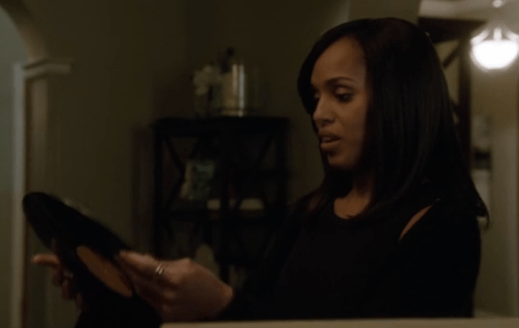
However, Rowan does have human moments, reaching out to his estranged daughter Olivia with wine and music, specifically Stevie Wonder. Her record collection is filled with Stevie Wonder. It is important that she has a record collection instead of a collection of CDs or playlist. Not only does this detail speak to the trope of “vintage” that runs through the show but also gives credence to how Olivia establishes her power. Her major moments are annotated by Stevie Wonder: when her name is leaked “Higher Ground” plays in the background. When she is kidnapped at the end of the episode for past December’s Winter finale “Don’t You Worry Bout a Thing” takes center stage. Again, the sounds of a man, her father in this instance, are the soundtrack to her work. The choice of music subverts the gender balance of power. Through male artists, the show gives Olivia her authority.
The most prominent sonic signifier is the instrumental accompaniment from the artist The Album Leaf titled “The Light.” Also known as Olivia and President Fitz’s “song,” the track plays each time the two characters interact and share intimacy (physical and otherwise).
Notes from what sounds like an electric piano playing a scale are short and sweet to the ear. The track lends its innocence and vulnerability to Olivia and Fitz’s affair and offers a possibility that their love for each other can be read as star-crossed instead of in bad taste.
Scott Poulson-Bryant offered an intriguing read on his Facebook page on “The Light” as an allusion to the Civil Rights’ theme song “We Shall Overcome.” This reading of “The Light” as the context to Olivia and Fitz’s relationship makes room to complicate how Olivia’s agency as a black woman is historically and politically bound to women before–she alludes to her similarity to Sally Hemmings in one episode. Olivia’s Sally Hemmings reference uses Hemmings as the genesis point for understanding the complexity of Olivia’s sexual encounters as well as how to navigate black women’s sexual agency – and pleasure – in popular spaces. Sally Hemmings’ relationship to President Thomas Jefferson lends historical credence to Olivia and Fitz’s Scandal but also signifies the gray area of historical memory, cultural expectations, and consent as a form of power for African American women. “The Light” instrumental is not only a sonic accompaniment of Olivia as she relates to Fitz but her own struggles to recognize and balance her public and personal agency.
The soundtrack of Scandal gives a voice to not just Olivia’s authority in a place where race and power are intertwined but also a voice on national television to how whiteness and political power operate. Scandal’s controversial protagonist/anti-hero Olivia Pope is often central to recent discussions of race, gender, and popular culture. But the soundtrack to the show asks viewers to not just watch closely but also listen closely. Tune out and you might miss something.
—
Regina Bradley recently completed her PhD at Florida State University in African American Literature. Her dissertation is titled “Race to Post: White Hegemonic Capitalism and Black Empowerment in 21st Century Black Popular Culture and Literature.” She is a regular writer for Sounding Out!
—
REWIND!…If you liked this post, you may also dig:
SO! Reads: Shana Redmond’s Anthem: Social Movements and the Sound of Solidarity in the African Diaspora—Ashon Crawley
Freedom Back: Sounding Black Feminist History, Courtesy the Artists–Tavia Nyong’o
They Do Not All Sound Alike: Sampling Kathleen Cleaver, Assata Shakur, and Angela Davis—Tara Betts
Share this:


Current Top Posts





April 2021

January 2020

November 2019

October 2019

August 2019

April 2014

November 2017

March 2015

December 2017

October 2015
 Sounding Out!
Recent Comments