
Easy Listening: Spreading and the Role of the Ear in Debating

Photo courtesy of Sounding Out! intern, Sky Stage. All rights reserved.
As I write, my institution, the University of Denver, is gearing up to host the first of the 2012 Presidential Debates. The debate promises a polite and eloquent exchanging of reasons on matters of public concerns. This image of “the good man [sic] speaking well,” roughly represented by Obama and Romney, pervades popular culture representations of debate. While there are certainly some forms of debate that stress public reason, like Worlds style debate, most other competitive styles of debate, look and sound very different.
American “Policy Debate,” the type of debate I will explore today, is a high school and collegiate competitive activity where two-person teams argue the merits of governmental legislation. In every round there is an affirmative that advocates an action and a negative defending the status quo, or some alternative. The debate prompts, or resolutions, change yearly and produce research collections comparable to a master’s thesis. But, it is not the research that captures newcomers’ attention. No, it is the velocity that information travels. Indeed, highly successful debaters transform their voice into a high-speed information weapon, sometimes speaking up to 400 words per minute (wpm).
Nobody really knows who decided that speaking quicker than her/his opponents would be a viable strategy. Some allege that David Seikel and Mike Miller, a dominant team from the University of Houston in the late 1960s invented the strategy. However, Miller denies this fact, insisting that the practice of speaking quickly, or “spreading,” predated their success by a couple years. While it is difficult to pin down exactly when talking becomes spreading, studies indicate passive comprehension has a threshold of around 210 wpm. Simply put, spreading is a vocal practice that propagates more arguments than an opponent can rebut, forcing the opposing team into a strategic choice of conceding and/or inadequately responding to some positions.

Almost immediately after its introduction, spreading became a polarizing issue. While some alleged that speed undermined communicative argumentation, others applauded its ability to foster critical thinking. Rate of delivery became a site for what Douglas Ehninger called in 1958 the debate about debate: should debate be concerned with public reason or technical proficiency? Spreading figured prominently in these discussions because it circumscribed debate to the technical sphere, the quick pace precluding lay comprehension. As a site for cultivating what argumentation theorists Ron Greene and Darrin Hicks call “the ethical attributes required for democratic citizenship” (101), debate operates as an ideal problem space to inquire about the relationship between listening and judgment that underwrite argumentative exchanges.
Extracting meaning from a spread requires a trained ear that can delineate the nuance of tone, rhythm, code, and breathing, while translating these sounds into symbols that are then recorded onto a “flow” (a document where participants keep notes of the debate). This technical sphere of argumentation, then, requires what cultural historian Jonathan Sterne calls in The Audible Past: Cultural Origins of Sound Reproduction an “audile technique,” or a set of culturally defined listening practices. Here, spreading denotes not just rate of delivery, but encompasses a range of other practices that attend to the debate. Yoking velocity with technical proficiency, spreading requires an audile technique that attunes the ear to speed, while calibrating the viscera to quickly appraise each position espoused. Extending Sterne’s observations into an embodied theory of listening, I argue that spreading entrains visceral judgment that organizes expertise under the banner of “exchange-value,” instead of its veracity. Reflecting what Jodi Dean calls in Blog Theory: Feedback and Capture in the Circuits of Drive capitalism’s communicative style, I contend, audition in this case privileges flow over content.
Today, debaters are much faster than their 1960s counterparts. Take for example the championship round of this year’s (2012) National Debate Tournament (NDT). The 2012 topic debated the merits of the United States’ democracy assistance in the Middle East.
Finals – NDT 2012 Northwestern BK v Georgetown AM – 1AC + CX
In the speech linked to above, dubbed the first affirmative constructive (1AC), the speaker’s first words are easily audible, but as the seconds expire, the affirmative’s words increase in velocity; syllables collide and contort. The speaker pushes through, taking a split second to take a short, fast breath (called a clutch) before he begins his next word. To the seasoned ear, the voice is instructive; a slower, deeper tone signifying an assertion. also known as a “tag,” and a faster tempo indicating evidence. Out of this buzz, debaters’ are able to discern distinct phrases, like “Arab Spring,” “economic down turn,” and “nuclear war.” In 9 minutes the speaker outlined his advocacy, consisting of multiple scenarios for planetary extinction.
During the 1AC, the negative team is carefully listening, gathering the affirmative’s evidence, and translating the speech into symbolic shorthand, termed flowing. In addition to its purely functional use—to keep track of positions—the flow also provides third party adjudicator(s) a document to evaluate the debate.

Image of flow notes taken during a debate
After a period of questioning, the first negative speaker, linked to below, elaborates his positions: a procedural concern that the affirmative is outside the confines of the resolution; two philosophical objections (or critiques); two alternative courses of action that resolve the affirmatives exigencies, while conserving the president’s political capital, so Obama can push for Jackson-Vanik legislation; and finally direct responses to the affirmative position.
Finals – NDT 2012 Northwestern BK v Georgetown AM – 1NC + CX
Coupled with the “burden of rejoinder,” which dictates a conceded argument is a true argument, speed becomes a strategic weapon. The more positions, the more likely one will be missed, granting the other team an advantage. For example, failure to address the negative’s concerns about the Jackson-Vanik legislation means that the affirmative position would result in a US-Russian nuclear war culminating in extinction and probably losing the affirmative the debate. Even less dire claims exert force in the round. For instance, missing the relatively innocuous claim that Obama does not have political capital abrogates the negative’s whole Jackson-Vanik position. After all, what would be the point of Obama conserving capital, if he has none to begin with?
Debating thus requires a refined ear capable of quickly determining a argument’s merit, while allotting the proper amount of attention. If a claim is deemed irrelevant, the debater can focus on a more relevant position, keeping her/his ear piqued for beginning of the next position.
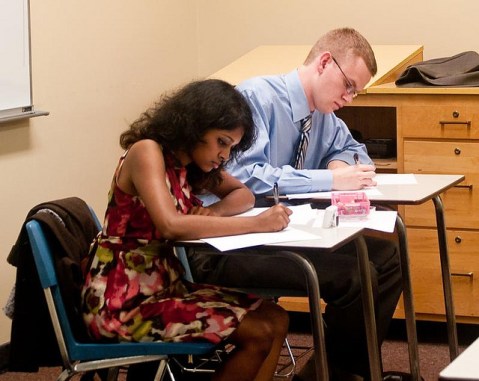
Debate team members listening to the flow at a 2009 Tournament at University of the Pacific; Image by Flickr User Inkyhack
This confluence of speed, evidence, time constraints, and a burden of rejoinder cultivates an instrumental relationship to expertise. Media theorist Jayson Harsin suggests in “The Rumour Bomb: Theorising the Convergence of New and Old Trends in Mediated US Politics” that these “conditions encourage a relationship of viewer to text (slogan, soundbite, fragment) which is essentially fiduciary, based on trust, not critical understanding”(101). Indeed, time constraints coupled with a proliferation of positions, produces a sound to listener relationship, where the veracity is assumed and significance is dictated by strategies, not the least of which is vocal. This is because there is simply not enough time to evaluate the credibility of each piece of evidence read. Patrick Speice and Jim Lyle, two debate coaches, explain that “Debaters have to be focused on the arguments being offered, have to be able to understand them very quickly, and they have to be able to discern which arguments are of the greatest significance for the round.” Evidence, then, is reorganized along a strategic continuum—the more likely an argument may help or hinder a team’s chances of winning, the more important it becomes. This can precipitate a “race to the margins,” where one side tries to find an obscure argument to beat back more probable analysis. This is not to say that one kind of argument is better than the other. But, the rationality used to organize the evidence relegates veracity to the epiphenomenal. This fosters an epistemic leveling, indexing expertise according to its exchange-value.
The repetitive nature of debate inscribes these listening habits into the body, shaping future interaction. Writing on the pious ear, cultural anthropologist Charles Hirschkind explains in The Ethical Soundscape: Cassette Sermons and Islamic Counterpublics, “patterns of sensory attunement configured through continuous practice of such a listening constitute an intensifying perceptual background for […]ethical agency and public reason”(28). Similarly, the practice of listening to debate rounds, along with the movement of the hands, quickness of thought, and so on are burned into an affective substrate, defining the horizons of future action. That is, through the repetition of debates, audile technique is entrained into motor memory, residing just below the conscious register of thought, acting as a potentiality. Most often, this listening technique is activated in the next debate round, the spread’s distinctive sound generating an anamnestic effect, activating the policy debate ear.
In sum, spreading proffers an audile technique concerned with the exchange-value of evidence, where the “best claim” is the one that wins the round. It entrains a technical mode of audition, aiding the debater in making quick decisions. This listening style underwrites a knowledge economy, where expertise becomes just another commodity that is bought, sold, and traded to support pre-formulated opinions. “Under communicative capitalism,” Jodi Dean writes, “an excess of polls, surveys, and assessments circulates, undercutting not only the efficacy of any particular poll or survey but the conditions of possibility for knowledge and credibility as such. There is always another survey, done by another group or association with whatever bias and whatever methodology, displacing whatever information one thought one had” (103).
—
Justin Eckstein is a doctoral candidate and former director of debate at the University of Denver. His work explores the intersection of listening, affect, and argumentation. Justin’s writing has appeared in Argumentation & Advocacy, Relevant Rhetoric, and Argumentation in Context. Currently, he is writing his dissertation on the micropolitics of podcasting in the post-deliberative moment.
Share this:

Listening to #Occupy in the Classroom

 Yes, it’s that time again, readers. You are going to have to stop pretending the “Back to School” aisles haven’t been appearing in stores for the past few weeks. We at SO! are here to ease your transition from summer work schedules to the business of teaching and student-ing with our fall forum on “Sound and Pedagogy.” Developed to explore the relationship between sound and learning, this forum blends the thinking of our editors (Liana Silva), recruited guests (D. Travers Scott), and one of the winners of our recent Call For Posts (Jentery Sayers) to explore how listening impacts the writing process, the teachable moment, and the syllabus (and vice versa). We hope to inspire your fall planning–whether or not you teach a course on “sound studies”–and encourage teachers and students of any subjects to reconsider the classroom as a sensory space. We also encourage you to share your feedback, tips, and experiences in comments to these posts and on our Twitter, Facebook, and Reddit sites. As I said in the Call for Posts for this Forum: “because teaching is so crucial—yet so frequently ignored at conferences and on campus—Sounding Out! wants to wants to provide a virtual space for this vital discussion.” This conversation will be ongoing: we will also bring you a “Spring Break Brush-Up” edition in 2013 featuring several more excellent posts by writers selected from our open call. Right now, the bell’s about to ring–so take a seat, open those ears, and enjoy this shiny auditory apple of an offering from D. Travers Scott in which he discusses how the sounds of #Occupy invigorated his classroom. And, yes, it will be on the test. —JSA, Editor-in-Chief
—

In the late fall of 2011, I was teaching a class on cultural studies of advertising. I presented the Occupy Student Debt campaign, a subcategory or spinoff of the larger Occupy movement, while we were examining ways people challenged consumer culture. We discussed education as a commodity and students as consumers. Unsurprisingly, my seniors were dissatisfied consumers. They expressed that what had been advertised to them was a product that guaranteed or at least would strongly increase their chances for quality employment (of course, it was also a product they had worked for years in creating, and one they couldn’t return.) If higher education really did land you the lucrative job it had been advertised as guaranteeing, in theory, then, you would be able to more easily pay off student loan debt. To address this dissatisfaction, I showed them two artifacts: a video from the launch in New York City on November 12, 2011, and the OSD debtors’ pledge*.
In the video, OSD founder Pamela Brown reads the pledge one line at a time, with each line chanted back by others. I played the video in a dark classroom. I also projected it on the room’s main screen, but I didn’t use the room’s amplification system because it sounds too much like an authoritarian public address and disperses the audio in a dominating way. External speakers connected to my laptop made the sound feel, to me, more localized and objectified, something we could focus on rather than an institutional part of the room. The students’ first reaction was, not to the words, but the sound: the verbal relay used at the public demonstration. Brows furrowed and heads cocked quizzically, they asked, “Why are they all repeating the speaker like that?” I explained how this provides additional amplification, but the students’ listening experience was instructive to me. Their unfamiliarity with a sonic practice of vocalization indicated their unfamiliarity with larger practices of collective, public social action.
Listening to OSD, and paying attention to how my students listened to it, informed me of larger contexts they needed to understand and discuss it, in ways that the object of the text did not suggest to me. It made me think about the experience and process of my students’ encountering OSD. I immediately noticed its ambient sounds of city life, which I no longer hear. These sounds of traffic, the acoustics of being surrounded by buildings, etc. gave several urban dimensions to the movement the pledge text did not. From the perspective of Upstate South Carolina, “urban” is not a simple thing, an identity or geography category, but intersectional: our largest city, Greenville, has a population under 60,000. City noises feel not merely urban, but un-Southern, and thereby alien. (I say un-Southern rather than Northern or Yankee because another thing I’ve learned here is the inadequacy of that binary: Los Angeles, for example, is not a Northern city but most certainly is as un-Southern as New York. Cities also carry a class dimension.) Even though my school is one of the elite institutions in this area, this region is still worse off economically than the rest of the country and has a generally lower cost of living. Cities require money to live in. In spatial, class, and urban dimensions, OSD felt alien.
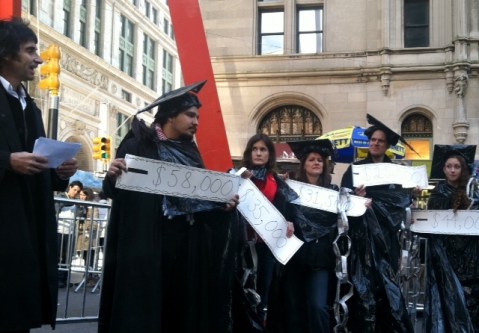
Opening of the Occupy Student Debt Campaign, Image by Flickr User JohannaClear
The experience of listening to the ODS rally illustrates how a sound studies perspective foregrounds experiential processes over exclusive categories of things and ideas. For example, when I read the OSD Debtors’ Pledge aloud to my students—vocalizing the text and sounds and listening to them— it brought the text into my body, making it an action. It also made students uncomfortable. Even just a round-robin reading of theory seems to make then anxious and fidgety. While I try to understand and accommodate anxieties around public speaking, I think the way sound makes a text enter the body can be a powerful affective experience. And no one ever said the classroom always had to be comfortable. For me, reading the text aloud personalized the OSD pledge. It evoked sensory memories: “Pledge of” evoked saying the pledge of allegiance in public school; saying “We believe” took me to attending Lutheran church services with my husband at the time where they collectively recite the Apostles’ Creed. These associations evoked emotional disidentifications from organized religion and mandatory collective professions of patriotism. It also temporalized and spatialized OSD for me, positioning it in relations to Dallas, Texas in the 1970s and Greenville, SC today.
Overall, the reading aloud of the pledge staged a tension or dialectic of identification and disidentifications. Although I agreed and identified with the sentiments of the movement, several alienating and unsettling aspects of the pledge came through as I read aloud: the blithe collapsings of “we” and “as members of the most indebted generations” made me wary (collectives always do, but so do easy historical assertions. Really? Are we more indebted than indentured servants who came to America, or people born into slavery?), and the sudden shift to first person singular at the very end seemed jarring: (After saying “we” six times, suddenly it’s ‘I’ now – what happened?). Lastly, the numerous alliterations also had an alienating effect, making the text seem sophistic and manipulative, artificial, composed.
The auditory experience of OSD can also provide insight into how we create texts. A video of Andrew Ross shows him presenting the first, “very rough draft” weeks earlier at an OWS event. Listening to him read this different, earlier version underscores the text as process. The pledge is something that developed. While his flat tone and straight male voice do not appeal to me, they do complexify and dimensionalize Brown’s reading, giving it depth. They also show that some things that bothered me in the final version – the collectivity and alliterations – were not there. This intertextual, diachronic listening does not erase troublesome aspects of the ‘final’ text, but it mediates them. I am moved closer to it by listening to its different origin.
Arguably, any of these points could have been arrived at by good ole’ textual analysis. My point is not that listening always should supplant visual modes; sound studies tries to break that false dichotomy by not denigrating or replacing the visual but by elevating the sonic to complementary – not superseding – status. I argue that reading aloud should be a fundamental, basic component of sound studies methodology, as it allows anyone to hear, voice, embody, and experience a text. I not only noticed these aspects sooner through listening – my first time speaking it aloud, despite having read it at least a dozen times before. Moreover, I didn’t just notice them: I felt them on a personal, emotional, level, which spurs thinking and analysis that is, if not completely new and unique, definitely qualitatively different in its potency and urgency.
Listening to OWS, and the OSD in particular, brings insights affective and personal. Yes, I can read a statistic from a survey stating that a certain percentage of participants in OWS feel angry or betrayed. That doesn’t mean anything to me in a specific, personal, and empathetic way – and empathy is crucial for a social movement to garner support. Listening to both Ross and Brown, I am reflective and conflicted over my professional role – no longer a grad student, but certainly not an established scholar like Ross. I feel connected to OSD in ways beyond the literal facts of my debt. Listening draws me into a contemplative, reflexive space beyond a sticky note on my office desk saying “OWS: teachable moment.” I can see a map with big, red OWS circles over Washington D.C. and New York, but I don’t feel the distance from myself and my students in the same way—and this is crucial for my teaching and engaging them in dialogue about what could be the most significant social movements of their lifetimes.
Share this:


Current Top Posts





April 2021

January 2020

November 2019

October 2019

August 2019

April 2014

November 2017

March 2015

December 2017

October 2015
 Sounding Out!
Recent Comments