
Doubled Double Consciousness and the Sound of New Afrikan Expression

 Inspired by the recent Black Perspectives “W.E.B. Du Bois @ 150” Online Forum, SO!’s “W.E.B. Du Bois at 150” amplifies the commemoration of the occasion of the 150th anniversary of Du Bois’s birth in 2018 by examining his all-too-often and all-too-long unacknowledged role in developing, furthering, challenging, and shaping what we now know as “sound studies.”
It has been an abundant decade-plus (!!!) since Alexander Weheliye’s Phonographies “link[ed] the formal structure of W.E.B. Du Bois’s The Souls of Black Folk to the contemporary mixing practices of DJs” (13) and we want to know how folks have thought about and listened with Du Bois in their work in the intervening years. How does Du Bois as DJ remix both the historiography and the contemporary praxis of sound studies? How does attention to Du Bois’s theories of race and sound encourage us to challenge the ways in which white supremacy has historically shaped American institutions, sensory orientations, and fields of study? What new futures emerge when we listen to Du Bois as a thinker and agent of sound?
Over the next two months, we will be sharing work that reimagines sound studies with Du Bois at the center. Pieces by Phillip Luke Sinitiere, Kristin Moriah, Aaron Carter-Ényì, Austin Richey, Jennifer Cook, Vanessa Valdés, and Julie Beth Napolin move us toward a decolonized understanding and history of sound studies, showing us how has Du Bois been urging us to attune ourselves to it. To start the series from the beginning, click here.
Readers, today’s post by Austin Richey considers the possibilities of Du Bois’ idea of double consciousness, as it applies to the Black Atlantic in general. He approaches “doubled double consciousness” through the case study of two artists: Tendai “Baba” Maraire and Efe Bes.
–Jennifer Lynn Stoever and Liana Silva, Eds.
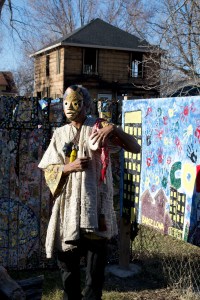
Efe Bes with his tama at Ohana Gardens, Highland Park, MI – taken by the author
In his 1903 text The Souls of Black Folk, W.E.B. Du Bois expresses the “otherness” of Black American identity as a “double consciousness,” an internalized condition whereby an individual’s self is contested by what Du Bois describes as the “sense of always looking at one’s self through the eyes of others…One ever feels his two-ness, an American, a Negro; two souls…; two warring ideals in one dark body” (2). This in-between status requires one to negotiate between these dual perspectives, and through the sonic expressions of cultural mediation, we may hear the tactics with which Black American culture creators select and present a particular version of their cultural identity.
In this essay, I argue for a doubled double consciousness that extends Du Bois’s conception into an increasingly interconnected space that Paul Gilroy called the Black Atlantic, a space which includes the histories and traditions of distinct African cultures, diasporic African communities, and Pan-African ideology. Based on the sonic practices of two artists, Seattle-based Zimbabwean American rapper and multi-instrumentalist Tendai Maraire, and Detroit-located Afrikan drummer and storyteller Efe Bes, we may hear doubled double consciousness as a multi-dimensional site of negotiation whereby musicians source from plural geographic, temporal, and cultural springs to compose a sonic “mix” of Black musical histories; this “mix” echoes the space where the hip hop DJ “noisily bring[s] together competing and complementary beats without sublating their tensions” (Weheliye 13). This anti-anti-essentialist tactic, as Carter Mathes describes in “The Sounds of Anti-Anti-Essentialism: Listening to Black Consciousness in the Classroom,” demonstrates that “it is the open space of sound that invests the project of black radical thought with the uncanny spontaneity of experimentation.”

“Tendai Maraire of Shabazz Palaces, Sub Pop Silver Jubilee, Pop Stage” by Flickr user Jeff Few, CC BY-NC-ND 2.0
Importantly, doubled double consciousness is a challenge to the received status of the “other,” and reveals a multiplicity of gazes through which an individual is viewed. As Maraire reflected,
I always felt that America saw us the same; not as African-American, Zimbabwean or even Black. Just Ignorant Negroes. As I got older my friends and I learned we’re all in the same social and economic positions. But I still had American friends who thought I felt better than them because I was Zimbabwean, and friends that were from Zimbabwe who thought I was better than them, or lost my culture because I had a curl and wore Jordans. (quoted in Devriendt)
Maraire assumed a singular, hegemonic gaze, yet his lived experience in America and Zimbabwe exposed him to critiques from black Americans, diasporic Africans, cosmopolitan and rural Zimbabweans, not to mention advocates, and sometimes appropriators, of different cultural lineages in a diverse city like Seattle.
While Du Bois claimed that the doubly conscious individual “does not wish to Africanize America,” the sonic expressions of doubled double consciousness reflect a particular Afrikan perspective, that is, a redefined social discourse which emerged from the intertwining of Black American activist efforts and knowledge derived from plural ancestral histories and African culture. By positioning themselves as Afrikan – not American, not African, but in-between – these artists showcase how doubled double consciousness is not a condition, but a tactic of negotiation and re-presentation.
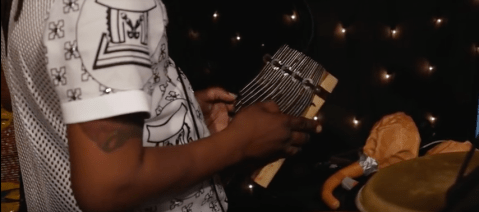
Screenshot of Maraire playing the nhare mbira, from the video “Chimurenga Renaissance – The B.A.D. Is So Good (Live on KEXP)”
Rapper and multi-instrumentalist Tendai “Baba” Maraire has been a staple of the Seattle hip hop scene since the early 1990s. While he honed his lyrical style in the cyphers of Seattle’s Columbia City, his parents Dumisani Maraire and Lora Chiorah-Dye, a renowned Zimbabwean ethnomusicologist and performer, and Zimbabwean dancer and instructor respectively, fostered a cosmopolitan Zimbabwean household; musically, Maraire performed live with his parents’ drum, dance, and marimba ensemble, sung Christian hymns in Shona, and opened for hip hop legends Snoop Dogg and Slick Rick. This provided Maraire with an extensive sonic palette to source from, yet his early attempts to bring these worlds together into an Afrocentric message were met with resistance:
[Audiences] didn’t even know what I was playing when I pulled out an mbira [a Zimbabwean lamellaphone] on stage 20 years ago and rapped with it. No one cared, rappers laughed. The world just wasn’t ready for that. With gangsta music at the time…they didn’t want to accept a dude with an mbira talking about political views out in Zimbabwe.” (Maraire interview)
Today, as half of the Afrofuturistic hip hop duo Shabazz Palaces, Maraire has continued to incorporate the mbira, ngoma (drums), and hosho (gourd rattles) into his musical production; as Shabazz Palaces toured with artists such as Radiohead and Lauryn Hill, Maraire’s Afrikan hip hop style reached a global stage.
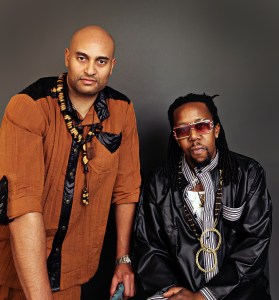
Tendai Maraire and Hussein Kalonji – courtesy of the artists
Doubled doubleness tactics come out forcefully in Maraire’s side project Chimurenga Renaissance, a moniker which connects chimurenga, a Zimbabwe-specific political struggle, to a global Black consciousness movement. Maraire and musical partner Hussein Kalonji, son of the famous Congolese Rhumba guitarist Raymond “Braynck” Kalonji, blend the melodic elements of Zimbabwean mbira and Congolese guitar with the sounds of the Roland 808 drum machine, funk and soul samples, topped by Maraire’s stream-of-consciousness lyrical flow.
Chimurenga Renaissance’s single “Pop Killer,” from 2013’s Defenders of the Crusades EP, exemplifies the power of doubled double consciousness to signify complex ideas to a variety of audiences: through his dismantling of problematic pop musicians who have left their culture behind, Maraire aims his Afrikan hip hop at American and Zimbabwean communities who have critiqued his cultural claims, as well as encourages other black musicians to dig deep and proudly represent their heritage. The video for the track follows Maraire as he travels to the ruins of Great Zimbabwe, the capital of the Kingdom of Zimbabwe (11th-15th centuries), with his mbira to confer with his ancestors. Sonically, the song has three distinct sections whose juxtaposition showcases the multiple sound cultures which make up Maraire’s complex identity.
The track opens with sound of wind, followed by a sampled and chopped up boom-bap drum beat. As Maraire improvises on his reverb-drenched mbira he is joined by a sampled walking bassline, while the chorus and reverb effects Kalonji uses for his arpeggiated melodies complement the timbre of Maraire’s amplified mbira. In the second section, the mbira remains while sampled drums are replaced by hand clapping, hosho, and ngoma, signifying a shift from the reproduction of electronic sounds to the liveness of group participation. Over this, Maraire’s unremitting lyrics call out those who reject their histories, telling them, “This ain’t a show, this a sacred ritual. You can’t possess it because your life is hypocritical.” As Kalonji’s guitar re-enters, the track slows to a third section where Maraire’s raps: “The gold on my pinkie represents where I’m from. If you ain’t never seen it then we ain’t close enough. I got some bigots in my wallet, sativa’s in my pocket, passport to touch the world cause the man can’t stop me.”
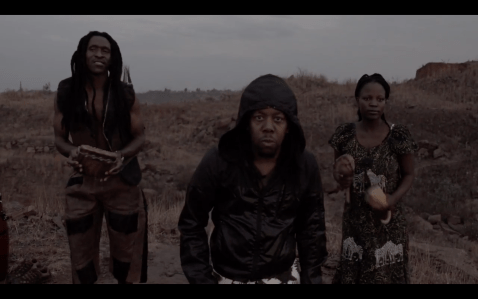
Jacob Mafuleni, Tendai Maraire, and Martha Thom in a still from Chimurenga Renaissance’s “Pop Killer”
The official video also includes a bonus verse, featuring Maraire rapping live in a field accompanied by Zimbabwean musicians Jacob Mafuleni and Martha Thom; this rural scene, featuring an unamplified mbira and driving rhythms from the hosho, further amplifies Maraire’s connection to ancestral life, while his raw vocals and intense delivery are reminiscent of a rap cypher.
In Detroit, Afrikan drummer and storyteller Efe Bes has used doubled double consciousness as a platform to critique those who have lost a cultural connection to African ancestors.
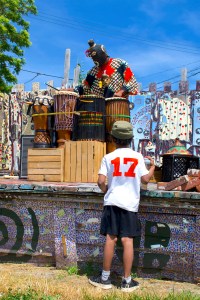
Efe Bes performing at Dabls’ MBAD African Bead Museum, Detroit, MI – taken by author
His own Afrikan-ness is marked not just visibly by his self-made Afrikan masks but also aurally through his unique musical instrumentation and style: Bes plays a collection of drums from across the African continent, including Senegalese sabar drums, West African tama and dundun, and South African ngoma, as well as a modified kora, balafon, and multiple drum machines. Bes performs complex patterns that source from the polyrhythms of West African music to the shuffle of American Blues, occasionally over instrumental recordings of popular hip hop singles, such as rapper Future’s “Fuck Up Some Commas.” For Bes, these musical traditions are connected by an emphasis on the drum, and his performances are marked by shifting patterns that easily move from the deep swing of the blues to the automated soul of techno, a tactic which he developed while DJing for Aretha Franklin in the early 1990s. Weaving these multiple black musical traditions, Bes creates a soundscape that simultaneously looks back to ancestral sound cultures while pushing the boundaries of what Detroit’s musical legacy will sound like in the future.
In addition to live performances, Bes produces his own music videos and promotes his music through YouTube. His archive of over 200 videos shows the breadth of his musical abilities, ranging from spoken word poetry combined with talking drum, to his most viewed original song, “Gimme Back My Shit,” an Afrikan funk tune in which Bes demands reparations for the devastation of Black culture worldwide.
The song begins with Bes humming and performing the main melody of the piece on electric piano. While his humming is laid back, the insistent rhythms of the piano foreshadows the lyrical intensity of this “real reparation song”; this is highlighted by the piano’s synthesized guitar sound, whose bright, cutting timbre and plucked sound are reminiscent of an amplified kora. This introduction leads to the main groove, where looped samples of syncopated funk drums and guitar accompaniment create a foundation for improvised tama drumming and his soulfully styled yet acerbically lyrical vocal performance.
“Give me back my shit, you done had it for so long you think that you own it.
I’m not talking about some, I’m talking all of it.”
Bes’s lyrics go beyond simple criticism, and instead, demand reparations in the form of cultural repatriation, or as Bes sings, “Give me back my ancestors you grave-robbing bitch.” In the self-produced music video, visuals of Pan-African statues, masks, and Mbuti pygmies are juxtaposed with images of Cecil Rhodes, starving children, and cellphones which rely on conflict materials like coltan; these images are punctuated by the sounds of African languages, such as the clicks and pops of Xhosa, as well as the sound of deforestation, such as gas-powered saws, further emphasizing the degradation and destruction of African cultures through the loss of music, language, tangible culture, and environment.
Through the sonic practices of Tendai Maraire’s Afrikan hip hop and Efe Bes’s Afrikan drumming, we may hear how doubled double consciousness is a tool used to negotiate complex ancestral recall. For these artists, doubled double consciousness is not simply a condition, but a powerful space to negotiate and re-articulate what it means to be Afrikan in America.
—
Featured image: Screenshot from video “Pop Killer” by Chimurenga Renaissance
—
Austin T. Richey is a Ph.D. candidate in Ethnomusicology at Eastman School of Music in Rochester, New York. His current dissertation research is based in his hometown of Detroit, Michigan, where he is exploring the resonances between diasporic African musical, dance, and visual arts and Detroit-specific musical genres, such as techno, in this historically multifaceted American city.
Richey has published original research in African Music, and has forthcoming articles in the Routledge Handbook of Music in the New African Diaspora and Opioid Aesthetics: Expressive Culture in an Age of Addiction, published by West Virginia University Press. Support for his work has come from the Society for Ethnomusicology’s African Libraries Prize, the Frederick Douglass Institute, as well as the Society for American Music, where he is an Adrienne Fried Block Fellow. Richey is also an active performer, playing regularly in the New York area with Serevende Mbira and Mounafanyi Drum and Dance.
—
 REWIND! . . .If you liked this post, you may also dig:
“Most pleasant to the ear”: W. E. B. Du Bois’s Itinerant Intellectual Soundscapes–Phillip Luke Sinitiere
On Whiteness and Sound Studies–Gustavus Stadler
Unlearning Black Sound in Black Artistry: Examining the Quiet in Solange’s A Seat At the Table–Kimberly Williams
Share this:

“I Dreamed and Loved and Wandered and Sang”: Sounding Blackness in W.E.B. Du Bois’s Dark Princess

Inspired by the recent Black Perspectives “W.E.B. Du Bois @ 150” Online Forum, SO!’s “W.E.B. Du Bois at 150” amplifies the commemoration of the occasion of the 150th anniversary of Du Bois’s birth in 2018 by examining his all-too-often and all-too-long unacknowledged role in developing, furthering, challenging, and shaping what we now know as “sound studies.”
It has been an abundant decade-plus (!!!) since Alexander Weheliye’s Phonographies “link[ed] the formal structure of W.E.B. Du Bois’s The Souls of Black Folk to the contemporary mixing practices of DJs” (13) and we want to know how folks have thought about and listened with Du Bois in their work in the intervening years. How does Du Bois as DJ remix both the historiography and the contemporary praxis of sound studies? How does attention to Du Bois’s theories of race and sound encourage us to challenge the ways in which white supremacy has historically shaped American institutions, sensory orientations, and fields of study? What new futures emerge when we listen to Du Bois as a thinker and agent of sound?
Over the next two months, we will be sharing work that reimagines sound studies with Du Bois at the center. Pieces by Phillip Luke Sinitiere, Kristin Moriah, Aaron Carter-Ényì, Austin Richey,Julie Beth Napolin, and Vanessa Valdés, move us toward a decolonized understanding and history of sound studies, showing us how has Du Bois been urging us to attune ourselves to it. To start the series from the beginning, click here.
Readers, today’s post by Kristin Moriah looks at Du Bois’s novel Dark Princess, and explores the relationship between sound and freedom in the text.
–Jennifer Lynn Stoever and Liana Silva, Eds.
Summer is come with bursting flower and promises of perfect fruit. Rain is rolling down Nile and Niger. Summer sings on the sea where giant ships carry busy worlds, while mermaids swarm the shores. Earth is pregnant. Life is big with pain and evil and hope. Summer in blue New York; summer in gray Berlin; summer in the real heart of the world!
W.E.B. Du Bois, Dark Princess (1928)

“Malcolm X BLVD” by Flickr user Alex Proimos, CC BY-NC 2.0
It is summer in Harlem now. Thick blankets of heat roil the city, and the pavement shimmers. Even the most die-hard city dwellers try to create distance between themselves and the noisy streets where political tensions threaten to boil over this season, as they always seem to. Airy tunes are often sung in vain here. More often than not, summer in New York City can be characterized by the sounds of the protests Julie Beth Napolin writes about so powerfully. At the moment, many of those protests are directed towards immigration detention centers and against forced family separation policies. Harlem, long a nexus for African diasporic and Latinx immigration and culture, has become a site of forced migration for migrant children separated from their families at the U.S. border and relocated to foster shelters like East Harlem’s Cayuga Center. Thus, contemporary nostalgia for Harlem as a site of creative freedom can be belied by reality.
But is there another place like this, not here, where one can go? An urban metropolis where one can be more attuned to sounds of the city and cries for justice? Where summer sings songs of freedom? Historically, there have been other options, especially for black travelers and migrants, and those options can tell us much about the way African American writers have conceptualized the relationship between sound and freedom. There was a strong correlation between sound and travel for African American intellectuals and performers during the Harlem Renaissance. During the brief period between Reconstruction and World War II, Europe, particularly Berlin, presented African Americans who traveled abroad with opportunities to hear and be heard differently. In The Sonic Color Line (2016), Jennifer Stoever has argued that W.E.B. Du Bois’s attention to the problem of the color line should inform our understanding of the centrality of sound in U.S. racial formations. But what happens to perceptions of the sonic color line once you cross the U.S. border? How have African American writers reflected on the sonic color line from a distance? W.E.B. Du Bois’s 1928 novel Dark Princess is an ideal place to begin exploring these questions.

Cover of Dark Princess, fair use
W.E.B. Du Bois fictionalized the experience of traveling to Berlin at the turn of the 20th century. As a whole, his work on travelling in Europe while black contributes to the discourse around race and sound by illustrating the importance of sounding blackness to political discourse. Du Bois continually accounted for sound in both his prose and fiction about his European travels during the early 20th century. For instance, in his autobiography Darkwater, Du Bois writes “as a student in Germany, I built great castles in Spain and lived therein. I dreamed and loved and wandered and sang; then after two long years I dropped suddenly back into ‘nigger’—hating America!” (16). Here and elsewhere, Du Bois portrays singing, performing, and listening–or what I identify here as sounding blackness–as crucial activities that foster intellectual development, creativity, and political awareness. In “Death Wish Mixtape,” Regina Bradley observes that contemporary instances of sounding blackness in popular culture are often linked to commodification and death. But the act of sounding blackness can be pliable, even as it signifies keen political awareness. In the Harlem Renaissance, sounding blackness was linked to black internationalism. In Du Bois’s work, sounding blackness involves testing the limits of blackness abroad and making African American culture audible by introducing blackness into political discourse for progressive purposes.
In the opening epigraph of the novel Dark Princess, at the beginning of this post, a summer journey begins with a song in the wake of tragedy. Written during the height of the Harlem Renaissance, in W.E.B. Du Bois’s Dark Princess, African American hero Matthew Towns travels to Europe to heal himself from racism’s psychic wounds, macroagressions, and foreshortened career prospects. Like Du Bois, Towns seeks respite from the systemic racism he encounters in the U.S. educational system, in this case at the University of Manhattan, a fictional Harlem medical school that is a stone’s throw from the City University of New York’s City College. In other words, Towns is a refugee of American racism.
Matthew Towns experiences new forms of freedom when he travels abroad. Fin-de-Siècle Berlin’s ambiguous racial boundaries allow Matthew Towns to practice American citizenship, perform an unfettered African American identity, and act as a spokesperson for the first time. Faced with the question of whether African diasporic “blood must tell,” or reveal its weaknesses through inarticulate discourse, Towns boldly asserts that it won’t tell “unless it is allowed to talk. Its speech is accidental today” (22). He begins to advocate for African Americans using various performative modes. Du Bois depicts Towns as what Alex Black might term a “resonant body,” a performer who uses embodied sound to shape the viewers’ perceptions of his or her humanity. In Berlin, Towns becomes a resonant body who sounds blackness outside the boundaries of the American color line in an attempt to ameliorate conditions for African Americans at home. As such, Towns echoes Du Bois’ insistence on the importance of song to the African American tradition and socio-political ambitions in The Souls of Black Folk (1903). Thus, Dark Princess picks up on the sonic themes Du Bois proposed in his earlier works.
As Du Bois’s novel unfolds, readers learn how Berlin could both confound and appeal to the African American imagination as a utopic site of black performance. Towns sings to a multi-ethnic group of elite political activists at a dinner party in Berlin. Invited by Princess Kautilya of Bwodpur, at first, “Matthew felt his lack of culture audible, and not simply of his own culture, but of all the culture in white America which he had unconsciously and foolishly, as he now realized made his norm” (24). Initially, American racism prevents Towns from sounding blackness and participating in global discourses around race and freedom. And yet, at the same party in Berlin, Towns is also overcome by the memory of Negro spirituals. He becomes a resonant body by reclaiming black working-class sensibility and pride: “it was as if he had faced and made a decision, as though some great voice, crying and reverberating within his soul, spoke for him and yet was him” (23). For Matthew Towns, sounding blackness abroad is not just personally empowering; sounding allows him to imagine himself as a key contributor to larger social movements and, potentially, black liberation. In both examples, the acts of hearing, verbalizing, and singing are depicted as necessary modes of political awareness and engagement. Without access to these sonic forms, Matthew is divorced from meaningful political participation.
Eventually, Matthew finds his way into the conversation by making a powerful argument for the cultural achievements of African Americans, or “the black rabble of America,” (26) by way of Negro Spirituals: “silence dropped on all, and suddenly Matthew found himself singing. His voice full, untrained but mellow, quivered down the first plaintive bar…” (26). It is the most striking instance of black performance in the novel:
The blood rushed to Matthew’s face. He threw back his head and closed his eyes, and with the movement, he heard again the Great Song. He saw his father in the old log church by the river, leading the moaning singers in the Great Song of Emancipation. Clearly, plainly he heard that mighty voice and saw the rhythmic swing and beat of the thick brown arm. Matthew swung his arm and beat the table; the silver tinkled. (25)
Du Bois continues: “He forgot his audience and saw only the shining river and the bowed and shouting throng […] Then Matthew let go of restraint and sang as his people sang in Virginia, twenty years ago. His great voice, gathered in one long deep breath, rolled the Call of God” (26).
Towns’s newfound ability to sound blackness in Berlin, or in other words vocalize African American claims to citizenship and freedom, stand in contrast to his earlier inability to respond coherently to Northern racism in New York City, where he is left “sputtering with amazement” at his exclusion from a medical school at which he has rightfully earned his place. In that instance, Matthew is rendered speechless. When “his fury had burst its bounds” it resulted in not a stream of invectives or vain pleas for justice, but a physical response. He throws “his certificates, his marks, and commendations straight into the drawn white face of the Dean” (4). Afterwards, isolated and alone, he stalks New York City. If there is a distinct sonic dimension to this flight from discrimination, readers are not privy to it. The sounds of Matthew’s footsteps, and cries of righteous indignation, fade into the background of Harlem’s streets. They are perhaps indiscernible amidst the ebb and flow of any number of similar city sounds and experiences. In this instance, Du Bois seems to suggest that the sound that emanates from physical gestures loses potency in certain urban contexts.
When Matthew Towns returns to Harlem, we are told that it’s with a renewed ear and life purpose. Standing on Seventh Avenue, with City College to his left, “he turned east and the world turned too – to a more careless and freer movement, louder voices and easier camaraderie” (41). From the sounds of church music to the accents of West Indian immigrants, he is much more attuned to the city’s diverse African diasporic presence. Hearing these African diasporic connections in a new way, he is fueled for black leadership and political activism.
Thus, Towns’s experiences sounding blackness abroad are a pivotal step in his political awakening and activism on U.S. soil. In locating the project of sounding blackness between Harlem and Berlin, Du Bois’s fiction makes space for the privileged summer traveler, the forced migrant, and immigrant. All are bound by the desire for social progress on local and global scales. Finally, I argue that the dynamic relationship between sound, space, justice and travel that Du Bois maps out has striking relevance to contemporary political and ethical crises. As in Dark Princess, justice in the here and now can be measured by the ability to sound aloud and effect social change the world over and on street corners.
—
Featured image: “Mapping Courage” by Flickr user Laurenellen McCann, CC BY-NC 2.0
—
Kristin Moriah is an Assistant Professor of African American Literary Studies in the English Department at Queen’s University. She is the editor of Black Writers and the Left (Cambridge Scholars Press, 2013) and the co-editor of Adrienne Rich: Teaching at CUNY, 1968-1974 (Lost & Found: The CUNY Poetics Document Initiative, 2014). Her work can be found in American Quarterly, PAJ: A Journal of Performance and Art, Theater Journal, and Understanding Blackness Through Performance (Palgrave Macmillan, 2013). Her research has been funded through grants from the Social Science and Humanities Council of Canada, the Freie Universität Berlin, the CUNY Graduate Center’s Advanced Research Collaborative and the Harry Ransom Center. In spring 2015 Moriah was a Scholar-in-Residence at the NYPL Schomburg Center for Research in Black Culture.
—
REWIND! . . .If you liked this post, you may also dig:
Black Mourning, Black Movement(s): Savion Glover’s Dance for Amiri Baraka –Kristin Moriah
“Most pleasant to the ear”: W. E. B. Du Bois’s Itinerant Intellectual Soundscapes — Phillip Luke Sinitiere
The Noise You Make Should Be Your Own–Scott Poulson-Bryant
Share this:


Current Top Posts





April 2021

January 2020

November 2019

October 2019

August 2019

April 2014

November 2017

March 2015

December 2017

October 2015
 Sounding Out!
Recent Comments