
Aurally Other: Rita Moreno and the Articulation of “Latina-ness”
 Dear Listeners,
This year, my first book—Dance and the Hollywood Latina: Race, Sex, and Stardom (Rutgers UP: 2011)—was born. The writing process required nearly a decade of thought and development, a gestation period that reminded me how to listen as well as see.
As a sound recordist in film school, I became acutely aware of the hierarchization of the visual over the aural: it was a challenge to claim space for sound when the director wanted to yell “Action” as soon as camera was ready. Me (covered in grime, Nagra deck over one shoulder and boom pole in hand): “What’s the frame line? Is my mic—or the shadow of my boom pole—in the shot? And, maybe I can get a level-check before we shoot—so the audio levels are as pretty as your exposure? Maybe?”
Yet, most of those instincts and that tenacity dissipated during graduate school. As I honed the language of film and television analysis, I, too, began to privilege the visual over the aural. Over time—and with the help of colleagues like Jennifer Stoever-Ackerman—Dance and the Hollywood Latina reminded me how to listen.
And so, I present a moment from the book that reinforced the scholarly importance of watching with my ears. In the following excerpt, I analyze Rita Moreno’s aural Otherness in West Side Story. The scene, like many others of Moreno’s career, illustrates the tension between the “look” and the “sound” of the Hollywood Latina. While my book is primarily organized around the ways that racialized sexuality is encoded in the dance of the Latina body in Hollywood film, the chapter “Rita Moreno, the Critically Acclaimed ‘All-Round Ethnic'” helps clarify how the Hollywood Latina has been read as both “easy on the eyes, but hard on the ears,” a phrase used to describe Moreno during her appearance on The Muppet Show in 1976.
The excerpt explores a pivotal scene in the film, where Anita (Moreno) confronts Maria (Natalie Wood), whom she discovers has just slept with Tony—the murderer of Bernardo (George Chakiris), Anita’s boyfriend and Maria’s brother:
[T]he nondance musical number “A Boy Like That” illuminates how the Hollywood Latina has also been aurally imagined and reproduced. [The song] expresses Anita’s anger and sense of betrayal, and eventually builds into a powerful duet (“I Have a Love”) between the women. As a backdrop, the setting and bodies of the scene are visually coded as Latino/a: the apartment matches the purples, blues, and reds associated with the Sharks in the film, while the two Latinas in the frame—one real and one diegetic—are colored Puerto Rican through the use of brown makeup. These stylized signifiers set the tone for Moreno’s aural representation in the scene. As the only Puerto Rican in the film cast, Rita Moreno gave a performance that became a touchstone of aural authenticity for non-Puerto Rican actors such as George Chakiris (Bernardo). In one interview, Chakiris notes that he and the Shark actors used Moreno as their sonic “guide” (Gross 2001). [Interestingly, the West Side Story shooting script available in the Bob Wise Collection at the University of Southern California Cinematic Arts Library includes written dialect for the Jets but not the Sharks, suggesting that the sonic expectations of the Latino/a characters were self-evident].
Both Natalie Wood and Rita Moreno lip-synch to prerecorded tracks, but unlike Wood, Moreno performs her other songs herself; “A Boy Like That” is Moreno’s only song that does not feature her real singing voice. While the dubbed vocal performance compensates for Moreno’s higher vocal range, it undercuts the ferocity of her physical performance. As Moreno’s facial expressions and posturing exhibit an angry and forceful delivery, singer Betty Wand’s vocal interpretation of the lyrics overly amplifies the supposed sound of a Latina body in lieu of the emotional urgency of the song. Moreno’s assertive body language is thus mismatched with the generic quality of Wand’s artificial accent, a kind of aural brown-face that flattens the scene’s intensity.
In a 2001 interview, Moreno expressed her disapproval of the vocals in “A Boy Like That,” claiming that Wand’s lack of acting skills resulted in a restricted interpretation that did not match the physical intensity of the scene. She explains: “[Wand] just couldn’t get it the way I wanted it…to sound. It should have almost been a growl…you know, barely sung. And she ended up sounding…almost like a cliché Mexican” (Gross 2001). Despite Moreno’s coaching, Wand could only articulate the song’s Latina-ness, a sonic interpretation that solely relied on a stereotypical accent to tell its story. This racialized vocal performance is incompatible with the emotional depth Moreno produces onscreen because it was only—always, and already—aurally Other. [This shift is most noticeable at the moment in “A Boy Like That” when Rita Moreno’s dialogue as Anita suddenly shifts to the lyrics of the song].


Rita Moreno’s career enabled me to hear the Hollywood Latina, an experience that enhanced my analysis of Dolores Del Rio, Carmen Miranda, Rita Hayworth (Rita Cansino), and Jennifer Lopez—the other women I study in Dance and the Hollywood Latina. I am thankful for Moreno’s (creative/political/critical) voice and hope that she continues to help me listen anew.
And thank you, dear listeners, for your time and attention. I hope to hear from you soon.
Sincerely,
priscilla.
PS: Dance and the Hollywood Latina: Race, Sex, and Stardom
😉


Share this:

“Ain’t Got the Same Soul”
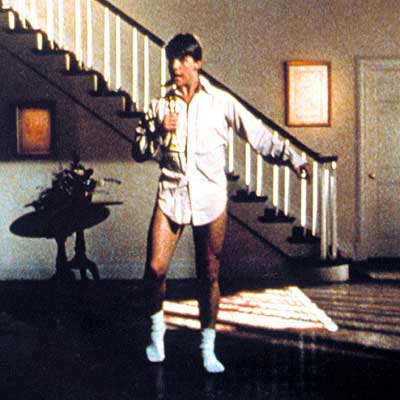 Bob Seger’s “Old Time Rock n’ Roll” has bothered me for a long time. I first heard it in Risky Business in 1983, four years after its initial release, as the soundtrack to a young Tom Cruise frolicking in his tightie-whities to his father’s sacrosanct (and expensive) hi-fi, expressing his repressed white suburban middle-class masculinity and sexuality. It was the song’s vague appeal that got me wondering even back then, how Cruise’s character was even old enough to remember the “old times” that Seger sang of. Hearing it on a “classic rock” station on a recent drive, it suddenly hit me – for many young people the song is a representation of what it clearly isn’t: “old time” rock n’ roll itself.
The song performs a form of hyper-nostalgia, not only eliding all potentially negative aspects of the “old times”—such as the racial erasure at rock n’ roll’s emergence into the mainstream—but eschewing any kind of specificity about “old time rock n’ roll” altogether. The song’s lyrical and sonic vagueness, punctuated by bland guitar solos and cheesy piano rolls, hearkens to an undefined sense of authenticity that casts doubt on other musical forms and implicitly marks itself as legitimate and authentic – laying a kind of homogeneous claim on rock itself.
The key phrase to Seger’s song, “Today’s music ain’t got the same soul / I like that old time rock n’ roll,” is leavened with irony, because it could be used as an example of “today’s music” itself – at least contemporary to the release of the song in 1979. And let’s face it, “Old Time Rock ‘n Roll” itself seems to be lacking in the soul department. Now, “soul” is a shibboleth. It is a call to a form of racial authenticity that many assume blacks have a natural, essential access to. When whites allegedly have it–it is something worthy of a NY Times article. However, when used by Seger, “soul” becomes a way of defining authentic music as having an unchanging “feel” anchored in a particular vision of the past. So distant it seems, that the lyrics can give us no real hint as to what constitutes “soul”; listeners are just supposed to know it when they feel it.
And yet, “Old Time Rock n’ Roll” arguably lacks that feel; leaving aside the happy accident of the repeated piano intro and the grain of Bob Seger’s voice, I’d make the argument that any close listening to the musical portions themselves makes the lack of “feeling” in the song evident. The song’s music can only be described as an attempt to present a generic portrait of rock n’ roll sounds, with Chuck Berry guitar licks deprived of all gusto and a sax so filtered it may have come from a late seventies synth. This could be attributable to the fact that Seger is singing over a demo meant as a model for his band to record its own version, but the fact remains that is the cut that was kept and that we all know.
The questions then arise: why so generic? Why the lack of specificity in sound and content?
The answer, I feel, can be found in the two listening practices described in the song and the preference of one over the other. The speaker’s unwillingness to be taken “to a disco / you’ll never even get [him] out on the floor” seems to be putting down a genre of music that emerges from a line of descent in the development of popular music in America that can be traced from the “blues and funky old soul” he claims he’d rather hear – Black American music. “Old Time Rock n’ Roll” can be seen as a kind of anthem of the disco wars, where rock fans violently objected to disco.
The rejection of disco then becomes part of a conflict at the time between “rock” as a dominant mainstream white musical form and disco, which Alice Echols has described in her recent book, Hot Stuff: The Remaking of American Culture, as a heterogeneous site that was black, queer, women-friendly and social and that eschewed the centrality of a ineffable “authenticity” that rock n’ roll always strove for. In order for Bob Seger’s “Old Time Rock n’ Roll” to establish its authenticity, it must contrast itself to disco, accomplishing this not only by pulling rock n’ roll into a personal listening sphere, but by eliding the sexual energy present in early rock n’ roll and still evident in the disco of the 70s. To heap upon this irony, the fact the high-hat cymbal moves into a disco off-time beat at several points in the song provides “Old Time Rock n’ Roll” with what catchy-rhythm it does have.
Leaving the disco after 10 minutes along with the opening lines of the song “Just take those old records off the shelf / I sit and listen to them by myself” one gets a sense of an anti-social listening practice that divorces the music he claims to love from its cultural context and transform it into a solitary act. Like nearly all forms of nostalgia, Seger’s view of the past of the music is problematic in its glossing over the complexities and specificities of the time he is ostensibly singing about.
 Another one of Seger’s hits may claim that “rock n’ roll never forgets,” but it seems like forgetting might be what it does best. Looking at Bob Seger’s professed influences— Little Richard and Elvis — we can see some of that forgetting in action. If the former suggests that the shifting, slippery, and flamboyant sexuality of disco has been present from rock’s very beginning, then the crowning of the latter as the “King of Rock n’ Roll” highlights just the kind of erasure that allows for a song like “Old Time Rock n’ Roll” to make sense as an anthem of whitewashed “heartland” rock. Seger’s clarion call to old timey-ness strips it of its sex even as he evokes a particular kind of “blackness” through the grain of his voice – a throaty howl full of a representation of sonic authenticity profiting of a vague sense of racial marking. In other words, Seger’s voice performs soulfulness through a growly working-class sound (typified in his “Like a Rock” Chevy commercials), itself a placeholder for race which is verboten in this construction of rock n’ roll. This kind of rock star class passing functions because of the racial erasure the songs enacts by means of white privilege.
Richard’s slippery sexuality and the way in which his most famous songs, like “Tutti Frutti” emphasize dance–and dancing as a euphemism for sex: “she rocks it to the east/she rocks it to the west/but she’s the girl that I know best”–brings me back to Seger’s denial of dance and the solitude of his idealized rock n’ roll, and thus back to Tom Cruise in his tightie-whities dancing around by himself in his parents’ fancy suburban Chicago house.
It makes sense that the scene in Risky Business is so isolated, middle-class and white – idealized rock n’ roll has been hijacked out of the heterogeneity of urban centers, and into the mythic American Heartland where white masculine sexuality can be extolled without threat. Seger’s reactionary song makes a world where it is safe for a teen-aged Cruise to enact his youthful rebellion by unproblematically participating in a form of class-passing of his own – lest we forget, the plot of Risky Business has his character playing the part of pimp to earn his way into Princeton – and yet retain his privileged position insulated from further influence of Black America on his music and on his life.

Share this:


Current Top Posts





April 2021

January 2020

November 2019

October 2019

August 2019

April 2014

November 2017

March 2015

December 2017

October 2015
 Sounding Out!
Recent Comments