
Regulating the Carceral Soundscape: Media Policy in Prison

In Alcatraz, prisoners were allowed to listen to radio via this two-channel device; Image by Flickr user adrian8_8
The first thing I noticed about 4-block was the silence. It was so quiet that every time I sat on my bunk I fell asleep. The Reformatory was always one continuous roar, musicfrom radios and televisions, noise from guys shouting to one another up and down the block, it seemed to never end. But in Jackson it was very, very different. The daytime hours you could hear typewriters and the closing of cell doors, the phone at the guards desk ringing but that was it. And after 9:00 PM you heard absolutely nothing …” –“Chet” (qtd. in Music Behind Bars: Liberatory Musicology in Two Michigan Prisons, 66-67)
Film and television usually portray prison as the loudest place on earth, filled with nonstop clanking and shouting and slamming, the noise reverberating sharply off its hard, flat surfaces. Actually, prison is much more likely to be a binary soundscape: either too loud or, at times, inhumanly quiet.
In fact, the manipulation of the sonic environment behind bars is part of the punishment mechanism itself, imposing or withholding different kinds of sound from different kinds of prisoners. There is a long history of prison music and prison radio, often within the context of education and activities aimed at recreation and rehabilitation, but here I’m talking about the mundane sounds of closing gates, locking doors, intrusive PA announcements, whirring fans, banging buckets, clattering garbage cans, and of course the human voice at any and all hours and volume levels: the inescapable sounds of quotidian prison life. The denial of the inmates’ ability to control that soundscape for themselves—or the compulsion that they do—thus becomes an issue not just of penal policy, but, interestingly, of media policy as well.
Indeed, the most fascinating questions in media policy these days are arising not at the FCC or OFCOM, but in places where policy scholars don’t usually look: schools, cinemas, and prisons. The state may have a lock on binding legislation, spectrum allocation, and international trade agreements, but it is the everyday policymakers on the school board or in the guard tower who directly affect more lives. With their pronouncements on which media forms may be used by whom, in what ways, and for what purposes, such accidental policymakers seek to regulate behavior through culture. Therefore, it is crucial to consider: which behaviors? which culture? and with which understandings of the relationship between the two?
One such instance of vernacular policymaking came last year when the Bureau of Prisons began testing the use of mp3 players in federal prisons, a technological update on rules that already allowed radios, televisions, and portable cassette or CD players. The move opens up new vistas of choice and control for the prisoners, who are no longer limited to the 20-30 cassette tapes or CDs for their Walkmen that cell space allows, nor dependent on the spotty radio reception in the rural areas where many prisons are located (a spatial impact which itself is an effect of multiple layers of ideology, policy, and control). Unsurprisingly, the players have become many prisoners’ most prized commodity, though the control they may exercise is far from absolute. The song selection is vetted by authorities (no “Cop Killer” in the Penitential Jukebox, don’t you know) and a remote kill switch allows the warden to brick the player should an inmate’s privileges be revoked, or in the case of theft or barter (trading goods and services is almost always a no-no in prison, a prohibition only slightly more effective, one guesses, than the ban on masturbation).

JPay’s JP4, The most common Mp3 device in U.S. Prisons
The introduction of mp3 players reveals not just the power and problems of local policymaking but the ways in which sound functions within a carceral system. For authorities, sound is “noise” when it interferes with security and a disciplinary tool when it doesn’t. As Robert Powitz’s article, “A Simple Primer on Jail Noise Control” reminds readers of American Jails, the trade publication for the prison industry, “Good security practices dictate that we want to hear certain sounds, particularly those associated with malfunctioning mechanical systems such as ventilation and plumbing, and more importantly, we need to hear a correctional officer’s call for help, an inmate in distress, and even seditious conversation” (Sep./Oct. 2007, 104). While it is surprisingly nice that Powitz threw “an inmate in distress” in the article, he otherwise presents an exclusively top-down rationale for separating sound from noise; Michel Foucault’s emphasis on the visual panopticon notwithstanding, which several scholars have critiqued, aural surveillance is equally important to the well functioning disciplinary institution and the production of docile bodies.

The Visitation Area at the former Moundsville State Penitentiary in West Virginia; Image by Flickr user IndyDina
Sound that American Jails would not classify as “noise”— i.e. sound that doesn’t interfere with security operations—is not merely incidental ambience, however, as the well-regulated soundscape produces its own disciplinary effects. The tortuous sensory deprivation of solitary confinement commonly includes the removal of sonic stimulation: silence as punishment. Already in the 1830s Alexis de Tocqueville critiqued the cruel silence imposed on prisoners in the U.S., and contemporary research repeatedly confirms the mentally destabilizing effects of sonic deprivation (see e.g. here and here). Total sonic deprivation is merely an extreme, however; there is an array of situations involving sound management. For example, conversations with visitors often occur through soundproof glass; obviously the surveillance function of this setup is paramount, but the distanciating filtration of the telephone adds further punishment through physical denial of the unmediated sound of a loved one’s voice. The raucous cacophony of the daytime cell block, meanwhile, acts efficiently as population control of another kind: as an incentive to self-regulate so as to enjoy the perks that enable one to escape the noise. The routines of prison policy intersect with the technologies of media policy to turn the chaotic soundscape into good behavior, through the mechanism of a prisoner’s desire for a pair of earbuds and some familiar tunes. (Media policies also turn that soundscape into a profit center: tracks on the prison’s version of iTunes cost between $1.29 and $1.99, obviously more than the going rate on the outside.)
Via the regulation of the aural environment, the authorities’ “sound”—the elements of the sonic environment that they impose or, at least, see no need to reduce or eliminate—thus becomes the prisoners’ “noise,” while prisoners’ “sound” can be either provided or withheld as part of the disciplinary and economic logic of the carceral system as a whole. As one prisoner, “Marcos,” summarized the system:
They pacify us with these so-called liberties, such as personal TVs, personal radios, personal guitars, tapes, cable TV, a complete store like the free world. And plenty of sports! Why–they call this our rights. In actuality it’s a break down in our system” (qtd. in Elsila, 56).
Such are the effects of so-called “personal” media for such an impersonal environment, for individuals who have been turned into social non-persons: media policy disguised as personal liberty rather than mass prisoner control. This disguise often fools the “throw away the key” law-and-order types who object to coddling criminals with the current Kenny Chesney track; for them, it is worth mentioning that the computers where prisoners download songs for their mp3 players are appropriately called—no joke—“Music Wardens.”
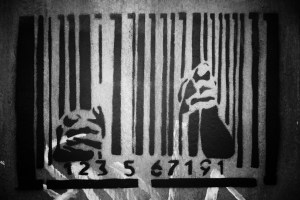
Image by Flickr User lanier67
Foucault’s great metaphor for the disciplinary society—the prison as a template of surveillance and control that has been adapted to all spheres of modern life—becomes punishingly literal behind bars, but that is merely where it is most visible or, often, audible. As I explain to my students, media policymakers claim merely to regulate gadgets, physics, and economic relations, but in fact they are always and inevitably also regulating bodies and ideas. The production of the prison soundscape reveals the relation of policy to conduct, a relation that in everyday life often remains cloaked behind scientific and legal discourses.
A final point: equally punishingly literal is the notion of media effects held by those policymakers in the prisons. Inveterate behaviorists, they imagine–and then attempt to manipulate–a direct causal relationship between media consumption and action, between sound and deeds. Those manipulations, however, are a broken media policy for a broken system. As Marcos put it, speaking of the many entertainment options available to the docile inmate: “Even before I ever could imagine I was going to end up in prison, never in my wild imagination could I expect it to be this easy. Yes I said easy. We have no serious form of rehabilitation. . .Why does the state spend more on activities than education?”
—
Thanks to Genevieve Spinner for invaluable research assistance on this project.
—
Bill Kirkpatrick is Assistant Professor of Media and Cultural Studies in the Communication Department at Denison University. His ongoing research and teaching interests include media history and cultural policy; impacts of popular culture on American public life; theories, practices, and future of citizen-produced media; and media and disability. He is also co-producer of Aca-Media, a monthly podcast that presents an academic perspective on media. You can find out more at www.billkirkpatrick.net.
—
 REWIND! . . .If you liked this post, you may also dig:
Prison Music: Containment, Escape, and the Sound of America—Jeb Middlebrook
SO! Reads: Jonathan Sterne’s MP3: The Meaning of a Format–Aaron Trammell
Pushing Play: What Makes the Portable Cassette Recorder Interesting?-Gus Stadler
Share this:

Goalball: Sport, Silence, and Spectatorship
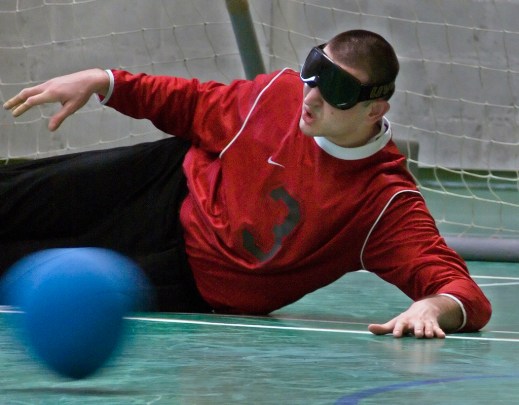
 Editor’s Note: Today, SO! kicks off our summer series on “Sound and Sport,” an interrogation of the roles that sound and listening play in the interconnected aspects of many sports: athletic skill, spectatorial experience, laws of physics challenged and exploited, and politics expressed and created. Often, the true play in sports involves power–and sound is a key venue to help us understand its flows and snags, and parse out the actual winners and losers. And, perhaps more directly than other venues, sports is a heightened arena that helps us understand just how important sound is in our everyday lives, even if (and especially because) we take it for granted.
One of my favorite personal “sports metaphors” for sounds’ unacknowledged centrality involves the precise 3.5 seconds I snowboarded with an iPod before I hit an ice patch full speed and had one of the worst falls I have suffered in my 15+ years of the sport. While I was laying on the hard packed snow gasping for breath and trying to piece together what happened, I realized exactly how much I depended on my listening to provide me with crucial, even-life saving, information. With my ears overwhelmed with treble-y punk, I had charged straight into an icepatch that I would have deftly avoided as soon as I heard the inevitable and unmistakeable scratching sound signalling its location. That kinesthetic lesson has continued to inform my everyday, every day since it happened and has led me to ever deeper understandings about sound’s power and the various forms of power that it clarifies–and are clarified by it in turn. I hope that this series will do the same for you, but without the blood and the bruises, even as some of our writers will remind you about the complex and dubious relationship sports can draw between “pain” and “gain.”
Batting first up on our line-up is Melissa Helquist, who describes how the Paralympic sport Goalball challenges the norms of the spectator/athlete relationship. Look for a post on Muhammad Ali in June (Tara Betts), skateboarding in July (Josh Ottum) and an all-out Olympic extravaganza in August, including a podcast discussing the sonic transformations of Brazil’s favelas in anticipation of the world’s ears in 2016 (Andrea Medrado). This summer, it is Sounding Out! FTW. –-J. Stoever-Ackerman, Editor-in-Chief
—
it’s oh so quiet
it’s oh so still
you’re all alone
and so peaceful until
you ring the bell
bim bam
you shout and yell
hi ho ho
you broke the spell
–Bjork, “It’s Oh So Quiet”
During the London 2012 Olympics, the Copper Box venue, which hosted handball, was dubbed “the box that rocks.” The moniker was also, perhaps, a way to drum up interest in handball, a still obscure sport. And indeed, raucous spectators and the pulse and bounce of balls and shoes created a sonic spectacle.
.
When the Paralympics began a few weeks later, much was made of the transformation of “the box that rocks” into “the box that rocks you to sleep.” The game that supposedly will rock you to sleep is Goalball.
Goalball is a 3-a-side game, played in two 12-minute halves. The offensive team rockets the ball down the court (it must be rolling by mid-court), trying to gain the low and wide net on the other side. As the ball rolls toward the net, the defending players lie on their sides in front of the net, blocking the ball with their bodies. As the ball is pummeled back and forth across the court, it jingles—a simple, clear bell emanating from eight holes in the ball’s surface. In this sport, sound is quite literally a game changer.
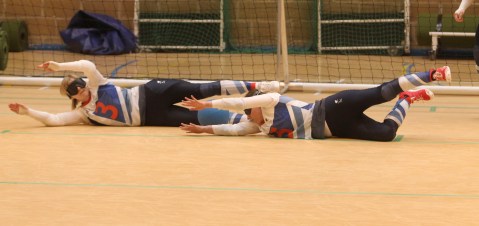
Goalball team practice at the ParalympicsGB Training Camp, Image by Flickr User The Department for Culture, Media and Sport
All goalball players are blind or low vison and wear blackout eyeshades to equalize the playing field and to ensure that any residual vision doesn’t get in the way of the gameplay’s sound. A pre-game equipment check includes referees ensuring that eyeshades don’t let in any light. Penalties include touching one’s eyeshades or making noises that disrupt the other team’s ability to hear the movement of the ball.
Goalball, a game first invented as a way to rehabilitate soldiers blinded in WWII, has been a Paralympic sport since 1976. It is one of the few sports designed specifically for blind athletes, rather than adapted from an existing sport. It is a game of sound and touch, a contrast to the visual perception typically associated with team-based ball games. The game, like many others in the Paralympics, expands the sensory experience of sport. The court’s borders are demarcated with tape-covered twine. Sonically, players orient themselves by calling out the position of the on-coming ball, rapping knuckles on the floor, and of course the jingle of the ball.
“Goalball” Courtesy of Perkins School for the Blind Archives
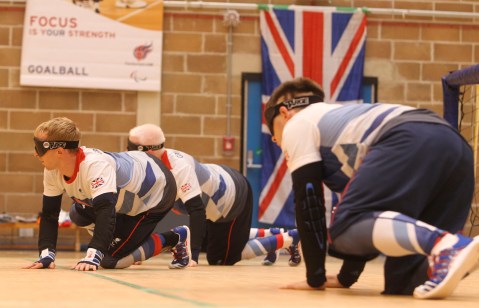
Image by Flickr User The Department for Culture, Media and Sport
The game is high impact; at the Paralympic level, the ball is thrown at speeds up to 60mph. Players launch the ball with high-velocity spins, something like a cross between a discus throw and bowling. Defenders block the ball with their entire bodies—hands, feet, torso. The game is intense, but it is also quiet.
The players’ reliance on sound demands new expectations of the audience. As spectators, we are watchers, but we are also noisemakers—shouters, shriekers, trashtalkers. Goalball spectators can (and do) cheer when a goal is scored, but when gameplay begins, silence is the rule. Before gameplay begins, referees demand, “Quiet Please!”
The Copper Box “was quite specifically designed to achieve a low background noise level so the blind athletes could play” (Soundscape, Issue 3, 38), enabling the venue to be transformed into an atypical space for the sound of sport and spectatorship, a place to challenge our assumptions and expectations.
Goalball? A description? from Daphnee Denis on Vimeo.
Goalball spectatorship doesn’t demand pure silence, but it is not the unfettered cacophony that we often expect in sports spectatorship. At the London 2012 Paralympics, Bjork’s “It’s So Quiet” was played during breaks in gameplay to remind spectators of their obligation. The song’s ebb and flow of silence and exuberance captures the sonic rhythm of Goalball, its pulsing cadence of silent attention and energetic eruption.
.
The nickname, “the box that rocks you to sleep” captures the discomfort spectators may have with Goalball’s soundscape. The silence during play is tense, but the scoring of a goal offers a sudden release. Spectators do not create a persistent cacophony, but rather a pulse, a constant pattern of lull and explosion. The silence of Goalball can feel disconcerting for spectators unfamiliar with the game. The sound of the crowd—the cheers, the clapping, the screams, the groans, the chants–often seem fundamental to the experience of sport.
Silent spectatorship, of course, is an expectation for other sporting events such as golf and tennis. Here, the demand for silence is linked ostensibly to concentration, but also invokes questions of tradition, class, and (in the case of tennis) gender. These sports are individualized demonstrations of skill, and we are admirers, observers.
Team sports invite identification from the crowd. We extend ourselves, making ourselves part of the team, often through sonic exuberance. Speaking about the crowd sounds of the London Olympics, Mike Goldsmith, author of Discord, notes:
Individual athletes commented that the crowd sound was a great source of energy to then, but could also distract. Their comments suggested that some of them used the crowd sound as a resource, that they could tap into or not as the moment demanded (Soundscape, Issue 3, 36).
Sound can feel like participation. Through sound, we make ourselves part of the game, cheering to support our team, hollering to distract a shot. Sound can make sport feel communal, and thus silence can feel like separation, a wall between spectator and team.
But the seeming silence of Goalball spectatorship offers an opportunity to pay attention to the sound of play, sounds that often get subsumed by the roar of the crowd. The meeting of disability and sport offers a “prime space to reread and rewrite culture’s makings” (Tanya Titchkosky, Reading and Writing Disability Differently, 2007), a space to hear sport differently. The culture of sport is rife with ableist assumptions about how we move, how we watch, how we play. Even when sound is part of sport, it is often an afterthought, an addition—sound might be distracting, it may affect play, but the center sensory preoccupation of sport is frequently visual. We watch, we spectate, we keep our eye on the ball. Sport is sight, but it is also sound. Spectatorship is raucous, but it is also silent.
zing boom shhhh.
—
Featured Image, “Goal Ball” by Flickr User BLac
—
Melissa Helquist is an Associate Professor of English at Salt Lake Community College and a PhD Candidate in Technical Communication and Rhetoric at Texas Tech University. Her dissertation research focuses on digital literacy and blindness and explores the use of sound to read, write, and interpret images. She is a 2012-13 HASTAC scholar and the recipient of a 2012-2013 CCCC Research Initiative Grant. She lives in Salt Lake City, where she hikes, camps, and canoes with her husband and daughter.
—
REWIND! . . .If you liked this post, you may also dig:
Eye Candy: The Absence of the Female Voice in Sports Talk Radio–Liana Silva
The Plasticity of Listening: Deafness and Sound Studies–Steph Ceraso
Taking Me Out of the Ball Game: Advertising’s Acoustic Pitch–Osvaldo Oyola
Share this:


Current Top Posts





April 2021

January 2020

November 2019

October 2019

August 2019

April 2014

November 2017

March 2015

December 2017

October 2015
 Sounding Out!
Recent Comments