
Playin’ Native and Other Iterations of Sonic Brownface in Hollywood Representations of Dolores Del Río
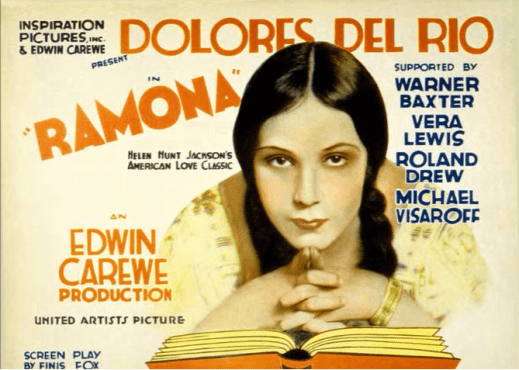
Mexican actress Dolores Del Río is admired for her ability to break ground; her dance skills allowed her to portray roles not offered to many women of color early in the 20th Century. One of her most popular roles was in the movie Ramona (1928), directed by Edwin Carewe. Her presence in the movie made me think about sonic representations of mestizaje and indigeneity through the characters portrayed by Del Río. According to Priscilla Ovalle, in Dance and the Hollywood Latina: Race, Sex and Stardom (2010), Dolores del Río was representative of Mexican nationhood while she was a rising star in Hollywood. Did her portrayals reinforce ways of hearing and viewing mestizos and First Nation people in the American imaginary? Is it sacrilegious to examine the Mexican starlet through sonic brownface? I explore these questions through two films, Ramona and Bird of Paradise (1932, directed by King Vidor), where Dolores del Río plays a mestiza and a Polynesian princess, respectively, to understand the deeper impact she had in Hollywood through expressions of sonic brownface.
Before I delve into analysis of these films and the importance of Ramona the novel and film adaptions, I wish to revisit the concept of sonic brownface I introduced here in SO! in 2013. Back then, I argued that the movie Nacho Libre and Jack Black’s characterization of “Nacho” is sonic brownface: an aural performativity of Mexicanness as imagined by non-Mexicans. Jennifer Stoever, in The Sonic Color Line (2017), postulates that how we listen to particular body(ies) are influenced by how we see them. The notion of sonic brownface facilitates a deeper examination of how ethnic and racialized bodies are not just seen but heard.
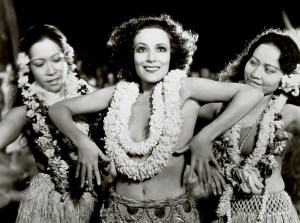
Picture of Del Rio as Luana in BIRDS OF PARADISE, available in the public domain.
Through my class lectures this past year, I realized there is more happening in the case of Dolores del Río, in that sonic brownface can also be heard in the impersonation of ethnic roles she portrayed. In the case of Dolores del Río, though Mexicana, her whiteness helps Hollywood directors to continue portraying mestizos and native people in ways that they already hear them while asserting that her portrayal helps lend authenticity due to her nationality. In the two films I discuss here, Dolores del Río helps facilitate these sonic imaginings by non-Mexicans, in this case the directors and agent who encouraged her to take on such roles. Although a case can be made that she had no choice, I imagine that she was quite astute and savvy to promote her Spanish heritage, which she credits for her alabaster skin. This also opens up other discussions about colorism prevalent within Latin America.
 First, let us focus on the appeal of Helen Hunt Jackson’s Ramona (1884), as it is here that the cohabitation of Scots, Spanish, Mestizos, and Native people are first introduced to the American public in the late 19th century. According to Evelyn I. Banning, in 1973’s Helen Hunt Jackson, the author wanted to write a novel that brought attention to the plight of Native Americans. The novel highlights the new frontier of California shortly after the Mexican American War. Though the novel was critically acclaimed, many folks were more intrigued with “… the charm of the southern California setting and the romance between a half-breed girl raised by an aristocratic Spanish family and an Indian forced off his tribal lands by white encroachers.” A year after Ramona was published, Jackson died and a variety of Ramona inspired projects that further romanticized Southern California history and its “Spanish” past surged. For example, currently in Hemet, California there is the longest running outdoor “Ramona” play performed since 1923. Hollywood was not far behind as it produced two silent-era films, starring Mary Pickford and Dolores del Río.
The charm of the novel Ramona is that it reinforces a familiar narrative of conquest with the possibility of all people co-existing together. As Philip Deloria reminds us in Playing Indian (1999), “The nineteenth-century quest for a self-identifying national literature … [spoke] the simultaneous languages of cultural fusion and violent appropriation” (5). The nation’s westward expansion and Jackson’s own life reflected the mobility and encounters settlers experienced in these territories. Though Helen Hunt Jackson had intended to bring more attention to the mistreatment of native people in the West, particularly the abuse of indigenous people by the California Missions, the fascination of the Spanish speaking people also predominated the American imaginary. To this day we still see in Southern California the preference of celebrating the regions Spanish past and subduing the native presence of the Chumash and Tongva. Underlying Jackson’s novel and other works like Maria Amparo Ruiz De Burton The Squatter and the Don (1885) is their critique of the U.S. and their involvement with the Mexican American War. An outcome of that war is that people of Mexican descent were classified as white due to the signing of Treaty of Guadalupe Hidalgo and were treated as a class apart. (See Michael Olivas’ anthology, Colored Men and Hombres Aqui from 2006 and Ignacio M. García, White but not Equal from 2008). These novels and films reflect the larger dominant narrative of whiteness and its relationship to nation building. Through Pickford’s and del Río’s portrayals of Ramona they reinforce the whiteness of mestizaje.

Screenshot from RAMONA (1910). Here, Ramona (played by Mary Pickford) finds out that she has “Indian blood.”
In 1910, Mary Pickford starred in D.W. Griffith’s short film adaptation of Ramona as the titular orphan of Spanish heritage. Henry B. Walthall played Alessandro, the Native American, in brownface to mimic physical attributes of the native Chumash of Southern California. Griffith also wanted to add authenticity by filming in Camulas, Ventura County, the land of the Chumash and where Jackson based her novel. The short is a sixteen-minute film that takes viewers through the encounter between Alessandro and Ramona and their forbidden love, as she was to be wedded to Felipe, a Californio. There is a moment in the movie when Ramona is told she has “Indian blood”. Exalted, Mary Pickford says “I’m so happy” (6:44-6:58). Their short union celebrates love of self and indigeneity that reiterates Jackson’s compassionate plea of the plight of native people. In the end, Alessandro dies fighting for his homeland, and Ramona ends up with Felipe. Alessandro, Ramona, and Felipe represent the archetypes in the Westward expansion. None had truly the power but if mestizaje is to survive best it serve whiteness.
.jpg#filelinks)
Poster of 1928’s RAMONA, under fair use
Edwin Carewe’s rendition of Ramona in 1928 was United Artists’ first film release with synchronized sound and score. Similar to the Jazz Singer in 1927, are pivotal in our understanding of sonic brownface. Through the use of synchronized scored music, Hollywood’s foray into sound allowed itself creative license to people of color and sonically match it to their imaginary of whiteness. As I mentioned in my 2013 post, the era of silent cinema allowed Mexicans in particular, to be “desirable and allowed audiences to fantasize about the man or woman on the screen because they could not hear them speak.” Ramona was also the first feature film for a 23-year-old Dolores del Río, whose beauty captivated audiences. There was much as stake for her and Carewe. Curiously, both are mestizos, and yet the Press Releases do not make mention of this, inadvertently reinforcing the whiteness of mestizaje: Del Río was lauded for her Spanish heritage (not for being Mexican), and Carewe’s Chickasaw ancestry was not highlighted. Nevertheless, the film was critically acclaimed with favorable reviews such as Mordaunt Hall’s piece in the New York Times published May 15, 1928. He writes, “This current offering is an extraordinarily beautiful production, intelligently directed and, with the exception of a few instances, splendidly acted.” The film had been lost and was found in Prague in 2005. The Library of Congress has restored it and is now celebrated as a historic film, which is celebrating its 90th anniversary on May 20th.
In Ramona, Dolores del Río shows her versatility as an actor, which garners her critical acclaim as the first Mexicana to play a starring role in Hollywood. Though Ramona is not considered a talkie, the synchronized sound comes through in the music. Carewe commissioned a song written by L. Wolfe Gillbert with music by Mabel Wayne, that was also produced as an album. The song itself was recorded as an instrumental ballad by two other musicians, topping the charts in 1928.
In the movie, Ramona sings to Allessandro. As you will read in the lyrics, it is odd that it is not her co-star Warner Baxter who sings, as the song calls out to Ramona. Del Río sounds angelic as the music creates high falsettos. The lyrics emphasize English vernacular with the use of “o’er” and “yonder” in the opening verse. There are moments in the song where it is audible that Del Río is not yet fluent speaking, let alone singing in English. This is due to the high notes, particularly in the third verse, which is repeated again after the instrumental interlude.
I dread the dawn
When I awake to find you gone
Ramona, I need you, my own
Each time she sings “Ramona” and other areas of the song where there is an “r”, she adds emphasis with a rolling “r,” as would be the case when speaking Spanish. Through the song it reinforces aspects of sonic brownface with the inaudible English words, and emphasis on the rolling “rrrr.” In some ways, the song attempts to highlight the mestiza aspects of the character. The new language of English spoken now in the region that was once a Spanish territory lends authenticity through Dolores del Río’s portrayal. Though Ramona is to be Scottish and Native, she was raised by a Spanish family named Moreno, which translates to brown or darker skin. Yes, you see the irony too.

United Artists Studio Film Still, under Fair Use
Following Del Río’s career, she plays characters from different parts of the world, usually native or Latin American. As Dolores del Río gained more popularity in Hollywood she co-starred in several movies such as Bird of Paradise (1932), directed by King Vidor, in which she plays a Polynesian Princess. Bird of Paradise focuses on the love affair between the sailor, played by Joel McCrea, and herself. The movie was controversial as it was the first time we see a kiss between a white male protagonist with a non-Anglo female, and some more skin, which caught the eye of The Motion Picture Code commission. Though I believe the writers attempted to write in Samoan, or some other language of the Polynesian islands, I find that her speech may be another articulation of sonic brownface. Beginning with the “talkies,” Hollywood continued to reiterate stereotypical representations though inaccurate music or spoken languages.
In the first encounter between the protagonists, Johnny and Luana, she greets him as if inviting him to dance. He understands her. He is so taken by her beauty that he “rescues” her to live a life together on a remote island. Though they do not speak the same language at first it does not matter because their love is enough. This begins with the first kiss. When she points to her lips emphasizing kisses, which he gives her more of. The movie follows their journey to create a life together but cannot be fully realized as she knows the sacrifice she must pay to Pele.
I do not negate the ground breaking work that Dolores del Río accomplished while in Hollywood. It led her to be an even greater star when she returned to Mexico. However, even her star role as Maria Candelaria bares some examination through sonic brownface. It is vital to examine how the media reinforces the imaginary of native people as not well spoken or inarticulate, and call out the whiteness of mestizaje as it inadvertently eliminates the presence of indigeneity and leaves us listening to sonic brownface.
—
reina alejandra prado saldivar is an art historian, curator, and adjunct lecturer in the Women, Gender and Sexuality Studies Program and Liberal Studies Department at CSULA and in the Critical Studies Program at CALArts. As a cultural activist, she focused her earlier research on Chicano cultural production and the visual arts. Prado is also a poet and performance artist known for her interactive durational work Take a Piece of my Heart as the character Santa Perversa (www.santaperversa.com) and is currently working on her first solo performance entitled Whipped!
—
Featured image: Screenshot from “Ramona (1928) – Brunswick Hour Orchestra”
—
 REWIND!…If you liked this post, you may also dig:
Afecto Caribeño / Caribbean Affect in Desi Arnaz’s “Babalú Aye” – reina alejandra prado saldivar
SO! Amplifies: Shizu Saldamando’s OUROBOROS–Jennifer Stoever
SO! Reads: Dolores Inés Casillas’s ¡Sounds of Belonging! – Monica de la Torre
Share this:

Look Away and Listen: The Audiovisual Litany in Philosophy

This is an excerpt from a paper I delivered at the 2017 meeting of the Society for Phenomenology and Existential Philosophy.
—

“Compressed and rarefied air particles of sound waves” from Popular Science Monthly, Volume 13. In the public domain, via Wikimedia Commons.
According to sound studies scholar Jonathan Sterne in The Audible Past, many philosophers practice an “audiovisual litany,” which is a conceptual gesture that favorably opposes sound and sonic phenomena to a supposedly occularcentric status quo. He states, “the audiovisual litany…idealizes hearing (and, by extension, speech) as manifesting a kind of pure interiority. It alternately denigrates and elevates vision: as a fallen sense, vision takes us out of the world. But it also bathes us in the clear light of reason” (15). In other words, Western culture is occularcentric, but the gaze is bad, so luckily sound and listening fix all that’s bad about it. It can seem like the audiovisual litany is everywhere these days: from Adriana Cavarero’s politics of vocal resonance, to Karen Barad’s diffraction, to, well, a ton of Deleuze-inspired scholarship from thinkers as diverse as Elizabeth Grosz and Steve Goodman, philosophers use some variation on the idea of acoustic resonance (as in, oscillatory patterns of variable pressure that interact via phase relationships) to mark their departure from European philosophy’s traditional models of abstraction, which are visual and verbal, and to overcome the skeptical melancholy that results from them. The field of philosophy seems to argue that we need to replace traditional models of philosophical abstraction, which are usually based on words or images, with sound-based models, but this argument reproduces hegemonic ideas about sight and sound.
 For Sterne, the audiovisual litany is traditionally part of the “metaphysics of presence” that we get from Plato and Christianity: sound and speech offer the fullness and immediacy that vision and words deny. However, contemporary versions of the litany appeal to a different metaphysics. For example, Cavarero in For More Than One Voice argues that the privileging of vision over sound is the foundation of the metaphysics of presence. “The visual metaphor,” she argues, “is not simply an illustration; rather, it constitutes the entire metaphysical system” (38). The problem with this videocentric metaphysics is that it “legitimates the reduction of whatever is seen to an object” (Cavarero 176) and it cannot “anticipate” or “confirm the uniqueness” of each individual (4). In other words, it objectifies and abstracts, and that’s bad. If vision is the foundation of the metaphysics of presence, one way to fix its problems is to replace the foundation with something else. Cavarero thinks vocal resonance avoids the objectifying and abstracting tendencies that images and text supposedly lend to philosophy.
Similarly, in the same way that the traditional audiovisual litany “assume[s] that sound draws us into the world while vision separates us from it” (Sterne 18), Barad’s argument for agential realism in Meeting the Universe Halfway assumes that diffraction draws theorists into actual contact with matter while “reflection still holds the world at a distance” (87). Agential realism looks is the view that even the most basic units of reality, like the basic particles of matter, exercise agency as they interact to form more complex units; diffraction is Barad’s theory about how these particles interact. This litany of distance-versus-relationality and external objectivity versus immersive materiality structures Barad’s counterpoint between reflection and diffraction. For example, she contrasts traditional investment in reflective surfaces—“the belief that words, concepts, ideas, and the like accurately reflect or mirror the things to which they refer-makes a finely polished surface of this whole affair” (86)–with diffractive interiorities, which get down to “the real consequences, interventions, creative possibilities, and responsibilities of intra-acting within and as part of the world” (37). But how do we know Barad is appealing to an audiovisual litany? We know because her fundamental concept–diffraction–describes the behavior of waveforms as they encounter other things, and 21st century Western scientists and music scholars think sound is a waveform. When two or more waves interact, they produce “alternating pattern[s] of wave intensity” or “increasing and decreasing intensities” (Barad 77), like ripples in water or alternating light frequencies.

“diffracted hydrogen” by Flickr user candace, CC BY 2.0
Barad appeals to notions of consonance and dissonance to explain how these patterns interact. For example, when diffracting light waves around a razor blade, “bright spots appear in places where the waves enhance one another-that is, where there is ‘constructive interference’-and dark spots appear where the waves cancel one another-that is, where there is ‘destructive interference’” (Barad 77). This “constructive” and “destructive” interference is like audio amplification and masking: when frequencies are perfectly in sync (peaks align with peaks, valleys with valleys), they amplify; when frequencies are perfectly out of sync (peaks align with valleys), they cancel each other out (this is how noise-cancelling headphones work). Constructive interference is consonance: the synced patterns amplify one another; destructive interference is dissonance: the out-of-sync patterns mask each other. Both types of interference are varieties of resonance, a rational or irrational phase relationship among frequencies. Rational phase relationships are ones where the shorter phases or periods of higher frequencies are evenly divisible into the longer phases/periods; irrational phase relationships happen when the shorter phases can’t be evenly divided into the longer wavelengths. Abstracting from waveforms to philosophical analysis, Barad often uses resonance as a metaphor to translate wave behavior into materialist philosophical methods. However, even though most of Barad’s examples throughout Meeting the Universe Halfway are visual, she’s describing what scientists call acoustic relationships.
For example, Barad argues that “diffractively read[ing]” philosophical texts means processing “insights through one another for the patterns of resonance and dissonance they coproduce” (195; emphasis mine). Similarly, she advises her readers to tune into the “dissonant and harmonic resonances” (43) that emerge when they try “diffracting these insights [from an early chapter in her book] through the grating of the entire set of book chapters” (30). As patterns of higher and lower intensity that interact via ir/rational phase relationships, diffraction patterns are a type of acoustic resonance. Appealing to acoustics against representationalism, Barad practices a version of the audiovisual litany. And she’s not the only new materialist to do so—Jane Bennett’s concept of vibration and Elizabeth Grosz’s notion of “music” also ontologize a similar idea of resonance and claim it overcomes the distancing and skeptical melancholy produced by traditional methods of philosophical abstraction.

“Painter” by Flickr user Flood G., CC BY-NC-ND 2.0
There are also instances of the audiovisual litany in phenomenology. For example, Alia Al-Saji develops in the article “A Phenomenology of Critical-Ethical Vision” a notion of “critical-ethical vision” against “objectifying vision,” and, via a reading of Merleau-Ponty, grounds the former, better notion of sight (and thought) in his analogy between painting and listening. According to Al-Saji, “objectifying vision” is the model of sight that has dominated much of European philosophy since the Enlightenment. “Objectifying vision” takes seeing as “merely a matter of re-cognition, the objectivation and categorization of the visible into clear-cut solids, into objects with definite contours and uses” (375). Because it operates in a two-dimensional metaphysical plane it can only see in binary terms (same/other): “Objectifying vision is thus reductive of lateral difference as relationality” (390). According to Al-Saji, Merleau-Ponty’s theory of painting develops an account of vision that is “non-objectifying” (388) and relational. We cannot see paintings as already-constituted objects, but as visualizations, the emergence of vision from a particular set of conditions. Such seeing allows us “to glimpse the intercorporeal, social and historical institution of my own vision, to remember my affective dependence on an alterity whose invisibility my [objectifying] vision takes for granted” (Al-Saji 391). Al-Saji turns to sonic language to describe such relational seeing: “more than mere looking, this is seeing that listens (391; emphasis mine).
This Merleau-Pontian vision not only departs from traditional European Enlightenment accounts of vision, it gestures toward traditional European accounts of hearing. Similarly, Fred Evans, in The Multivoiced Body uses voice as a metaphor for the Deleuzo-Guattarian metaphysics that he calls “chaosmos” or “composed chaos” (86); he then contrasts chaosmos to “homophonic” (67) Enlightenment metaphysics. According to Evans, if “‘voices,’ not individuals, the State, or social structures, are the primary participants in society” (256), then “reciprocity” and “mutual intersection” (59) appear as fundamental social values (rather than, say, autonomy). This analysis exemplifies what is at the crux of the audiovisual litany: voices put us back in touch with what European modernity and postmodernity abstract away.

“Image from page 401 of “Surgical anatomy : a treatise on human anatomy in its application to the practice of medicine and surgery” (1901)” by Flickr user Internet Archive Book Images
The audiovisual litany is hot right now: as I’ve just shown, it’s commonly marshaled in the various attempts to move past or go beyond stale old Western modernist and postmodernist philosophy, with all their anthropocentrism and correlationism and classical liberalism. To play with Marie Thompson’s words a bit, just as there is an “ontological turn in sound studies,” there’s a “sound turn in ontological studies.” But why? What does sound DO for this specific philosophical project? And what kind of sound are we appealing to anyway?
The audiovisual litany naturalizes hegemonic concepts of sound and sight and uses these as metaphors for philosophical positions. This lets philosophical assumptions pass by unnoticed because they appear as “natural” features of various sensory modalities. Though he doesn’t use this term, Sterne’s analysis implies that the audiovisual litany is what Mary Beth Mader calls a sleight. “Sleights” are, according to Mader in Sleights of Reason,“conceptual collaborations that function as switches or ruses important to the continuing centrality and pertinence of the social category of a political system like “sex” (3). Sleights, in other words, are conceptual slippages that render underlying hegemonic structures like cisheteropatriarchy coherent. More specifically, sleights are “conceptual jacquemarts” (Mader 5). Jacquemarts are effectively the Milli Vanilli of clocks: sounds appear to come from one overtly visible, aesthetically appealing source action (figures ringing a bell) but they actually come from a hidden, less aesthetically appealing source action (hammers hitting gongs). The clock is constructed in a way to “misdirect or misindicate” (Mader 8) both who is making the sound and how they are making it. A sound exists, but its source is misattributed. This is exactly what happens in the uses of the audiovisual litany I discuss above: philosophers misdirect or misindicate the source of the distinction they use the audiovisual litany to mark. The litany doesn’t track the difference between sensory media or perceptual faculties, but between two different methods of abstraction.

Screenshot from Milli Vanilli’s video “Don’t Forget My Number”
This slippage between perceptual medium and philosophical method facilitates the continued centrality of Philosophy-capital-P: philosophy appears to reform its methods and fix its problems, while actually re-investing in its traditional boundaries, values, and commitments. For example, both new materialists and sound studies scholars have been widely critiqued for actively ignoring work on sound and resonance in black studies (e.g., by Zakiyyah Jackson, Diana Leong, Maire Thompson). As Zakiyyah Jackson argues in “Outer Worlds: The Persistence of Race in Movement “Beyond the Human,” new materialism’s “gestures toward the ‘post’ or the ‘beyond’ effectively ignore praxes of humanity and critiques produced by black people” (215), and in so doing ironically reinstitute the very thing new materialism claims to supercede. Stratifying theory into “new” and not-new, new materialist “appeals to move ‘beyond’…may actually reintroduce the Eurocentric transcendentalism this movement purports to disrupt” (Jackson 215) by exclusively focusing on European philosophers’ accounts of sound and sight. Similarly, these uses of the litany often appeal only to other philosophers’ accounts of sound or music, not actual works or practices or performances. They don’t even attend to the sonic dimensions of literary texts, a method that scholars such as Jennifer Lynn Stoever and Alexander Weheliye develop in their work. Philosophers use the audiovisual litany to disguise philosophy’s ugly politics—white supremacy and Eurocentrism—behind an outwardly pleasing conceptual gesture: the turn from sight or text to sound. With this variation of the audiovisual litany, Philosophy appears to cross beyond its conventional boundaries while actually doubling-down on them.
—
Featured image: “soundwaves” from Flickr user istolethetv
—
Robin James is Associate Professor of Philosophy at UNC Charlotte. She is author of two books: Resilience & Melancholy: pop music, feminism, and neoliberalism, published by Zer0 books last year, and The Conjectural Body: gender, race and the philosophy of music was published by Lexington Books in 2010. Her work on feminism, race, contemporary continental philosophy, pop music, and sound studies has appeared in The New Inquiry, Hypatia, differences, Contemporary Aesthetics, and the Journal of Popular Music Studies. She is also a digital sound artist and musician. She blogs at its-her-factory.com and is a regular contributor to Cyborgology.
—
 REWIND! . . .If you liked this post, you may also dig:
From “listening” to “filling in”: where “La Soeur Écoute” Teaches Us to Listen-Emmanuelle Sontag
The Listening Body in Death –Denise Gill
Re-orienting Sound Studies’ Aural Fixation: Christine Sun Kim’s “Subjective Loudness”-Sarah Mayberry Scott
Share this:


Current Top Posts





April 2021

January 2020

November 2019

October 2019

August 2019

April 2014

November 2017

March 2015

December 2017

October 2015
 Sounding Out!
Recent Comments