
“I Dreamed and Loved and Wandered and Sang”: Sounding Blackness in W.E.B. Du Bois’s Dark Princess

 Inspired by the recent Black Perspectives “W.E.B. Du Bois @ 150” Online Forum, SO!’s “W.E.B. Du Bois at 150” amplifies the commemoration of the occasion of the 150th anniversary of Du Bois’s birth in 2018 by examining his all-too-often and all-too-long unacknowledged role in developing, furthering, challenging, and shaping what we now know as “sound studies.”
It has been an abundant decade-plus (!!!) since Alexander Weheliye’s Phonographies “link[ed] the formal structure of W.E.B. Du Bois’s The Souls of Black Folk to the contemporary mixing practices of DJs” (13) and we want to know how folks have thought about and listened with Du Bois in their work in the intervening years. How does Du Bois as DJ remix both the historiography and the contemporary praxis of sound studies? How does attention to Du Bois’s theories of race and sound encourage us to challenge the ways in which white supremacy has historically shaped American institutions, sensory orientations, and fields of study? What new futures emerge when we listen to Du Bois as a thinker and agent of sound?
Over the next two months, we will be sharing work that reimagines sound studies with Du Bois at the center. Pieces by Phillip Luke Sinitiere, Kristin Moriah, Aaron Carter-Ényì, Austin Richey,Julie Beth Napolin, and Vanessa Valdés, move us toward a decolonized understanding and history of sound studies, showing us how has Du Bois been urging us to attune ourselves to it. To start the series from the beginning, click here.
Readers, today’s post by Kristin Moriah looks at Du Bois’s novel Dark Princess, and explores the relationship between sound and freedom in the text.
–Jennifer Lynn Stoever and Liana Silva, Eds.
Summer is come with bursting flower and promises of perfect fruit. Rain is rolling down Nile and Niger. Summer sings on the sea where giant ships carry busy worlds, while mermaids swarm the shores. Earth is pregnant. Life is big with pain and evil and hope. Summer in blue New York; summer in gray Berlin; summer in the real heart of the world!
W.E.B. Du Bois, Dark Princess (1928)

“Malcolm X BLVD” by Flickr user Alex Proimos, CC BY-NC 2.0
It is summer in Harlem now. Thick blankets of heat roil the city, and the pavement shimmers. Even the most die-hard city dwellers try to create distance between themselves and the noisy streets where political tensions threaten to boil over this season, as they always seem to. Airy tunes are often sung in vain here. More often than not, summer in New York City can be characterized by the sounds of the protests Julie Beth Napolin writes about so powerfully. At the moment, many of those protests are directed towards immigration detention centers and against forced family separation policies. Harlem, long a nexus for African diasporic and Latinx immigration and culture, has become a site of forced migration for migrant children separated from their families at the U.S. border and relocated to foster shelters like East Harlem’s Cayuga Center. Thus, contemporary nostalgia for Harlem as a site of creative freedom can be belied by reality.
But is there another place like this, not here, where one can go? An urban metropolis where one can be more attuned to sounds of the city and cries for justice? Where summer sings songs of freedom? Historically, there have been other options, especially for black travelers and migrants, and those options can tell us much about the way African American writers have conceptualized the relationship between sound and freedom. There was a strong correlation between sound and travel for African American intellectuals and performers during the Harlem Renaissance. During the brief period between Reconstruction and World War II, Europe, particularly Berlin, presented African Americans who traveled abroad with opportunities to hear and be heard differently. In The Sonic Color Line (2016), Jennifer Stoever has argued that W.E.B. Du Bois’s attention to the problem of the color line should inform our understanding of the centrality of sound in U.S. racial formations. But what happens to perceptions of the sonic color line once you cross the U.S. border? How have African American writers reflected on the sonic color line from a distance? W.E.B. Du Bois’s 1928 novel Dark Princess is an ideal place to begin exploring these questions.

Cover of Dark Princess, fair use
W.E.B. Du Bois fictionalized the experience of traveling to Berlin at the turn of the 20th century. As a whole, his work on travelling in Europe while black contributes to the discourse around race and sound by illustrating the importance of sounding blackness to political discourse. Du Bois continually accounted for sound in both his prose and fiction about his European travels during the early 20th century. For instance, in his autobiography Darkwater, Du Bois writes “as a student in Germany, I built great castles in Spain and lived therein. I dreamed and loved and wandered and sang; then after two long years I dropped suddenly back into ‘nigger’—hating America!” (16). Here and elsewhere, Du Bois portrays singing, performing, and listening–or what I identify here as sounding blackness–as crucial activities that foster intellectual development, creativity, and political awareness. In “Death Wish Mixtape,” Regina Bradley observes that contemporary instances of sounding blackness in popular culture are often linked to commodification and death. But the act of sounding blackness can be pliable, even as it signifies keen political awareness. In the Harlem Renaissance, sounding blackness was linked to black internationalism. In Du Bois’s work, sounding blackness involves testing the limits of blackness abroad and making African American culture audible by introducing blackness into political discourse for progressive purposes.
In the opening epigraph of the novel Dark Princess, at the beginning of this post, a summer journey begins with a song in the wake of tragedy. Written during the height of the Harlem Renaissance, in W.E.B. Du Bois’s Dark Princess, African American hero Matthew Towns travels to Europe to heal himself from racism’s psychic wounds, macroagressions, and foreshortened career prospects. Like Du Bois, Towns seeks respite from the systemic racism he encounters in the U.S. educational system, in this case at the University of Manhattan, a fictional Harlem medical school that is a stone’s throw from the City University of New York’s City College. In other words, Towns is a refugee of American racism.
Matthew Towns experiences new forms of freedom when he travels abroad. Fin-de-Siècle Berlin’s ambiguous racial boundaries allow Matthew Towns to practice American citizenship, perform an unfettered African American identity, and act as a spokesperson for the first time. Faced with the question of whether African diasporic “blood must tell,” or reveal its weaknesses through inarticulate discourse, Towns boldly asserts that it won’t tell “unless it is allowed to talk. Its speech is accidental today” (22). He begins to advocate for African Americans using various performative modes. Du Bois depicts Towns as what Alex Black might term a “resonant body,” a performer who uses embodied sound to shape the viewers’ perceptions of his or her humanity. In Berlin, Towns becomes a resonant body who sounds blackness outside the boundaries of the American color line in an attempt to ameliorate conditions for African Americans at home. As such, Towns echoes Du Bois’ insistence on the importance of song to the African American tradition and socio-political ambitions in The Souls of Black Folk (1903). Thus, Dark Princess picks up on the sonic themes Du Bois proposed in his earlier works.
As Du Bois’s novel unfolds, readers learn how Berlin could both confound and appeal to the African American imagination as a utopic site of black performance. Towns sings to a multi-ethnic group of elite political activists at a dinner party in Berlin. Invited by Princess Kautilya of Bwodpur, at first, “Matthew felt his lack of culture audible, and not simply of his own culture, but of all the culture in white America which he had unconsciously and foolishly, as he now realized made his norm” (24). Initially, American racism prevents Towns from sounding blackness and participating in global discourses around race and freedom. And yet, at the same party in Berlin, Towns is also overcome by the memory of Negro spirituals. He becomes a resonant body by reclaiming black working-class sensibility and pride: “it was as if he had faced and made a decision, as though some great voice, crying and reverberating within his soul, spoke for him and yet was him” (23). For Matthew Towns, sounding blackness abroad is not just personally empowering; sounding allows him to imagine himself as a key contributor to larger social movements and, potentially, black liberation. In both examples, the acts of hearing, verbalizing, and singing are depicted as necessary modes of political awareness and engagement. Without access to these sonic forms, Matthew is divorced from meaningful political participation.
Eventually, Matthew finds his way into the conversation by making a powerful argument for the cultural achievements of African Americans, or “the black rabble of America,” (26) by way of Negro Spirituals: “silence dropped on all, and suddenly Matthew found himself singing. His voice full, untrained but mellow, quivered down the first plaintive bar…” (26). It is the most striking instance of black performance in the novel:
The blood rushed to Matthew’s face. He threw back his head and closed his eyes, and with the movement, he heard again the Great Song. He saw his father in the old log church by the river, leading the moaning singers in the Great Song of Emancipation. Clearly, plainly he heard that mighty voice and saw the rhythmic swing and beat of the thick brown arm. Matthew swung his arm and beat the table; the silver tinkled. (25)
Du Bois continues: “He forgot his audience and saw only the shining river and the bowed and shouting throng […] Then Matthew let go of restraint and sang as his people sang in Virginia, twenty years ago. His great voice, gathered in one long deep breath, rolled the Call of God” (26).
Towns’s newfound ability to sound blackness in Berlin, or in other words vocalize African American claims to citizenship and freedom, stand in contrast to his earlier inability to respond coherently to Northern racism in New York City, where he is left “sputtering with amazement” at his exclusion from a medical school at which he has rightfully earned his place. In that instance, Matthew is rendered speechless. When “his fury had burst its bounds” it resulted in not a stream of invectives or vain pleas for justice, but a physical response. He throws “his certificates, his marks, and commendations straight into the drawn white face of the Dean” (4). Afterwards, isolated and alone, he stalks New York City. If there is a distinct sonic dimension to this flight from discrimination, readers are not privy to it. The sounds of Matthew’s footsteps, and cries of righteous indignation, fade into the background of Harlem’s streets. They are perhaps indiscernible amidst the ebb and flow of any number of similar city sounds and experiences. In this instance, Du Bois seems to suggest that the sound that emanates from physical gestures loses potency in certain urban contexts.
When Matthew Towns returns to Harlem, we are told that it’s with a renewed ear and life purpose. Standing on Seventh Avenue, with City College to his left, “he turned east and the world turned too – to a more careless and freer movement, louder voices and easier camaraderie” (41). From the sounds of church music to the accents of West Indian immigrants, he is much more attuned to the city’s diverse African diasporic presence. Hearing these African diasporic connections in a new way, he is fueled for black leadership and political activism.
Thus, Towns’s experiences sounding blackness abroad are a pivotal step in his political awakening and activism on U.S. soil. In locating the project of sounding blackness between Harlem and Berlin, Du Bois’s fiction makes space for the privileged summer traveler, the forced migrant, and immigrant. All are bound by the desire for social progress on local and global scales. Finally, I argue that the dynamic relationship between sound, space, justice and travel that Du Bois maps out has striking relevance to contemporary political and ethical crises. As in Dark Princess, justice in the here and now can be measured by the ability to sound aloud and effect social change the world over and on street corners.
—
Featured image: “Mapping Courage” by Flickr user Laurenellen McCann, CC BY-NC 2.0
—
Kristin Moriah is an Assistant Professor of African American Literary Studies in the English Department at Queen’s University. She is the editor of Black Writers and the Left (Cambridge Scholars Press, 2013) and the co-editor of Adrienne Rich: Teaching at CUNY, 1968-1974 (Lost & Found: The CUNY Poetics Document Initiative, 2014). Her work can be found in American Quarterly, PAJ: A Journal of Performance and Art, Theater Journal, and Understanding Blackness Through Performance (Palgrave Macmillan, 2013). Her research has been funded through grants from the Social Science and Humanities Council of Canada, the Freie Universität Berlin, the CUNY Graduate Center’s Advanced Research Collaborative and the Harry Ransom Center. In spring 2015 Moriah was a Scholar-in-Residence at the NYPL Schomburg Center for Research in Black Culture.
—
 REWIND! . . .If you liked this post, you may also dig:
Black Mourning, Black Movement(s): Savion Glover’s Dance for Amiri Baraka –Kristin Moriah
“Most pleasant to the ear”: W. E. B. Du Bois’s Itinerant Intellectual Soundscapes — Phillip Luke Sinitiere
The Noise You Make Should Be Your Own–Scott Poulson-Bryant
Share this:

They Can Hear Us: Surveillance and Race in “A Quiet Place”
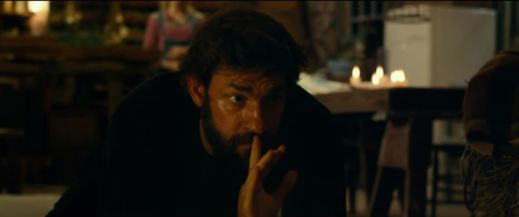
The family in A Quiet Place (2018) lives a life marked by incessant trauma. Invisible to the hunters who are far more powerful than they are, the family remains safe from direct assault as long as they remain unheard by the hunters, who can’t see them. But that same invisibility means the everyday mundanities of life become a constant struggle marked by the terror of the horrific death that will claim them should they make an errant sound. A trip to the pharmacy could prove fatal; a hungry child could summon the hunters and put in danger the entire family. When sketched out in these broad strokes, A Quiet Place, as Kathryn Adams Burton pointed out to me when we left the theater, summons terror from its viewers by depicting the kind of institutional surveillance and violence that endanger Black lives in the US, without one person of color in the entire movie. Thinking with Simone Browne’s Dark Matters (2015), Jennifer Stoever’s The Sonic Color Line (2016), and Jared Sexton’s Amalgamation Schemes (2008), I argue here that A Quiet Place places white characters in a non-white relationship with surveillance, which they overcome in a way that projects white ingenuity and strength and reinforces the centuries-old notion that those who live under the eye and ear of hyper-surveillance tactics do so because they deserve to and because they are not exceptional enough to evade those tactics.
 The Quiet family’s invisibility is literal: the creatures who hunt them have no sense equivalent to human vision and instead track their prey using hyper-developed listening abilities. They remain vigilant for the audible traces of their victims; sound is the thing that can put the family in trouble. Simone Browne highlights in Dark Matters the significance of visibility and invisibility in the history of antiblack surveillance in the US. Lantern laws in 18th century New York City stipulated that enslaved black and indigenous people must carry a lit lantern if they were in the streets after dark, a regulation that Browne understands as an act of “racializing surveillance,” a “form of knowledge production about the black, indigenous, and mixed-race subject” (79). Specifically, the knowledge created through the lantern laws marked bodies of color as “un-visible,” in need of illumination in order to be properly seen. And here “seen” slips into a couple of different meanings, encompassing not only the ocular but also the notion of “seeing” that connotes understanding and discernment.
The early technology of lantern surveillance, as well as the boundaries delineated by sundown towns, marked black, indigenous, and mixed-race bodies as untrustworthy, scheming, and therefore in need of ongoing surveillance that would make these bodies visible to the eye. At the heart of Dark Matters is Browne’s contention that the history and techniques of surveillance cannot be understood separate from their racializing work: “surveillance…is the fact of antiblackness” (10). So while the Quiet family is white, their relationship to the powerful beings that hunt them–an existence unseeable and unknowable apart from heightened measures of surveillance–appropriates signifiers of racialized surveillance in order to heighten the stakes of the movie’s characters.

The family walks on sand in order to muffle their footsteps.
While Browne focuses primarily on acts of looking as mechanisms for violently enforcing the color line in Dark Matters, Jennifer Stoever traces the history of that same color line through listening practices. Stoever isn’t explicitly engaging surveillance studies the way Browne is, but her theorization of the “listening ear”–the social and political norms that shape how we hear race–includes surveillance acts that, like lantern laws, mark voices perceived to be non-white as always already ready to be monitored, bounded, and eliminated should they exceed their boundaries (13). For both Browne and Stoever, the act of surveilling uncovers a racializing sleight of hand: non-Whiteness is held up as that which stands out, though this racialization is proven backwards if we look and listen a bit closer. US looking and listening norms condition people to organize blackness and brownness and noise as aberrations against natural, invisible, inaudible whiteness, but it takes a good deal of white supremacist work to create this illusion (by “white supremacy,” I mean the social and political practices and institutions that reify and reward whiteness). Looking through brighter lights and sharper camera lenses at non-White subjects and listening through amplification devices and ubiquitous bugs to non-White subjects are both ways of drawing attention away from whiteness–the racialized construct that fuels US social, legal, and political praxis–and toward non-whiteness.
Stoever opens The Sonic Color Line by considering the violence visited upon Jordan Davis, Sandra Bland, and a Spring Valley High School student when each was considered too loud and unruly by white listening ears trained to surveil blackness. The Quiet family is listened to in the same way Davis, Bland, and the Spring Valley student were, in the same way non-whiteness has been surveilled in the US: with dire consequences for being too loud. But, by erasing black and brown bodies and histories from the screen, A Quiet Place divorces these surveillance tactics from their real-world context, where they work as tools of white supremacist systems to “fix and frame blackness as an object of surveillance” (Browne 7). Part of the fantasy of A Quiet Place involves “fixing and framing” whiteness as the objects of sonic surveillance practices that have historically worked to preserve and reward whiteness, not target it.
 While the Quiet family is subjected to antiblack surveillance techniques, they are otherwise marked as white–and not just based on what their skin color looks like. Farmers in a rural, hilly region of Upstate New York, the Quiet family navigates the apocalypse with a libertarian aplomb. They’re stocked and loaded when the government fails to protect its citizens, and they’re also aware of but not in collaboration with other survivors in the surrounding area. Operating outside the bustle of urban noise, which Stoever notes is marked as non-White by the listening ear, the Quiet family likely boasts generations of working class whites who benefited from the kind of social safety nets built by the New Deal, only to mistake the wealth those social programs built to be fully the fruits of their own hard work.

The father, played by John Krasinski, looks over their plot of land.
The independence and autonomy that the Quiet family demonstrates is not on its own a marker of whiteness, but the kind of wealth accumulation that makes non-collaborative survival possible is the kind that’s historically been more readily available to white folks in the US. It’s a history that is flattened, as is the history of the surveillance that shapes their lives. Their wealth simply exists, and viewers aren’t meant to wonder where it came from or at whose expense. Likewise, viewers learn very little about what the hunters are, where they came from, and why they’re here. The hunters just appear, terrifying sonic surveillers who carry signifiers of antiblack listening practices but who remain detached from the antiblack history of surveillance.
The racialized terror at the heart of A Quiet Place grows from the fear of being denied one’s whiteness, being subjected to the same controlling surveillance measures that have helped maintain the color line for centuries in the US. It’s a standard white sci-fi nightmare scenario where technologies spin out of control and subjugate all of humanity, white people included. It’s also a white exceptionalist fantasy, where whiteness–not just white people but the wealth and freedom created for white people by white supremacist systems–conquers the unconquerable. Jared Sexton’s Amalgamation Schemes can prove helpful here, as he outlines the way racial ideology has shifted in recent decades to permit multiculturalism so long as it preserves whiteness. While systems like slavery and segregation were buttressed by explicit white supremacy, where whiteness = good and non-whiteness = bad, contemporary racial hierarchies are maintained by conceding that multiculturalism = virtuous and race-based solidarity = problematic. Here, white supremacy cloaks itself in diversity, hybridity, mixedness and points to any group that coheres around racial identity as regressive.
 Flattening history is crucial to that ideological shift. In order to maintain a racial hierarchy that tips in favor of whiteness, past violence and kleptocratic seizures of money, resources, and lives must be removed from the equation so that the kind of multiculturalism that Sexton critiques can proceed as if all who participate do so on a level playing field. Whiteness becomes “something equivalent to the…ethnicities and cultures of nonwhite immigrants and American Indians” (Sexton 66). The field, of course, isn’t level when white supremacy has funneled centuries of ill-gotten gains to whiteness, so this kind of multiculturalism is a way of gaming the system, mixing up racial signifiers so that white folks can take on just enough racial signifiers to blend into a racially diverse society without giving up the power and privilege that continues to give them a leg up.
A Quiet Place follows a calculus similar to the multiculturalism Sexton describes. First, the movie extracts emotional responses of terror and dread through a mixture of racial signifiers, subjecting white characters to forms of surveillance rooted in antiblackness. With no historical context to explain the forms of surveillance the hunters use or the characters’ previous relationships to surveillance, the Quiet family’s whiteness becomes just another ethnicity, a flattened way of being in the world divorced from the white supremacist context that funnels resources their way. Their privilege and power become as invisible to viewers as they are to the hunters. By masking that privilege, A Quiet Place clears space for a fantasy world where the white heroes have survived by virtue of being simply more clever, more resourceful, more brave, more everything than all the black and brown people who have, by implication of their absence from the film, been killed off by the hunters.
 A Quiet Place, then, takes a family of multiculturally white characters and positions them in roles white characters have become accustomed to occupying: that of world saviors–some of them even martyrs. Here, hyper-surveillance is simply a fact of life, and those who are able to live life free of the dire consequences of that hyper-surveillance are able to do so because they are exceptional. By this logic, what protects you from the police is either your innocence or your guile, not your whiteness. What guarantees your safety when you publicly challenge government policies is the righteousness of your cause, not your whiteness. What allows you to move in the dark without a lantern or to listen to your music loudly in public spaces without being shot or to cross borders without fear is your inherent virtue, not your whiteness. And when surveillance is positioned as a fact of life, and when those who avoid the crushing consequences of surveillance are understood to do so because they are virtuously exceptional, then those who are targeted, hunted, and killed using hyper-surveillance tactics are understood to be deserving of their fate because they are not virtuous or exceptional enough to avoid it. This is the logic that frames slavery as a choice, that cages children at the border, that influences and fixes elections across the globe but takes umbrage when subjected to the same tactics.
One terrible irony of a movie like A Quiet Place is that its flattened hyper-surveillance context makes it incapable of seeing and hearing the deep and rich history of black and brown evasion of hyper-surveillance. There’s an ingenuity coursing through activities of evading surveillance–“looking back,” marronage, and fugitivity chronicled by writers including Sylvia Wynter, Franz Fanon, Katherine McKittrick, and Simone Browne, among others–an ingenuity that evades hyper-surveillance and simultaneously exposes hyper-surveillance as antiblack while arguing against the notion that it is simply a fact of life and signalling avenues to freedom. Instead of those stories, though, the white Quiet family whispers to us a familiarly unsettling refrain: the white Quiet family, alone, can eradicate these terrors. The white Quiet family, alone, can fix this. The white Quiet family, alone, are exceptional.
—
Featured image, and all images in this post are screenshots from “A Quiet Place ALL TRAILERS – Emily Blunt & John Krasinski 2018 Horror Movie” by Youtube user Flicks And The City Clips.
—
Justin Adams Burton is Assistant Professor of Music at Rider University. His research revolves around critical race and gender theory in hip hop and pop, and his book, Posthuman Rap, is available now. He is also co-editing the forthcoming (2018) Oxford Handbook of Hip Hop Music Studies. You can catch him at justindburton.com and on Twitter @j_adams_burton. His favorite rapper is one or two of the Fat Boys.
—

REWIND! . . .If you liked this post, you may also dig:
Teach Me How To Dougie Like A Mediocre White Man–Justin Burton
Resounding Silence and Soundless Surveillance, From TMZ Elevator to Beyoncé and Back Again–Priscilla Peña Ovalle
Quiet on the Set?: The Artist and the Sound of a Silent Resurgence– April Miller
Share this:




Current Top Posts





April 2021

January 2020

November 2019

October 2019

August 2019

April 2014

November 2017

March 2015

December 2017

October 2015
 Sounding Out!
Recent Comments