
Learning to Listen Beyond Our Ears: Reflecting Upon World Listening Day

World Listening Day took place last week, and as I understand it, it is all about not taking sound for granted – an admirable goal indeed! But it is worth taking a moment to consider what sorts of things we might be taking for granted about sound as a concept when we decide that listening should have its own holiday.
One gets the idea that soundscapes are like giant pandas on Endangered Species Day – precious and beautiful and in need of protection. Or perhaps they are more like office workers on Administrative Professionals’ Day – crucial and commonplace, but underappreciated. Does an annual day of listening imply an interruption of the regularly scheduled three hundred and sixty four days of “looking”? I don’t want to undermine the valuable work of the folks at the World Listening Project, but I’d argue it’s equally important to consider the hazards of taking sound and listening for granted as premises of sensory experience in the first place. As WLD has passed, let us reflect upon ways we can listen beyond our ears.
At least since R. Murray Schafer coined the term, people have been living in a world of soundscapes. Emily Thompson provides a good definition of the central concept of the soundscape as “an aural landscape… simultaneously a physical environment and a way of perceiving that environment; it is both a world and a culture constructed to make sense of that world.”(117) As an historian, Thompson was interested in using the concept of soundscape as a way of describing a particular epoch: the modern “machine age” of the turn of the 20th century.

“Rock Series – Microphones” by Flickr user Stefano Tambalo, CC BY 2.0
Anthropologist Tim Ingold has argued that, though the concept that listening is primarily something that we do within, towards, or to “soundscapes” usefully counterbalanced the conceptual hegemony of sight, it problematically reified sound, focusing on “fixities of surface conformation rather than the flows of the medium” and simplifying our perceptual faculties as “playback devices” that are neatly divided between our eyes, ears, nose, skin, tongue, etc.
Stephan Helmreich took Ingold’s critique a step further, suggesting that soundscape-listening presumes a a particular kind of listener: “emplaced in space, [and] possessed of interior subjectivities that process outside objectivities.” Or, in less concise but hopefully clearer words: When you look at the huge range of ways we experience the world, perhaps we’re limiting ourselves if we confine the way we account for listening experiences with assumptions (however self-evident they might seem to some of us) that we are ‘things in space’ with ‘thinking insides’ that interact with ‘un-thinking outsides.’ Jonathan Sterne and Mitchell Akiyama, in their chapter for the Oxford Handbook of Sound Studies, put it the most bluntly, arguing that
Recent decades of sensory history, anthropology, and cultural studies have rendered banal the argument that the senses are constructed. However, as yet, sound scholars have only begun to reckon with the implications for the dissolution of our object of study as a given prior to our work of analysis.(546)
Here they are referring to the problem of the technological plasticity of the senses suggested by “audification” technologies that make visible things audible and vice-versa. SO!’s Jennifer Stoever-Ackerman has also weighed in on the social contingency of the “listening ear,” invoking Judith Butler to describe it as “a socially-constructed filter that produces but also regulates specific cultural ideas about sound.” In various ways, here, we get the sense that not only is listening a good way to gain new perspectives, but that there are many perspectives one can have concerning the question of what listening itself entails.

“listen (069/365)” by Flickr user Tim Pierce, CC BY 2.0
But interrogating the act of listening and the sounds towards which it is directed is not just about good scholarship and thinking about sound in a properly relational and antiessentialist way. It’s even less about tsk-tsking those who find “sound topics” intrinsically interesting (and thus spend inordinate amounts of time thinking about things like, say, Auto-Tune.) Rather, it’s about taking advantage of listening’s potential as a prying bar for opening up some of those black boxes to which we’ve grown accustomed to consigning our senses. Rather than just celebrating listening practices and acoustic ecologies year after year, we should take the opportunity to consider listening beyond our current conceptions of “listening” and its Western paradigms.
For example, when anthropologist Kathryn Lynn Guerts first tried to understand the sensory language of the West African Anlo-Ewe people, she found a rough but ready-enough translation for “hear” in the verb se or sese. The more she spoke with people about it, however, the more she felt the limitations of her own assumptions about hearing being, simply, the way we sense sounds through our ears. As one of her informants put it, “Sese is hearing – not hearing by the ear but a feeling type of hearing”(185). As it turns out, according to many Anlo-ewe speakers, our ability to hear the sounds of the world around us is by no means an obviously discrete element of some five-part sensorium, but rather a sub-category of a feeling-in-the-body, or seselelame. Geurts traces the ways in which the prefix se combines with other sensory modes, opening up the act of hearing as it goes along: sesetonume, for example, is a category that brings together sensations of “eating, drinking, breathing, regulation of saliva, sexual exchanges, and also speech.” Whereas English speakers are more inclined to contrast speech with listening as an act of expression rather than perception, for the Anlo-Ewe they can be joined together into a single sensory experience.

“Listening, Regent Street, London, 17 December 2011” by Flickr user John Perivolaris, CC BY-NC-ND 2.0
The ways of experiencing the world intimated by Geurts’ Anlo-Ewe interlocutors play havoc with conventionally “transitive,” western understandings of what it means to “sense” something (that is, to be a subject sensing an object) let alone what it means to listen. When you listen to something you like, Geurts might suggest to us that liking is part of the listening. Similarly, when you listen to yourself speak, who’s to say the feeling of your tongue against the inside of your mouth isn’t part of that listening? When a scream raises the hairs on the back of your neck, are you listening with your follicles? Are you listening to a song when it is stuck in your head? The force within us that makes us automatically answer “no” to questions of this sort is not a force of our bodies (they felt these things together after all), but a force of social convention. What if we tried to protest our centuries-old sensory sequestration? Give me synaesthesia or give me death!
Indeed, synaesthesia, or the bleeding-together of sensory modes in our everyday phenomenological experience, shows that we should loosen the ear’s hold on the listening act (both in a conceptual and a literal sense – see some of the great work at the intersections of disability studies and sound studies). In The Phenomenology of Perception, Maurice Merleau-Ponty put forth a bold thesis about the basic promiscuity of sensory experience:
Synaesthetic perception is the rule, and we are unaware of it only because scientific knowledge shifts the centre of gravity of experience, so that we have unlearned how to see, hear, and generally speaking, feel, in order to deduce, from our bodily organization and the world as the physicist conceives it, what we are to see, hear and feel. (266)
Merleau-Ponty, it should be said, is not anti-science so much as he’s interested in understanding the separation of the senses as an historical accomplishment. This allows us to think about and carry out the listening act in even more radical ways.
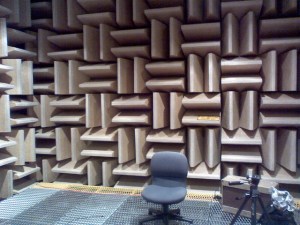
“Listening Room” by Flickr user Consumerist Dot Com, CC BY 2.0
Of course all of this synaesthetic exuberance requires a note to slow down and check our privilege. As Stoever-Ackerman pointed out:
For women and people of color who are just beginning to decolonize the act of listening that casts their alternatives as wrong/aberrant/incorrect—and working on understanding their listening, owning their sensory orientations and communicating them to others, suddenly casting away sound/listening seems a little like moving the ball, no?
To this I would reply: yes, absolutely. It is good to remember that gleefully dismantling categories is by no means always the best way to achieve wider conceptual and social openness in sound studies. There is no reason to think that a synaesthetic agenda couldn’t, in principle, turn fascistic. The point, I think, is to question the tools we use just as rigorously as the work we do with them.
—
Owen Marshall is a PhD candidate in Science and Technology Studies at Cornell University. His dissertation research focuses on the articulation of embodied perceptual skills, technological systems, and economies of affect in the recording studio. He is particularly interested in the history and politics of pitch-time correction, cybernetics, and ideas and practices about sensory-technological attunement in general.
—
Featured image: “” by Flickr user woodleywonderworks, CC-BY-2.0
—
 REWIND!…If you liked this post, you may also dig:
Snap, Crackle, Pop: The Sonic Pleasures of Food–Steph Ceraso
“HOW YOU SOUND??”: The Poet’s Voice, Aura, and the Challenge of Listening to Poetry–James Hyland
SO! Amplifies: Eric Leonardson and World Listening Day 18 July 2014–Eric Leonardson
Share this:

Snap, Crackle, Pop: The Sonic Pleasures Of Food

 After a rockin’ (and seriously informative) series of podcasts from Leonard J. Paul, a Drrty South banger dropped by SO! Regular Regina Bradley, and a screamtastic meditation from Yvon Bonenfant, our summer Sound and Pleasure series serves up some awesomeness on a platter this week with the return of Steph Ceraso, who makes us wish all those food pics on instagram came with recordings. Take a big bite out of this! –-JS, Editor-in-Chief
—
Lightly I tap the burnt surface with a cold metal spoon until it cracks; it fractures like a fine layer of sugary glass; silent, smooth custard mixes with the sticky sweet crunch of the caramelized shards.
An otherwise bland and unmemorable dessert, crème brûlée is always my go-to treat. The sonic pleasures of this indulgence keep me coming back: the tapping, cracking, crunching.
Though the taste and visual presentation of food usually get most of the hype, it’s no secret that sound can amplify the enjoyment and delight of eating. Indeed, sound has become an increasingly important ingredient in the design, advertising, and experience of food: from “junk” food to gourmet dining. What is especially fascinating and disconcerting about this strategic use of sound is the powerful connection between pleasure and sensory manipulation. To my mind, the myriad ways sound is employed to manipulate perceptions of food underscores the need to pay more attention to when, how, and why sound influences our thoughts, feelings, and sensory experiences.

“Crack” by Flickr user Gabriela Castillo, CC BY-NC-ND 2.0
* * *
Food engineers and marketing teams have been taking advantage of the pleasures of sound for years. Rice Krispies’ “Snap, Crackle, Pop” trademark has been around since the late 1920s. And of course there are Pop Rocks, my favorite sounding retro product. The carbonated sugar crystals were invented in the 1950s, but thanks to commercials that celebrated the candy in all of its sonic glory, Pop Rocks’ popularity reached a fever pitch in the 1970s and it’s still going strong today. The official Pop Rocks website boasts that the product continues to be the “leading popping candy brand worldwide.”
Sound is a crucial part of the pleasurable experience of food’s packaging, too. Consider Pringles’ famous “Once you pop you can’t stop” slogan. A neatly stacked chip cylinder with a pleasant-sounding lid is marketed as a refreshing alternative to crinkly chip bags.
Designing sound for the things that contain food may seem like a silly marketing gimmick, but the sounds of packaging can make or break the product. For instance, in an attempt to make its SunChips brand more environmentally friendly, in 2010 Frito-Lay introduced a compostable chip bag. Consumers found it to be ridiculously noisy and complained. The bag had so many haters, in fact, that a facebook group called “SORRY I CAN’T HEAR YOU OVER THIS SUN CHIPS BAG” attracted nearly 30,000 fans. Sales fell, and the financial loss caused Frito-Lay to go back to the un-environmentally friendly bags. Just this year, the company introduced yet another version of the compostable bag. It’s too early to tell if consumers will deem its sound acceptable.
While many companies strive to hit the right note when it comes to the pleasurable sounds of food and its packaging, recent research on taste and sound has been more focused on how external sounds affect the experience of eating. In a noteworthy study, the food company Unilever and the University of Manchester found that the experience of sweetness and saltiness in food decreased in relation to high levels of background noise (perhaps one of the reasons that airplane food generally sucks). They also identified a correlation between the increased volume of background noise and the eater’s perception of crunchiness and freshness.
Additionally, the Crossmodal Laboratory at Oxford University run by professor Charles Spence got a lot of press for discovering that low-pitched sounds tend to bring out bitter flavors while high-pitched sounds heighten the sweetness of food. Go grab a snack (chocolate or coffee work best) and you can try this experiment for yourself.
Armed with scientific knowledge, many chefs and entrepreneurs have been teaming up to put these ideas into practice. For a limited time London restaurant House of Wolf served what they called a “sonic cake pop.” The treat came with a phone number that presented callers with the choice of pushing 1 for sweet (to hear a high-frequency sound) and 2 for bitter (to hear a low-frequency sound). The experiment was a success. People seemed to want to hear their cake and eat it too. The same Guardian article reports that Ben and Jerry’s plans to put QR codes on its packaging so that customers can use their smartphones to access sounds that compliment the flavor of ice cream they are eating.
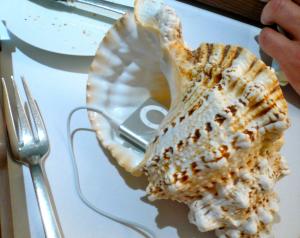
“Sound of the Sea” by Flickr user Cennydd Bowles, CC BY-NC-SA 2.0
For some, making sound a more prominent feature of eating experiences is more than a fun experiment or savvy marketing strategy: it’s a full-blown artistic performance. World-renowned chef Heston Blumenthal uses sound to draw attention to the holistic sensory experience of dining. His dish “Sound of the Sea,” for example, consists of seafood, edible seaweed, tapioca that looks like sand, decorative shells, and an iPod so that diners can listen to the sounds of the ocean.
Blumenthal has also performed sound experiments while eaters spooned up his bacon and egg ice cream (Yep. That’s a thing!). When the sound of bacon frying in a pan was played, people rated the bacon flavor of the ice cream to be more intense than the egg flavor, and vice versa when the sound was clucking chickens.
In a similar vein, Boston chef Jason Bond and composer Ben Houge have paired up to create food operas, or what they call “audio-gustatory events.” They use real-time musical scoring techniques based off of Houge’s work in video games to design eating experiences that explicitly link sound and taste.
Clearly, when it comes to the pleasures (and displeasures) of eating, sound matters. I’ll admit that I’m a fan of the more imaginative, experimental uses of sound in experiences like the food opera or Blumenthal’s edible sonic creations. There is a sense of play and discovery in these designed experiences; and, people know what they are signing up for and willingly choose to participate. Such endeavors have the potential to heighten participants’ sensitivity to how sound figures into eating and other kinds of everyday activities.

“WWII Food Ad, Kellogg’s Rice Krispies Cereal…” by Flickr user Classic Film, CC BY-NC 2.0
Yet, along with the sonic branding and marketing of edible products, these experiments raise some troubling questions about the relationship between pleasure and sensory manipulation: When is it wrong or unethical to use sensory manipulation to create pleasurable experiences? At what point does manipulation become pleasurable? Is all pleasure a form of manipulation?
Perhaps more significantly, the ways that people are applying scientific knowledge about sound and taste opens up another can of worms: What are the implications of trying to standardize pleasurable sounds via commercial products? What kinds of bodies are invited to participate in pleasurable sensory experiences, or not? I’m thinking particularly of individuals who are deaf and hard-of-hearing, or who have different cultural cues when it comes to recognizing a sound as “pleasurable.”
The sounds of food do not necessarily have to be engineered to be pleasurable. However, because new information about the relationship between sound and other senses is being used to explicitly and implicitly manipulate our experiences, it seems that there is a real need for cultivating a keener, more critical sensory awareness. This means questioning when, how, and why sound is being employed to create pleasurable experiences in a range of products and environments; it means paying careful attention to the ways that sound interacts with all of our senses to influence everyday experiences. So, the next time you’re having what seems to be a simple “feel good” eating experience, be sure to open your ears along with your mouth.
—
Featured image by Flickr user Wizetux, CC BY 2.0
—
Steph Ceraso received her doctorate in 2013 from the University of Pittsburgh, specializing in rhetoric and composition, pedagogy, sound studies, and digital media. In addition to being a three-peat guest writer for Sounding Out!, her work has been featured in Currents in Electronic Literacy, HASTAC, and Fembot Collective. She is also the coeditor of a special “Sonic Rhetorics” issue of Harlot. Her current book project, Sounding Composition, Composing Sound, examines how expansive, consciously embodied listening and sonic composing practices can deepen our knowledge of multimodal engagement and production. Steph will be joining the faculty in the English department at the University of Maryland, Baltimore County this fall. You can find more about her research, media projects, and teaching at http://www.stephceraso.com.
—
 REWIND! . . .If you liked this post, you may also dig:
Tofu, Steak, and a Smoke Alarm: The Food Network’s Chopped & the Sonic Art of Cooking— Seth Mulliken
On Sound and Pleasure: Meditations on the Human Voice— Yvon Bonenfant
‘Corn-ing’ the Suburbs on Halloween, a Sonic Trick and Treat— Steph Ceraso
Share this:




Current Top Posts





April 2021

January 2020

November 2019

October 2019

August 2019

April 2014

November 2017

March 2015

December 2017

October 2015


Recent Comments