
SO! Amplifies: The Electric Golem (Trevor Pinch and James Spitznagel)

—
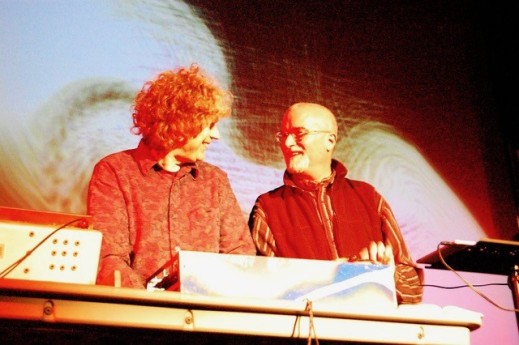
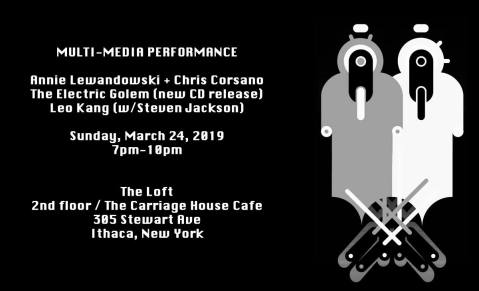
On March 24th, 2019 the record release party for The Electric Golem’s 6th CD Golemology was held at the Loft in Ithaca, New York. The Electric Golem is an avant-garde synthesizer duo featuring Trevor Pinch and James Spitznagel, that has been in existence for about ten years.
Trevor Pinch is a local sound artist and professor at Cornell University. He is an STS (Science and Technology Studies) and Sound Studies scholar. As a key thinker of STS, Trevor is the coproducer of theories about Sociology of Scientific Knowledge, Social Construction of Technology (SCOT), and the role of users in technological history and innovation. However, Trevor’s interest in dates back much farther; he built his first modular synthesizer when he was a physics student in London in the 1970s.
The other half of The Electric Golem, James Spitznagel, is a multi-media artist who uses the iPad as a musical instrument and to create digital paintings. While he has played many roles in the music and culture industries—guitarist in a rock band, record store owner, art gallery and guitar shop investor, and even business manager for the Andy Warhol Museum—he moved to Ithaca to focus on producing abstract art: digital paintings and experimental, improvisational music. Being an energetic and enthusiastic person who has unrestrained fantasies, James finds that everything around him can be his inspiration.
Pinch and Spitznagel formed the group after Spitznagel read Analog Days: The Invention and Impact of the Moog Synthesizer (by Trevor Pinch and Frank Trocco) and realized Pinch also lived in Ithaca. Spitznagel simply looked his name up in the phone book and called him up: “I go, ‘is this Trevor Pinch?’ He said, ‘yes.’ I said, ‘well, you don’t know me, but I just read your book and I love it.’” And then they got together for a beer and have been best friends and collaborators ever since. Once Spitznagel heard about Pinch’s homemade synthesizer, he asked Trevor to try to make something together and it turned out to be a fascinating mixture of analog–Trevor’s synth, Moog Prodigy, and a Minimoog–and James’s digital instruments.
Building from this first moment of discovery, The Electric Golem’s music is electronic, experimental, and totally improvised. Typically, the pieces of music last twenty minutes to half an hour and expresses their interaction with the machines and with each other in the studio. James is much more controlling of the tone and rhythm, and patches the sound as he goes along, whereas Trevor is much more about making spontaneous weird sounds. They complement each other and the creation process is usually by random and spontaneous, as Spitznagel describes: “I didn’t tell Trevor what to do or what to play, but I said, here’s the piece of music I’ve written. He just instinctively knew what add to it.” Reciprocally, “he might just play something that I go, oh, I can weave in and out of the ambient sound he’s putting there.”
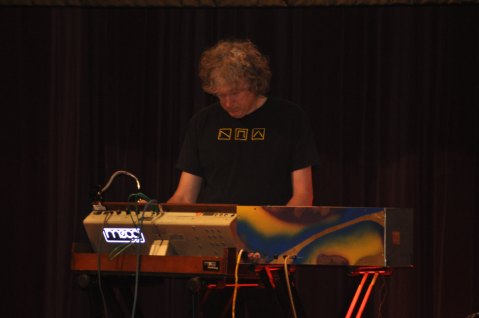
Trevor Pinch, Electric Golem at Elmira College, 2012
For the duo, the process of producing music becomes a shared experience with their listeners. The music is ever changing and evolving. In addition, unexpected drama adds vitality to the palette. “The iPad might freeze up or synthesizer might break somehow,” Spitznagel notes, “that’s happened to us, but we carry on. Like Trevor looks at me and says, it’s not working there. Or, I look at him and go, I have to reboot my computer, it’s not working. But, those times actually inspire us to try new things and go beyond what we are doing.” James explained. Their inspiration comes from the unknown, which just emerges from their practice. “Generally, this sort of music is completely unique to Electric Golem.” Trevor concluded.
The name “Electric Golem” comes from a series of books with Golem in the titles that Trevor collaborated on with his mentor Harry Collins. “The golem is a creature of Jewish mythology,” Pinch and Collins wrote in The Golem, What You Should Know about Science, “it is a humanoid made by man with clay and water, with incantations and spells. It is powerful, it grows a little more powerful every day. It will follow orders, do your work, and protect you from the ever threatening enemy. But it is clumsy and dangerous. Without control, a golem may destroy its masters with its flailing vigour” (1). Noting Trevor’s association with the concept of the Golem, Spitznagel added the “Electric” twist not just as a metaphor for their sound but also because “it’s kind of like a retro name.” The Electric Golem mushroomed from there, and in the past decade they have had many invitations and bookings to play out, receiving the first recording contract from the Ricochet Dream label, and have played with a bunch of notable musicians, such as Malcolm Cecil of Tonto’s Expanding Head Band, Simeon of Silver Apples, and “Future Man” (aka Roy Wooten), and they haven’t stopped there.
According to Pinch, the key feature of The Electric Golem’s music is its ability to encompass different moods. “I think Electric Golem has become good at one thing: its changing and transitioning from one sort of mood of music to another. And we have become quite good at those transitions. I think people would say that’s what they kind of like about us.” These sorts of slow transitions construct a unique texture of sound that can be quite cinematic, so much so that in 2012, the Electric Golem performed the accompaniment to the silent movie A Trip to the Moon, a special Cornell cinema event. Overall, as improvised experimental music, it is sometimes challenging to listen to, with no regular rhythm or reliable melody. Trevor produces warm, rich drones from the analog side that contrast with the sharper digital rhythms that James programs. In short, the Electric Golem varies between these two affects but the music goes far beyond the representation of emotional states; sometimes it conjures up the feeling of the vastness of space and time.
Experimental music, is a collaboration and negotiation process between instruments and their users. No matter if analog or digital, instruments have autonomy; they are non-human actors with their own agency to some extent. As Trevor Pinch intimates, “I understand the general sort of sound that can be produced, but the particular details of how it will work out, you don’t really know, that’s much more spontaneous, you have to react to that.” Instruments can often be uncontrollable–making their own sounds—so that Electric Golem must respond in kind. “So, it’s sort of like higher level meta-control versus actually doing what you’re doing in response to the instrument that combines together,” Trevor describes, “which I think is the secret to controlling these sorts of instruments.” It is incredible that Pinch and Spitznagel know each other so well—and each know their instruments so well–that they can improvise for long periods with no trouble. Trevor says: “Follow the use of these instruments! Follow the instruments! They are not essentialized. They are just stabilized temporarily.”
On the whole, The Electric Golem shows an artistic form which breaks the traditional paradigm, deconstructs and then reconstructs it, seeking to free sound from the instruments. Their music is beyond pure melody and rhythm, beyond the expression of existence, expressing more of an aesthetic state of transcendence. They challenge what music is, and what musical instruments are; they challenge divisions between the identities of engineer and musician. Electric Golem’s music co-constructs art and technology and binds them together; art, for them, is a mode of presenting technology, and vice versa, technology is a pathway through which art can flourish.
My favorite Electric Golem piece is called “Heart of the Golem.” What is the heart of the Golem? According to Pinch, “It is a mystery, a process of unfolding and discovery. It is somewhere where analog and digital sound meet, and an improvisation.” What the magic is remains unknown and unlimited, just like the future of the Electric Golem.
—
Featured Image: Courtesy of The Electric Golem
—
Qiushi Xu is a PhD candidate in the subject of Philosophy of Science and Technology in Tsinghua University, Beijing and in a joint PhD program in the Department of Science and Technology Studies in Cornell University, working with Prof. Trevor Pinch. Her research areas are Sound Studies, STS, Cultural Studies and Gender Studies. Her current research focuses on the sociology of piano sound and the negotiation and construction of piano sound in the recording studio (PhD dissertation), gender issues in recording industry, experimental music, auscultation and sound therapy. She holds an MA in Cultural and Creative Industries from King’s College London; a BA in Recording Arts and a BA in Journalism and Communication from the University of China, Beijing. She is also an amateur pianist, writer, and traditional Chinese painter. As a multiculturalist, she is am fascinated by different forms of art and culture in different cultural contexts.
Share this:

SO! Reads: Rebecca Tuhus-Dubrow’s Personal Stereo

 In Personal Stereo, Rebecca Tuhus-Dubrow’s eminently readable history of the Walkman and its kind, it is telling to learn that Sony founders Masaru Ibuka and Akio Morita were prone to conversing in ‘something akin to a private shared language’ or idioglossia. “They would sit there,” recounts Morita’s eldest son, “and we would listen but we had no idea what they were saying” (21). In later life, following strokes, both lost the ability to speak; Ibuka’s son characterises their subsequent relationship as “communicating without words’.” Even the name Sony itself, notes Tuhus-Dubrow, with its origins in the Latin sonus and the English slang “sonny,” was ultimately “a word in no language’” (13). It is as though aural perception, delivered on an intimate scale, is somehow revelatory in a way that transcends the typical organising principles of language. The incorporation of the sonic into everyday life forever approaches a kind of affective intensity.
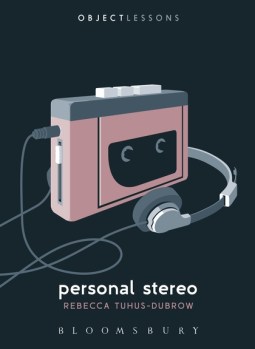 Personal Stereo tunes into this frequency and – by virtue of its array of research and skilful marshalling of social and cultural history – offers a compelling map of its coordinates. If, as part of Bloomsbury’s Object Lessons series, one of its central tasks is to apprehend the affective resonance of the inanimate, it is testament to Tuhus-Dubrow’s work that she is able to manage the breadth of her material into an adroit and concise narrative while at the same time allowing space for her writing to approach these contained moments of intensity. “When I think of [the Walkman] now, I think of joy,” she writes in the introduction (1). While acknowledging that undue celebration of the past can stymie the present, she offers a quietly persuasive case for an examination of nostalgia amid the anxiety of contemporary life, which almost serves as a rallying cry for a generation pinioned between the two: ‘The past, whatever its shortcomings, has the virtue of having already happened. And we survived it.’
As iTunes – like the glory of the world – passes into epilogue, it is again time to consider how we might frame obsolete technologies as echoes of a particular moment in our lives, anchored between progress and decay. As texts, they harbour a kind of degraded cartography: a summation of meaning and collapse.
The story of the Walkman begins in the bombed-out ruins of 1940s Tokyo, as Ibuka and Morita establish the foundations of the company that would become a consumer electronics giant as part of Japan’s ill-fated post-war boom. It is striking how much of the Walkman’s development was shaped by the ravages of warfare: Tuhus-Dubrow notes how its antecedent, the tape recorder, was first used in the German military, and early headphones were issued to fighter pilots. It is possible to read the subsequent commercial adoption of personal listening devices as an attempted refashioning of the domestic interior, transgressed so violently in acts of conflict. One of Ibuka’s founding principles for Sony was to “apply highly advanced technologies…developed in various sectors during the war to common households” (12). Tuhus-Dubrow also recounts the case of Andreas Pavel, a native of post-war Berlin, who emigrated with his family to São Paulo and developed what we might term a “counter-prototype” to the Walkman, partly inspired by the internal acoustics of his mother’s home – “a mecca of sound” – in Cidade Jardim. Object lessons are formed through disintegration and salvaged materials. Morita compares his formative partnership with the older Ibuka to a newly-established familial unit: “It was almost as though an adoption were taking place” (13).

Akio Morita (left) and Masaru Ibuka (right), 1961. Courtesy of Sony
This elides neatly with Tuhus-Dubrow’s central chapter, which is also the strongest. Here, she discusses the reception of private listening within the public domain, and how existing societal norms apprehended this new sonic phenomenon. It is intriguing, and at times hilarious, how much of the reaction operates as moral critique: from a 1923 article comparing the very act of solo listening to alcohol abuse or a drug habit, to rather more recent takes that foreshadow the current intergenerational culture wars. “The personal stereo,” harrumphs A.N. Wilson, ‘became the archetypal accessory of the me-generation” (68).
Tuhus-Dubrow’s research is smart and on point, not least because it leads to a productive consideration of how the cathartic element of the private soundtrack becomes something that society struggles to assimilate. She takes to time to weave in personal testimonies and reminiscences that are effective and somehow touching: “the Walkman,” she admits, “was a source of elation and comfort” (85). A friend recalls how “[my] inner world was enriched by the freedom to explore music on my own” (84). Pavel describes how the first use of his prototype, in the snows of St Moritz, evoked “a state of ecstasy,” in which life temporarily assumed a cinematic quality. “Suddenly,” he remembers, curiously switching to the present tense, “I’m inside a film” (27).

Darryl with a new Walkman, December 25, 1982, Image by Flickr User Kent Kanouse
Others speak of how musical accompaniment aids a more immersive interaction with the world around them, and it is here that perhaps the real strength of Tuhus-Dubrow’s work emerges: the generosity of an approach that permits mutual recognition; the summoning of an experiential quality that is elusive in its definition but vivid and immediate in its resonance. It is a mode of writing – and indeed a mode of listening – that is resolutely contemporary, formed in a firestorm of technological innovation that was both oppressive and liberatory, attuning us to new ways of being at the same time as it degrades and erodes old certainties.
It bears resemblance to what Tuhus-Dubrow recognises as “the logic of our own bodies, with organs and limbs whose motions are connected to their functions, and which are susceptible to injury and gradual breakdown” (102). Earlier she writes, “as one song neared its end, I would begin to hear the opening chords of the next in my head.”
What is it, this sense of auditory anticipation?
It is the forming of new waves. We have blood in our ears.
—
Featured Image: “Walkman through the cassette” by Flicker User Narisa (CC BY-NC-ND 2.0)
—
Lewis Jones is a writer and itinerant based in Brighton, UK. He received an MA in Literature, Culture and Theory from the University of Sussex, having previously graduated in English Literature from the University of Winchester. He is interested in how artistic and aesthetic mediums might be used to develop new theoretical approaches to culture and society. He particularly likes urban spaces, as visual and auditory environments, and the intersections between music, movement and the body. He thinks that dancing about architecture is a perfectly valid exercise.
—
 REWIND! . . .If you liked this post, you may also dig:
SO! Reads: Hiromu Nagahara’s Tokyo Boogie-Woogie: Japan’s Pop Era and Its Discontents–Shawn Higgins
SO! Reads: Janet Borgerson and Jonathan Schroeder’s Designed For Hi Fi Living–Gina Arnold
SO! Reads: Susan Schmidt Horning’s Chasing Sound: Technology, Culture and the Art of Studio Recording from Edison to the LP— Enongo Lumumba-Kasongo
SO! Reads: Steph Ceraso’s Sounding Composition: Multimodal Pedagogies for Embodied Listening–Airek Beauchamp
Share this:




Current Top Posts





April 2021

January 2020

November 2019

October 2019

August 2019

April 2014

November 2017

March 2015

December 2017

October 2015
 Sounding Out!
Recent Comments