
Sounds of Life: Fetal Heartbeat Bills and the Politics of Animacy

June 2018 was marked by the amplification of distant warning sounds regarding the fate of abortion rights in the United States. Although within recent months there have been positive steps forward, such as in Ireland and Argentina, within a broader politics of abortion, the medical procedure remains illegal and inaccessible across large swaths of the globe. Since abortion was legalized in the U.S. in 1973, anti-abortion advocates have chipped away at the constitutional “right” such that its current status is more of a “privilege.” After a recent victory for “crisis pregnancy centers” (fake clinics), in combination with the resignation of Justice Anthony Kennedy from the Supreme Court, the past few weeks have sounded further alarms within the decades-long “abortion wars.” These wars have included not only devastating anti-abortion legislation such as the Hyde amendment, but violence against abortion clinics (including 11 murders and 26 attempted murders) and the quieter yet just as nefarious technologization and romanticization of the fetal heartbeat.
***
The “Heartbeat Protection Act” of 2017 (H.R. 490) would make it illegal for physicians to “knowingly perform an abortion: (1) without determining whether the fetus has a detectable heartbeat, (2) without informing the mother of the results, or (3) after determining that a fetus has a detectable heartbeat.” Introduced by the 115th United States Congress, the bill is a nation-wide version of existing, state-level “heartbeat bills” promising to “protect every child whose heartbeat can be heard.” The “Heartbeat Protection Act” would effectively make it illegal for doctors to terminate pregnancies after six or seven weeks’ gestation, at which time a heartbeat typically can be detected. The bill makes it clear that the abortionist, and not the pregnant person, is the moral agent within the context of pregnancy termination: “A physician who performs a prohibited abortion is subject to criminal penalties—a fine, up to five years in prison, or both,” while “A woman [sic] who undergoes a prohibited abortion may not be prosecuted for violating or conspiring to violate the provisions of this bill.” As of May 2018, a total of 59 heartbeat bans have been proposed over the past seven years.
“Heartbeat” bills not only articulate the subjecthood of physicians and the objecthood of pregnant bodies; they also rely on the animating capacity of sound in their efforts to enliven embryos and fetuses. In Animacies: Biopolitics, Racial Mattering, and Queer Affect, Mel Chen describes “animacy” as a “slippery” value problematizing the contemporary biopolitical boundaries between ontological categories dividing “the living” from “the dead” (9). Hierarchies of animacy indicate the ways in which entities perceived to be nonhuman or nonliving, such as monkeys, lead, and toxins, are endowed with racialized and/or gendered “human” qualities through the politicization of language and figuration (The 2007 “lead panic” in the U.S., in which Chinese-manufactured toys were viewed as unidirectional transmitters of racialized toxicity, is an example). The sounds of fetal heartbeats are implicated in the construction of a hierarchy of animacy as they render pregnant bodies less animate. Drawing from Chen in exploring a politics of animacy can help us understand the animating and silencing capacities of reproductive healthcare legislation and restrictions. Within this politics, the fetal heartbeat becomes so loud that it silences the pregnant person.
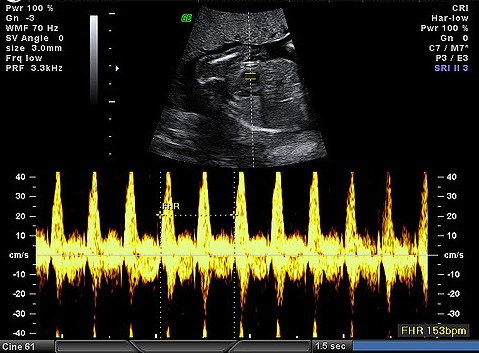
A sonogram and Doppler visualization, Image by Flickr User DYT, (CC BY-NC-ND 2.0)
This silencing and objectification of pregnant bodies occurs not only through anti-abortion legislation but in the sphere of the everyday. The pregnant body becomes animated with the capacity (and expectation) for nurturing and selflessness, while its contents are animated with qualities of potentiality and personhood. As feminist phenomenologist Iris Marion Young points out in an essay on pregnant embodiment (which can be found in her collection On Female Body Experience), the pregnant body not only becomes a synecdochal figuration for heteropatriarchal structures and narratives, but is experienced as “Other” even from a first-person perspective: “in pregnancy I literally do not have a firm sense of where my body ends and the world begins” (50). Pregnant people can expect to be stared at, to get asked personal or even inappropriate questions, and to have their bodies touched without consent as they move through public space. The presumed ownership over female-presenting bodies is magnified when these bodies are perceived as housing another living being presumed to be the progeny and property of a male “father figure.” The blurred line between internality and externality allows for a further window through which the surveillant male gaze can stare, and through which the sounds of sonic patriarchy can be broadcast.

Image by Flickr User jennykarinaflores, (CC BY 2.0)
The concept of the “male gaze” is at this point well recognized; “sonic patriarchy” can be heard to be its aural counterpart. Sonic patriarchy is a concept I have theorized in order to give name to the domination of a sound world in gendered ways, as well as to the control of gendered bodies via sound. In public space, sonic patriarchy can be heard in the catcalls and whistles and mansplaining that grope their way into the aural space of female and feminine bodies. And, as Christine Ehrick points out, masculine voices can be heard as a signifier of power within a “gendered soundscape.” Sonic patriarchy can be heard within private space, too; recently, a friend texted me about a roommate’s boyfriend who never bothers to use headphones when listening to music in the living room “even though he doesn’t even live here!” Both the male gaze and sonic patriarchy are misogynist and objectifying forces that shape and control space, demarcating boundaries of safety, mobility, and accessibility for many female and gender-nonconforming bodies. However, these modes of surveillance and control have been discussed primarily through a visual lens within the realm of feminist and queer theory.
The sonification of the male gaze manifests in mundanities, such as the daily catcalls women are subjected to in literally every corner of the world, and in more disturbing contexts such as anti-abortion rhetoric, which I’ve observed through my ethnographic work at abortion clinics throughout the United States. At these demonstrations, the bodies of clinic patients are invaded both literally, with the shouting of the protesters, and figuratively, in the making-public of the figure of the fetus with four-foot-tall posters depicting mangled fetal body parts. Ironically, these inanimate posters animate the figure of the fetus as they lend more humanity and visibility to the imagined contents of a pregnant body; meanwhile the pregnant person fades into a mere backdrop for this spectacle. This voyeurism also occurs sonically, as the protesters ‘give voice to’ imaginary fetuses by yelling “Mommy, mommy don’t kill me!” In the space of the clinic protest, feminized ears exist as gendered and sexualized organs in which masculine vocalizations can penetrate and reverberate. Just as misogynist conceptions of female sexual receptivity frequently ignore the word “no” and the concept of consent itself, these vocalizations ignore the active non-consent of the patients as they persistently rupture their aural space.
The patriarchal control of the sound world, whether on the sidewalk outside an abortion clinic or in a doctor’s office, is a reminder of broader schemes of biopolitical control that have been at play in the U.S. since the late 1970s, when previously apolitical evangelical Christians were drawn into political conversations through the transformation of abortion access into a “moral issue.” Within this discourse, the politicized female body is assumed to be perpetually pre-pregnant, a muted object housing a potential subject. At abortion clinic protests, the seemingly mundane act of “exercising free speech” vocalizes not only an opposition to abortion as a medical procedure, but also an assertion of the four decades of “moral authority” that have limited access to and availability of this medical procedure through a sustained regulation of the bodily autonomy of female citizens. The fetus is animated in service of this authority through tactics that range from fetal heartbeat bans to the amplification of an “acousmatic fetus” at a North Carolina abortion clinic protest:
https://twitter.com/heyitscalla/status/991719274178863104
When it comes to anti-abortion politics, the rhetoric hinges on the making public of the internal space of the womb in order to more effectively level the male gaze (and its listening ear) at the figure of the fetus. Anti-abortion rhetoric relies on the dissolution of boundaries between the public and the private; remember that the right to an abortion was eventually won in 1973 not on the grounds of bodily autonomy but on the constitutional “right to privacy.” These boundaries perpetuate gendered divisions of space that deem public space the space of men, while relegating women to the “private space” of the home. Female-presenting bodies are therefore seen (and heard) to be out of place in public space, even when the contents of their bodies are not. And when the focus always lies on these possible contents, female-presenting bodies are always assumed to be pregnant. Their bodies come to represent what Lauren Berlant, in her 1994 essay titled “America, ‘Fat,’ the Fetus,” describes as “fetal motherhood” (147). Within this representation, the female body possesses value only through the promise of its eventual maternal status. Within a patriarchal economy of reproduction and citizenship, the female body accrues value through its capacity to sustain and revitalize “the nation”; Berlant points out that pro-life rhetoric has in its turn revitalized the female body as a symbol of nation-formation.
Berlant argues that political and cultural rhetoric in the U.S. transforms pregnant people into babies and unborn babies into full-on “persons” through this process of “fetal motherhood.” She details this process and its implications within a broader sociopolitical discourse that hinges not only on dehumanizing tactics that reduce women to objects, but on the expectation and exploitation of the all-too-human capacity for nurturing and motherhood that society demands from women. This rhetoric is meant to mobilize the figure of the fetus in what Berlant refers to as “the nationwide competition between the mother and the fetus that the fetus, framed as a helpless, choiceless victim, will always lose” since “the fetus has no voice” (150-151). Providing a voice for the fetus has been a primary tactic in anti-abortion strategies within this “competition.” Animating the fetus’s body and voice therefore always involves the erasure and silencing of the pregnant person, who, in the state of “fetal motherhood,” is flattened into an entity as two-dimensional as an anti-abortion protester’s photoshopped poster. And just as dominant narratives and vocabularies for sonic reproduction frequently neglect the gendered implications of the term, broader political concepts of “reproduction” listen more closely to the product of motherhood than to mothers themselves.

Image by Flickr user TR Haun, (CC BY-ND 2.0)
The heartbeat bans are only one component of the anti-abortion trend in the U.S., where 288 abortion restrictions have been enacted since 2010. These bills typically deny the agency of pregnant people, while affirming the moral agency of doctors and the “personhood” of embryos and fetuses. Yet that has not stopped pregnant people, and particularly pregnant people of color, from enduring punishment. The most well-known case is probably that of Purvi Patel, an Indian American woman who self-aborted in 2015 and was subsequently sentenced to 20 years in prison after an Indiana jury found her guilty of feticide (She served about a year and a half before a judge reduced her sentence to eighteen months, resulting in her release). Within the dominant hierarchy of animacy in contemporary reproductive rights, the agency of potential persons is amplified so loudly that it drowns out the agency of actual people existing in the world. Control of the sound world doesn’t just mirror visual control over bodies and the worlds they move through, it enacts new and arguably more invasive limits on these bodies. Whether clamoring for an audience on the sidewalks of public space, or quietly sonifying potential life via Doppler technology, the sounds of sonic patriarchy continue to interrupt feminist endeavors for autonomy and agency.
—
Featured Image: March for Life, Washington DC 2015 by Flickr User American Life League, (CC BY-NC 2.0)
—
Rebecca Lentjes is an NYC-based writer and gender equality activist. Her work has appeared in VAN Magazine, Music & Literature, TEMPO Quarterly Review of New Music, Bachtrack, and I Care If You Listen. By day she researches anti-abortion protests as an ethnomusicology PhD student at Stony Brook University and works as an editor and translator at RILM Abstracts of Music Literature; by night she hatches schemes to dismantle the patriarchy.
—
 REWIND!…If you liked this post, check out:
A Tradition of Free and Odious Utterance: Free Speech & Sacred Noise in Steve Waters’s Temple–
Gabriel Salomon Mindel and Alexander J. Ullman
Gendered Sonic Violence, from the Waiting Room to the Locker Room–Rebecca Lentjes
Sounding Out! Podcast #63: The Sonic Landscapes of Unwelcome: Women of Color, Sonic Harassment, and Public Space–Locatora Radio
Share this:

Mixtapes v. Playlists: Medium, Message, Materiality
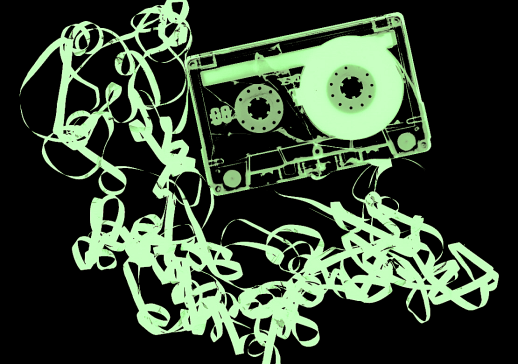
The term mixtape most commonly refers to homemade cassette compilations of music created by individuals for their own listening pleasure or that of friends and loved ones. The practice which rose to widespread prominence in the 1980s often has deeply personal connotations and is frequently associated with attempts to woo a prospective partner (romantic or otherwise). As Dean Wareham, of the band Galaxie 500 states, in Thurston Moore’s Mix-Tape: The Art of Cassette Culture, “it takes time and effort to put a mix tape together. The time spent implies an emotional connection with the recipient. It might be a desire to go to bed, or to share ideas. The message of the tape might be: I love you. I think about you all the time. Listen to how I feel about you” (28).
Alongside this ‘private’ history of the mixtape there exists a more public manifestation of the form where artists, most prominently within hip-hop, have utilised the mixtape format to the extent that it becomes a genre, akin to but distinct from the LP. As Andrew “Fig” Figueroa has previously noted here in SO!, the mixtape has remained a constant component of Hip Hop culture, frequently constituting, “a rapper’s first attempt to show the world their skills and who they are, more often than not, performing original lyrics over sampled/borrowed instrumentals that complement their style and vision.” From the early mixtapes of DJs such as Grandmaster Flash in the late ’70s and early ’80s, to those of DJ Screw in the ’90s and contemporary artists such as Kendrick Lamar, the hip-hop mixtape has morphed across media, from cassette to CDR to digital, but has remained a platform via which the sound and message of artists are recorded, copied, distributed and disseminated independent of the networks and mechanics of the music and entertainment industries. In this context mixtapes offer, as Paul Hegarty states in his essay, The Hallucinatory Life of Tapes (2007), “a way around the culture industry, a re-appropriation of the means of production.”
More recently the mixtape has been touted by corporations such as Spotify and Apple as an antecedent to the curated playlists which have become an increasingly prominent factor within the contemporary music industry. Alongside this the cassette has reemerged as a format, predominantly for independent and experimental artists and labels. The mixtape has also reemerged as a creative form in experimental music practice – part composition, part compilation, this contemporary manifestation of the mixtape is located somewhere between sound art and the DJ mix.

image by Flickr user Grace Smith, (CC BY 2.0)
This article explores these current manifestations of the mixtape. It analyses Spotify’s curated playlists and identifies some of the worrying factors that emerge from the ‘playlistification’ of recorded music. It goes on to discuss contemporary cassette culture and the contemporary mixtape identifying a set of characteristics which warrant the use of the term “mixtape” and distinguish it from forms such as the playlist. These characteristics, I suggest, may be adopted as strategies to address some of the contemporary crises in how we create, distribute, listen to, and consume music.
Playlists

“Day 213: Mix Tape – The Lost Art Form” by Flickr User Juli, (CC BY-NC-ND 2.0)
The mixtape has been presented as something of a forerunner to the music industry’s current streaming and subscription model and, in particular, of the curated playlists which Spotify sees as its, “answer to product innovation.” For Kieran Fenby-Hulse, writing in Networked Music Cultures: Contemporary Approaches, Emerging Issues, “the mixtape’s aura has underpinned the development of music streaming services such as Spotify and Apple Music” (174). Spotify’s corporate literature makes this connection explicitly via multiple references to mixtapes. The press release announcing the launch of its Discover Weekly playlist, for example, promises, “our best-ever recommendations delivered to you as a weekly mixtape of fresh music,” stating, “It’s like having your best friend make you a personalised mixtape every single week.”
Where the mixtape’s audience of one however, is the favoured other, friend, loved one, lover, Spotify’s curated and algorithmic playlists shift the focus inward. They are not created by someone for another, nor gifted to someone by another. They are created algorithmically for me and me alone. The promise of Spotify is that of “every playlist tuned just to you every single week.” Spotify delivers on this promise via its vast accumulation and exploitation of user data. The labour of the Spotify playlist thus is not the labour of love often associated with the mixtape, but rather it is an example of the increasingly prominent practice of corporations and service providers benefiting from unremunerated fan labour via, as Patrick Burkart notes in an essay entitled Music in the Cloud and the Digital Sublime , commodification of the “comments, playlists, recommendations, news, reviews, and behavioral profiles,” of music fans.
Analysis of Spotify For Brands’ corporate literature provides more insight into how Spotify utilises this data. Amongst millennials, for example, Spotify identifies “seven key audio streaming moments for marketers to tap into” – working, chilling, chores, gaming, partying and driving – and advises that “for marketers, this is a chance to reach millennials through a medium they trust and see as a positive enhancer or tool.” Spotify’s party playlists thus are an opportunity for brands to “think about enhancing the party moment by learning your audience’s favorite genres and subgenres and matching the beat” or “think audio for connected speakers and mobile display ads for that obsessive DJ always checking on their next song to further drive your message.” Spotify’s party playlists also seek to dispense with the unexpected juxtapositions and sonic clashes that have formed such a vital and valued component of DJ/sampling culture and the amateurism, imperfections, and crude edits of their supposed mixtape forebear. Thus ‘the mix,’ what Paul Miller (DJ Spooky) refers to as the process whereby “different voices and visions constantly collide and cross-fertilize one another” is replaced with promises of “professionally beat-matched music [where] every song blends smoothly with the next.” The hybrid of the mix thus is homogenised in the playlist.
In seeking to provide a music mix that is smooth, adaptable and perfectly transitioned, Spotify’s mood based playlists (“Your Coffee Break,” “Sad Songs,” “Songs To Sing In The Car”) are more closely aligned with the aura of Muzak and the Muzak Corporation than with that of the “mixtape” (a comparison previously made by Liz Pelly in her article The Problem with Muzak). The Muzak Corporation provided background music for the workplace from the 1920s and public spaces such as hotel elevators and shopping malls from the 1940s onwards aiming, as Brandon Labelle states in Acoustic Territories: Sound Culture and Everyday Life, to provide “a form of environmental conditioning to aid in the general mood of the populace.” (173)
Spotify’s promise of smoothly blended sound, for example, recalls Muzak’s mission, as quoted in Joseph Lanza’s, Elevator Music: A Surreal History of Muzak, Easy-Listening and Other Moodsong, to eliminate, “factors that distract attention – change of tempo, loud brasses, [and] vocals.”(48) Spotify’s stated desire, “to be the soundtrack of our life, […] to deliver music based on who we are, what we’re doing, and how we’re feeling moment by moment, day by day,” assigns a utilitarian function to its archive of recorded sound, recasting it, like Muzak, as quoted by Lanza again, as, “functional music,”(43) or, “stimulus progression program.” (49)
Cassette and the Contemporary Mixtape
Alongside the commercial playlists’ channeling of the mixtape’s aura there has been a reemergence of cassette, and the mixtape itself, as creative media. Cassette has become a prominent format for a host of underground labels attracted by its low manufacturing and distribution costs as well as its aesthetic qualities. Labels such as The Tapeworm, Opal Tapes, Fort Evil Fruit, and Nyege Nyege Tapes release short-run cassettes (typically 100-150 copies) encompassing noise, field recording, improv, drone, ambience, modular electronics, psychedelia and there ‘out there’ sounds. As Paul Condon of Fort Evil Fruit explains, “producing vinyl is prohibitively expensive and CDs often feel like landfill nowadays. The cassette format is a low-cost means of presenting albums as beautiful physical artifacts when they might otherwise only exist as downloads.”
As well as the economy and physicality of cassette, many enthusiasts are attracted by its sonic characteristics. The tendency of cassettes towards distortion, saturation and phasing are for many positive characteristics. Gruff Rhys of the band Super Furry Animals, for example, has observed that “listening to a cassette tape is not an exact science. Some cassette players play them a little faster. Others distort and phrase the music, changing the sound on the cassette forever.”
Since 2013 the experimental electronic duo Demdike Stare have released a series of cassette only limited edition mixtapes which form a body of work both linked to and distinct from their “official” album and EP releases. Whittaker of the duo has said of their aesthetic that, “Demdike Stare is all about records and the archive of aural culture from the last 50 years.” Where the Spotify playlist seeks to reconfigure the musical archive as functional or background music, artists such as Demdike Stare may be said to explore the recombinant potential of the archive as a vast body of aural culture which can be utilised to create hybrid works spanning temporal and cultural barriers. This reconfiguration of the aural archive arguably attains its most direct distillation on the duo’s mixtapes. These releases combine and overlay original and sampled sound in such a manner that the distinction between one and the other is obscured. They create a hybrid sound world in which sounds from multiple genres, cultures and timeframes overlap and interact, demonstrating what Joseph Standard in Wire magazine has described as, Demdike’s ability to employ sampling “as a means to release the hidden potential they detected in obscure and forgotten records.”
Dissecting 2013’s The Weight of Culture, unsubscribedblog detects:
a wave of static which quickly recedes to usher in a fine piece of Ethio-jazz from Mulatu Astatke…..a burst of the brief Les Soucoupes Volantes Vertes by French electronic prog band Heldon….a minimal rhythm track…overlaid with radio interference, muted voices, cymbals and all manner of audio artefacts before being subsumed by a wavering drone, vinyl static, plucked strings and finger bells.
While The Weight of Culture may be likened to a DJ mix (though one which exists distinct from the rhythm based, dance floor focused requirements which often determine the content of that form) elsewhere Demdike’s mixtapes serve as companion pieces to, or re-imaginings of their more mainstream releases (though again distinct from the more common forms of the remix or dub album). Circulation (2017) is “an hour-long mixtape/sketchbook of ideas and influences for…[their] Wonderland album, contrasting its heavily rhythmic stylings with this largely ambient-affair comprising archival tracks, bespoke edits and re-contextualised classics.” The Feedback Loop (2018) meanwhile reassembles elements of the catalogue of Italian improv collective Il Gruppo Di Improvvisazione Nuova Consonanza into a new collage composition and performance. As the duo themselves explain:
Tasked by the Festival Nuova Consonanza for a live performance at their 53rd Edition, with the remaining gruppo members in attendance, (Ennio Morricone, Giancarlo Schiaffini, Giovanni Piazza, Alessandro Sbordoni) we apprehensively dived into our collections for pieces by Gruppo and it’s members in order to create this homage. Using samplers, synths and effects we looped and layered chosen sections to create new pieces which we had to then play in front of the mighty Il Gruppo, captured here for posterity.
Demdike Stare, Postcollapse cassette and packaging

The German electronic composer Hainbach also reimagines the mixtape as a recombinant performance/composition hybrid. His YouTube series of C45 Lo-Fi Ambient mixtapes utilises his own self-made cassette loops, manipulated using modified cassette recorders and custom technology, and mixed amongst those of artists drawn from the contemporary underground cassette scene. The artist describes the first of these, C45 #1 | Lo-Fi Ambient Mixtape, as, “a grungy, half-speed lo-fi mix I made in one take with two cassette recorders, the Koma Electronics Fieldkit and a delay.”
What Hainbach calls mixtapes are audio visual records of live studio performances with the artist documenting the creation of the piece via video. They contain a participatory element and viewers/listeners are invited to send their own tapes to be, “mangled,” while the techniques and equipment employed are detailed in videos such as Tape Ambient Music Techniques | Making Of C45, and modification specs for some of the equipment used, such as Gijs Gieskes’ modified walkman are also available online.
Defining the Mixtape
Analysis of these works, along with more historical forms of the mixtape, suggests a set of characteristics which may be said to warrant the use of the term mixtape, even in a context wherein there is no engagement with the original material form of the medium, the cassette tape, which gave rise to the term.
- Hybridity: The mixtape is a uniquely hybrid form, part composition, part compilation. It combines elements from multiple sources, media and timeframes and frequently blurs lines between read and write cultures, or cultural consumption and production.
- Distribution: Mixtapes are distributed via non-mainstream methods. This may be via personal exchange, mail order, download from non corporate/commercial websites, purchase from merch stands at gigs, or via non-mainstream formats (in which category the cassette tape may now be placed).
- Intervention: The creator of a mixtape must be able to intervene in the recording process and to attain control over what is heard, to affect where sounds begin and end, to overlay material, and to combine elements from multiple sources.
- Labour: The creation of a mixtape involves an investment of labour at least equal to that required to listen to it in full. This time, effort, and investment of labour differentiates the mixtape from the playlist, mix CD, or disc drive filled with MP3s, often created simply by dragging and dropping file references from one window to another or via algorithmic selection.
Why set parameters around the mixtape as a genre? These characteristics may also form a series of strategies to counteract contemporary crises in how we create, distribute, listen to, and consume music – some of which are identified in the consideration of Spotify playlists within this article. The creation of hybrid works which are not easily defined or categorised, for example, might push back against the drive to assign a utilitarian function to music – to reframe it as something that happens in the background while we chill or do our chores. It might also serve as a form of resistance to the homogenisation of music and of DJ culture while also giving rise to new forms and practices.
Consideration of how and by whom music is distributed could help sustain a culture that supports independent artists and labels as opposed to corporations, brands and their marketing teams. Maintaining the ability to intervene in and act upon recorded sound sustains the ability to ‘play’ with sound and retains the potential for new forms in the lineage of the mixtape, or genres such as turntablism to emerge. Awareness of how the labour of musicians and music lovers is utilised and of who benefits from it may also serve to diminish the capacity for the exploitation of this labour.
—
Featured Image: “Untitled” by Flickr user Jenna Post (CC BY-NC-ND 2.0)
—
Mike Glennon is a Dublin based composer, audio visual artist and academic. His compositions and audiovisual works have featured in digital arts exhibitions and at music and film festivals in locations including the Venice, Paris, New Orleans and Dublin. He has been commissioned as a composer by organisations including the National Museum of Ireland and Dublin City Council. As a member of the band the 202s his music has been released to positive critical notice across Europe by Harmonia Mundi / Le Son du Maquis making him labelmates with artists including Cluster, Faust and A Certain Ratio. Mike is currently a PhD Research Scholar in the Graduate School of Creative Arts & Media (GradCAM) at the Dublin Institute of Technology where his research focuses upon the aesthetics of post-digital electronic music. He recently premiered new work stemming from his research at the Research Pavilion of the Venice Biennale thanks to the support of Culture Ireland.
—

REWIND! . . .If you liked this post, you may also dig:
Pushing Play: What Makes the Portable Cassette Recorder Interesting?–Gus Stadler
Evoking the Object: Physicality in the Digital Age of Music–-Primus Luta
Tape Hiss, Compression, and the Stubborn Materiality of Sonic Diaspora–Christopher Chien
Share this:


Current Top Posts





April 2021

January 2020

November 2019

October 2019

August 2019

April 2014

November 2017

March 2015

December 2017

October 2015
 Sounding Out!
Recent Comments