
Someplaces: Radio Art, Transmission Ecology and Chicago’s Radius

This week Sounding Out! is proud to present the first post in Radio Art Reflections, a three part series curated by radio artist and senior radio lecturer at Canterbury Christ Church University Magz Hall. Focusing on innovative approaches to radio art, the series will bring together three leading practitioners who have been researching the field from Canada, Australia and the U.K.
We begin with a fascinating exploration of “transmission ecologies” in recent works in Chicago, Iceland and elsewhere, written by Canadian sound and radio artist Anna Friz — one of the most exciting radio artists working today — who discusses how transmission art has shaped her practice.
— Special Editor Neil Verma
—
From the early avant-garde Futurists to present-day, utopian dreams litter the history of art meeting technology. When it comes to radio and wireless, these often include the dreams that each new technology will conquer space and time; that the overcoming of distance will enable the symbiosis of human with machine and the union of self with other, while the overcoming of time will bring about a simultaneity of experience. For many radio and transmission artists (myself included), our work with so-called “trailing edge” media seeks to critically engage these myths, positing wireless transmissions instead as time-based, site-specific encounters between people and devices over distances small or large, where the materiality of the electro-magnetic spectrum is experienced within a constantly shifting transmission ecology in which we all, people and devices, function.
If one hallmark of radio art is the desire to appropriate broadcasting by rethinking and re-using technologies of transmission and reception in service of crafting new mythologies and futures for the medium. Artists have long questioned the policies and norms established by state and market around radio broadcasting which delimit experimentation and autonomous practices. Bertolt Brecht‘s call in 1932 for radio to exceed its one-to-many broadcast format in favor of a democratized, transceptive (or many-to-many) medium still resonates with contemporary artists and activists alike. What else could radio become, we ask, if not only a disseminator of information and entertainment, acoustic or digital? If radio so far has largely acted as an accomplice in the industrialization of communications, artistic appropriations of radio can destabilize this process with renewed explorations of radio and electromagnetic phenomena, constructions of temporary networks small or large, and radical explorations of broadcast beyond the confines of programming and format norms.
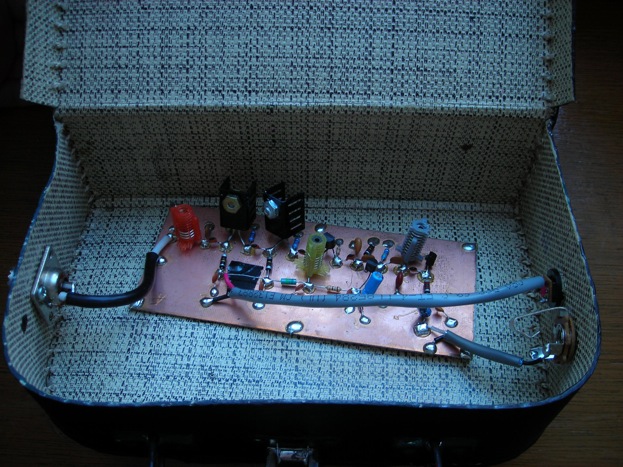
My first transmitter, built on the Tetsuo Kogawa model, as modified by Bobbi Kozinuk, 1998;
Curators, producers and art historians typically describe radio art as the use of radio as an artistic medium, which is to say, art created specifically for the technical and cultural circumstances of broadcast, and which considers these circumstances as artistic material. Today these circumstances have exceeded terrestrial broadcast to include satellite, online, and on-demand forms; similarly radio art has also expanded to include sprawling telematic art exchanges, online podcast series, and unlicensed temporary interventions into the radio dial. As a further reclamation of radio as a medium, many artists pull radio out of the studio to create installations, performance works and public actions which consider not just the act of transmission or the creation of artistic content, but also the material aspects of the electro-magnetic spectrum, and the circuits of people and devices which activate and reveal them.
Japanese media theorist and artist Tetsuo Kogawa describes broadcast radio art as art radio, where art is the content of a transmission. By contrast, radio art involves directly playing with electro-magnetic waves as the artistic medium. Galen Joseph-Hunter of Wave Farm further expands Kogawa’s formulation of radio art with the term transmission art, so as to include audio visual broadcast media and artistic activities across the entire electro-magnetic spectrum, such as work with Very Low Frequency (VLF) and Extremely Low Frequency (ELF) waves, or high frequency wireless networks. These definitions of radio and transmission art emphasize that radio is not a container for content, but is defined as relationships between people and things, occurring in the context of the electro-magnetic spectrum within a transmission ecology.
I apply the term transmission ecology in reference to both the symbolic spaces of cultural production such as a radio station, and to the invisible but very material space of dynamic electromagnetic interactions, both of which feature the collaboration between people and things. Transmission ecology asks more than “who owns the airwaves” by questioning the shifting relationships between all actors in the environment, from human to device to localized weather system to nearby star, and thus is not defined by homeostasis but by constant change. These relationships also support a theory of technology where people are not the absolute controllers of things, but where a push and pull of collaboration occurs within complex material and cultural environments.

Photo of Respire by Anna Friz, a large installation of radios from Nuit Blanche Toronto, 2009.
All activities in the electro-magnetic spectrum form ecologies in relation to one another conceptually, performatively, and materially. Consider the Radia network, an international alliance of independent radio stations who share radio art programming as an alternate transmission ecology within the broader culture of private broadcast radio stations. Another kind of ecology is formed by radio receivers all playing the same station diffused across countless cars and households, as they function in relation to other kinds of wireless devices and electronic systems nearby. Such a muster of receivers can be physically brought together, for instance, in a multi-channel radio installation, to reveal the complex relationships among devices, as each receiver also becomes a sender by electronically effecting its neighbor. A mobile phone receiving wireless internet likewise functions within the instability inherent in the surrounding transmission ecology shaped by all aspects of the built environment, such as the electrical grid and other urban infrastructure, as well as weather or time of day or solar flares. Human bodies and devices alike register the invisible electromagnetic activity that surrounds us as physical, measurable, and affective.
With this in mind consider radio art as occupying “radio space,” a continuous, available, fluctuating area described by the reach of signals within overlapping fields of influence and the space of imagination that invisible territory enables. The extrasensory nature of radio space allows for a productive slippage between real material signals and audible imaginary landscapes. Many radio art and transmission art works specifically draw attention to the transmission ecology in order to question the naturalization of mainstream communications systems, the normalization of practices within those systems, and the pervasiveness of electrical infrastructure, proposing alternate narratives and experiences.
So what is some of this work like? In the past year I have had the pleasure to work with Chicago-based Radius, an experimental radio-based platform which curates monthly episodes broadcast locally using the Audio Relay Unit, an unlicensed autonomous low-watt FM radio transmitter system developed in 2002 by Temporary Services and the Intermod Series. Radius neatly unites radio and transmission art by embracing the production of artistic content for broadcast, sampling existing content for artistic expression, and artistic use of the electro-magnetic spectrum generally. Radius functions as an intermittent exhibition space and as an intervention into the predictable daily grind of the FM dial. Artists compose their pieces specifically for the interference-prone radio space where their work may only be heard in fragments, as the instability and fluctuations of the relatively small Radius signal in relation to the big commercial stations broadcasting from downtown all form the context for experiencing the radio art works. Radius broadcasts one episode per month, on a schedule determined by the artist, with pieces varying in length and repetition, and some following a strict schedule related to cosmic or social timing.

Photo of my private transmitter + antenna pointing out the window in Seydisfjördur, Iceland
Recently I crafted an episode for Radius while on an artist residency in Seydisfjördur, Iceland. The town was the site of the first trans-Atlantic telegraph link between Europe and Iceland in 1906, which was also the year that Reginald Fessenden first broadcast a human voice over radio from his workshop in Brant Rock, Massachusetts. Iceland is remote enough that the electro-magnetic ‘pollution’ from human signal activity is notably absent, and located far enough to the north that in October the light disappears rapidly, so that each day loses eight minutes of daylight. The piece was called Radiotelegraph, a beacon crafted from spoken morse code and sampled signals, then sent from north to south, simulcast on my own low-watt FM transmitter in Seydisfjördur at sundown each day as well as on Radius in Chicago. The transmission marked time passing, beginning earlier each day as it followed the path of the sun. My intention was not to overcome but to experience and recuperate distance through the relation of a remote radio outpost to another minor outpost further south within a metropolis; to hear distance and feel it; to understand that distance, however finite, is a necessary condition for communication and relationship, and that distance is the key ingredient of situated, time-based, spatialized sonic experiences.
Here is the Radius episode featuring Radiotelegraph:
.
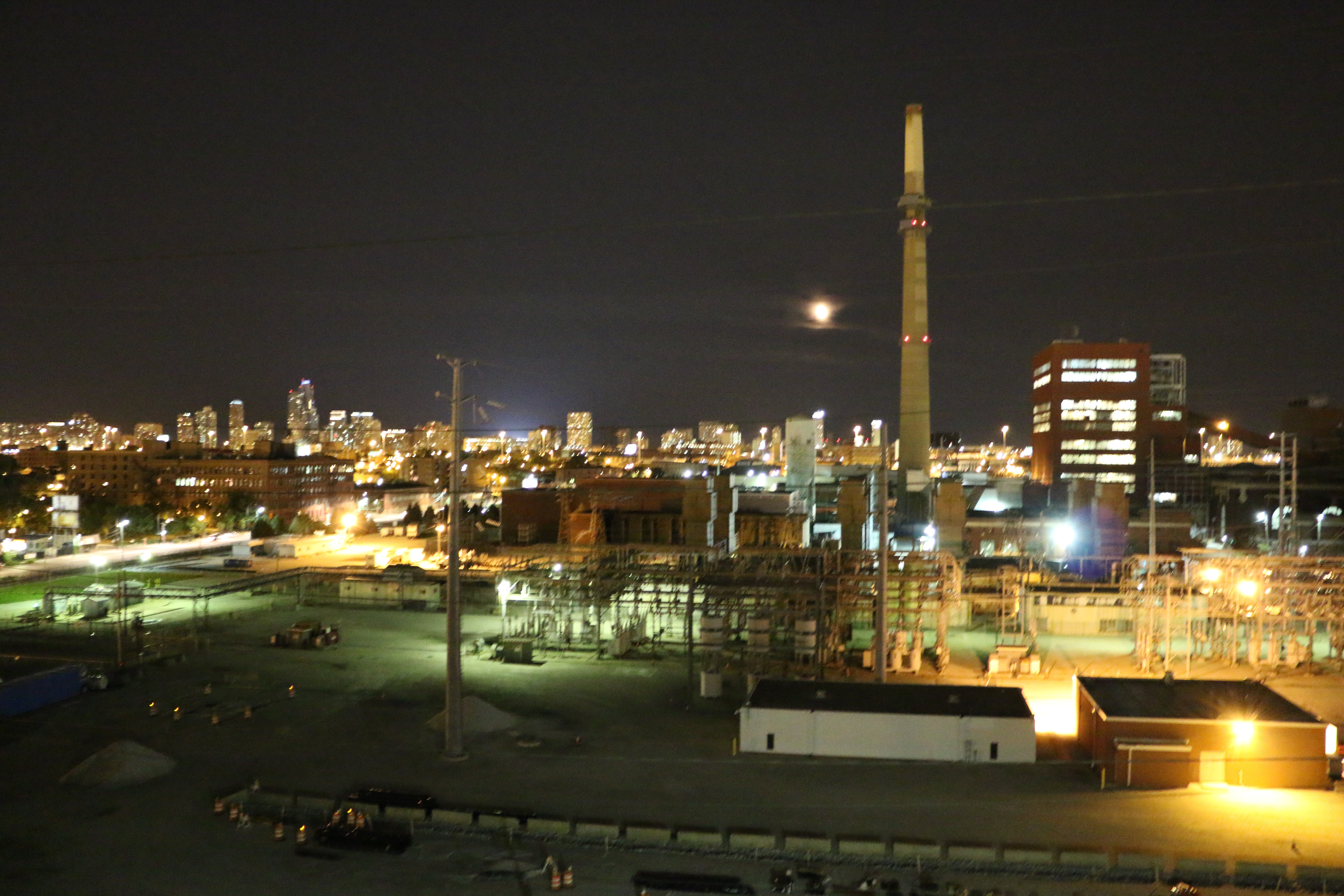
Power station across the parking lot from the Radius studio at MANA Contemporary, Chicago
As part of a recent yearly theme on “Grids” Radius tackled the electro-magnetic field space of the city by inviting four artists to create new works to be performed near power stations. In his piece electrosmog, Canadian artist Kristen Roos utilized a high frequency receiver to sonify signal activity in the 800 MHz – 2.5 GHz range, which includes mobile phones, wireless phones, wifi, and microwaves. His site-specific performance took place overlooking the Fisk Generating Station in Chicago, and included microwave ovens and micro-watt transmission to a sound system made of radio receivers. Thus the work was site-specific to both the transmission ecology of urban Chicago and the field effects of the electrical grid, mixing material signals with a speculative approach as to what the cumulative effects of living in this built environment characterized by centralized power could be. In Roos’ work, radio space contextualized and revealed the real–though naturalized and often invisible–relationships between people, things, and systems, where a microwave oven gestured at both danger and musicality.
Listen to the Roos piece here:
.

Kristen Roos’ set up for his Grids performance
These radio art works enact places in radiophonic space, and experiment with transmission to question the status quo of how the airwaves are controlled and used. As radio trickster Gregory Whitehead notes, it is position, not sound, that matters most with regard to radio. Artists remain committed to making radiophonic someplaces, however temporarily constructed, inhabited by interpenetrating and overlapping fields and bodies.
—
Featured Image: Jeff Kolar with Radius’ mobile transmitter, the Audio Relay Unit, on the shore of Lake Michigan. Used with permission.
—
Anna Friz is a Canadian sound and radio artist who specializes in multi-channel transmission systems for installation, performance, and broadcast. Anna holds a Ph.D. in Communication and Culture from York University, Toronto, and recently completed a post-doctoral fellowship in the Sound Department at the School of the Art Institute of Chicago. She has performed and exhibited widely across North America, South America, and Europe, and her radio art/works have been heard on the airwaves of more than 25 countries. She is a steering member of the artist collective Skálar |Sound Art | Experimental Music based in Iceland.
nicelittlestatic.com
—
 REWIND! . . .If you liked this post, you may also dig:
Catastrophic Listening — China Blue
Maile Colbert, Rui Costa, and Jeff Cain’s “Radio Terramoto” — Maile Colbert
Yvon Bonenfant’s Voice Bubbles App — Yvon Bonenfant
Share this:

The Sonic Roots of Surveillance Society: Intimacy, Mobility, and Radio


It’s an all too familiar movie trope. A bug hidden in a flower jar. A figure in shadows crouched listening at a door. The tape recording that no one knew existed, revealed at the most decisive of moments. Even the abrupt disconnection of a phone call manages to arouse the suspicion that we are never as alone as we may think. And although surveillance derives its meaning the latin “vigilare” (to watch) and French “sur-“ (over), its deep connotations of listening have all but obliterated that distinction.
Rounding out our series on surveillance, Kathleen Battles offers a historical perspective that shows how early twentieth century crime drama naturalized practices of citizen surveillance. A million eyes were activated as millions of listeners learned that the immediacy of radio and telephone allowed for an unprecedented level of participation in law enforcement. Calling all cars…Calling all cars… -AT
—
Police Headquarters, a 1932 radio crime drama, was produced in the infancy of narrative radio. Containing barely 12 minutes of narrative content, the program opened each episode with a repeating segment of call, connection, and dispatch to quickly establish both the crime committed and how the police responded to it. For example, in the “Payroll Robbery” episode it takes just over a minute and a half to hear a phone call to the titular headquarters, its connection to the proper unit, a radio call to a specific police car, and the responding officers arriving at the assigned location. Compared with the graphically and visually intense images of modern surveillance in contemporary popular culture, this brief exchange no doubt sounds quaint, simplistic, and even banal. After all, radios, cars, and telephones have served as the routine backdrop of most police dramas for some 70 years. But in 1932 the interlinking of these technologies was factually, as well as imaginatively, novel. This essay shows how radio, as “new media,” was central to imagining surveillance in sonic terms, prefiguring many features of contemporary surveillance practices.
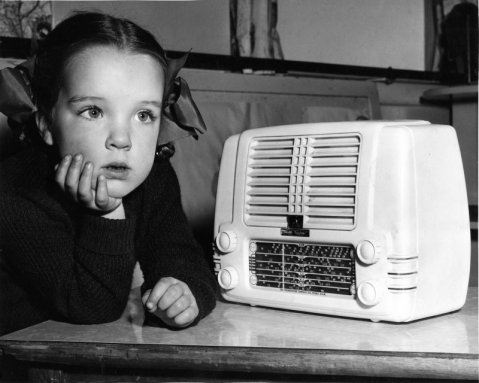
“Kindergarden of the Air,” by the Australian Broadcasting Corporation CC BY-NC-ND.
The introduction of radio and cars into police work took place in the first decades of the twentieth century, especially during the years between the two world wars that Richard Popp (2011) calls “the machine age”. He argues that this period witnessed vast transformations brought on by cars and radios, which, when combined with existing technologies like the telephone, forged new communication networks that transformed both work and leisure. These changes were central to the narratives of criminality and policing that emerged during the interwar years. Police were the focus of radio dramas, including Police Headquarters and Calling All Cars. These dramas played with the intermingling of automobility, telephony, and radio in ways that spoke to the main problems police forces saw themselves facing: organized, professional, mobile, machine-age criminals. Cars, telephones, and automobiles were not just tools to criminals, but they were also the building blocks for a machine age surveillance made possible by the sonic power of radio.
Recently, Robin James (2014) has suggested that the acousmatic is a useful metaphor for understanding the emerging practices of data based surveillance. Acousmatic surveillance listens for patterns in “ambient data environments” instead of profiling individuals in the panoptic sense. At the turn of the twentieth century, radio allowed for a panacoustic mastery of spaces that bridged both panoptic and acousmatic surveillance. Radio also speaks to another key feature of information age surveillance, what Mark Andrejevic (2011) describes as the “redoubling of tools for communication and leisure as technologies for surveillance and security.” (165-66) The technical capabilities and imaginative potentials of radio help us to consider it both as a police technology and entertainment medium. The sonic power of radio was often figured as an “Invisible Man Hunter,” whose realignment of spatial and temporal arrangements rendered criminal escape impossible. As an entertainment medium, radio’s aurality was key to understanding its imaginative potential as highly intimate and mobile: invasive and expansive.
In Police Headquarters we hear how radio’s sonic and aural qualities come together. Radio acts as the link between the telephone and car, allowing for a swift response to a citizen request. The tactical use of sound effects and narrative compression in the broadcast situate the listener inside a machine like apparatus that presents the police as always available. At their broadest level, radio crime dramas aurally situate communication and transportation technologies, like radio, as key to both the narrative organization of the story and as a plot element. In the opening to the “Stop That Car” episode of Calling All Cars, a dispatcher advises for cars to be on the lookout for a specific car involved in a hit and run, including the address of the crime and possible location of the vehicle. Overlaid with sound effects made to signify a car, these openings situate listeners as riders eavesdropping on the adventures of mobile police officers. As the program’s title suggests, each episode opened with a police radio call, often voiced by real life LAPD dispatcher, Jessie Rosenquist. The program’s sponsor was the gasoline company that supplied the fuel for LAPD patrol cars – further linking cars and radio as a key theme. In the opening to the “Two Man Crime Wave Episode,” the very ad for the product is performed as a police radio call.
The conceit of eavesdropping on a police adventure did much to link private life and the police. This theme runs tandem to radio’s sonic immediacy, which allowed listeners to imagine a seemingly instantaneous response to citizen phone calls.. For example, the “July 4th in a Radio Car” episode of Calling All Cars situates radio listeners as sonic participants, able to ride along with police from the comfort of their own living rooms. Here, cars respond to a number of calls made by private citizens that bring the policing function into daily life. There is even one call that involves domestic violence, in particular. Throughout the episode, police are situated as an available force – thanks to the telephone, radio, and automobile – to adjudicate all manner of private disputes. In these particular instances the intimacy of radio as a machine age technology is “redoubled” with radio as a police technology. Radio’s intimate address allowed the voices of police officers to enter the private space of the home. At the same time, the machinery of crime fighting required citizen participation, most often figured through the phone call from within the space of the home to the police.

“Radio Police Automation 1924,” by Robert Wade, CC BY-NC-SA.
If the intimacy of radio served to cross the divide between public and private, the spatial-temporal collapse achieved by radio made it ideal for sonically monitoring great swaths of space. Intimately linked with cars, radio was understood as especially mobile. Radio’s ability to compress the relationship between space and time is frequently dramatized. For example, in the “Crime vs. Time” episode of Calling All Cars, the host explains how radio has rendered the average response time to a police call for help only two minutes and forty seconds. The episode then proceeds to show how radio was used by the police to track and apprehend two men who robbed a movie theater. Representing phone and radio calls, while specifically referencing geographic locations, radio dramatists used radio’s aural dimensions to render radio’s sonic power of surveillance. Capable of reaching everywhere, police radio, when linked with the telephone and automobile, could be used to sonically pinpoint any somewhere that a criminal might try to escape to.
In our era of high-tech and sophisticated technologies, visually rich narratives, and algorithmically driven methods of tracking, there is certainly something simple, comforting, and even nostalgic in these tales of low-tech machine age criminal apprehension. Depression era true crime dramas certainly do not offer the kind of sophistication as information age narratives, such as The Wire. The medium’s sonic qualities were key to linking together its use as both a police instrument and as a domestic entertainment technology. With sonic forces invisibly and silently crossing the into intimate domestic spaces and covering large swaths of territory, radio became key to imagining many features that we take for granted as “new” about the information age: the control of movement across space, the constant availability of communicative connection, the promise of perfect coordination across a field of institutional actors, the marshaling of citizen participation in surveillance efforts, and the construction of increasingly intimate links between domestic life and law enforcement procedures. In serving as central node in refiguring shifting notions of space and time that existing institutions were not prepared to handle, radio’s sonic qualities remapped the meaning of police work and helped to establish a relationship between the police and citizen body that still resonates today. While not as technologically sophisticated, machine age policing and police narratives took advantage of radio’s double function as both a machine of coordination and medium of entertainment to extend the policing function into more areas of life. This reflects a sonic mode of power that allows neither the interior space of the home nor the exterior world of the road relief from police presence. This moment of technological interconnection, however, evoked the excitement and anxiety that made sonic surveillance at once thrilling and calming; a salve to soothe the woes of a world that now seemed intensely close and impossibly far flung. Is it any wonder that while some fret over the power of corporate and state dataveillance today, that some continue to find comfort in the possibility of being recognized as someone in a world of ever more intense interconnection?
—
Featured image “Radio for Backup” by Jonathan Flinchbaugh CC BY-NC-SA.
—
Kathleen Battles is Associate Professor and Graduate Director in the Department of Communication and Journalism at Oakland University. Her research focuses on radio history, especially as it relates to issues of policing, sound and surveillance, questions concerning technology and culture, and sexuality and the media. She is the author of Calling All Cars: Radio Dragnets and the Technology of Policing (University of Minnesota Press, 2010); co-editor (with Joy Hayes and Wendy Hilton-Morrow) of War of the Worlds to Social Media: Mediated Communication in Times of Crisis (Peter Lang, 2013); and co-author (with Wendy Hilton-Morrow) of Sexual Identities and the Media: An Introduction (Routledge, 2015). In addition, her work has appeared in Critical Studies in Media Communication, The Radio Journal, and the Journal of Homosexuality.
—
 REWIND!…If you liked this post, check out:
Acousmatic Surveillance and Big Data-Robin James
The Dark Side of Game Audio: The Sounds of Mimetic Control and Affective Conditioning–Aaron Trammell
À qui la rue?: On Mégaphone and Montreal’s Noisy Public Sphere-Lilian Radovac
Share this:


Current Top Posts





April 2021

January 2020

November 2019

October 2019

August 2019

April 2014

November 2017

March 2015

December 2017

October 2015
 Sounding Out!
Recent Comments