
In the Flesh: Embodiment, Listening, and Transcription
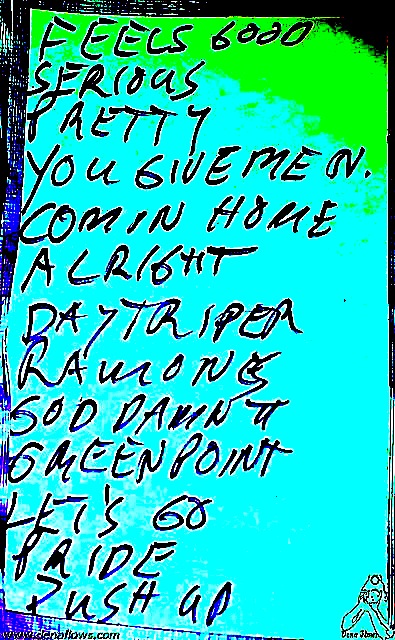
Editor’s Note: July 18th, 2012 has been designated as World Listening Day by the World Listening Project, a nonprofit organization founded in 2008 “devoted to understanding the world and its natural environment, societies and cultures through the practices of listening and field recording.” World Listening Day is a time to think about the impacts we have on our auditory environments and, in turn, its affects on us. This year, Sounding Out! has decided to observe World Listening Day by planning a month-long special forum of posts exploring several different facets of listening such today’s offering by SO!‘s Multimedia Editor Aaron Trammell on listening’s relationship to the body and next week’s discussion by novelist Bridget Hoida on the impact of listening on her writing process. We will also explore questions that we need to remember when we celebrate listening as a cultural, embodied act. What happens when listening is interrupted? distorted? A post on tinnitus by Mack Hagood will help us think through what happens when we take listening (and the able body) for granted as a universal, normative experience. We’ll also publish a special bonus multi-sensory post by our newest regular writer, Maile Colbert, on World Listening Day itself and we will launch our regular quarterly spring podcast for on July 12th, which will feature Eric Leonardson, director of the World Listening Project. In addition to being interesting as all hell, the podcast will suggest some ideas for how to get involved in WLD activities–or how to embark on a listening project of your own this July. Enjoy our ear-opening extravaganza and please keep those comments coming. We’d love to hear from you! –JS, Editor-in-Chief
—
DOI: https://doi.org/10.59350/esr2v-vjs70
What happens when the body translates sound from one medium to another? How is the body both affected by a song (when listening), and affecting it’s content (when writing)? In this post, I will relate my experience transcribing the lyrics of the song “Hexbreaker!” by The Fleshtones in an effort to answer these questions.
I love to sing. Often, I feel that it is only through singing that I feel that I can adequately relate to the emotions, ideas, and narrative of the songwriter. This relational practice is called embodiment. While psychologists such as Sigmund Freud and Carl Jung had at one point considered this sort of emotional relationship to be a libidinal drive – either to the phallus (in Freud’s case), or a unifying mythological symbol like the mandala (in Jung’s). These feelings, or drives, in classical psychoanalytic theory are part of our interior psyches, the unconscious mind.
Contemporary physiological research has departed from the sharp dichotomy of the conscious/unconscious mind. Instead, emotions are looked at as exterior phenomena – invisible links which form between bodies. As Lisa Blackman (2010) explains in her essay Embodying Affect: Voice-hearing, Telepathy, Suggestion and Modelling the Non-conscious: “The voices can be materialized through particular technologies of inscription such as neuro- imaging scans, and can even be located within the right temporal-parietal lobe, showing the capacity of the right brain not only for psychological attunement, but also for registering the affects of others” (166). Other theorists such as Sara Ahmed (2004) have argued that emotions float between and stick to bodies. Julian Henriques (2010) has even noted the ways that sonic vibrations work to activate reciprocal affective moods in others (75), a point very much in line with Blackman’s musings on the voice’s centrality to “psychic,”right brain, linkages. To these points, it is important to consider exactly what it means for the body to work as a medium of translation. What emotions can a song activate in my body, and how do these feelings become words, stored in the mnemonic confines of paper?
Because listening is central to the transmission and construction of emotional bonds, I will now detail my experience transcribing “Hexbreaker!”.
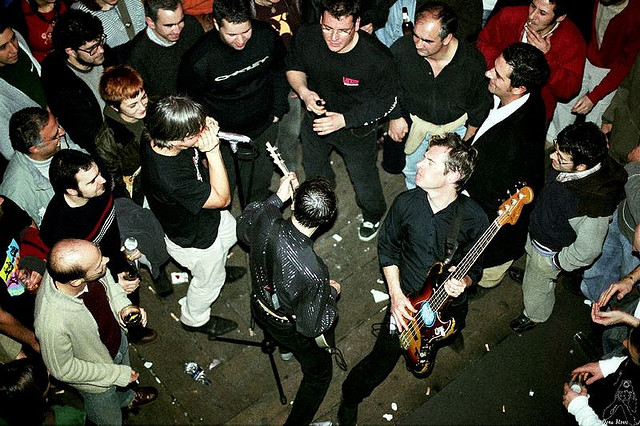
The Fleshtones are a band that I love. Their songs find the perfect balance of Animal House cool, Swinging Medallions style garage rock, and campy B-movie flavor. They have cred too, as they were a frequent act in the late-70s CBGB punk scene who shared a rehearsal space with The Cramps (a similar, but notably more famous band). Their song “American Beat” was key in the soundtrack of Tom Hanks’ shlocky 1984 film Bachelor Party. Peter Zaremba, the group’s singer, was a host on MTV’s interview based program, I.R.S. Records Presents the Cutting Edge. And, best of all, The Fleshtones have been largely eclipsed by bands with more visible albums, members, and histories. The band is all mine, and they serve as the perfect accent to any mixtape or conversation trivia at a mixer.
The digital footprint left by The Fleshtones is surprisingly sparse. Only a handful of key songs (from movie soundtracks) come up when a search for “fleshtones lyrics,” is queried on Google. A search for guitar notation or chord charts is completely fruitless, a rare feat in today’s search ecosystem. Even their vintage releases, 1982’s Roman Gods and 1983’s Hexbreaker!, were hard to pin down until the Australian label Raven re-released them on CD in 2011. For whatever reason, this sense of scarcity does nothing but excite me. It makes me feel an increased sense of intimacy and ownership. The Fleshtones, in this sense, are a knowledge commodity that has been underappreciated. By transcribing “Hexbreaker!”, and submitting it to the lyrics archive at lyrics.com (yet to be posted), I feel that I am laying claim to a space of knowledge and expertise neglected by many others.
Transcription is generally dull. Having transcribed many interviews in the past, I admit to regarding it as a job that requires patience more than practice: Press play. Listen for ten seconds. Jot down what was said. Forget half of what I was writing. Rewind five seconds. Listen again. Not quite enough to replace when I missed. Rewind eight seconds. Finish constructing the first sentence. Repeat. Hang in there for a few hours. Slow, repetitive, and monotonous is the work of interview transcription. In lieu of my previous experiences, I was happy to learn that the work of song transcription is notably more pleasurable. Although it came with its own share of frustrating and repetitive points, the presence of melody, cadence, and rhyme schemes made the entire process much more endearing and predictable.
One of the most engaging portions of song transcription came with the puzzling-out of unintelligible lyrics. The second verse of “Hexbreaker!” begins with a line that sounded like “With ____-____ mud and a hoodlum stack, finding fire in a mangled park” on first listen. It wasn’t until I had listened to each phrase five times in a row that I was able to revise to, “Well knee-high mud, and a moon lit shack, fightin’ flies in a mangled marsh.” Still not confident with that wording, I decided to do a dictionary search for similar words. To my elation after I had typed m-a-n-g into the dictionary the first word to appear was “mangrove,” the perfect word which I would never have guessed (it’s a weed-like tree found in coastal swamps!). Next I was spirited to discover that the following line evoked images of conquistadors sailing and exploring: “Well knee-high mud, and a moon lit shack, fightin’ flies in a mangrove marsh / Sendin’ sabres across the seven seas, or any foreign shores they may wash / I need a hexbreaker!”
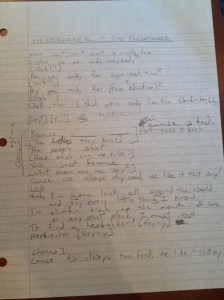
After I was able to get a gist of the overall narrative through transcription, I went back through the piece and was better able to make educated guesses about what the lyrics were. Although Zaremba often takes an unintelligible pitch when singing, the context of 17th century exploration helped me to piece together many of the tougher bits of the song. For instance, I revised the beginning of the chorus from “Well toss it back / [The bottles they break],” to fit the overall theme of colonial exploration, “The cause is had. / [The bodies they break].” Although, I’m not certain that these are the words to the song, I’m very confident because they match the overall theme. The practice of song-transcription has been fulfilling in the same way that figuring out a jigsaw, or tangram is exciting. It is a creative sort of problem solving, one that combines both analytic (left brain) and spatial, metaphoric (right brain) intelligence.
Emotionally, however, I did not feel the same satisfaction that I do when singing. Perhaps this has something to do with transcription alternate mode of embodiment. Transcription, and the pleasures associated – problem solving, precision, and permanence – are all of an analytical, and somewhat strategic sort. These are the pleasures of a conduit, processes associated more with the enduring construction of emotional bonds (belonging, and community), than the lucid enjoyment of them. It is my hope that one day another Fleshtones fan plumbs the depths of Google to find the lyrics of “Hexbreaker!” and that the fruit of my efforts, a completed transcript on lyrics.com, greets them and helps them to sing along and revel. Until then, it is enough to know that the work of transcription, for myself at least, is analytic and dry–definitely worlds apart from the euphoric mode of singing where my entire body vibrates in rhapsody to the melody, rhythm, and harmony of song.
—
Aaron Trammell is co-founder and multimedia editor of Sounding Out! He is also a Media Studies PhD candidate at Rutgers University.
—
Share this:

Music Meant to Make You Move: Considering the Aural Kinesthetic

DOI: https://doi.org/10.59350/6m3px-ch875
In the two weeks prior to my drafting this piece, the world lost Adam “MCA” Yauch, Robin Gibb, Donna Summer, and Chuck Brown. In their wake they leave a profound legacy of music, yes, but of dance music particularly. MCA declared your right to party while demonstrating that white MCs aren’t always gimmicks. The BeeGees gave you a new strut courtesy of the bounce-funky soundtrack to Saturday Night Fever. The goddess Donna Summer seduced your ears with her orgasmic whispers, then pumped up the pulsating synthetic beats that brought the discotech from its urban centers directly to you. And go-go’s blaze, though not as far-reaching as disco’s, grew out of Chuck Brown’s musical sensibility, and burned deep in the hearts of Chocolate City natives. For all of these artists, moving to the music isn’t merely a possibility or inclination, but a deeply irresistible impulse. Altogether, these artists brought music that not only called out to people to dance, but if you didn’t dance you missed something essential: the inextricable ties between music and movement. One acts as a key that opens up a dimension to understanding the other.
Seeing people dance to a live go-go band taught me how to appreciate their music. When I finally heard go-go for the first time at a club in 1995, it challenged my musical sensibilities, which were more attuned to smooth R&B and jazzy Hip Hop. By then, go-go music seemed so fast, and coupled with the multiplicity of drums that I didn’t know how to get inside of the groove. In the midst of the bubbling fervor I stood noticeably still as the young woman next to me ripped the shirt off her sweaty body and whipped it above her head (like a flag at carnival), never once missing a beat in her frantic jumping and pumping to the live drums while wearing only her bra and a pair of jeans. The dancing bodies of the whole club fueled my understanding, and by extension appreciation, of what go-go does. Without them, I would have missed out on something deeper.
I am drawing your attention both to music meant to make you dance and dancing that is necessarily done to music—i.e the arena of social dance. Julie Malnig, in Ballroom, Boogie, Shimmy Sham, Shake: A Social & Popular Dance Reader, defines “social dancing” by “a sense of community often derive[d] less from preexisting groups brought together by shared social and cultural interests than from a community created as a result of the dancing” (4, emphasis in original). That might include social dances that correspond to particular songs, or called and standardized steps, like the twist or the electric slide. My focus is more broadly on a visceral, embodied, kinesthetic response to dance music in a particular social space, which is not explicitly directed by the lyrics or a set of moves but by the feel of a song as a whole. In the Hip Hop social dances I write about, rather than a finite set of moves there are infinite possibilities for improvisational play within a particular style (like b-boying or popping) that the music draws out of the dancer. As David F. García states in his piece on mambo titled “Embodying Music/Disciplining Dance: The Mambo Body in Havana and New York City,” “the embodied experience of sound and movement [are] merged through the body” (172).

I have come to name the frame for analyzing the simultaneity of social dance and music (and sound broadly) as aural-kinesthetics. While these words capture sound and movement separately, together I am looking to engage more than just the sensory response of moving to what one hears. The term develops out of works by music scholars like Kyra Gaunt (The Games Black Girls Play: Learning the Ropes From Double Dutch to Hip Hop), Kodwo Eshun (More Brilliant Than the Sun: Adventures in Sonic Fiction), and Kai Fikentscher (“You Better Work!”: Underground Dance Music in New York City), who shift our orientation to music and rhythm by drawing on our kinesthetic responses to it. Aural kinesthetics recognize that social dance practices are kinesthetic forms within the all-encompassing aurality of an environment. I use spatial terms to acknowledge sound’s omni-directionalality, coming at you from all sides and helping to actually produce the social dance place. In other words, the aural kinesthetic is also a kind of spatial practice (along the lines of Henri Lefebvre’s The Production of Space). For example, consider how a bomba dancer orchestrates the primary bomba drummer’s rhythms within the rhythmic arena created by the second and tertiary drummers; or how loud music in street dance performances fills the immediate surroundings and bleeds out into other areas, attesting to their capacity to claim public spaces (the volume has volume). Music in particular plays a fundamental role in establishing the conceptual performance arena that ultimately makes the physical space functional for certain dance practices.
Despite the fact that social dances necessarily have a musical component, dance is typically overdetermined by the visual, which in Western cultures we are better equipped to address. The sound and feel of dance experiences are often overridden by the spectacle of dancing, which the following clip demonstrates. In this clip showcasing the final battle from the 2007 Freestyle Sessions in Los Angeles, the spectacle of these amazing dancers distracts you from the actual social dynamics of their battle, of which music is central.
.
The exchange between dancers is truncated, spliced together for dramatic effect. You focus on the center of the cypher, lost in the visual thrill of it all. The song they were actually dancing to is replaced by another that, though danceable, prevents us from appreciating a particular song’s nuances as well as the crowd and emcee’s involvement in the event. Overdubbing songs that you do not have clearance for is in compliance with copyright laws that force the video’s producers to instead play songs to which they have legal access, in sacrifice of aural-kinesthetic experiences the videos attempt to capture. Yet even in cases of the below clip where we hear the original song, the recording cannot capture the quality of the force of the music that is loud enough to feel throughout your entire body, thereby promoting a shared sensorial experience in the room. Whether one is recording with a camera or in writing, capturing the aural-kinesthetic can be tricky.
2009 Dutch B-Boy Championships Semi-Finals between Hustle Kids and Rugged Solutions
For me, the aural-kinesthetic is useful insofar as it opens up creative space for me in writing the simultaneity of sound and movement. Scholars like Mary Fogarty (Dance to the Drummer’s Beat: Competing Tastes in International B-Boy/B-Girl Culture) have approached the topic by distinguishing between notions of musical taste and musical competency in clarifying the contours of b-boying’s dance-music relationship. In my own writing, I’ve tended toward storytelling and descriptive analyses. In contrast, considerations such as those of Roland Barthes’ “The Grain of the Voice” (in Image, Music, Text) propose to expand the language on (vocal) music in general by shifting the object of analysis to create new ways of writing music, which we can extend to writing social dance.
So what is a productive approach for writing the aural-kinesthetic? I’m not prescribing a method, but I do want to consider the possibilities of shifting the focus of analysis in such a way that it allows for the simultaneity of music and movement. For example, there may be value in examining a gesture repeatedly made to a particular part of a song to understand what that song is doing; or examining the physical layout of a room and how that space gets used through the song that fills it. Perhaps coming at social dance indirectly and on multiple fronts makes for a richer depiction.
For now, let’s take advantage of this digital space and collectively consider our options. Here’s a task I hope you might take up: post a link to a song or a video clip that makes you move. Describe some quality of your visceral response to the song and place your thoughts in the comments section below. Include the multiple fronts that help you to articulate your experience. While music and dance have the capacity to “speak” in ways that verbal language cannot always reach, my hope is that a range of possibilities might get us there. or at least much closer.
—
Dr. Imani Kai Johnson is a Ford Dissertation Fellow, who has just completed a three year postdoctoral fellowship at NYU’s Performance Studies Department. She received her PhD in American Studies & Ethnicity at the University of Southern California in 2009, where she wrote a dissertation titled,”Dark Matter in B-Boying Cyphers: Race and Global Connection in Hip Hop,” which considers the cultural and performative dimensions of Hip Hop dance as a global phenomenon through cyphers (dance circles), and the invisible forces of the collaborative ritual. Dr. Johnson is currently completing a manuscript based on her dissertation.
—
Share this:




Current Top Posts





April 2021

January 2020

November 2019

October 2019

August 2019

April 2014

November 2017

March 2015

December 2017

October 2015


Recent Comments