
Pushing Play: What Makes the Portable Cassette Recorder Interesting?
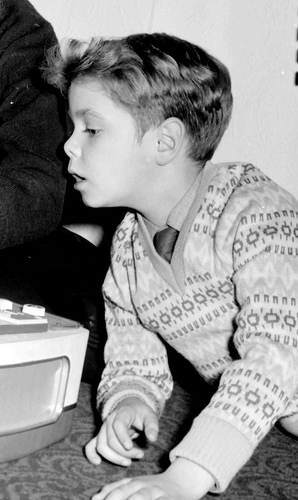
"Change the Speed": image from the "Vintage Kids" archive of flickr user theirhistory
One of my earliest memories of sound recording is one of my earliest memories, period: an isolated image of my own index and middle finger trying to push down the “record” and “play” buttons on my father’s portable cassette tape recorder. More prominent than the visual element of this memory is the haptic one: I can still call up the sensation of the effort required to make the red button go down and latch and the stress on the top joint of my index finger as the resistance bent it backward. Also still with me is a trace sense of the threat of sharp pain, as if at some point previous I had been wounded (perhaps pinched?) by these buttons. How young must I have been to have experienced this degree of opposition from such a small, unassuming device? And whence this desire to persist in the face of it?And: how and where does this object–so unprepossessing with its five big buttons, volume slider, cartridge tray, and little speaker–fit into sound studies and the history of sound recording technology?
There’s a small, rich, growing body of work on tape recording–including work by scholars as different as Kathleen Hayles, Steven Connor, Michael Davidson, and this blog’s doyen, Jennifer Stoever-Ackerman–but almost invariably it focuses on the reel-to-reel recorder, the device the cassette recorder was meant to simplify and miniaturize, at the expense of sound quality. The reel-to-reel was a vital contributor to the development of stereo and hi-fi hobbyism; it was also the mechanism at the center of a series of bold modernist literary experiments with tape recording by Samuel Beckett, William S. Burroughs, David Antin, and others.
Aside from Andy Warhol’s use of it to tape huge swaths of his everyday life (in 1965, he “wrote” a novel consisting of 24 largely consecutive hours of transcribed cassettes) the cassette recorder has no such avant-garde pedigree. The name of the first model, the Norelco Carry-Corder 150, which appeared in 1963, shows the primary focus of its manufacturers’ vision. Ads and trade journal articles from around this time touted the ease with which the device could be toted around on a vacation with the aim of producing an “audio album” of the trip. Doubtless, such albums were made and some may even still exist. But I suspect that the most vibrant history of the Carry-Corder and its descendants lies in the device’s easy adapability into the play world of children. As I and many others of my generation remember it, the pleasure of playing with the device was the way it instigated various sorts of performance, usually based in mimicry of ones we’d consumed through other electronic media. In a manner not unlike Warhol, we created our own little media empires: Dj-ing, news announcing, sportscasting, hosting talk shows with the baby and the dog as guests, singing like Cher on TV, re-enacting TV comedy sketches, recording one’s own comedy sketches, and on and on.
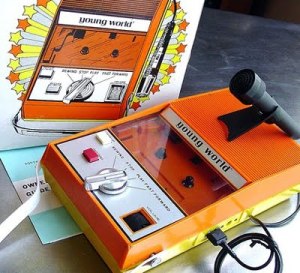
Child's play?: Young World BIC-202 Cassette Recorder
It’s not obvious how sound figures in the context of children’s play. Certainly, the quality with which the tape recorder recorded and played back sound mattered little, if at all. What mattered was the way the device initiated and constructed scenes, provided roles to play. Analogously, as David E. James has noted, one of the most powerful aspects of Warhol’s practice of bringing his Carry-Corder 150 everywhere he went (he was an early adopter, purchasing one in 1964) was that it “ma(de) performance inevitable” and “constitute(d) being as performance” (Allegories of Cinema, page 69). Even playback itself was a matter of secondary interest; how many times do you think I listened to the tape of myself “broadcasting” two innings of a random mid-70s Mets game, delivered as I watched on TV with the sound turned down? My wager is on none. Still, sound is the raison d’etre of the cassette recorder. A few years later, kids might have done similar things with a video camera, but to a lot of kids, the early mass-marketed versions of that device felt much more formal, complicated, authoritative. That was the instrument through which the “official” history of the family was to be told; the tape recorder picked up the creative fragments, the bored interstices, the embarrassments, the extremes–parts of a world that wasn’t to appear before guests. Plus, the sound-based device actually offered greater reach and flexibility along with more forms of integration into other media like television.
My early memory of the recorder, however, seems more primal. Given its intensity, it seems clear that the tape recorder served as a vehicle toward several important forms of self-demarcation, helping me to discover and negotiate certain limits: of my body, of my agency vis-à-vis machines, of my relationships to my parents, of my family’s position in a larger social and economic world. (And in fact, the device was an important part of my family’s livelihood, vital to my father’s work as a radio reporter.) In retrospect, I seem almost impossibly young to be left to my own devices with the machine, and I also have a vague sense that I had been violating some prohibition, perhaps a decree that the recorder is “not a toy.” I wonder how much the force of such a decree originated precisely in the ease with which it could and did become a toy.

gramophone, film, typewriter, and cassette tape recorder?
It’s unlikely that Friedrich Kittler was going to list “cassette tape recorder” next in his book title after “gramophone, film, and typewriter.” It’s unlikely he had an image of the device in mind when he wrote his bravura dictum, “media determine our situation.” Some technologies don’t stand up to such sweeping statements, toward which media studies sometimes seems particularly drawn. Certain devices, I think, necessitate a broadened and diversified understanding of the things both sound and technology do—even things that aren’t “about” sound in a conventional sense. For many historical narratives of sound reproduction, the cassette tape recorder is a regressive device, a drag on the pursuit of greater audio fidelity, with fidelity defined as “presence.” But the qualities of the cassette recorder that make it significant to our field are manifold, and some of them will be qualities that arise out of their adjacency to the central fact of recording and playing back sound. The “forgotten” areas of the history of sound reproduction technologies aren’t the notable failures—the 8-track players, which after all still draw camp-retro interest–but the most mundane successes. The portable cassette tape recorded never truly failed, it just got left back.
—
Gustavus Stadler teaches English and American Studies at Haverford College. He is the author of Troubling Minds: The Cultural Politics of Genius in the U. S.1840-1890 (U of Minn Press, 2006) and co-editor (with Karen Tongson) of the Journal of Popular Music Studies. His 2010 edited special issue of Social Text on “The Politics of Recorded Sound” was recently named a finalist for a prize in the category of “General History” by the Association of Recorded Sound Collections. He is currently working on Andy Warhol’s sound world, Woody Guthrie’s sexuality, and other stuff.
Share this:

GLaDOS, the Voice of Postfeminist Control

Warning, spoilers ahead. Image borrowed from ElderGeek.
Much has been written about Portal, it has won at least seven “Game of the Year” awards and has been ranked as the “Best Game of all Time” by Gamesradar. Perhaps because both the hero and antagonist are women, it has also been the object of several cultural critiques. One blogger writes, “GLaDOS [the game’s villian] is the archetypical oppressed woman.” In an article published by GamePro (a mass-market game review magazine) GLaDOS is considered a “feminist icon.” Although “feminist icon” is a bit extreme, GLaDOS does have a lot to do with feminism. When seen in light of Rosalind Gill’s (2007) essay, “Postfeminist media culture,” GLaDOS, and her wry, disembodied voice, hold striking parallels to the immanence of surveillance in today’s world.

GLaDOS and Chell. Borrowed from gryphonworks @ deviantART.
At their core, the games in Valve Software’s Portal series are relatively straightforward: you are put in control of a female character named Chell, who is attempting to escape from the Aperture Science Laboratory complex. Equipped, mainly, with a portal gun (think Yellow Submarine, “Hole in My Pocket”), Chell traverses precipices, laser drones, acid pits and everything in-between. As she navigates and manipulates these obstacles, a disembodied Orwellian voice guides Chell from one puzzle to the next. This is the voice of GLaDOS (Genetic Lifeform and Disk Operating System), a self-aware computer who runs the joint (at least in Portal 1) and is keeping you around for further “testing.” Where Portal is claustrophobic, just you and GLaDOS, Portal 2 is a little more dynamic. A third character, Wheatley, is introduced. In both games, however; there is an inescapable feeling of surveillance and scrutiny. GLaDOS’s monotonous voice is everywhere, the robotic platforms of the Aperture complex are the only appendages of her body to be found.
What to make of the GLaDOS’s character? Although she is helpful at first when guiding Chell through the early tests, GLaDOS quickly adopts a sarcastic tone – putting Chell down, and belittling her mistakes. G. Christopher Williams of PopMatters reads into the backstory a bit. He points out that GLaDOS is modeled on the personality of the Aperture Science CEO, Cave Johnson’s, wife: Caroline. In the second game there is a tape of Johnson elaborating:
Brain Mapping. Artificial Intelligence. We should have been working on it thirty years ago. I will say this—and I’m gonna say it on tape so everybody hears it a hundred times a day: If I die before you people can pour me into a computer, I want Caroline to run this place.
Now she’ll argue. She’ll say she can’t. She’s modest like that.
But you make her.
Hell, put her in my computer. I don’t care.
GLaDOS, then, has a bit of a history. Within this history there is a glass ceiling. GLaDOS has had a dampening sphere installed to limit her “irrational thinking,” and curb her “misbehavior.” Tellingly, this sphere whispers terrible ideas to her in a babbling male voice. At the end of Portal 1, Chell destroys the dampening sphere, and GLaDOS is free to get revenge on the society that has caged her. At this key moment, the tonality of her voice shifts from accommodating to sultry.
This change in voice accompanies a change in disposition. As Chell continues her adventures in Portal 2, GLaDOS returns with a set of suspiciously cutting remarks. Several barbs are made about Chell gaining weight, being unintelligent, and being adopted. In the sequel, GLaDOS is especially critical of Chell’s body. These pot-shots figure perfectly into Gill’s (2007) hallmarks of postfeminism: 1) the increased self-surveillance of the female body, 2) the increase of surveillance in new social sectors, and 3) a focus on the psychological transformation of one’s self, or interior life. Chell, the avatar, isn’t being judged on her weight (or lack thereof). Instead, GLaDOS’s remarks cut to the player, who recognizes that neither they nor Chell fit GLaDOS’s ideal. Although, in the narrative, GLaDOS typifies an extension of invisible and disembodied surveillance into new spheres of life, her comments act to foster self-surveillance in the embodied player.
GLaDOS’s comments have even jarred some users in the Steam Users’ Forums (Steam is Valve’s online distribution platform). In a thread entitled, “Portal 2 Sexist,” one user, loodmoney, asked if anyone else found GLaDOS’s fat jokes off-putting. To this, another user, Killalaz replied, “GLaDOS is trying to discourage/dishearten the testers. Chell is a woman, what bothers a woman more than being called fat? Not much. . .psychological warfare so to speak.” Although Killalaz may be reading too literally into Portal 2’s narrative, he is right about one thing: to some extent, GLaDOS, and therefore Valve Software, is waging psychological warfare on us all. Later in the thread another user, BC2 Cypher, demonstrates the extent that attitudes of self-surveillance can work to mold one’s psyche, “I don’t see the issue he’re. I actually used to BE fat. Lost 72 pounds when I was 15. 232 – 160. It’s not like Chell is even fat. That is the joke.” The real joke, if there is one, is that so many players are content to reduce GLaDOS’s comments to a self-contained dialogue between fictional characters. What is heard, actually, relates directly to the way dialogue from Portal is internalized. In these forums, the voice of GLaDOS is reproduced; it mediates the bodies of some fans (by supposing an ideal weight), and surveils the bodies of others (by guiding the dialogue).
But, when I play Portal, I occasionally smirk at GLaDOS’s comments. They are cutting satire. If GLaDOS is a feminist icon, it is because she is a voice that everyone carries with them at all times. The voice in our heads, that causes us to judge and shape ourselves, while simultaneously passing unkind judgment on to others. GLaDOS is iconic of the postfeminist condition – a condition where surveillance is assumed and internalized. And, our bodies are shaped through the hyper-mediation of games like Portal, and characters like GLaDOS, as they replicate themselves in web forums, and in our own voices.
AT


Share this:


Current Top Posts





April 2021

January 2020

November 2019

October 2019

August 2019

April 2014

November 2017

March 2015

December 2017

October 2015
 Sounding Out!
Recent Comments