
“Don’t Be Self-Conchas”: Listening to Mexican Styled Phonetics in Popular Culture*

*Dedicated to the love we hear in our mothers’ accents. This post is co-authored by Sara V. Hinojos and Dolores Inés Casillas
The Cinco de Mayo season showcases troubling instances of Spanish being mocked. Corporate ‘merica profits from Drinko de Mayo when menus advertise “el happy hour”; words like “fiesta” and “amigo” are overused; and Spanish hyperanglicized for laughs (one of the worst: “COM-PREN-DAY”). These acts of linguistic privilege, according to Jane Hill, elevate whiteness in public spaces. What is heard as playful for the dominant ear is simply an acoustic representation of the racist appropriation of mustaches, sombreros, and sarapes.
CinKO de Mayo(naise)
Fiesta like there’s no mañana
Said no Juan ever
That said, bilennials have struck back.
Last year, the Latino digital platform, we are mitú, published a list that resonated with its young, bicultural readers, those long accustomed to hearing Spanish Accented English (SAE) as part of their everyday speech: 17 Popular Brand Logos If They Looked The Way Your Parents Pronounce Them. This humorous phonetic play in the face of complaints about foreign accents being unintelligible or moral indignation over immigrants who do not learn English with native-like proficiency re-directs our attention to digital, engaged Spanish-English bilingual communities. Like Chicana/o listening practices, these digital memes, gifs, and lists embrace how these accents invoke sounds of survival, solidarity and place making.
Con Fleis (Corn Flakes)
Gualmar (Wal-Mart)
Feisbu (Facebook)
Cosco (Costco)
The witty Buzzfeed-ish list re-spelled English-language global logos in Mexican, immigrant styled phonetics to reflect how said stores, brands, and social media sites are heard within Spanish-dominant or bilingual speaking communities. The absence of letters (Cosco) and/or the substitution of letters (Gualmar) induce an “accented” non-English dominant speech, dislodging standard rules about English-language spelling and pronunciation. Readers chuckled at seeing immigrant, ESL (English as a Second Language), phonetic speech in print – a tactic Sara V. Hinojos refers to in her media writings as a visual accent, or a visual vocabulary based on sound.
In order to “get” the humor behind the wave of memes and gifs that use Spanish Accented English (SAE), Chicana/o readers rely much more on their listening ears than their eyes to understand how these accents are voiced in print. Here, listening to accents operates as a popular form of literacy, one that registers the audible, racialized experiences of Spanish-speaking immigrants. Of course, the use of creative, rasquache forms of humor have long been a hallmark aspect of Chicana/o humor. Yet listening to these digital literacies, especially within the contemporary “build the wall yet eat the taco” era, help make these accents legible.
Estop (Stop)
Eschool (School)
Espray (Sprite)

Certainly, some vocal accents are audibly more patent to select ears than others. Accents work to socially and geographically locate speakers; for instance, often racially indexing Spanish Accented English speakers as Mexican (regardless of nationality), immigrant (regardless of citizenship), and/or poor (regardless of occupation). Sociocultural linguists remind us that accents, word choice, vocal tone and other sound qualities of language are a part of a larger Bourdieu-ian rubric of linguistic capital. Social psychologists consistently demonstrate that listeners make “moral, intellectual, and aesthetic judgments of others based on language use and accent alone.” For scholars of race and sound, accents comprise part of a sonic color line; a socially constructed aural boundary that aligns accented English speech as non-white and non-accented (or Midwestern) English as white. Vocal neutrality, like whiteness itself, operates invisibly as privilege usually does.
Jess (Yes)
Brefas (Breakfast)
Effectively “reading” a visual accent does not privilege a bilingual speaker but rather an accented listener, one raised or surrounded by immigrant speakers. The humorous phonetic play of a visual accent symbolically challenges the capitalist logic that a “neutral accent” or non-accent in English holds immense Western value. For those of us with accented speakers in our families and communities, accents function as emotional markers; vocal or vernacular archives that trace an individual or family’s migration, travels and/or histories. As Denice Forham shares poetically about her Puerto Rican mother’s accent, “even when her lips can barely stress themselves around English, her accent is a stubborn compass, always pointing her towards home.” For our families, accents evince the affective labor entailed in retraining tongues, in learning new idioms, and general struggles to converse in Inglish.

(when your grandmother wants to motivate you)
Using the name of a popular Mexican sweet bread (conchas) as a substitute for “conscious” upsets Western, phonetic understandings of “scious” in favor of a phonetic, Mexican stand-in. Concha, a sea shelled shaped sweet bread, associated with female genitalia and used in digital Latino communities has become a symbol for body positive inclusion; an insistence to not feel “self conchas” when eating (see Nalgona Positivity and SOMAR ATX). These memes privilege an accented listener, a feminist sensibility, as well as a panadería connoisseur.
The mega-for-profit-English-teaching-colonial organization, known as Teaching English as a Foreign Language (TEFL), explains that the lack of distinction in the Spanish language between a short and long vowel – for instance ship/sheep – causes miscomprehension for assumed-yet-never-named native English listeners. Those learning English as a Second Language are encouraged to first reorient their own ears to listen to the subtlety between pull/pool before grasping the complexities of yacht/jot. The communicative burden lies on the accented speaker rather than the non-accented listener. The visual accent places the onus on the English-dominant listener, effectively excluding them.
Trico Tri, Japi Jalogüín!
(Trick or Treat, Happy Halloween!)
Despite the fact that the United States represents the second largest Spanish-speaking country in the world, Spanish maintains a racialized, classed and “second-tiered” status within the United States imaginary (see Bonnie Urciuoli; Jane Hill; Jonathan Rosa; and D. Inés Casillas). These disparaging attitudes are evident when Spanish is prohibited in work places; when bilingual education and English Language Learner (ELL) programs are eliminated at ballot boxes; or when public school teachers are removed from posts based on their “heavy accents.” Institutional efforts to tame bilingual, accented tongues are less about speech and much more about accommodating the dominant, white listening ear.
According to Jennifer Stoever, the listening ear refers to dominant listening practices. Listening, she argues, is an embodied cultural practice that influences one’s position to power. “As the dominant ‘listening ear’ is disciplined to process white male ways of sounding as default—natural, normal, and desirable—alternate ways of listening and sounding are deemed aberrant and, depending upon the historical context, as excessively sensitive, strikingly deficient, or impossibly both.” Therefore the dominant listening ear not only tunes out “other” sounds but also treats them as illegitimate because they deviate from what sounds “normal” (read: white).

Cálmate Carnal, Tey Quirisi
(Relax Friend, Take it easy)
Gail Shuck found that white, native English-speaking college students construct an ideological distinction between Us and Them; gesturing to a sonic color line. Compellingly, she reported how American tourists in Mexico would describe native Spanish speakers as “heavily accented.” Yes. The communicative proficiency of Spanish by Mexicans in Mexico continued to be scrutinized by native English-language listeners.
Cinco de Mayo has versed us too well on the visual markers of racism like oversized sombreros, felt mustaches, and cheap beer pursuits, all a part of the commercial exploitation of Mexican communities in the U.S. But then phrases such as “Grassy Ass” or “No Problem-o” are heard bitterly as recurrent reminders that our language and accents are policed with the same fervor as our bodies. The inventive use of the visual accent archives how we listen, privileging the accented ear. The loving jest that enwraps these digital literacies reminds us to never lose our accents.
—
—
 REWIND! . . .If you liked this post, you may also dig:
Chicana Radio Activists and the Sounds of Chicana Feminisms— Monica De La Torre
Could I Be Chicana Without Carlos Santana?— Wanda Alarcon
Speaking “Mexican” and the use of “Mock Spanish” in Children’s Books (or Do Not Read Skippyjon Jones)— Dolores Inés Casillas
Share this:

SO! Amplifies: Anne Le Troter’s “Bulleted List”
 SO! Amplifies. . .a highly-curated, rolling mini-post series by which we editors hip you to cultural makers and organizations doing work we really really dig. You’re welcome!
—
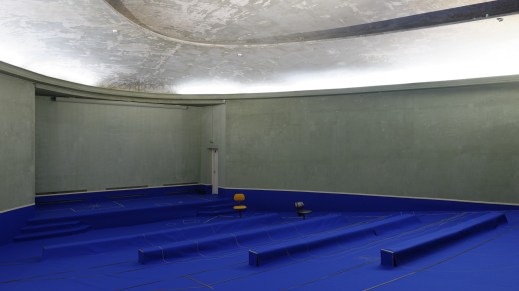
Nestled deep in a corner of Paris’ Palais de Tokyo, Anne Le Troter’s sound piece “Bulleted List” invites the museum’s visitors to explore the social similarities that people verbally express in response to cold calls. Le Troter’s first solo show to be on display in Paris, the work invites the audience to sit inside a modified cinema amphitheater as the sounds of recorded people answering survey queries echo throughout the sloped room. The seating arrangement inside the exhibition mirrors the cubicle-style setup of a call center, though each “station” consists solely of an outline designating where to sit and a coordinating amplifier. Both the questions and answers in the sound piece are produced by real survey callers; each voice sounds polished, poised and mechanized from years of vocal experience, revealing the automated nature that comes with the territory of making a scripted call. The result of each recorded voice unto the listener is akin to standing in the center of a symphony, with vocal patterns as punctuated as a visual, typographic list.
At the Palais de Tokyo I set up a play of light, a new element in my work, which gives visitors a time reference, even if they arrive half way through. Each broadcast is incidentally interspersed with a long silence to emphasize the idea of a session. This determines the attention span given to a work. The collective listening situation I find especially interesting because it reveals a set of patterns of behaviour, a whole language of bodies and eyes between the spectators. These micro-actions, just like the mental paratext of visitors and pollsters (those words that are not uttered but which ring out in our heads when we think or write), swell the work. –Anne Le Troter, interview with Raphael Brunel
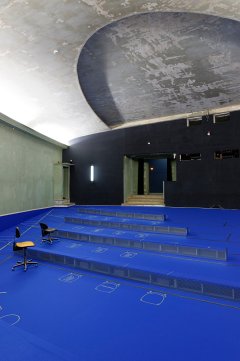
Still of Anne Le Troter’s “Bulleted List” at the Palais de Tokyo, image by author
The progression of sounds in the exhibition follow a distinct, if not choppy routine, with a clearly enunciated polling question asked — “What is your relationship status?” for example — followed by equally simplistic answers — “widowed,” “married” and “couple,” to note a few. Reflective of the exhibition’s timely concurrence with the French presidential election, each of the questions asked in the sound piece culminates in a political questionnaire, with the same questions and answers being traded back and forth between people in all areas of the political spectrum — indicating that there are fewer differences between the various polling demographics and how they express their opinions than what appears at first glance.
“Bulleted List” opened at the Palais de Tokyo on Feb. 3, 2017, and will close on May 8.
Anne Le Troter was born in 1985 and currently lives in Paris. She graduated from the Geneva School of Art and Design in 2012, and her first solo shows were held at the Arnaud Deschin Gallery (Paris, 2016), BF15 (Lyon, 2015), Espace Crosnier (Geneva, 2015) and Espace Quark (Geneva, 2014). In 2016, she was awarded the Grand Prix at the 61st Salon de Montrouge.
—
Featured Image: Still of Anne Le Troter’s “Bulleted List” taken by the author
—
Shauna Bahssin is a sophomore at Binghamton University who double-majors in English and art history. She currently serves as the copy desk chief for the student newspaper, Pipe Dream, and has written for its news and arts and culture sections in the past. Outside of the paper, she is involved with the university’s fundraising initiatives through the Binghamton Telefund, and she hopes to work within the field of arts development and advancement after she graduates.
—
 REWIND!…If you liked this post, you may also dig:
SO! Amplifies: Shizu Saldamando’s OUROBOROS
SO! Amplifies: Mendi+Keith Obadike and Sounding Race in America
Sound and Curation; or, Cruisin’ through the galleries, posing as an audiophiliac–reina alejandra prado
Share this:


Current Top Posts





April 2021

January 2020

November 2019

October 2019

August 2019

April 2014

November 2017

March 2015

December 2017

October 2015
 Sounding Out!
Recent Comments