
DIANE… The Personal Voice Recorder in Twin Peaks

READERS. 9:00 a.m. April 2nd. Entering the next installment of SO!’s spring series, Live from the SHC, where we bring you the latest from the 2011-2012 Fellows of Cornell’s Society for the Humanities, who are ensconced in the Twin Peaks-esque A.D. White House to study “Sound: Culture, Theory, Practice, Politics.” Enjoy today’s offering from Tom McEnaney, and look for more from the Fellows throughout the spring. For the full series, click here. For cherry pie and coffee, you’re unfortunately on your own. –JSA, Editor in Chief
“I hear things. People call me a director, but I really think of myself as a sound-man.”
—David Lynch
From March 6-April 14 of this year, David Lynch is presenting a series of recent paintings, photographs, sculpture, and film at the Tilton Gallery in New York City. The event marks an epochal moment: the last time Lynch exhibited work in the city was in 1989, just before the first season of his collaboration with Mark Frost on the ABC television series Twin Peaks. At least one painting from the exhibit, Bob’s Second Dream, harkens back to that program’s infamous evil spirit, BOB, and continues Lynch’s ongoing re-imagination of the Twin Peaks world, a project whose most well known product has been the still controversial and polarizing prequel film Twin Peaks: Fire Walk With Me.
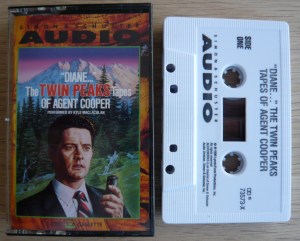
photo by Flickr user svennevenn
These forays into the extra-televisual possibilities of Twin Peaks began with the audiobook Diane…The Twin Peaks Tapes of Agent Cooper (1990). An example of what the new media scholar Henry Jenkins and others have labeled “transmedia storytelling,” the Diane tape provided marketers with another way to cash in on the Twin Peaks craze, and fans of the show a means to feed their appetite for FBI Special Agent Dale Cooper, aka Kyle Maclachlan’s Grammy nominated voice praising the virtues of the Double R Diner’s cherry pie.
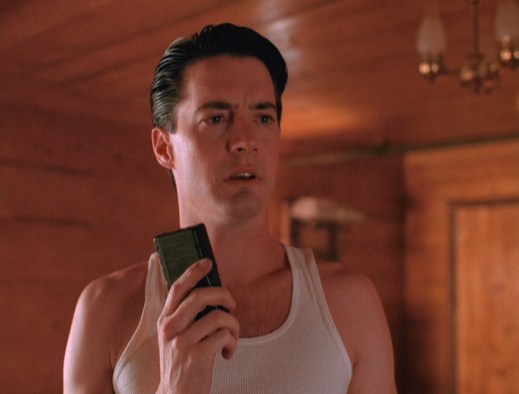
Based on the reminders Cooper recorded into his “Micro-Mac pocket tape recorder” on the show, the cassette tape featured 38 reports of various lengths that warned listeners about the fishy taste of coffee and wondered “what really went on between Marilyn Monroe and the Kennedys.” As on the program, each audio note was addressed to Diane, whose off-screen and silent identity remained ambiguous. For the film and audio critic Michel Chion, Diane is an abstraction, or the Roman goddess of the moon. Others claim “Diane” is Cooper’s pet name for his recorder. The producers delivered their official line in the 1991 book The Autobiography of Special Agent Dale Cooper: My Life, My Tapes, “as heard by Scott Frost,” (the brother of Lynch’s co-creator), where Cooper says, “I have been assigned a secretary. Her name is Diane. I believe her experience will be of great help.”
Whatever her identity, on the show Diane became the motive for Cooper’s voice recordings, and these scenes laid the groundwork for the audiobook. However, unlike the traditional audiobook, which reads a written text in its entirety, Cooper’s audio diary cuts away parts of the story, and includes additional notes and sounds not heard on the show.
The result is something like a voiceover version of Twin Peaks. And without the camera following the lives of the other characters, listeners can only experience the world of Twin Peaks as Diane would: through the recordings alone. Strangely, the inability to hear anything more than Cooper’s recordings opens up a new dimension: even as eavesdroppers we come closer to understanding Diane’s point of audition, the point towards which Cooper speaks in the first place.
Back on the show, Cooper’s notes to Diane track his movements as he tries to solve the mystery of who killed the Twin Peak’s prom queen Laura Palmer. Strangely—and not much isn’t strange in Lynch’s work— in some sense this mystery has already been solved by the show’s second episode, where Laura whispers the name of her killer to Cooper in a dream.
.
.
However, Laura’s whisper remains inaudible to the audience, and Cooper forgets what she said when he wakes up in the next episode. Much of the remainder of the program, full of Cooper’s reports to Diane, was spent trying to hear Laura’s voice. Thus, Diane, the off-screen and silent listener, became the narrative opposite to Laura, whose prom queen photograph closed each episode, and whose voice became the show’s central fetish object. Moreover, this silent relationship changes how the audience hears Cooper’s voice. Rather than a chance to relish in its sound, Cooper makes his recordings because of Laura’s voice from the grave, and directs them to Diane’s ears alone. In other words, Cooper and his recordings become a conduit to Laura/Diane rather than a solipsistic memoir about his time in Twin Peaks.

This triangulation becomes more obvious, if no less complicated in a typically labyrinthine Lynchian plot twist. As I mentioned, the Diane tape makes Cooper’s reports into a kind of voiceover. Critics have interpreted them as a parody of film noir, a genre whose history Ted Martin argues in his dissertation is defined by the relationship between voiceover and death: “Noir’s speaking voice moves from being on the verge of death to being in denial of death to emanating immediately, as it were, from the world of the dead itself.” Fascinated by this history, Lynch tweaks it through the introduction of a mina bird, famed for its capacity to mimic human voices. Discovered in a cabin at the end of episode 7, season 1, the police find the bird’s name—Waldo—in the records of the Twin Peaks veterinarian, Lydecker. The combined names—Waldo Lydecker—happen to identify the attempted murderer of Laura Hunter responsible for the voiceover in Otto Preminger’s classic noir film Laura (1944). On Twin Peaks, Cooper’s voice-activated dictaphone records Waldo the bird’s imitation of Laura Palmer’s last known words, which also happen to be Waldo’s last words, as he is shot by one of the suspects in Laura’s death.
If we follow this convoluted path of listening, we can trace a mediated circuit—from Laura to Waldo to Cooper’s voice recorder—which locates the voice of the (doubled) dead in the Dictaphone, thereby returning that voice to its noir origins in another classic of the genre: Double Indemnity (1944) (see SO! Editor’s J. Stoever-Ackerman’s take on the Dictaphone in this film here). More than a mere game of allusions, this scene substitutes Cooper’s voice with the imitation of Laura’s voice, inverting the noir tradition by putting the victim’s testimony on tape. And yet, while Waldo tantalizes the audience with an imitation of the sound of Laura’s voice, it ultimately only reminds the listener of the silent voice: Laura’s voice in Cooper’s dream.
The longer this voice remained out of range of the audience’s ears, the more it produced other voices—from Cooper’s recordings to Waldo to the dwarf in the Red Room.
Eventually, however, the trail of tape and sound it left behind ended with the amplification of Laura’s whisper, which became as much the “voice of the people” as Laura’s voice. After all, ABC instructed Lynch and Frost to answer the show’s instrumental mystery (“Who killed Laura Palmer?”) because of worries about the program’s declining ratings 14 episodes after Laura’s first inaudible whisper. The audience’s entrance into the show through the mediation of marketers mimicked the idea behind the Dianetape, but with a crucial difference: now the audience tuned in to hear their own collective voice, rather than to hear what and how Diane heard. Laura’s audible voice was audience feedback. It was the voice they called for through the Nielsen ratings. The image of her voice, on the other hand, was an invitation to listen. And Cooper’s voice-activated recorder, left on his bedside, placed in front of Waldo, or spoken into throughout the show remained an open ear, a gateway to an inaudible world called Diane. Although critics and Lynch himself have compared the elusive director to Cooper, perhaps its Diane who comes closest to representing Lynch as a “sound-man.”

David Lynch, August 10, 2008 by Flickr User titi
—
Tom McEnaney is an Assistant Professor of Comparative Literature at Cornell University. His work focuses on the connections between the novel and various sound recording and transmission technologies in Argentina, Cuba, and the United States. He is currently at work on a manuscript tentatively titled “Acoustic Properties: Radio, Narrative, and the New Neighborhood of the Americas.”
Share this:

I Will Always (Sonically) Love You: Whitney Houston on the Radio

"Whitney Houston Central Park, NYC September 1, 2009" by Flickr user asterisk611 under Creative Commons license
I knew Whitney Houston’s voice before I knew her face. She was a constant record on deck in my house, setting off a family get together or a typical Saturday night at home where I begged to stay up a little bit longer to listen to records—for-real records, vinyl—like the grown folks. Houston’s voice represented ‘grown folks talking’ but had enough effervescence that I could relate to as girlish charm. Houston’s vocal range relayed feelings and representations of sugary sweet to straight, no chaser. She could sing about loving a married man—definitely grown folks’ business—but still maintain the innocence of a school girl crush. My mom and I would dance around our great room lip synching her songs, her asking me who I loved, me declaring my name was not Susan. It was Gina and Whitney Houston’s voice was magic. Alongside Michael Jackson, she was the playlist of my childhood.
Sadly, it was my mom and me again as we listened to Houston’s funeral on the radio. We were stuck in traffic. It had to be fate, me listening to Houston one last time in the same way we were introduced: through the radio. Listening to the funeral instead of watching it on television or as it streamed across the internet triggered a nostalgic ache for Houston in the pit of my stomach, returning me to the same place as a five-year-old child who fell in love with the pretty voice from those Saturday nights.
For me, listening to Houston’s records and funeral on the radio resituated Houston as a vocalist. Detached from Houston’s well-documented shortcomings, listening to her funeral removed the static of her life that filtered her mastery of song and sound. In the last years of her life, Houston’s image was far removed from her stellar singing career. Houston’s personal conflicts and battles situated her as a fallen celebrity, quickly associating her with ill fitting jokes of drug abuse and caricatures of her former glory. Removing Houston from her sonic legacy strips her of the complexities of her persona that she highlighted and acknowledged using her voice, or as Dr. Guthrie Ramsey points out, her “instrument.” It is important to note Houston attempted to make her way back to music, slowly creeping back into public spotlight as a vocalist instead of a wayside star. Celebrity overpowered Houston’s humanity and it is unfortunate that her funeral reclaimed it. Thus, sound provides a space for rehabilitating Houston’s bruised reputation, providing an alternative, nonparodic reading of her life.
While listening to Houston’s funeral, I realized the significance of her sonic legacy, a reaffirmation of Houston’s mastery of song and voice through unending playlists and funeral performances. The radio provided a sonic space of reconciliation between Houston and her fans, uninterrupted by the visual whirl and the busyness of pomp and circumstance of a televised celebrity funeral. By listening to Houston’s funeral, the radio became a discursive space of performance, simultaneously retaining and (re)shaping Houston’s iconicity using sound as favorable space of reflection. Strictly listening to the funeral situated the listener in a position to recontextualize Houston’s legacy within sonic discourse and think about her against a musical backdrop which she constructed.
In considering Houston as not only a music but cultural icon, one must understand the significance of her prominence as a singer. Her career maps the trajectory of a post-Civil Rights black (women’s) experience, framing struggles of seeking out and validating new black identity markers within situating herself as a ‘black voice.’ Her catalog blends the secular with the sacred, effortlessly moving between gospel and pop music, frequently collapsing and creating a complex humanity within sonic soundscapes often restricted by industry and consumers alike. It is around these hybrid sonic-scapes that Houston’s funeral revolved.
Also, Houston’s funeral negotiated reconsiderations of the black church in the current popular cultural imagination, personifying grief and healing through sound. In a word, Houston’s funeral “took folks to church.” On display were prominent tropes of black cultural and musical tradition, parlaying call and response between speakers and attendees and improvisation of performers. In particular, Kim Burrell’s redressing of Sam Cooke’s “A Change Is Gonna Come” caters on numerous levels to intersection of Houston’s narrative and the role of spirituality in her life. Burrell used her voice and spirituality as a reflection of Houston’s spirituality while dictating how Houston’s life and image are redirected through song. Burrell’s retelling of Houston’s life pivots off Cooke’s original song as an acknowledged site of struggle and redemption. She improvises Cooke’s song to align with Houston’s literal birth (“She was born in New Jersey”) and the understanding of spiritual rebirth and death (“a change gonna come”).
In similar fashion to a church revival, Burrell performs her rendition of “A Change Gonna Come” as a testimony, pulling from her audience’s familiarity with the intonations, vocal runs, and whines of Sam Cooke’s performance. Burrell’s ‘remixing’ of Cooke’s song is, to an extent, an innovative form of sampling. By borrowing the familiarity of Cooke’s sound, Burrell is able to create a new sonic accompaniment. Overarching tropes of faith and redemption hinged upon the black oral tradition are intensified through using them to aurally frame Houston’s funeral. By strictly hearing Houston’s funeral, the listener becomes privy to not only the intersections of the black church and oral traditions but the unique interventions of sound and identity frequently understated in visual culture and discourse.
A fitting close to Houston’s funeral was the recording of her popular rendition of Dolly Parton’s “I Will Always Love You.” Houston’s voice rang out in the perfect intonation that solidified her place in music and cultural history, situated as a fitting goodbye to fans and this world. The tenderness of Houston’s delivery personifies the somberness of her funeral, a self-eulogy that harnesses its power from not only the moment but the untimeliness of her death. Houston’s last performance of “I Will Always Love You” detaches her from the paparazzi and scandal that suffocated her life. It is through sound that Houston’s legacy is revived.
As my mother dabbed tears away from the corners of her eyes while listening to the funeral, I silently hoped she would ask me who I loved. I would tell her I wasn’t Susan. And that I loved Whitney.
—
R.N. Bradley is a PhD candidate in African American Literature at Florida State University. She writes about African American literature, race and pop culture, Hip Hop, and her own awesomeness. She earned her BA in English from the Unsinkable Albany State University (GA) and a MA in African American and African Diaspora Studies from Indiana University Bloomington. Her dissertation project looks at negotiations of white hegemonic masculinity and race consciousness in 21st century African American literature and popular culture. You can read her work atAllHipHop, Newsone, TheLoop21, or her monthly column “The Race to Post” over atPopMatters. Scholar by day, unapologetic Down South Georgia Girl 24/7/365. Catch up with her awesomeness via twitter:@redclayscholar and her blog Red Clay Scholar (http://redclayscholar.blogspot.com).
Share this:


Current Top Posts





April 2021

January 2020

November 2019

October 2019

August 2019

April 2014

November 2017

March 2015

December 2017

October 2015
 Sounding Out!
Recent Comments