
Radio’s “Oblong Blur”: Notes on the Corwinesque
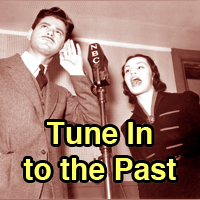
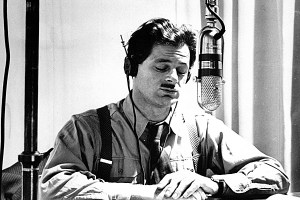
Editor’s Note: Today, Neil Verma kicks off our summer series “Tune In to the Past,” which explores the life and legacy of radio broadcaster Norman Lewis Corwin, the “poet laureate of radio” who died last summer at the age of 101. Corwin, pictured in the icon to the left with actress Peggy Burt around 1947, passed too quietly into the ether–as, unfortunately, has too much of radio history. Sounding Out!‘s three-part exploration of his legacy by radio scholars Verma, Shawn VanCour (July), and Alex Russo (August) not only gives his work new life (and critique), but also speaks to the growing vitality of radio studies itself. As I mentioned this past March in my round-up of the 2012 Society of Cinema and Media Studies conference, radio scholarship is on the rise–a Radio Studies Special Interest Group was established at SCMS this year, reaching a critical mass–and scholars are finding new and innovative ways to approach radio’s unique silences. We are proud over here at SO! to broadcast the future of radio studies by helping you “Tune In to the Past” this summer, so get ready for an array of voices–living and dead, textual and aural–spirited debate, and great sound history, in both senses of the word. So don’t touch that dial. –JSA
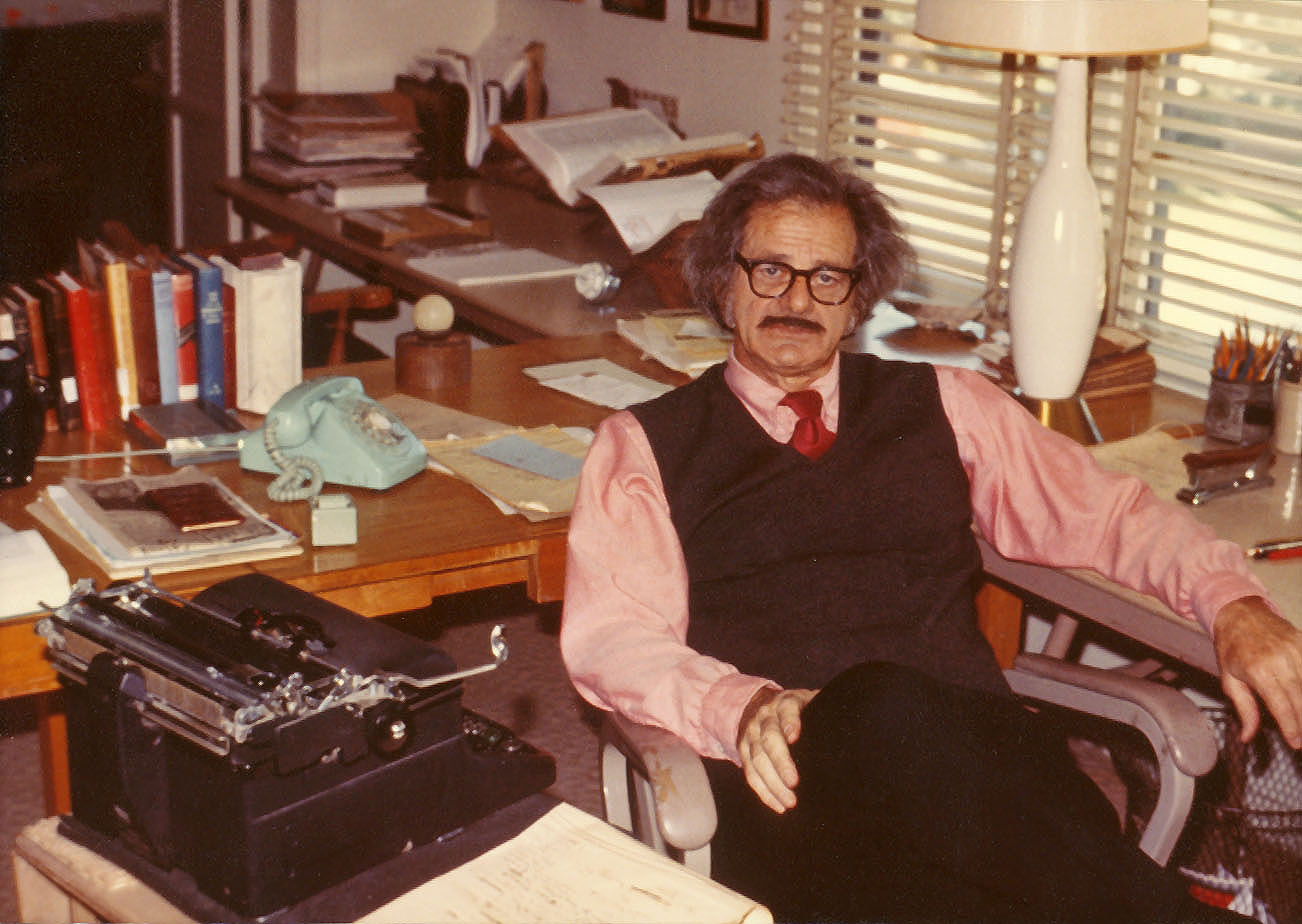
“I am a Dead Sea Scroll,” Norman Corwin, in an interview with writer Tom Lewis, 1992.
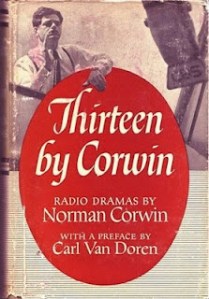
Rising to prominence in the 1930’s, radio dramatist Norman Corwin (1910-2011) aired a body of work of unsurpassed variety, reaching audiences upwards of sixty million with plays that range from “The Odyssey of Runyon Jones,” about a boy searching the afterlife for his beloved dog, to One World Flight, for which Corwin visited 17 countries seeking voices of peace. Often compared to such figures as Eugene O’Neill and Walt Whitman, Corwin was known for seventy years as the “Poet Laureate” of radio, an unofficial title invented for him and impossible to confer on another. I interviewed Norman for my book Theater of the Mind (University of Chicago Press, 2012). These remarks derive in part from those conversations.
—-
DOI: https://doi.org/10.59350/b690v-1kf27
In June of 1947, New Yorker writer Philip Hamburger published a profile of Norman Corwin, then already recognized as a distinguished radio dramatist. From Pearl Harbor to V-J Day, Corwin had staged daring plays to mark Allied milestones and earned frothy praise from the likes of Carl Sandburg, who called Corwin’s V-E Day show “On a Note of Triumph” one of the “all-time best” American poems.
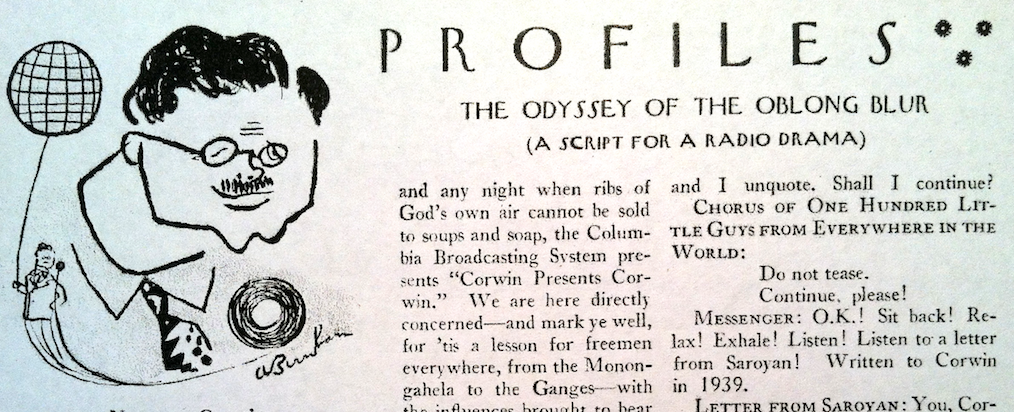
Such acclaim was not universal. That same broadcast drew scorn from historian Bernard DeVoto, who called it a “mistake from the first line” full of “pretentiousness” and “bargain-counter jauntiness.” Like many others, DeVoto and Sandburg reacted to Corwin’s habit of excess by mimicking it. Hamburger’s profile caught that same bug. Billing itself as “The Odyssey of the Oblong Blur,” Hamburger tells a gauzy story of Corwin’s older brother building him a crystal set out of a box of Quaker Oats, and relates tall tales of Corwin’s artistry, like the time he spent two days trying to simulate the sounds of depth charges. And not only did Hamburger write the profile as a radio play, but he wrote it in the style of Norman Corwin.
What is that style, exactly? Thoughts on that question have been surprisingly minimal. When Corwin died last fall, commentators celebrated his life (see here, here, here and here), but the memorials lacked precisely the sense of scale to which both Sandburg and DeVoto responded. There was no voice to speak of Norman in a “Corwinesque” manner, in part because the man probably outlived more likely eulogists than anyone else in the history of broadcasting. Had he not outlasted them, Corwin would have been mourned by the avuncular elders of midcentury liberalism, like his friends Edward R. Murrow and Carl Sandburg or admirers Robert Altman, Walter Cronkite and Studs Terkel, any one of whom could have written a loving burlesque in Corwin’s voice.
But no one did, and no one can, not now. Who would get the joke, anyway? Collective experience of Corwin’s sound is passing out of living memory. Yet this very elapsing “afterlife” of the radio age, I feel, lends new richness to the question of the Corwinesque, an aesthetic that needs clarification both to give full credit to the man behind it, and, in a larger sense, to show how a theory of sound experience can “happen” at the twilight zone of collective human memory.
So what was “the Corwinesque” around 1947? What is it nowadays? What might it become in the future? In this post I’ll consider both the nature of the “Oblong Blur” and the methods we’ve tried to bring its ongoing odyssey into focus.
A High Wireless Act
In its profile, The New Yorker poked fun at how Corwin made unreasonable demands of sound (e.g. “Music: a universal theme, oscillator beneath, denoting pain of the world and bigness thereof, fading”) and let childish literary tactics run amok, as when the audience is called “Sons of a Sun spinning sadly through space.” In his era, Corwin’s penchant for such overwriting was an unavoidable aesthetic issue.
Corwin’s work was widely understood as a challenge to technicians and actors just for the sake of it. In the script for “New York: A Tapestry for Radio,” for example, a date scene contains this befuddling note: “Music: Love on brownstone stoop at three in the morning after an evening at the RKO Proctor Theater and a long walk in the park. It sustains, behind.” In “The Undecided Molecule,” meanwhile, we learn of a particle that refuses to select his destiny before “The Court of Physiochemical Relations.” Here are some of many tongue-twisting lines in verse:
I’d argue that Corwin’s writing is impressive here precisely because it’s so easy to botch in delivery. The style spotlights its own overworked literary calisthenics, saying: look at me trying so hard I might blow it.
In this way, the Corwinesque names a connection between the soaring and the buffoonish, a link that a contemporary called his “frontier spirit.” Thanks to this spirit, even when the prose was purple, the defect came across as that of an innovator. To keep that up, Corwin had to innovate constantly. That’s why his plays took on so many other forms – the letter (“To Tim and Twenty”); the lecture (“Anatomy of Sound”); the pageant (“Unity Fair”).
So one key to the Corwinesque was to walk a high wire without a net, another was to say so. Nothing confirmed both better than a fall. I’d wager many listened for a lousy line or overdone tune as part of the pleasure of it all. Indeed, it may be incorrect to evaluate Corwin’s aesthetic as poetic; think of the Corwinesque as broadcasting rather than writing, and its liabilities come across as dares.
If that is correct, then the “high wire act” of the Corwinesque relies on a kind of listening-for-risk that’s hard for us to do now, because we can’t listen to Corwin’s work new, or live. One deep aspect of the Corwinesque of the 1940’s – the possibility, even anticipation, of artistic failure, up above an enormous audience out there in the dark – seems lost for good.
Coalition and Collation
But in another way, the Corwinesque is only possible to grasp now, at the safe remove of the digital era. Today it’s easy to listen “distantly” to classic radio through formats that allow us to pause, rewind, categorize and remix vast amounts of golden age audio in a way that was impossible in 1947. By doing so it becomes clear that what we call the “Corwinesque” drew on a broad vocabulary of radio dramaturgy, a way of “talking about” time and space that characterized many programs of that time.
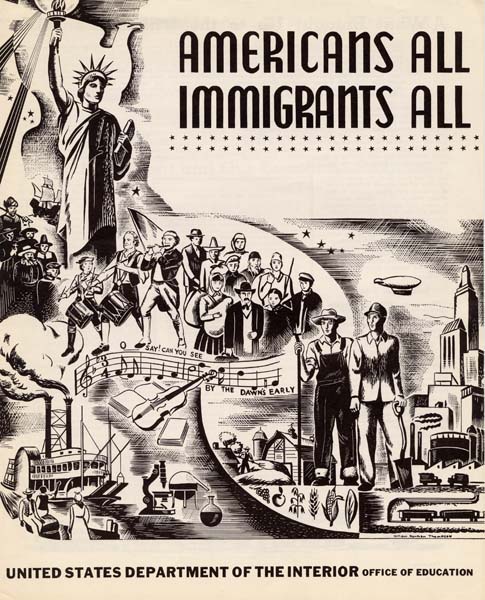
Consider Corwin’s famous attempts to glorify the “common man” – farmers, G.I.s, factory workers – by drawing their voices to a sonorous space and national coalition, indeed by making these two imaginary sites mirror and rationalize one another. Perhaps the paramount example is “We Hold These Truths,” which celebrated the 150th anniversary of the Bill of Rights only days after Pearl Harbor. In that broadcast, we hear Americans of the revolutionary period (widows, blacksmiths, politicians) speak from a series of shallow locations in a quick succession, and a similar group in the present (workers, Okies, businessmen, mothers), as a way of building mystical union through time.
This style has had many names. Historian Erik Barnouw likened it to painting, calling it a chance to “splash quickly over a large canvas,” while actor Joseph Julian called it a “telescoping montage.” Variety’s radio editor Bob Landry suggested that it resembled cantata. When I interviewed him, Corwin said that it was like writing music; elsewhere he spoke of a kind of “horizontal” drama, or mosaic form.
In my book, I employ another word: “kaleidosonic.” In kaleidosonic radio, we segue from place to place, experiencing shallow scenes as if from a series of fixed apertures, thereby giving time periods expressive existence. That can be contrasted with what I refer to as the “intimate style,” in which the listener is attached to a character who moves through deep scenes, as a way to give space expressive existence. A good example of the latter is Corwin’s American in England series, in which the horizon of wartime is shaped by a proximal relation to a surrogate narrating entity “nearby.” Here’s a representative episode:
Today, listening broadly, it becomes clear that neither of these styles belongs to Norman exclusively. For other uses of the kaleidosonic, consider the works of Stephen Vincent Benét, Orson Welles’ “The War of The Worlds” or Cavalcade of America. For examples of the “intimate style,” listen to Brewster Morgan’s “A Trip To Czardis,” or any “first-person” style play from The Mercury Theater on the Air. What made Corwin special was how he made these styles complimentary. The opening of “On a Note of Triumph” is a good example:
In six minutes, we go from a kaleidosonic sequence of songs and crowds to an ordinary G.I. overseas asking questions intimately. This connection between the context and the individual, between the nearby and the simultaneous, is Corwin’s way of letting space and time merge together vividly.
It is that capability, I contend, that underlies and secures Corwin’s glorification of the common man, who is really Corwin’s public aestheticized. In 1939, Archibald MacLeish wrote, “The situation of radio is the situation of poetry backwards. If poetry is an art without an audience, radio is an audience without an art.” Corwin intuited what MacLeish didn’t understand: in radio, the audience is the art.
And just as airing a coalition of voices was an epistemological act that reinvented those it depicted in 1945, our use of a new collation of recordings today redraws the parameters of what those sounds might mean, amplifying latencies, superficialities, and entwinings hitherto inaudible.
A Dead Sea Scroll
By 1947, Corwin’s dedication to the “little guy” was out of vogue. It seemed seditious to red-baiters, phony to leftists, and compromised to critics – The Nation’s Lou Frankel wrote of One World: “It is as if the late John Barrymore decided, without warning, to play Hamlet in pantomime.” On this point Hamburger’s profile pivots from hagiography to satire, including a series of goofy verses voiced by a “Chorus of One Hundred Little Guys from Everywhere in the World” and a grouchy monologue by the “Common Man,” complaining that Corwin talked past him, advising “you ought to think about what the words mean before you use them.”
That reminds me of another coda, this one in Corwin’s 1944 play “Untitled.” The play concerns a dead soldier named Hank Peters, who speaks as he lies “fermenting in the wisdom of the earth.” The monologue concludes this way:
Death is a patriotic act, a metaphysical state, but also a restless moral energy bearing down on life, a thing standing in requirement of its vindicating narration. Perhaps this feature of the Corwinesque will ring especially true as classic radio continues to exist in its ongoing pseudo-immortality. Now that Corwin reposes in his own acre of undisputed ground and his voice circulates ghostlike in clouds of data, our question may be what ontological relation we ought to have with that voice, and those of other dead social visionaries, who really do keep on advising us after death, and will go on echoing after we’re gone.
But the Corwinesque isn’t just about how the dead “speak” to the living, long the ruling conceit in the theory of sound recording. It is also about another enigma: how the dead listen to us, an audience eavesdropping, in hiding, taking notes on an old scroll in a lost language.
—
Neil Verma is a Harper-Schmidt Postdoctoral Fellow at the University of Chicago, where he teaches media aesthetics. Verma works on radio and its intersection with other media, and has taught subjects including film studies, sound, art history, literature, critical theory and intellectual history. His book, Theater of the Mind: Imagination, Aesthetics, and American Radio Drama, is published by the University of Chicago Press.
—
Share this:

Beat-ification: British Muslim Hip Hop and Ethical Listening Practices

As the beat drops for our latest Live from the SHC post, Cornell’s Society for the Humanities Fellow Jeanette Jouili hits us with some (social) science, sharing her ethnographic research on Muslim Hip Hop in pious communities in Britain. To give earlier installments by Damien Keane, Tom McEnaney, Jonathan Skinner, and Eric Lott another spin, click here. Next week, the needle comes to the end of the groove for the “Sound: Culture, Theory, Practice, Politics” crew as Society Director Tim Murray takes us on home. Good thing Sounding Out! can’t stop, won’t stop. . . –JSA, Editor in Chief (and 2011-2012 SHC Fellow)
—
DOI: https://doi.org/10.59350/tp112-w7650
Can Hip Hop sound Islamic? And conversely, can one listen to Hip Hop in a Muslim way? What is at stake when a contemporary musical form like Hip hop (or rock or punk) is introduced into the catalogue of recognized Islamic music genres? What impact do these genres have on longstanding Islamic traditions of ethical listening? In the process of creating new genres of Islamic music, which have not been previously connected to Muslim music traditions, norms are negotiated, border zones are walked upon, limits explored. At the same time, these Islamic music practitioners, even those who push established artistic limits within the Islamic movement, nevertheless intend to uphold the initial ethical project.
Considering music as producing sensual pleasure or extreme emotional excitement, Muslim scholars throughout the ages have been concerned with its capacity to hinder the exercise of reason and self-mastery as well as with its promises for spiritual benefit. Roughly, one can say that those who have opposed the practice of listening to music feared that music’s force arouses worldly passions which distract from the remembrance of God, whereas those who were favourable toward this practice – generally speaking these voices came from thinkers and practitioners of the Islamic mystical traditions –highlighted music’s capacity to impel the believer to seek the spiritual world while simultaneously being attentive to its potential dangers. Among these two sides, there is a wide range of theological opinions, from those that prohibit any kind of musical singing (considering Qu’ran recitation and poetry recitation not in terms of the category music) as well as all musical instruments, to those that allow for singing and certain musical instruments (i.e. drums permitted, stroke instruments not), and those who allow for all the array of musical expressions (given that specific moral conditions are fulfilled).
If the evolution of Islamic music toward the incorporation of modern music traditions has already been controversial within many Islamic revival contexts, it is not exaggerated to claim that Hip hop, at least in the UK, is probably the most contested and is until now the most marginalized of the different music genres within the Islamic popular culture scene. Today’s British Muslim Hip Hop is an occasion to think about the struggles of young Muslims to incorporate a music tradition that epitomizes black music culture like no other contemporary genre into the larger frame of Islamic music in Britain, which has been largely associated with South Asian and Middle Eastern music traditions.
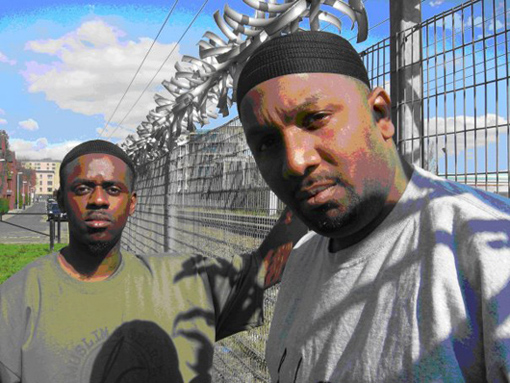
Muslim Hip Hop takes many different sonic and stylistic directions in the UK. Some artists advance their Muslim identity in the context of religion and others take a more political standpoint; many blend both to varying degrees. What connects these diverse orientations is the critique of contemporary mainstream commercial Hip Hop. Many Muslim Hip Hop fans and artists see this music as little more than a glorification of materialism and sexism. The thriving Muslim Hip Hop scene in the UK, which is deeply influenced by Afro-Caribbean converts to Islam, clearly situates itself in continuity with early Hip Hop, as defined by black awareness, political messages, and an underlying Islamic identity. Their own engagement in Islamic Hip hop is thus seen as holding true to the ‘authentic’ Hip hop traditions by purifying a corrupted Hip hop and renewing and reconnecting it to its Islamic identity.
While Aki Nawaz’ FUN-DA-MENTAL were Muslim Hip Hop pioneers in early nineties British hip hop, it was notably Mecca 2 Medina which opened the doors for Muslim rappers in the reticent U.K. Muslim community. Currently, the Mozambique-born rapper Mohammed Yahya, the female rap duo Poetic Pilgrimage, the sisters from Pearls of Islam, Muslim Belal, and Rakin Niass (formerly of Mecca 2 Medina) headline many urban Muslim cultural events in Britain. Lowkey and Jaja Soze are two well-established names in the UK Hip hop scene who are also present within the more subcultural Muslim scene.
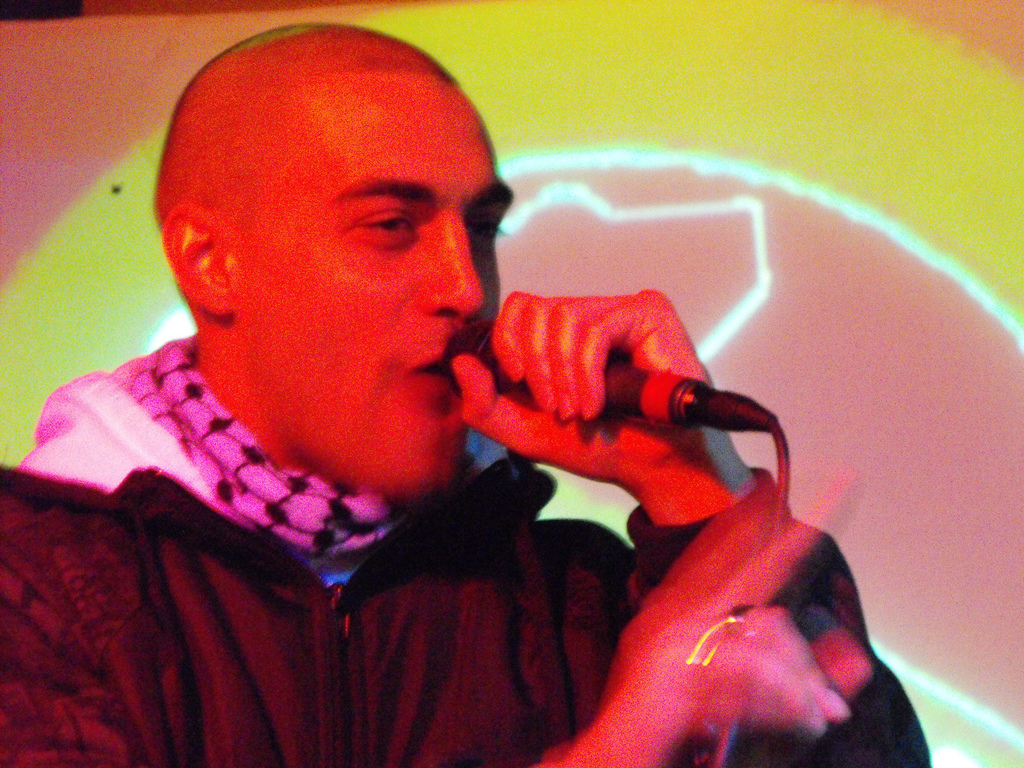
The Islamic Hip hop scene in Great Britain struggles to find a way to bring the tradition of Hip Hop in line with Islamic traditions, molding it to conform to Islam’s ethics of listening and sonic practices. Hip Hop can be especially problematic (from a certain Islamic point of view) because danceability is usually one of its prime objectives. The sensual dance style instigated by Hip Hop is notably achieved through amplified bass and repetitive beats that often drown the vocals. British Muslim Hip hop artists emphasize, however, that it is not so much the beats, but the spoken word art that connects Hip Hop to the sonic-linguistic practices of Islam’s pronounced oral tradition. A minority of rappers (for instance, Muslim Belal) adhere to a specific Islamic interpretation according to which music instruments are forbidden, and therefore use no instrumentals, only human voices as background music. But the large majority of Muslim artists, including those who are outspokenly religious, do use instrumentation. Yet, a fine line seems to exist where beats begin transmuting into “nightclub” sounds. While neither clearly defined, nor necessarily articulated by the artists themselves, Muslim artists nonetheless avoid this musical point of no return so as not to marginalize the spoken word. Jaja Soze’s “Just Like Me” is a good example of such sonic practice. Soze plans to do exclusively spoken word in the future.
.Notably, according many Muslim Hip Hop artists in the UK, Hip Hop invokes important similarities with forms of recited or sung poetry, practices which were so cherished in the early Islamic community. For all these artists, reconciling Islam with Hip hop means recentering the spoken art form by sonically emphasizing the voice and the words. Thus, Islamic Hip hop is stylistically related to spoken word poetry, which frequently critiques the camouflaging of Hip hop lyrics behind beats. The lyrical content is also reflective of an Islamic ethic, often weaving explicitly pious Islamic themes with politically and socially conscious lyrics. Racism, Islamophobia, Neo-Liberalism and Imperialism in the age of the Global War on Terror are constant themes, as are critiques of the gang violence faced by minority communities in England’s major cities and cultural practices connected to the countries of origins of Muslim immigrants. “Silence is Consent,” from Poetic Pilgrimage, a female Hip Hop and Spoken Word duo and one of the few Muslim female Hip Hop artists in the UK highlights such socially conscious lyrics.
.
Lowkey’s lyrics in “Terrorist?” are an especially strident critique of the War on Terror:
.
Far from constituting a vital unit with the lyrics (as is otherwise commonly assumed for Hip hop), beats and musical instrumentation are often treated as dispensable in Muslim Hip Hop. Even the artists who use instrumentation regularly perform their pieces a cappella on events that do not allow music instruments; many artists even offer their CDs in two versions: one with and one without instrumentation. Also, many artists switch easily from spoken poetry to Hip hop (the same lyrics can be performed, depending on the demands, as a spoken word or a Hip hop/rap piece), as they consider spoken poetry to be an intrinsic part of the broader Hip hop culture.
Such considerations are in line with Islamic traditions of listening, with their strong concern for listening to the voice and to the word. Listening to voices and words that carry spiritual and sacred contents or disseminate more broadly positive messages is reasoned through the paradigmatic experience of Qur’an recitation. The invocation of “beautification” (translated literally from the Arabic term tajweed, which refers to Qur’an recitation) has become a common trope among the British Muslim Hip Hop artists I have interviewed in order to defend their artistic activity (whether pertaining to voice and instruments or only to their vocal skills). As in Quran recitation, “beautification” is employed here as a tool to facilitate the reception and to reinforce the affective impact of the word. “Clarity” by Rakin Niass, who started rapping with the British rap group Cash Crew and is one of the founding members of Mecca 2 Medina, clearly promotes a moral life style.
.
Hip hop, if it wants to be considered legitimate within an Islamic context, must enable an ethical listening. Charles Hirschkind’s The Ethical Soundscape (2006) argues that listening in Islamic traditions, is “not a spontaneous and passive receptivity but a particular kind of action itself, a listening that is a doing” (34). It represents a form of active listening that involves both the intellect and the senses, promoting a specific way of being in the world. Consequently, I consider contemporary genres like Muslim Hip Hop, however modernized it might sound, does still bear the imprint of earlier da’wa traditions, encouraging an virtuous life for listeners, and cultivating necessary ethical and political sensibilities through the ear.
These new musical styles are not only reflective of new sensibilities and subjectivities, they are, as notes Jean-Luc Nancy in Listening (2007), productive of subjectivity. It is for this reasoning that one should not underestimate the significance of the evolving music genres within the Islamic revival movement. Listening carefully to them will therefore provide crucial keys for understanding the possibilities for the development of specific ethical projects within a global mass culture.
__
Featured Image Credit: Poetic Pilgrimage, B Supreme 2011 © 2011 Paul Hampartsoumian
__
Jeanette S. Jouili is a 2011-2012 fellow at Cornell’s Society for the Humanities. She has also held a Postdoctoral position at the Amsterdam Institute for Social Science Research at Amsterdam University where she did research on the (pious) Islamic cultural and artistic scene in France and the UK. In 2007, she received her PhD jointly from the Ecole des Hautes Etudes en Sciences Sociales in Paris (France) and the European University Viadrina in Frankfurt/Oder (Germany). Jeanette has published in various journals including Feminist Review, Social Anthropology, and Muslim World. She is currently completing a book manuscript based on the material of her PhD dissertation provisionally titled Pious Practice and Secular Constraints: Women in the Islamic Revival in France and Germany. Jeanette’s research and teaching interests include Islam in Europe, Islamic revivalism, secularism, pluralism, popular culture, moral and aesthetic practices, and gender.
—
Share this:




Current Top Posts





April 2021

January 2020

November 2019

October 2019

August 2019

April 2014

November 2017

March 2015

December 2017

October 2015


Recent Comments