
This Is How You Listen: Reading Critically Junot Díaz’s Audiobook
Last month, T.M. Luhrmann compared the experience of reading a written book versus listening to books in the New York Times article “Audiobooks and the Return of Storytelling.” Lurhmann points out how audiobook sales jumped 20% in 2012, whereas total industry book sales went down 1%. From the looks of it, books have benefited from audiobook sales, but in literary studies, print remains the primary vehicle for analysis. Might listening to an audiobook actually change how we critically read a text?
As I listened to Junot Díaz narrate This Is How You Lose Her (2012), the first book Díaz has read as an audiobook and the first book of short stories the author has published since 1996’s Drown, I wondered how his reading influenced how I interpreted the text. Díaz’s reading sounds less like regular speech and more like a performance, with its own cadence and rhythm:
This post approaches the audiobook as a text in itself, coming from a sound studies perspective. I attempt to conceptualize the idea of “close listening” as a methodology akin to “close reading” in literary studies. I listen for how Diaz reads the text but more specifically how the reading itself becomes a way of authoring the text. Ultimately, I argue that Díaz’s reading becomes a re-authoring the text—re-writing the text sonically. On a broader level, I hope to add to the conversation of what it means to read an audiobook, as Birgitte Stougaard Pederson and Ibsen Have brought up in “Conceptualising the Audiobook Experience.” Using This Is How You Lose Her, I show that reading an audiobook means engaging with the text from the angle of the ear, and that close listening can become an aural reading practice that relies not so much on the visual texts, but on aural cues from the narrator.
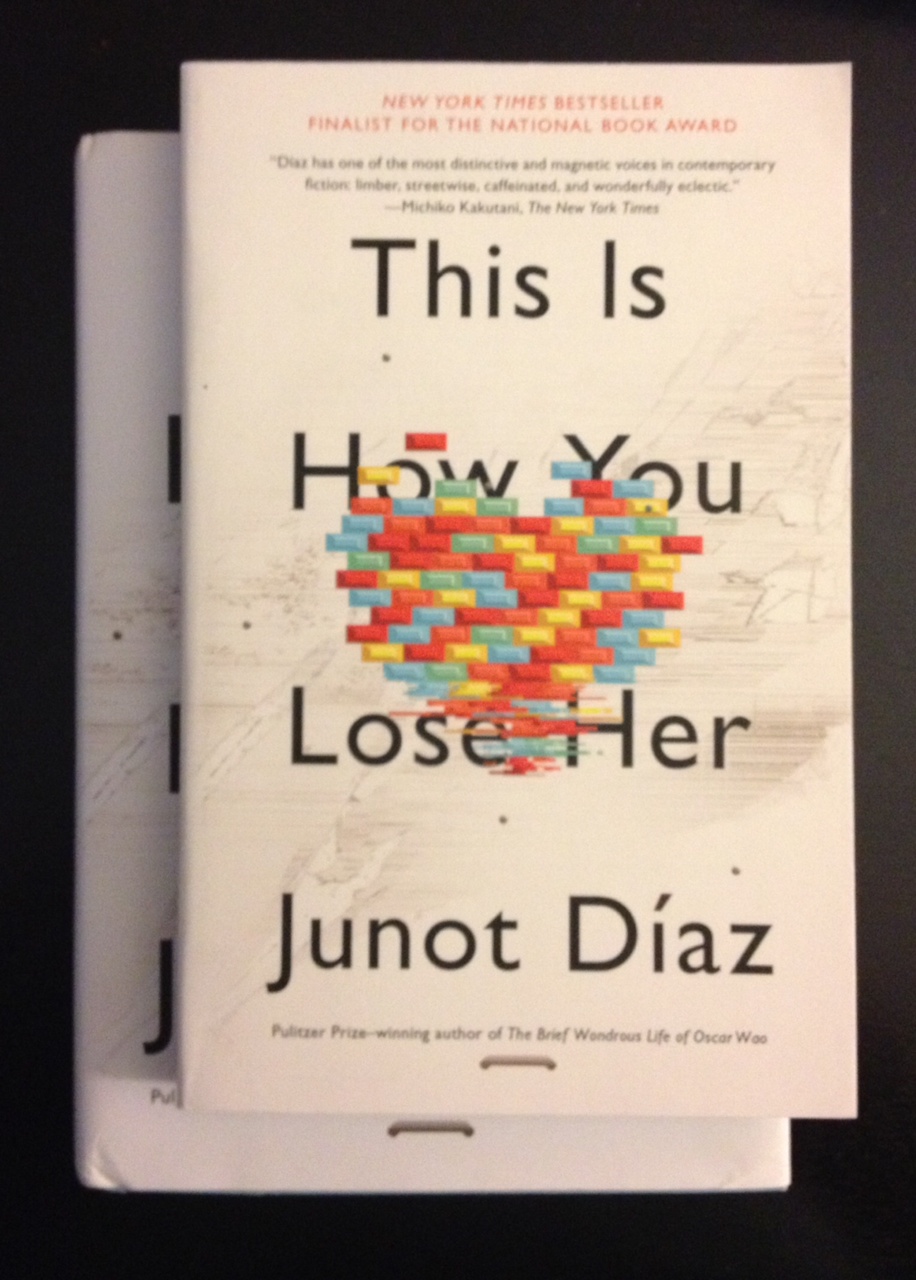
Not one but two (!) copies of This Is How You Lose Her
This Is How You Lose Her revolves around Yunior, a young Dominican immigrant who grows up in New Jersey and who ends up as a professor in Boston, and the many loves he has had or that he has encountered growing up. The stories trace his progress from a young, recently arrived Yunior, to a tenured, mature Yunior, showcasing certain relationships that influence how he relates to women—in sum, illustrating how he loses the women he loves. Throughout the short story collection, Díaz also calls attention to other relationships that may influence Yunior’s perspective, for example, his brother’s attachments with women, especially toward the end of his young life as he battled cancer, and his father’s relationship with his mistress, a Dominican woman who lived in New Jersey. At the end, Díaz illuminates how a mujeriego (womanizer) like Yunior comes to be; the short stories indicate that Yunior is as much a product of his environment as he is a seller of the merchandise.
Díaz is not a professional audiobook narrator. Although Díaz has done live readings, reading the full-length version of a book one has written is a different exercise. The Penguin Audio version of the collection is based on the actual short story collection (in other words, unabridged), so it does not contain additional stories or behind the scenes interviews. Technically, it is no different than the print version.
Listening to authors read their own work has value beyond the pleasure of hearing them read their text. Scholarly writing on audiobooks has emphasized the experience of listening to an audiobook for pleasure (like Deborah Phillips’ “Talking Books: The Encounter of Literature and Technology in the Audiobook” and James Shokoff’s “What Is An Audiobook?”), but it wasn’t until the 2011 edited collection Audiobooks, Literature, and Sound Studies that audiobooks were considered on their own instead of as extensions of the literature they were based on. The allure of doing this scholarly exercise with the audiobook version of This Is How You Lose Her is that Díaz’s delivery of the text is uncommon at the least.
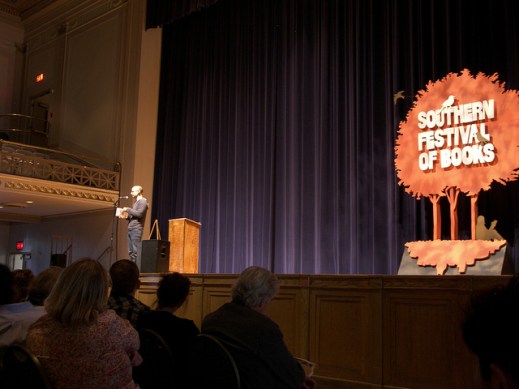
“Junot Diaz at the Southern Festival of Books” by Flickr user Stacey Kizer, CC BY-NC 2.0
Talking about Junot Díaz’s readerly voice requires to tune into conversations about his writerly voice. In many reviews of Díaz’s books, writers discuss how Díaz deftly conveys a writer’s voice in his text, indicating that his success is that his characters have a very clear voice—or at least Yunior does. Michiko Kakutani, for example, points out how “Junot Díaz has one of the most distinctive and magnetic voices in contemporary fiction: limber, streetwise, caffeinated and wonderfully eclectic, capable of conjuring for the reader everything from the sorrows of Dominican history to the banalities of life in New Jersey.” Although this quotation is in reference to Díaz’s second book, The Brief Wondrous Life of Oscar Wao, it describes Díaz’s writing in terms of his voice instead of, for instance, in terms of his use of metaphors or choice of subject.
Richard Wolinsky, in his Guernica interview with Díaz, sees an overlap between Yunior and Díaz: “He’s [Yunior] got a very distinct voice, and it’s a voice that’s informed by [Diaz’s] own reading, particularly science fiction and fantasy.” Although Díaz has pointed out that Yunior is loosely based on events that have happened to him, Wolinsky “hears” Díaz in his main character. The tone and the language Yunior uses is read as a reflection of Díaz.
Conversations about the voice of the writer point to a sensibility about sound, but are often limited to a written text. Anna Barnet, in an interview with Junot Díaz, states “His two principal linguistic registers (‘this kind of crazy Caribbean language and music’ and ‘this sort of African-American-infused American vernacular’) grind against each other along with the many other voices he ventriloquizes in his writing.” Barnet reminds readers that Díaz’s writing style is based in spoken language—particularly Díaz’s spoken language. This language of “voice” to describe a writer’s style (or, specifically, a writer’s ability to convey a clear sense of who the character is and/or their views) is commonplace but gives the impression that there is a sonic aspect to an author’s work, when in reality it is but a metaphor for something that occurs at the level of text.
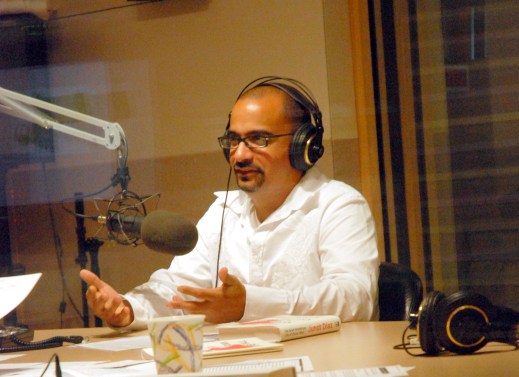
A critical reading of a text that includes the audiobook rendition allows critics to add substance to those references to “voice.” In Junot Díaz’s case, it is possible that readers encounter him first through written text, and so have an expectation of what Díaz (or Yunior) would sound like live. In my textual analysis of eight audiobook reviews (and one book review that included a mention of the narration in the audiobook) most listeners showed some sort of discomfort with Díaz’s narration. One reviewer, for example, had issue with the “smoothness” of Díaz’s narration: “At times the reading was a little shaky and uneven”. Another reviewer stated “at times his cadence is choppy, with odd pauses and emphasis on strange words that detract from the overall experience.” Reviewers also had an issue with Díaz’s pace, which is characterized by pauses in places that many not seem normal in casual American speech. These statements hint at a “weird” quality in Díaz’s speech, something that does not come through when Díaz has a casual conversation. (Listen to this podcast episode of NPR’s Alt. Latino guest-starring Díaz and compare with this video of him reading part of This Is How You Lose Her.) Although one blogger pointed out that Díaz sounded “professorial” in the reading, others used the words “native,” “authenticity,” “Dominican” and even “Jersey accent” to describe how Díaz sounded. It is unclear how these reviewers define “native” or “authentic.”

“Junot Diaz” by Flickr user ALA The American Library Association, CC BY-NC-SA 2.0
Connecting sound to authenticity implies that Dominicans can only sound a certain way, or that the audio narration is lacking when it does not represent a “typical” Dominican voice. To the extent that Díaz is Dominican, his voice is of a Dominican male who has grown up in the Northeastern United States. His uneven audio narration creates a feeling of sonic unintelligibility in the listener, similar to the effect of including Spanish words in the written text. Díaz-as-narrator can make a listener uncomfortable, and by extension forces that reader to listen.
The sonic unintelligibility also relies on the text, on how Díaz plays with language by switching back and forth from English to Spanish. Díaz mentions in an interview with Marva Hinton that some readers are not happy with his choice of Spanglish in his writing: “There [are] folks who hear one Spanish word, and they’re convinced this is some sort of immigrant conspiracy” Farther down, in the same article, Díaz refers to his mix of Spanish and English (and a particular kind of Spanish and English at that, since he moves among Standard American English, African American Vernacular English, and Dominican Spanish) as “opaque language.” There’s a connection between the kind of “opaqueness” that Spanish gives and the unintelligible effect of Díaz read his work.
An example of how sonic unintelligibility operates in the audiobook is the first story, “The Sun, The Moon, The Stars.” This opener, told in first person, revolves about one of Yunior’s break-ups; Yunior and his girlfriend Magdalena, on whom he cheated, go to the Dominican Republic on a trip they had planned before she found out about the affair. It frames the book as being an in-depth analysis of loves lost, from the man who keeps losing them. It also sets the tone sonically for the audiobook reading: after the introduction of the book, a snippet of bachata music comes on, and then makes way for Díaz, who reads the title of the story. This is the pattern of the book: slices of bachata, followed by Díaz’s narration.
His voice is characterized by a slight sing-song cadence that is reminiscent of Dominican Spanish accent. If this were in Spanish, it might be easier to lose track of the cadence, but in English it sounds like a disembodied accent. I showcase the swing in Díaz’s narration by alternating capital letters and lower-case letters: “Her FAther, who usually would treat me like his HIjo, CALLS me an ASShole on the PHONE, SOUNDS like he’s STRANgling himself with the cord.” The voice seems to float for a while until Díaz arrives to the end of a paragraph or a series of sentences, and then it sinks. Moreover, this pattern does not change when Díaz switches characters: it’s hard to tell Yunior apart from Magdalena unless the reader pays close attention to when the narrator is switching characters and/or when the narrator uses a pronoun. The same effect comes from the odd pauses in the author’s narration: “Oh God, she wailed. Oh. My God.”
The choppiness and the emphasis in the reading are a way to dislocate the listener, in a similar way that Spanish phrases or lack of quotation marks in the text dislocate a reader who does not understand Spanish or who depends on the quotation marks to make sense of the prose. Also, this story focuses on Magdalena withdrawing from Yunior and not communicating with him. The tone, cadence, and sound of Díaz’s voice can be read to mirror the relationship between Yunior and Magdalena (and the other women in the text): the sonic unintelligibility is manifest at the level of plot through Yunior’s relationships.
Although many audiobook reviewers may consider the plot in their reviews, part of what makes an audiobook stand out is the performance of the text. I take my cues from audiobook reviewers and consider critically my listening experience of This Is How You Lose Her and how this can become the basis for a critical interpretation of the text. My analysis underscores that having an author read a text can provide a different way into analyzing the text and prompts readers to pay attention to sound. If, like Shokoff asserts, most audiobook readers listen to an audiobook while doing something else, Díaz shows that listening closely to the audio text can be as rewarding as reading a book.
—
Featured Image: “Junot Diaz” by WBUR Boston’s NPR News Station, Attribution-NonCommercial-NoDerivs License
—
Liana Silva-Ford is co-founder and Managing Editor of Sounding Out!.
—
 REWIND! . . .If you liked this post, you may also dig:
“‘Or Does It Explode?’ Sounding Out the U.S. Metropolis in Hansberry’s A Raisin in the Sun“-Liana Silva-Ford
“‘HOW YOU SOUND??’: The Poet’s Voice, Aura, and the Challenge of Listening to Poetry”-John Hyland
“Fade to Black, Old Sport: How Hip-Hop Amplifies Baz Luhrmann’s The Great Gatsby“-Regina Bradley
Share this:

Living with Noise

Image by Flickr User Bill Selak
[O]ne of the chief values of living with music lies in its power to give us an orientation to time.– Ralph Ellison, “Living with Music” (1955)
Early this past fall, my wife and I moved back to Brooklyn after three years in central New York State. We spent two of those years on a back street in a mostly rural area of Cortland, NY, where are there are more dogs than people and more cows than dogs. Those dogs were probably the most intrusive neighborhood sound—a barker would get going and that’d set off a chain reaction from yard to yard, like a real life version of the “Twlight Barking” from 101 Dalmations. Still, I could get used to it, ignore it, zone out. The only other sounds that penetrated our home were the nearby freight trains, but their sounds are almost soothing—the rhythm of the clacking rails like Paul Simon singing “Everybody loves the sound of a train in the distance. . .” or a relaxation tape.
Now back in New York City, I am very aware of the different degree, frequency and quality of sounds I am subjected to while in my living space. Reconsidering living with noise put me in the mind of Ralph Ellison’s 1955 essay “Living With Music” from High Fidelity magazine. Like the living situation Ellison describes, our new place is a rear-facing apartment and we get the sound of echoing voices, car horns or yowling cats (fighting and/or making more cats) bouncing off the back wall of a garage on the next street. However, as most city-dwellers know, it is our neighbors that provide the most persistent and profound sonic disturbances. Ellison himself was disturbed at an upstairs neighbor’s overzealous singing, vocalizing “[f]rom morning until night.” In our case, another four-family apartment house abuts ours and through the two brick walls sandwiched by two layers of plaster, we can frequently hear the shrill cries of teenage anguish. The violent screaming between teenaged siblings or between one or more of them and their parents can shake the walls. It is difficult to ignore.
 The noise of children in New York City apartments was a topic of a New York Times feature a couple of years ago, but in that article the age of the children makes it easy to sympathize with the parents and to cast the complainers as insensitive villains. Little children cannot be expected to regulate their own crying or the seemingly ceaseless energy that is so easily transformed into cries of glee or the galloping of those baby shoes. In the case of my neighbors, it harder to sympathize when the sound is from near-adult children screaming about how life isn’t fair, or getting forced into frequent violent disagreements with a similarly aged sibling with which they must share a tiny part of an already tiny space—a New York City apartment.
It is easy to get angry when they get going. A teenager is not a chorus of barking dogs, a small crying child, or even some jerk honking his horn a block away who doesn’t realize how far the sound can travel, but ostensibly someone developing into a functional adult. The things they are screaming about can often seem beyond ridiculous to older people, and thus their need to scream about them is particularly offensive when I am simply trying to enjoy a evening of catching up on Mad Men or (more importantly) an afternoon writing my dissertation. As my wife often asks, “Why don’t their parents regulate?” But I try to remind her, it is the attempt to regulate their behavior that often starts the screaming matches. Like a 2-year old testing the range of her voice, these teens are exploring their own boundaries. Furthermore, unlike the class entitlement permeating the NYT Real Estate section feature, the economic reality of living in row houses in Bensonhurst changes expectations regarding the living experience.
The sonic disturbances often come when I am trying to get some writing done, so it is not hard to think about Ellison’s essay, since writing was also what he endeavored to do when bedeviled by his neighbor’s practice of “bel canto style.” The way noise can carry in these apartments creates a form of anonymous intimacy. Think of Duke Ellington’s “Harlem Airshaft,” a musical representation of just that urban intimacy.
As he said of the apartment airshaft that inspired that piece,
You hear fights, you smell dinner, you hear people making love. You hear intimate gossip floating down. You hear the radio. An air shaft is one great loudspeaker, you hear people praying, fighting and snoring.
While I don’t know my neighbors better than a polite nod of hello when I pass them sitting on the stoop, I am ear-witness to their dramas, and more than that I am sometimes drawn into them, finding myself banging the wall with a forearm and calling through the wall “enough already!” Or spending time discussing the family’s private affairs with my wife, speculating about the arguments. Similarly, Ellison’s trepidations about trying to silence his neighbor come from how her practice makes him intimately aware of her aspirations, even as that same intimacy drives him to build a stereo to blast at her in an attempt to conquer their shared sonic space.
Urban sonic intimacy is tightly tied to Ellison’s assertion regarding music and our orientation to time. However, Ellison’s observations can be expanded beyond music, because remember one person’s music is another person’s noise, as Scott Poulson-Bryant discussed in his Sounding Out! post on music and New York City apartment life in “The Noise You Make Should Be Your Own” (August 2010). A noise can likewise orient me in time: the sound of freight trains will bring me back to my time in Cortland, and more profoundly, that teenaged screaming brings me back to my own volatile adolescence, asking me to reconcile that version of me with the one I am now.
 In Ellison’s essay, he arrives at two conclusions regarding music. The first is the above-mentioned orientation to time and the second is deep sympathy that arises from that realization, as he associates his upstairs neighbor’s intrusive singing practice with his own childhood attempts to master the trumpet. The orientation to time he discusses is not only a matter of looking back and making associations with a younger self’s relationship to music, but also comes from an adult understanding that there were those “who were willing to pay in present pain for future pride. For who knows what skinny kid. . .might become the next [Louie] Armstrong?” The anonymous intimacy of city-living has made me reflective regarding these screaming matches and I have begun to develop a sympathy that lets me tolerate the disturbance, to understand it in a context of living and growing. For how do I know that those volatile teenaged emotions might not develop into the sensitive and thoughtful adult attitude I try to have in my own life? There is no need to imagine that these kids will grow into anyone special (though the world could certainly use a couple more Louis Armstrongs or Ralph Ellisons), but their noise is a signal for the need for empathy, to remember our own ability to make noise not only through simply living but in trying to grow, to become. . .
Ellison may have thought that “the enjoyment of music is always suffused with past experience,” but I think enjoyment is just the tip of an iceberg of sonic experience, because it also holds out the possibility for an affective relationship with sound that can shift from annoyance to understanding without actually having to enjoy. It is not just music, but noise that “gives significance to all those indefinable aspects of experience, which. . .help to make us what we are.” Noise transforms in the cramped urban setting from a residue of life into a connective tissue that signals a challenge to boundaries, requiring greater empathy and patience. The very noise that endangers our peace is also a reminder of how close and alike we really are. It is only time that separates me from the screaming of a teenager and it is only time that stands between me and a screaming teen of my own.
—
Osvaldo Oyola is a regular contributor to Sounding Out! and ABD in English at Binghamton University.
—
 REWIND! . . .If you liked this post, you may also dig:
Summer Soundscapes, East Coast Style–Jennifer Stoever-Ackerman
The Noise You Make Should Be Your Own–Scott Poulson-Bryant
Sound-politics in São Paulo, Brazil–Leonardo Cardoso
Share this:


Current Top Posts





April 2021

January 2020

November 2019

October 2019

August 2019

April 2014

November 2017

March 2015

December 2017

October 2015
 Sounding Out!
Recent Comments