
Audiotactility & the Medieval Soundscape of Parchment


series co-editors Dorothy Kim and Christopher Roman
Each of the essays in our “Medieval Sound” forum focuses on sound as it, according to Steve Goodman’s essay “The Ontology of Vibrational Force,” in The Sound Studies Reader, “comes to the rescue of thought rather than the inverse, forcing it to vibrate, loosening up its organized or petrified body (70). These investigations into medieval sound lend themselves to a variety of presentation methods loosening up the “petrified body” of academic presentation. Each essay challenges concepts of how to hear the Middle Ages and how the sounds of the Middle Ages continue to echo in our own soundscapes.
Read all the previous posts here, and, HEAR YE!, in April 2017, look for a second series on Aural Ecologies of noise! –Guest Editors Dorothy Kim and Christopher Roman
—
As humans, we engage all of our senses in every undertaking, whether or not we consciously perceive our sensory interactions. For instance, when we consume a gourmet meal, we don’t simply taste the food—we also see it, smell it, and feel it. We might also hear it as it is being prepared and/or consumed, and the meal’s pleasure can be enhanced by conversation. Overall, our experiences are enriched (or worsened) through our multisensory engagement. Similarly, reading involves multimodal feedback. While we might think of it as solely a visual experience, both auditory and tactile interactions occur within the process. As The Handbook of Multisensory Processes (518) tells us, audiotactile (sound+touch) and visuotactile (sight+touch) interactions are of great functional importance as they link remote senses to the body.
Thus, our interactions with everyday objects are multisensory, even if we do not consciously realize that fact. Arguably, although the sense of hearing is the first to develop in the womb, it is often the sense we overlook in solitary pursuits such as reading. Nevertheless, every human action occurs within a soundscape, much like they take place within a landscape. A soundscape is “an environment of sound with emphasis on the way it is perceived and understood by the individual, or by a society. It thus depends on the relationship between the individual and any such environment” (Handbook for Acoustic Ecology, 1978). Like landscapes, soundscapes must be considered in context and in relation to multisensory experience.

Fontaine des Mers, France, Image by Flickr User Daniel Mennerich
In particular, audio-visual interactions have been shown to have an effect on soundscape perception. Soundscape design elements reflect this concern. For example, a plan might include adding fountains, both as a noise control element and as a deliberate introduction of a soothing sonic feature. At the same time, fountains are a managed version of a natural element (water) that incorporate certain visual effects (e.g. reflective space and sparkling sunlight) creating textured and appealing landscapes. How the element is introduced into the environment has an effect on the perception (and appreciation) of the space. Furthermore, the touch of cool, clean water can supplement the overall impression, heightening the soothing effect initiated by the tinkling sound of the moving water. This is an audiotactile experience; that is, sounds connected with the sense of touch, an ecological system that combines the haptic and the aural.
Although the field of audiotactile integration has been somewhat dormant in the biological sciences since Paul von Schiller suggested back in 1932 that sounds, especially patterned noises, could affect tactile perception of roughness, recently some researchers have conducted experiments that test audiotactile qualities of materials. Several have suggested that these results might be synthetic—that is, the impact the sounds have modulate the haptic perception of the material being touched. For the most part, there seems to be connections between the perceptions of the sounds involved in touch and the perceptions of the stiffness of material. However, one study demonstrates that synchronized movements and sounds can affect the perception of the subject’s own skin. Suffice it to say, then, that sounds and texture and material quality are linked, both physically and perceptively.
Although humans rarely display deliberate awareness of audiotactile interaction, both auditory and haptic stimulation share similar temporal and psychological patterns in human consciousness. This connection would have perhaps been even more true in the Middle Ages than it is now, since the context of parchment and manuscript production and consumption was more immediately personal than paper production and reading is today.
To understand both the historicizing of the senses and the impact of shifting modes of literacy, it is possible to recreate some of the former immediacy of parchment production. During the summer of 2015, I participated in a National Endowments for the Humanities Seminar on Manuscript Materiality. This occasion provided me with the opportunity to make a manuscript page replica, starting from the “ground up” with the creation of parchment. We also studied theory, page layout, and other material circumstances, allowing us to really think about how people—both medieval and modern—engage with manuscripts using their senses. Elsewhere I have discussed the sense of touch. Here, I want to extend that discussion to include the sense of hearing; that is, I will focus on the sounds of parchment-making and parchment-reading, as activated through touching.
Parchment (Latin pergamenum) is the general term used for an animal hide that has been prepared for writing. Vellum (Latin vitulinum) more specifically refers to prepared calfskin. Parchment is made through an extended process of skinning, cleaning (de-fleshing and de-hairing), stretching, and scraping. It is stretched and scraped on special frames with adjustable screw pegs. The parchment maker scrapes the skin to the desired thickness with a curved tool, adjusting the pegs as the skin dries and changes texture. Often the skin is rewetted, scraped, and stretched numerous times in order to achieve the desired thickness. Sometimes a pumice stone finish is used at the end to create a surface porous enough to accept and retain ink. This is a vastly different process than tanning, which involves chemical alteration of the skins.
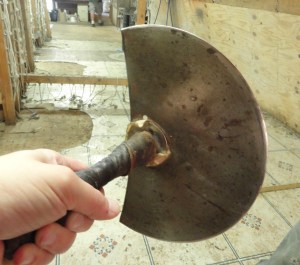
A close up of the scraping tool crafted by Jesse Meyer of Pergamena.
In the seminar, our parchment master was Jesse Meyer of Pergamena. He provided tools, guidance, and expertise as we participants stumbled through the process. Parchment making is hard, smelly work. My hands ached after only a few go-rounds with the tools, which included a pumice-like concoction of over-baked bread mixed with ground glass, knives that had been reshaped and re-handled, and Jesse’s special skin-refiner tool discussed below. Jesse told us many eye-opening things over the days of parchment making; however, possibly one of the most intriguing was how parchment masters could make a parchment “sing,” and how they, through this sound, knew whether or not the skin had reached its full potential.
So when Jesse demonstrated the various techniques on his sample skin, I listened carefully to the sounds he made by scraping as well as watching what he did with his hands. As he scraped away, the parchment did indeed sing. You can hear it yourself:
Audio Clip of Jesse’s “Parchment Singing”
.
This aspect of parchment making fascinated me. After our seminar was done, I got back in touch with Jesse to talk further about the sounds of parchment making. He was more than forthcoming about his experiences. When Jesse first read about medieval parchment making, he ran across several mentions of the “ringing” sound that parchment masters produced when shaving their skins. He, like many of us, had never considered that aspect before. So he started paying attention to the different sounds he made as he used various tools on the skins. Right now, he uses a handmade tool that consists of a saw blade shaved to his specificity with a handmade handle on it. Each of us got a chance to hold it and try it on our own skin. It was an unwieldy tool for the uninitiated, and my parchment did not “sing” like Jesse’s did.
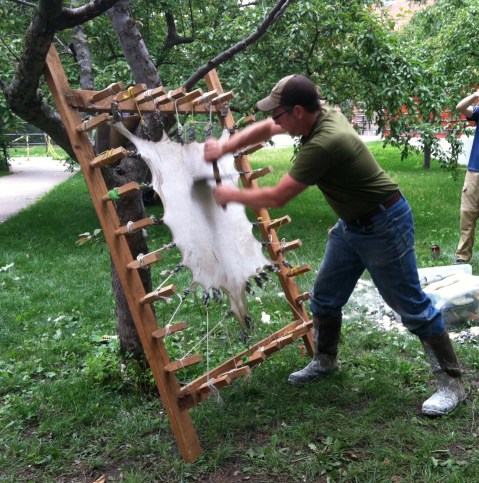
Parchment master, Jesse Meyer of Pergamena demonstrating his technique using a tool he created himself, designed after the fashion of medieval instruments. Image by author.
.
Jesse is an expert, but even he says he cannot quite tell the nuances among the different types of skins by sound alone, although he notes that there are similarities among the types. Perhaps that skill could be developed over years of working solely with parchment, as a master in the Middle Ages would have. What Jesse has shared, however, is valuable: thicker skins are not as flexible, but they produce a “better,” that is clearer, sound.

Close up of parchment “dust.” Image by author.
Thickness of parchment can be due to a number of factors including preparation technique, but also the age and type of animal. Older animals yield thicker skins. Thicker skins are usually smoother and yield a cleaner sound. Of course if the animal has been injured or diseased, the skin may not be smooth. The firmer and tighter a skin is, the denser it is, and the easier it is to shave as well. In fact, Jesse says that denser skins can also make full, warm, “drum-like” sounds. Even more intriguingly, when I asked Jesse if he had ever noticed a difference between the hair side and the flesh side of skins, he said yes: the hair side of parchment sounds better to him because it is cleaner once the hair has been removed. The flesh side often retains fibrous bits even after many scrapings, and produces a more diffuse sound. When this side is scraped, it leaves behind a “fuzzy” residue until it has seen many passes with the scraper.
The relative dryness and “freshness” of the skin can also alter the clarity of the “ringing.” For example, compare the sound from the freshly prepared goatskin last summer to the sound from scraping a drier goatskin in Jesse’s workshop:
Repeat of first audio clip of Jesse’s “parchment singing”
Comparison clip of Jesse making a drier parchment sing
Both of these clips were produced from goatskins, and both were produced by Jesse who also used the same tool on each. While the sound is very similar, and both ring true, the drier skin produces a clearer, purer sound.
Plainly, then, the sounds of parchment making are vital to quality production. Most medieval manuscripts are made of three types of animal skins: sheep, goat, and calf. The prevalence of each animal is geographically dependent (sheepskin is more common in England, calfskin in France, and goatskin in Italy), although of course manuscripts traveled, and wealthy patrons commissioned materials they preferred. (see “DNA May Reveal Origins of Medieval Manuscripts” from Livescience)
Age, breed, size, and animal health can all contribute to the audiotactile qualities of a skin. However, there are some general guidelines. Sheepskins, for instance, are stretchier than goat skins, so their “ringing” can be muffled. Goatskins, which are thinner and stiffer, make a higher pitched “ring.” Calfskins are larger and easier than the others to get clean, and thus often make the cleanest “ring” and can do so more quickly than the others.
The type of skin is not the only factor in play. A rough blade would have produced a rough sound; conversely, an even, sharp blade would have produce the cleanest sound. The tautness of the skin in the frame can also affect pitch and tone, as can its dryness, its fatty content, and the age of the animal. As noted in a recent study, “The density of collagen fibrils in calf and goat parchment, compared with a more open weave and higher fat content in sheep parchment, favors the former two species [for producing the finest parchment]” (15070). Nevertheless, master parchment makers should have been able to manipulate any skin to produce superior results. As long as the corium (the dermis layer of skin containing all the connective tissues, including collagen, elastic fibers, hair follicles, sebaceous glands, blood vessels, and a number of other components) is sufficiently ground down, the parchment produced can be made very fine. And as the corium wears away, the sound of the scraping grows ever cleaner and clearer, just as the feel of the skin grows ever smoother. Overall, the tone gets higher as the skin gets thinner, and as long as the scrape is even, the tone should remain pure.
Here’s a video of Jesse scraping a calfskin. Compare this clear “ringing” to the goatskin scrapings:
https://www.instagram.com/p/BEByB4cFi8Y/?taken-by=runninghands
.
That’s all well and good for production of manuscripts, but texts are made for consumption. Earlier, I mentioned my having considered the qualities of hapacity and manuscripts involving Christ’s side wound in another blog post. One of the manuscripts I discussed, London, British Library, MS Egerton 1821, was clearly designed to be touched. This unusual manuscript contains a number of woodcuts that reflect devotion to the wounds of Christ, but, more strikingly, opens with three pages painted black, covered in drops of paint meant to emulate Christ’s flowing blood.
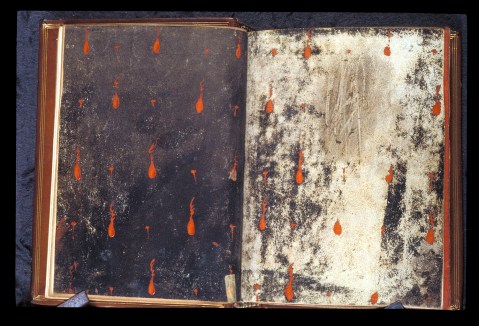
Image of MS Egerton 1821, British Library, London.
After a series of woodcuts, seven more pages appear. These are painted red with darker red paint splatters representing drops of blood. Although these pages do not contain specific images, they are meant to evoke interactive piety. The reader is invited to touch Christ’s wounds while praying or meditating. The worn appearance of Folio 2r demonstrates just how frequently the pages were touched and rubbed.
How did those pages feel to a medieval reader? Did they feel rough or smooth? Did the reader feel a frisson of excitement? Animal skin, such as parchment, carried with it the essence of the life of the animal, thus imbuing the images painted onto it with some semblance of life force, such as suggested by Thomas Aquinas in his Question 8 (Summa Theologica) regarding the potential for divinity placed within material objects. To a certain extent, then, touching an image of Christ was akin to touching a proxy of his body, allowing a powerful and individual haptic experience of faith. But what about the sounds made when these images became the subject of interaction? Was the medieval reader aware of touching the page, touching Christ’s wounds, even more because he or she would hear the interaction?
I took it upon myself to rub the worn folio in Egerton 1821. I did so reverently, if not because I felt a mystical connection to Christ, but because I felt awed at being able to reproduce a medieval experience (albeit 500 years later). There was a distinct sound, which you can hear in this clip:
Clip of the author rubbing the worn folio in Egerton 1821
I was surprised at the resultant sound. The worn part of the page looked soft, and the paint splatters looked cracked. Instead, to my surprise, the worn portions felt rougher than the cracked paint. Like the modern studies demonstrated, my audiotactile perceptions were altered initially by what I saw, but then by what I heard. At first, I touched hesitantly, but when the sounds produced became rhythmic, my hands felt smoother and the noise sounded more even. If I were repeatedly rubbing the same spot, in the same manner, producing the same sounds—much as a medieval reader might have done—the combined sensations would likely have produced a soporific and meditative state. That is, combining touch, particularly of a textured surface, with measured reading might have resulted in the ideal perceptive state for experiencing an immersive religious experience.
If, as numerous studies have demonstrated, vibrotactile stimuli can facilitate hearing, both for those with and without hearing impairments, then the sounds hand and fingers make when exploring a surface must contribute to an individual’s haptic perception and vice versa. How, then, would this connect on the behavioral or emotional level? Researchers have been exploring the reciprocal interactions of the auditory, tactile, and visual (sometimes referred to as cross-modal effects), often concentrating on sensory thresholds, information processing performance, and spatial navigation; however, only recently are studies beginning to investigate the emotional and physical benefits of such exchanges. For instance, one such study suggests auditory-tactile stimulation as a means to increase health and well-being.
Thus, a combination of touch felt by a reader with sound heard by a reader at the same time might influence the reader’s state of mind in a positive way, resulting in a positive effect on the body as well. A desired state can be reached more quickly through an audiotactile combination, resulting in a sensory illusion (perceiving something not physically extant but mentally present)—a powerful manner of evoking emotion. Similarly, the positive physical effects include relaxation, stress relief, and sleep enhancement. Again, this seemingly suggests that multisensory integration, especially the combination of touch and sound, might have produced a mental state in the (medieval) reader that made them particularly receptive to spiritual experience.
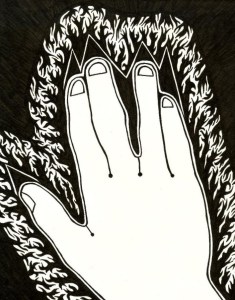
“Touch” by Daniel Friedman (CC BY 2.0)
I would suggest, then, that as medieval scholars, we should examine how audiotactile events are processed during dynamic contact between hands and material. Since different sensory modalities are integrated in the human brain to form our perceptions as a whole, including spatial and temporal relationships, it is important that we consider multisensory interactions that code the location of external events relative to our own bodies. Thus, to think through the process of making, touching, and hearing medieval parchment opens up a lot of possibilities for the study of medieval materiality—indeed for materiality in general as a field. The importance of the whole body sensory experience, including hearing, in reading is something we need to continue to imagine, to reimagine, to recreate, and to explore.
—
Michelle M. Sauer is a professor at the University of North Dakota in the English Department. She recently released her latest book, titled Gender in Medieval Culture (Bloomsbury, 2015).
—
REWIND!…If you liked this post, you may also dig:
Sounding Out! Podcast #54: The Sound of Magic-K.A. Laity
Mouthing the Passion: Richard Rolle’s Soundscapes–Christopher Roman
EPISODE LI: Creating New Words from Old Sounds–Marcella Ernest, Candace Gala, Leslie Harper, and Daryn McKenny
Share this:

Listen to the Sound of My Voice

Betrayal
I first realized there was a problem with my voice on the first day of tenth grade English class. The teacher, Mrs. C, had a formidable reputation of strictness and high standards. She had us sit in alphabetical order row after row, and then insisted on calling roll aloud while she sat at her desk. Each name emerged as both a command and a threat in her firm voice.
“Kelly Barfield?”
“Here,” I mumbled quietly. I was a Honor Roll student with consistent good grades, all A’s and one B on each report card, yet I was shy and softspoken in classes. This was an excellent way to make teachers amiable but largely go unnoticed. The softness of my voice made me less visible and less recognizable.
Mrs. C repeated my name. Caught off guard, I repeated “here” a little more loudly. She rose to her feet to get a better look at me. I knew what she saw: a petite girl with long ash blonde hair, big brown eyes, and overalls embroidered with white daisies on the bib. When her gaze finally met mine, Mrs. C frowned at me and cleared her throat loudly. I curled into my desk, hoping to disappear.

“Lincoln High School 9-16-2007 008” by Flickr user Paul Horst, CC BY-NC 2.0
“Miss Barfield, did you hear me call your name twice? In this class, when I call roll, you respond.” I gave a quick nod, but Mrs. C wasn’t finished: “We use our strong voices in here, not our girly, breathy ones.” My cheeks flushed red while Mrs. C droned on about confidence and classroom expectations.
“Do you understand me?”
I stammered a “yes.” Mrs. C turned her attention back to the roll call. Her harsh words rang in my ears. I sank low in my chair, humiliated and angry. I couldn’t help that I sounded girly: I was, in fact, a girl. This was the way my voice sounded. It was not an attempt to sound like the dumb blonde she appeared to think I was.
That day I decided that I would never speak up in her class. Forget the Honor Roll. If the sound of my voice was such a problem, then my mouth would remain firmly shut in this class and all of my others. I would never speak up again.

“Listen” by Flickr user lambda_x, CC BY-ND 2.0
My vow to stop speaking lived a short life. I enjoyed Mrs. C’s serious fixation on diagramming sentences and her attempts to show sophomores that literature offered ideas and worlds we didn’t quite know. At first, I spoke up with hesitation and fear of the inevitable dismissal, but I continued to speak. Becoming louder became my method to seem confident, even when I felt anything but.
Throughout high school, my voice emerged again and again as a problem. Despite the increased volume, my voice still sounded tremulous, squeaky, hesitant, and shrill to my own ears. Other girls had these steady, warm voices that encouraged others to listen to them. Some had higher voices that were melodic and lovely. I craved a lower, more resonant voice, but I was stuck with what I had. In drama club, our director scolded me with increasing frustration about my tendency to end my lines in the form of a question. My nerves materialized as upspeak. The more he yelled at me, the more pronounced the habit became. He eventually gave up, disgusted by my inability to control my vocal patterns.

By Dvortygirl, Mysid [GFDL (http://www.gnu.org/copyleft/fdl.html) or CC-BY-SA-3.0 (http://creativecommons.org/licenses/by-sa/3.0/)%5D, via Wikimedia Commons
Meanwhile, at a big state university in my native Florida, I learned quickly that a Southern accent marks you as a dumb redneck from some rural town that no one had heard of. Students in my classes asked me to say particular words and then giggled at my pronunciations. “You sound like a Southern belle,” one student noted. This was not really a compliment. According to my peers, Southern belles didn’t have a place in the classroom. Southern belles didn’t easily match up with “college student. As a working-class girl from a trailer park, I learned that I surely didn’t sound like a college student should. I worked desperately to rid myself of any hint of twang. I dropped y’all and reckon.
I listened carefully to how other students talked. I mimicked their speech patterns by being more abrupt and deadpan, slowly killing my drawl. When I finally removed all traces of my hometown from my voice, my friends both from home and from college explained that now I sounded like an extra from Clueless. My voice was all Valley girl. I was smarter, they noted with humor, than I sounded and looked. My voice now alternated between high-pitched and fried. Occasionally, it would squeak or crack. I thought I sounded too feminine and too much like an airhead, even when I avidly tried not to. I began to hate the sound of my voice.
My voice betrayed me because it refused to sound like I thought I needed it to. It refused to sound like anyone but me.
When I started teaching and receiving student evaluations, my voice became the target for students to express their displeasure with the course and me. According to students, my voice was too high and grating. Screechy, even: one student said my voice was at a frequency that only bats could hear. In every set of evaluations, a handful of students declared that I sounded annoying. This experience, however, was not something I alone faced. Women professors and lecturers routinely face gender bias in teaching evaluations. According to the interactive chart, Gender Language in Teaching Evaluations, female professors are more likely to be called “annoying” than their male counterparts in all 25 disciplines evaluated. The sound of my voice was only part of the problem, but I couldn’t help but wonder if how I sounded was an obstacle to what I was teaching them.
Once again, I tried to fix my problematic voice. I lowered it. I listened to NPR hosts in my search for a smooth, accentless, and educated sound, and I attempted to create a sound more like them. I practiced pronouncing words like they did. I modulated my volume. I paid careful attention to the length of my vowels. I avoided my natural drawl. None of my attempts seemed to last. Some days, I dreaded lecturing in my courses. I had to speak, but I didn’t want to. I wondered if my students listened, but I wondered more about what they heard.
Sound
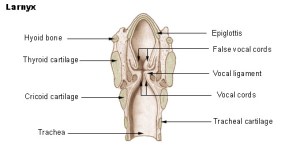
Public Domain, https://commons.wikimedia.org/w/index.php?curid=1393933
The sound of your voice is a distinct trait of each human being, created by your lungs, the length of your vocal cords, and your larnyx. Your lungs provide the air pressure to vibrate your vocal cords. The muscles of your larnyx adjust both the length and the tension of the cords to provide pitch and tone. Your voice is how you sound beyond the resonances that you hear when you speak. It is dependent on both the length and thickness of the vocal cords. Biology determines your pitch and tone. Your pitch is a result of the rate at which your vocal cords vibrate. The faster the rate, the higher your voice. Women tend to have shorter cords than men, which makes our voices higher.
Emotion also alters pitch. Fright, excitement, and nervousness all make your voice sound higher. Nerves would make a teenage girl have an even higher voice than she normally would. Her anxious adult self would too. Her voice would seem tinny because her larnyx clenched her vocal cords tight. Perhaps this is the only sound she can make. Perhaps she is trying to communicate with bats because they at least would attempt to listen.
Biology, the body, gives us the voices we have. Biology doesn’t care if we like the ways in which we sound. Biology might not care, but culture is the real asshole. Culture marks a voice as weak, grating, shrill, or hard to listen to.
“Speak” by Flickr user Megara Tegal, CC BY-NC-ND 2.0
My attempts to change my voice were always destined to fail. I fought against my body and lost. I couldn’t have won even if I tried harder. My vocal cords are determined that my voice would be high, so it is. The culture around me, however, taught me to hate myself for it. Voice and body seem to cast aspersions on intelligence or credentials. It’s the routineness of it all that wears on me. I expect the reactions now.
I wonder if I’m drawn to the quietness of writing because I don’t have to hear myself speak. I crave the silence while simultaneously bristling at it. Why is my voice a problem that I must resolve to placate others? How can I get others to hear me and not the stereotypes that have chased me for years?
Fury
My silence has become fruitful. The words I don’t say appear on the page of an essay, a post, or an article. I type them up. I read aloud what I first refused to say. I wince as I hear my voice reciting my words. I listen carefully to the cadence and tone. This separation of words and voice is why writing appeals to me. I can say what I want to say without the sound of my voice causing things to go awry.
People can read what I write, yet they can’t dismiss my voice by its sound. Instead, they read what I have to say. They imagine my voice; my actual sound can’t bother them. But, they aren’t really hearing me. They just have my words on the page. They don’t know how I wrap the sound around them. They don’t hear me.
Rebecca Solnit, in “Men Explain Things to Me,” writes “Credibility is a basic survival tool.” Solnit continues that to be credible is to be audible. We must be heard to for our credibility to be realized. This right to speak is crucial to Solnit. Too many women have been silenced. Too many men refuse to listen. To speak is essential “to survival, to dignity, and to liberty.”

“Listen” by Flickr user Emily Flores, CC BY-ND 2.0
I agree with her. I underline her words. I say them aloud. The more I engage with her argument, the more I worry. What about our right to be heard? When women speak, do people listen? Women can speak and speak and speak and never be heard. Our words dismissed because of gender and sound. Being able to speak is not enough, we need to be heard.
We get caught up in the power of speaking, but we forget that there’s power in listening too. Listening is political. It is act of compassion and empathy. When we listen, we make space for other people, their stories, their voices. We grant them room to be. We let them inhabit our world, and for a moment, we inhabit theirs. Yes, we need to be able to speak, but the world also needs to be ready to listen us.
We need to be listened to. Will you hear me? Will you hear us? Will you grant us room to be?
When I think of times I’ve been silenced and of the times I haven’t been heard, I feel the sharp pain of exclusion, of realizing that my personhood didn’t matter because of how I sounded. I remember the burning anger because no one would listen. I think of the way that silence and the policing of how I sound made me feel small, unimportant, or disposable. As a teenager, a college student, and a grown woman, I wanted to be heard, but couldn’t figure out exactly how to make that happen. I blamed my voice for a problem that wasn’t its fault. My voice wasn’t the problem at all; the problem was the failure of others to listen.
“listen” by Flickr user Jay Morrison, CC BY-NC-ND 2.0
Loss
While writing this essay on my voice, I almost lost mine, not once but twice. I caught a cold and then the flu. My throat ached, and I found it difficult to swallow. A stuffy nose gave my voice a muted quality, but then, it sounded lower and huskier. I could hear the congestion disrupting the timber of my words. My voice blipped in and out as I were radio finding and losing signal. It hurt to speak, so I was quiet.
“You sound awful,” my husband said in passing. He was right. My voice sounded unfamiliar and monstrous. I tested out this version of my voice. It was rougher and almost masculine. I can’t decide if this is the stronger, more authoritative voice I wanted all along or some crude mockery of what I can never really have. I couldn’t sing along with my favorite songs because my voice breaks at the higher register. I wheezed out words. I croaked my way through conversations. “Are you sick?” my daughter asked, “You don’t sound like you.”
Her passing comment stuck with me. You don’t sound like you. Suddenly, I missed the sound of my voice. I disliked this alien version of it. I craved that problematic voice that I’ve tried to change over the years. I wanted my voice to return.
After twenty years, I decided to acknowledge the sound of me, even if others don’t. I want to be heard, and I’m done trying to make anyone listen.
—
Featured image: “Speak” by Flickr user Ash Zing, CC BY-NC-ND 2.0
—
Kelly Baker is a freelance writer with a religious studies PhD who covers religion, higher education, gender, labor, motherhood, and popular culture. She’s also an essayist, historian, and reporter. You can find her writing at the Chronicle for Higher Education‘s Vitae project, Women in Higher Education, Killing the Buddha, and Sacred Matters. She’s also written for The Atlantic, Bearings, The Rumpus, The Manifest-Station, Religion Dispatches, Christian Century’s Then & Now, Washington Post, and Brain, Child. She’s on Twitter at @kelly_j_baker and at her website.
—
REWIND!…If you liked this post, you may also dig:
Vocal Gender and the Gendered Soundscape: At the Intersection of Gender Studies and Sound Studies — Christine Ehrick
On Sound and Pleasure: Meditations on the Human Voice– Yvon Bonefant
As Loud As I Want To Be: Gender, Loudness, and Respectability Politics — Liana Silva
Share this:


Current Top Posts





April 2021

January 2020

November 2019

October 2019

August 2019

April 2014

November 2017

March 2015

December 2017

October 2015
 Sounding Out!
Recent Comments